

Eastern Cornbelt:
After a round or two of showers early in the week, dry conditions and steadily warming temperatures fueled a rapid spring planting pace across the Eastern Cornbelt.
Temperatures reached the upper-80s and low-90s in all three states on May 18-20, but a cold front was expected to move in for the coming weekend, bringing scattered showers and cooler temperatures. Highs on May 22 were expected to stay in the upper-60s across most of the Eastern Cornbelt.
Corn planting as of May 15 had progressed to 55% complete in Illinois, 40% in Indiana, and 31% in Ohio, with soybean planting reported at 38% in Illinois, 28% in Indiana, ad 18% in Ohio. While still trailing the average pace in all three states, planting progress was up dramatically from the prior week, when just 5-15% of the corn and 4-11% of the soybeans were seeded.
Western Cornbelt:

The Western Cornbelt experienced another week of summer-like temperatures that helped growers make huge strides on spring planting.
Highs in the 80s and low-90s were common across Iowa during the week, although forecasts warned of severe thunderstorms in central and northern Iowa on May 19. By the weekend, much cooler weather was on tap, with highs in Des Moines only expected to crack the 55-degree mark on May 21 Forecasts even warned of patchy frost in some parts of the state on May 21-22.
It was hot and windy across much of Nebraska as the week progressed. Temperatures ranged from the upper-70s to upper-80s in western Nebraska, while highs across eastern Nebraska reached the low- to mid-90s on May 19. Showers and thunderstorms were on tap for the coming weekend, however, with much cooler weather moving in after the precipitation.
In Missouri, highs in St. Louis were expected to hit the 90-degree mark on May 20 before a weekend cool down.
Corn planting was reported at 57-65% complete in the region as of May 15, still trailing the five-year averages for each state, but well ahead of the prior week’s 11-39% progress. Soybean planting also ramped up, with progress rated at 44% complete in Nebraska, 34% in Iowa, and 19% in Nebraska.
Missouri growers also had 47% of the cotton and 56% of the rice planted by May 15, while sorghum planting in Nebraska was reported at just 4% complete by that date, well behind the 17% five-year average.
Southern Plains:
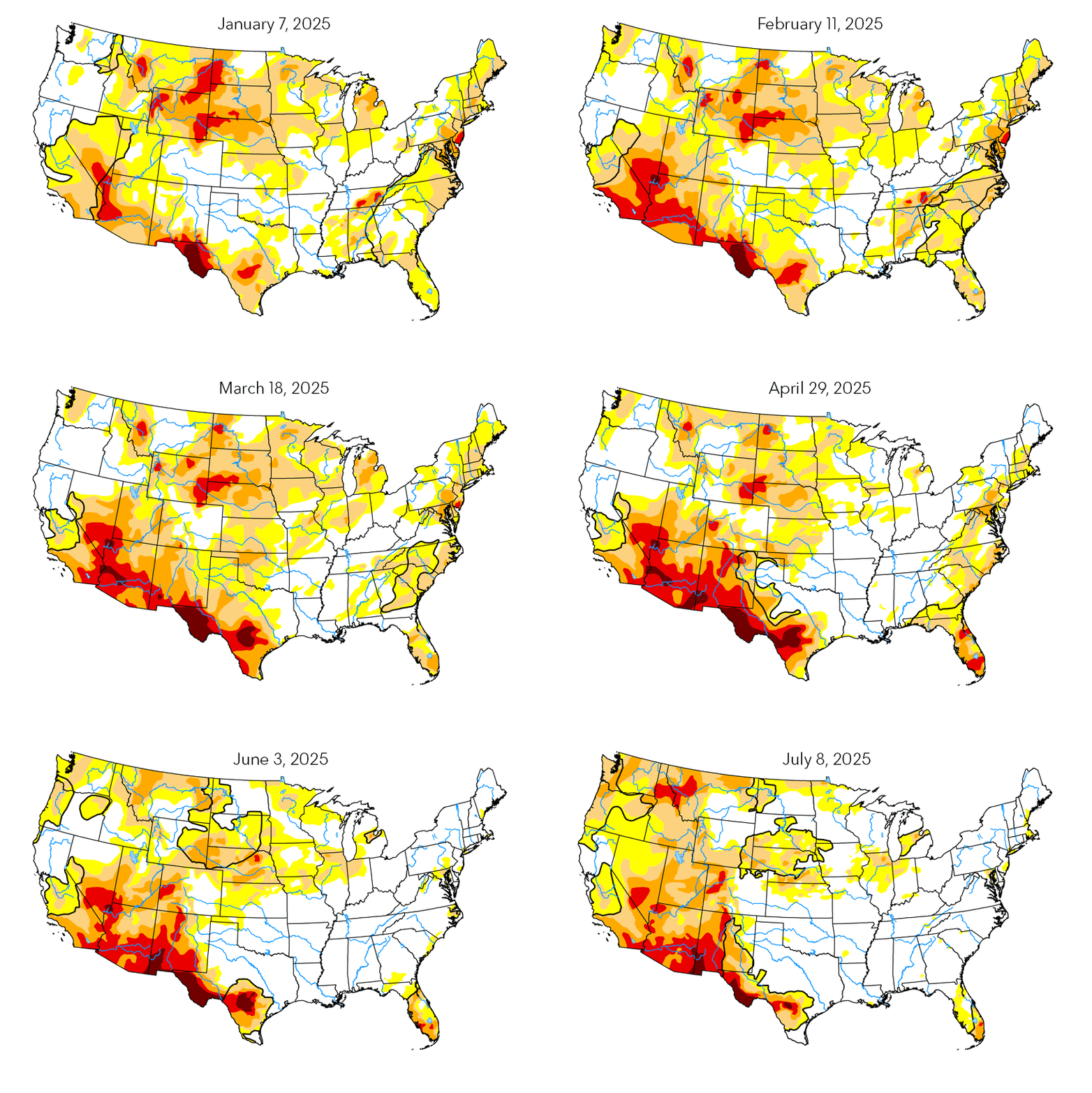
Extreme-to-exceptional drought continued to cover most of the Southern Plains in mid-May, with the worst conditions reported in New Mexico, western Oklahoma, and western and south-central Texas. The dry conditions were exacerbated by high heat, with parts of Texas notching 11 straight days of record heat at mid-month.
The combination of drought and heat pushed the Hermits Peak Fire in northern New Mexico to a record 465 square miles during the week. The fire was only 27% contained as of May 16.
Eastern Kansas, eastern Oklahoma, and eastern Texas were the only areas of the Southern Plains not experiencing some form of drought in mid-May. Strong thunderstorms rolled through northeastern Kansas once again on May 17, producing strong winds, hail, and heavy rain.
Highs in Colorado also reached the upper-80s and low-90s at midweek, but a drastic weather change saw temperatures fall more than 40 degrees from May 19 to May 20. Forecasts warned of snow down to 5,000 feet on May 20-21, with cold rain expected in the valleys. The colder weather was also taking aim at western Kansas. Sources there said weekend temperatures were expected to drop to the 30s, with a mix of rain and snow on May 21
Corn planting as of May 15 had progressed to 87% complete in Texas, 60% in Kansas, and 41% in Colorado, with soybean planting reported at 32% complete in Kansas. Kansas growers also had 41% of the cotton crop planted by that date, compared with 30% in Texas and 20% in Oklahoma. Sorghum planting was 73% complete in Texas, compared with just 5-7% in Kansas, Colorado, and Oklahoma.
The condition of the winter wheat crop illustrated clearly the impact of drought conditions in the region. While just 5-13% of the acreage in Texas and Oklahoma was rated good or very good, fully 81% of the Texas crop fell in the poor or very poor categories in mid-May, along with 52% of the acreage in Oklahoma. The Kansas wheat crop was 24% good or excellent, and 41% poor or very poor.
South Central:
High heat and scattered thunderstorms were common across the South Central region during the week. Severe weather in central Arkansas on May 15 left more than 50,000 customers without power, and another line of strong storms moved through Middle Tennessee and southern Kentucky on May 18, with reports of damaging winds and large hail in some locations.
Highs across much of the region tipped into the 90s as the week progressed, with some daily records expected to fall on May 20. The warm weather allowed planting to progress at a swift pace, with most crops tracking ahead of their five-year averages.
Corn planting as of May 15 was 65% complete in Kentucky and 84% in Tennessee, while soybean planting had progressed to 89% in Louisiana, 80% in Mississippi, 57% in Arkansas, and 36-41% in Tennessee and Kentucky. Cotton planting was also ahead of schedule at 80% complete in Louisiana, 55% in Mississippi, 53% in Arkansas, and 49% in Tennessee.
Growers were moving quickly on rice planting as well, with progress as of May 15 estimated at 96% complete in Louisiana, 92% in Texas, 84% in Mississippi, and 76% in Arkansas.
Southeast:
High heat blanketed much of the Southeast as the week progressed, which followed a round of strong thunderstorms and severe weather in mid-May.
Central North Carolina and parts of Georgia were under a severe thunderstorm watch on May 16, with reports of damaging wind and hail in some locations. By midweek, however, a ridge of high pressure pushed temperatures well into the 80s, with highs in the 90s expected on May 19-21 in Virginia, Georgia, Alabama, and the Carolinas.
Highs in the mid- to upper-80s were common across Florida during the week as well, along with scattered thunderstorms.
Sources in Georgia reported some cotton planting delays due to dry field conditions. “We are about 2-3 weeks behind getting cotton planted,” said one industry contact. By contrast, recent rains helped spark some fertilizer movement on pastures in Florida. “Hopefully that will continue,” added one Florida source.
Cotton planting as of May 15 was estimated at 54% complete in Alabama, 47-48% in the Carolinas, 39 % in Georgia, and 34% in Virginia. Peanut planting was tracking very close to the average pace at 60% complete in Florida, 56% in South Carolina, 51% in Virginia, 48% in Alabama and Georgia, and 40% in North Carolina.
North Carolina growers also had fully 95% of the corn planted by May 15, along with 44% of the soybeans.