

Eastern Cornbelt:
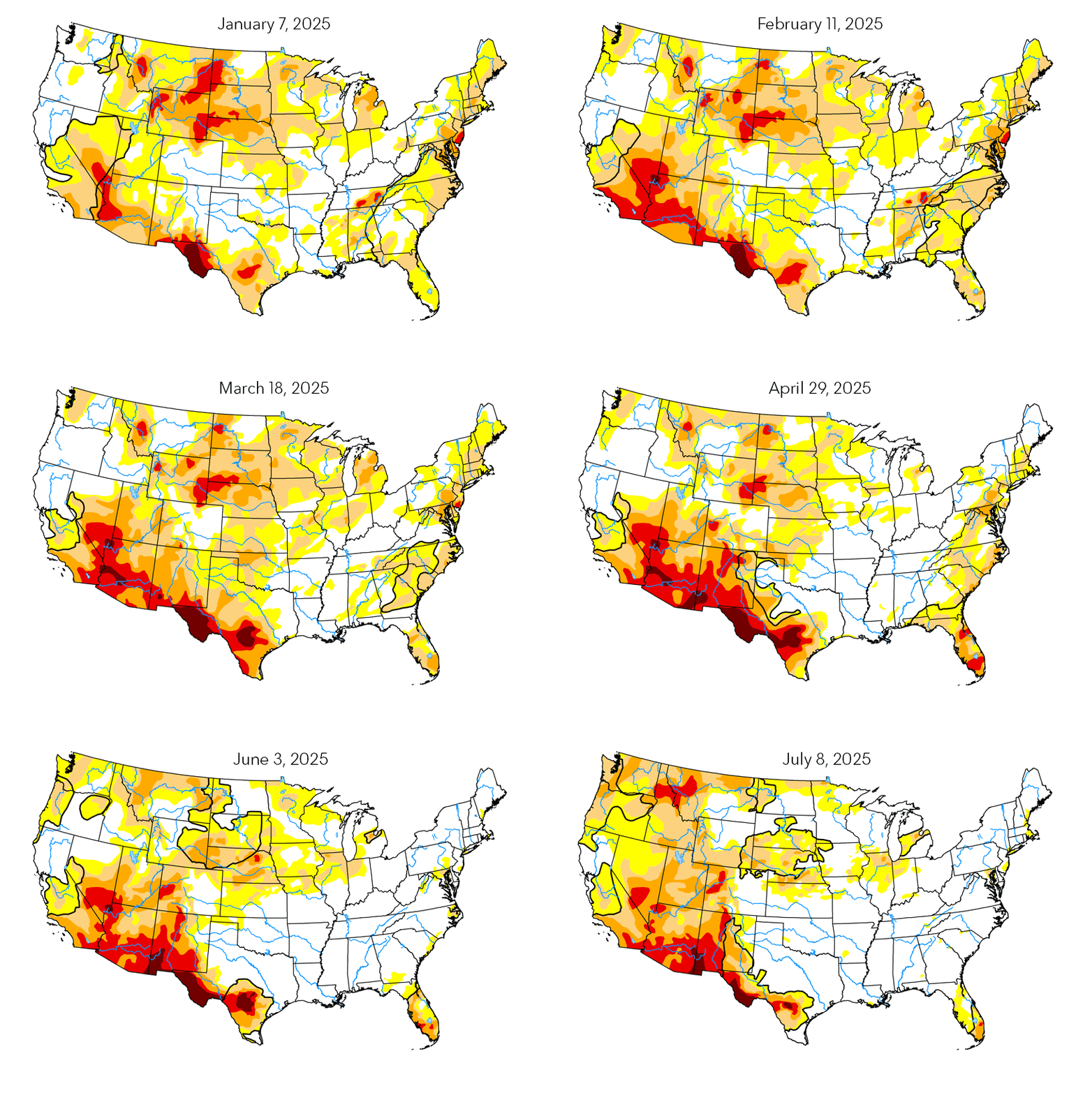
High heat and humidity blanketed the Eastern Cornbelt in mid-July, with forecasts warning of an increased chance of thunderstorms by the weekend.
Temperatures in the 90s were common across Illinois and Indiana during the week, with heat index readings reaching the triple digits in some locations. Most of Ohio registered temperatures in the mid- to upper-80s. Storms were expected to pop up in some locations on July 21-22, with continued heat likely through the weekend.
Illinois continued to lead the region in crop conditions, with 62-70% of the corn and soybeans in the state rated as good or excellent, compared with 45-49% in Indiana and Ohio. Ohio’s oat crop was 4% harvested by July 17, with 70% of the acreage rated as good or excellent.
Western Cornbelt:
As with much of the Midwest and Plains regions, the Western Cornbelt experienced brutal heat during the week, along with high humidity.

Central Iowa was bracing for highs in the low- to mid-90s as the week progressed, although weekend temperatures were expected to drop to the 80s in most locations.
Sweltering temperatures ranging from the mid-90s to the low-triple digits were common across Nebraska on July 20-22. With the high humidity, heat index readings on July 22 were expected to hit 101 degrees in Omaha and 103 in Lincoln and Beatrice.
Similar conditions were reported in Missouri, where heat index values were expected to hit 105-110 in St. Louis by July 23-24. An increased chance of thunderstorms was also in the weekend forecast for parts of Missouri.
Fully 78-81% of Iowa’s corn and soybeans were rated as good or excellent on July 17, compared with 64-66% in Nebraska and 51-55% in Missouri. Other crops experienced declines in quality from last week. Nebraska’s sorghum crop was 50% good or excellent on July 17 compared with 65% the week before, while Missouri’s cotton and rice were reported at 53% and 61% good or excellent, respectively, down 4-5% from last week.
Southern Plains:
The National Weather Service on July 21 warned of “dangerous heat” across much of the Southern Plains, with highs expected to reach 113 degrees in Amarillo, Texas. Oklahoma City, Okla., hit 110 degrees on July 19, surpassing the previous record for that date set in 1936 and coming close to the all-time high of 113 degrees on Aug. 3, 2012.
Extreme-to-exceptional drought also covered much of Texas in mid-July, along with portions of eastern New Mexico and western Kansas. Tinder dry conditions and hot winds fueled a number of destructive wildfires in northern and western Texas at midweek, with 24 new fires reported on July 19 alone.
The weather was taking a toll on crop conditions in the region, causing what one source described as a “massive liquidation” of cattle herds in the region. “We are two weeks away from wheat planting for fall grazing, but it won’t happen if it stays this dry,” he added.
“There is basically zero movement on dry fertilizer at this point, harvest is well underway for corn and milo, and yields are off by 20-30% across the board,” said another source. “Cotton is maturing rapidly, and with continued heat units, we will be harvesting the first cotton in 3-4 weeks, which is way ahead of schedule.”
Good or excellent ratings were assigned to just 46-47% of the corn and soybeans in Kansas at mid-month, while cotton in those two categories slipped to 44% in Kansas and 21-26% in Oklahoma and Texas. Sorghum quality was also dropping, with good or excellent ratings assigned to just 47% of the acreage in Oklahoma, 38-40% in Colorado and Kansas, and 19% in Texas.
Perhaps more telling was the percentage of Texas crops rated as poor or very poor at mid-month, which totaled 42% of the state’s corn, 39% of the cotton, and 48% of the sorghum.
South Central:
Heat warnings and advisories were in place across a large swath of the Lower Mississippi Valley during the week, with highs expected to reach 108 degrees in Shreveport, La. The sweltering temperatures sparked some strong thunderstorms in southern Kentucky and Middle Tennessee at midweek.
Corn conditions showed the effects of emerging drought across western Tennessee and western Kentucky, with just 31-40% of the crop rated as good or excellent in mid-July, compared with 26-28% in the poor or very poor categories. Soybeans rated as good or excellent totaled 81% of the crop in Louisiana, 69% in Arkansas, 58% in Mississippi, 39% in Tennessee, and just 25% in Kentucky.
Cotton conditions showed a similar spread, with good or excellent ratings assigned to 83% of the acreage in Louisiana, 73% in Arkansas, 54% in Mississippi, and 37% in Tennessee. Rice in the good or excellent categories totaled fully 88% of Louisiana’s crop at mid-month, compared with 64% in Arkansas, 58% in Mississippi, and 43% in Texas.
Southeast:
High heat and humidity were reported across much of the Southeast in mid-July, sparking strong thunderstorms in parts of North Carolina, Georgia, and Alabama as the week advanced.
Heavy rain, flooding, and power outages were reported in the Atlanta area on July 21, with some areas picking up more than 2 inches in a matter of hours. Forecasts warned of possible heat advisories across southern Florida by the coming weekend.
Recent rains have helped crops in the region after earlier concerns about drought. While just 32% of North Carolina’s corn registered as good or excellent at mid-month, 45% of the state’s soybeans were in those two categories. Cotton rated as good or excellent totaled 58% of the acreage in North Carolina, 64% in Alabama and Georgia, 74% in South Carolina, and 84% in Virginia.
Peanuts were in even better condition, with good or excellent ratings assigned to 68% of the crop in Georgia, 70% in North Carolina, 76% in Florida, 79% in South Carolina, 87% in Alabama, and fully 91% in Virginia.
Sources reported some late topdress applications on cotton in the region, and pasture work was picking up after the recent rains.