

Eastern Cornbelt:
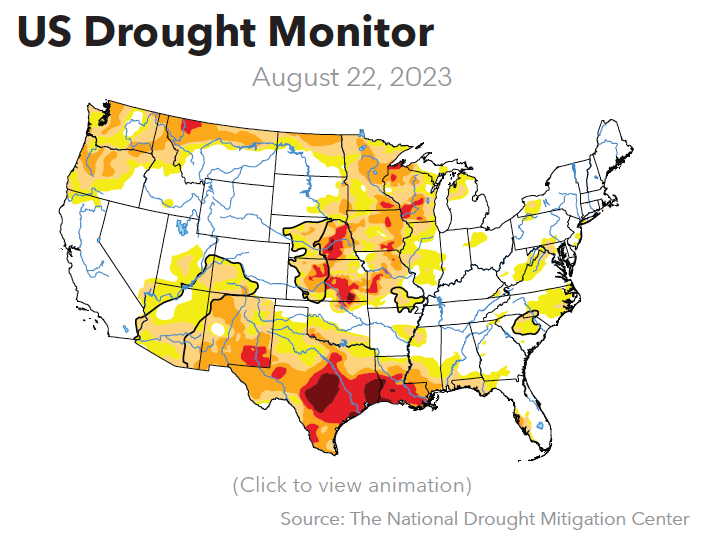
Much of the Eastern Cornbelt enjoyed beautiful weather during the last week of August, with temperatures down from recent highs in the 90s and triple digits. Another blast of heat was expected over the Labor Day weekend, however.
Good or excellent ratings were assigned to 76-79% of Ohio’s corn and soybeans on Aug. 27, compared with 67-70% in Indiana, 67-68% in Illinois, and 43-50% in Michigan.
Western Cornbelt:
Pleasant temperatures were reported across much of the Western Cornbelt during the week, but hot weather was once again in the weekend forecast, with highs expected in the 90s and heat indices rising to the low triple digits by Labor Day.
Drought conditions expanded in the region in late August, with extreme-to-exceptional drought now covering portions of northeastern and southeastern Iowa, eastern Nebraska, and western Missouri. The Des Moines Register reported on Aug. 31 that drought conditions across Iowa are the worst they’ve been since March 2013.
With 6-16% of the regional corn crop mature, USDA on Aug. 27 assigned good or excellent ratings to 54-55% of the crop in Iowa and Nebraska and 41% in Missouri. Some 49-53% of the regional soybean crop also fell in the good or excellent categories, along with 75% of Missouri’s cotton, 64% of Nebraska’s sorghum crop, and fully 81% of Missouri’s rice.
Southern Plains:

Dry, hot conditions were reported across much of the Southern Plains during the last days of August, with temperatures climbing to the mid-90s in Kansas, Oklahoma, and Texas. Gusty winds prompted a fire weather watch in northern Kansas late in the week.
Drought conditions expanded across Kansas, Texas, and New Mexico in late August, with large areas of extreme-to-exceptional drought reported in eastern Texas, southeastern New Mexico, and central Kansas.
The drought has impacted the regional cotton crop significantly, with just 12-14% of the acreage in Texas and Oklahoma rated as good or excellent, compared with 44% in Kansas. Fully 67-75% of the cotton in Texas and Oklahoma fell in the poor or very poor categories in late August.
Texas growers had 63% of the sorghum harvested by Aug. 27, with 45% of the crop rated as good or excellent, compared with 37% in Kansas, 56% in Oklahoma, and 80% in Colorado. The Kansas soybean crop was 37% good or excellent, while cotton in those two categories totaled 70% of Colorado’s crops, 49% in Texas, and 35% in Kansas.
South Central:
Slightly cooler temperatures were reported across the South Central region during the week, with parts of southern Mississippi picking up heavy rain from Hurricane Idalia.
Midweek highs in Kentucky topped out in the upper-70s with lows falling to the 50s across Kentucky and Tennessee. Hot weather was expected to return by Labor Day weekend, however, with highs reaching the mid- to upper-80s.
Highs in Louisiana on Aug. 27 included 109 degrees in Lake Charles and 110 degrees in Lafayette before dropping to the upper-90s for the balance of the week. Parts of southern Mississippi were hit with 2-4 inches of rain from Idalia, though high winds were not a factor in the state.
USDA rated 29-32% of the corn crop in Kentucky and Tennessee as mature and 71-75% of the acreage as good or excellent on Aug. 27. Soybeans in the good or excellent categories totaled 77% of the crop in Tennessee, 72% in Kentucky, 69% in Arkansas and Mississippi, and 56% in Louisiana.
Fully 80% of Tennessee’s cotton was rated as good or excellent in late August, compared with 68-70% in Arkansas and Louisiana and 55% in Mississippi. The rice harvest as of Aug. 27 was 81% complete in Louisiana, 70% in Texas, 15% in Mississippi, and 11% in Arkansas, with good or excellent ratings assigned to 78% of the crop in Arkansas, 63% in Texas, 60% in Mississippi, and 52% in Louisiana.
Southeast:
Hurricane Idalia caused extensive damage on Florida’s west coast before unleashing torrential rain in Georgia and the Carolinas.
Idalia’s landfall on Aug. 30 inundated Florida’s Big Bend region with a storm surge up to 16 feet and 120 mph winds, while southern coastal areas of the state were hit with heavy rain as the storm churned through the Gulf on Aug. 29-30. As Idalia moved inland, up to 10 inches of rain fell in eastern Georgia and South Carlina, with 4-6 inches reported in central North Carolina.
The storm caused significant structural damage and widespread flooding, but sources in the Carolinas said the heavy rainfall was probably a good thing for most crops after weeks of drought.
Good or excellent ratings were assigned on Aug. 27 to 56% of North Carolina’s soybeans and 74% of the state’s corn, with 68% of the corn crop rated as mature. Cotton in the good or excellent categories totaled 48% of the acreage in North Carolina, 66% in Georgia, 69% in South Carolina, 74% in Alabama, and 88% in Virginia.
Florida’s peanut crop was 59% good or excellent in late August, compared with 60% in Georgia and North Carolina, 61% in Alabama, 89% in Virginia, and 90% in South Carolina.