

Eastern Cornbelt:
High heat and humidity continued for much of the Eastern Cornbelt over the Labor Day weekend, with temperatures reaching the low-to-mid 90s and heat indices climbing to the upper-90s. Spotty thunderstorms moved through parts of Indiana and Ohio as the week progressed, however, with cooler weather on tap for the balance of the week.
The Illinois corn crop was 15% mature as of Sept. 3, compared with 2-4% in Indiana, Ohio, and Michigan. Good or excellent ratings were assigned to 76-80% of Ohio’s corn and soybeans on that date, compared with 66% in Indiana, 57-58% in Illinois, and 46-52% in Michigan.
Western Cornbelt:
Temperatures in the 70s and 80s were reported across Iowa during the week, along with smoky conditions from ongoing wildfires in Canada. Similar conditions were reported in Nebraska, although parts of the state were bracing for potentially strong thunderstorms late on Sept. 7.
Missouri Gov. Mike Parson on Sept. 6 requested a federal disaster declaration for 33 Missouri counties impacted by severe weather from July 29 through Aug. 14, including torrential rain and an EF-2 tornado on Aug. 4 in northeastern Missouri. Preliminary assessments by state and federal agencies estimate more than $14 million in damages and emergency response costs.
With 17-32% of the regional corn crop mature by Sept. 3, USDA assigned good or excellent ratings to 51% of the acreage in Nebraska, 49% in Iowa, and 32% in Missouri. Roughly 45-49% of the regional soybean crop also fell in the good or excellent categories, along with 75% of Missouri’s rice, 52% of Nebraska’s sorghum, and 67% of Missouri’s cotton crop.
California:

California’s remarkable drought recovery was aided by heavy rain from Hurricane Hilary in August. As of Sept. 7, virtually the entire state was drought-free for the first time in three years, with only a small slice of abnormally dry conditions reported on the northern edge of the state.
Crops have also benefited from the precipitation. Fully 95% of California’s cotton was rated as good or excellent on Sept. 3, compared with 75% in Arizona. California’s rice crop was 85% good or excellent on that date.
Pacific Northwest:
Warm, sunny weather was reported throughout the Pacific Northwest during the first week of September, with temperatures climbing to the upper-70s and low-80s. A weather system brought rain to parts of Montana and Idaho on Sept. 4, with scattered thunderstorms reported across western Montana for the balance of the week.
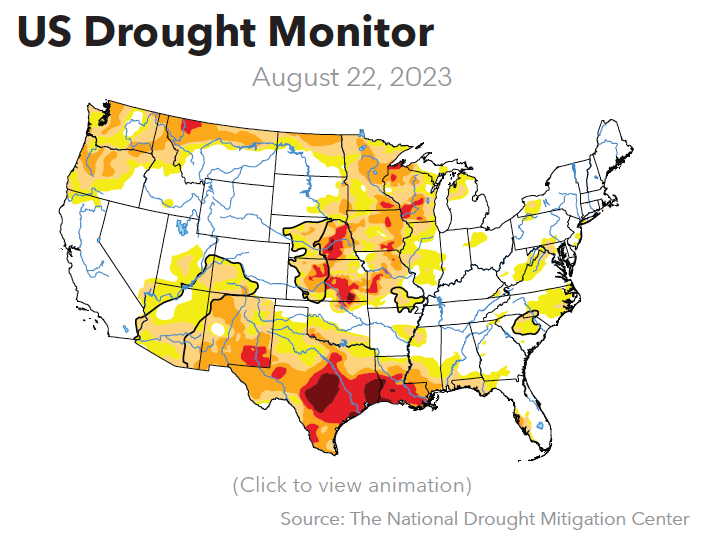
Drought conditions ranging from moderate to extreme were reported across northern and western Oregon, most of Washington, the Idaho panhandle, and the northern half of Montana in early September.
The region was gearing up for the potato harvest this month, while progress on small grains continued. Idaho growers had 63-71% of the spring wheat and barley in the bin by Sept. 3, compared with 82-83% in Washington and 85-86% in Montana.
Western Canada:
Thunderstorms moved through parts of southern Manitoba early in the week, but dry, smoky weather continued for most of Western Canada in early September. The dry conditions benefited harvest activities but did little to aid firefighting efforts.
All of Saskatchewan was under air quality advisories during the week, while the Alberta cities of Calgary, Edmonton, Peace River, Grande Prairie, and Cold Lake all posted records on Sept. 5 for the number of “smoke hours” recorded during the summer.
More than 430 wildfires continue to burn in British Columbia, with more than 2,070 fires reported this season that have charred in excess of 22,200 square kilometers.