

Eastern Cornbelt:
Scattered rains across the Eastern Cornbelt were followed by clear skies and temperatures in the 60s and 70s as the week progressed. Northern Ohio was bracing for more moisture over the coming weekend, with highs falling to the 40s and 50s.
The regional corn harvest was tracking equal to or slightly behind the average pace, with progress as of Oct. 15 estimated at 52% complete in Illinois, 30% in Indiana, and 17% in Ohio. The soybean harvest was ahead of schedule at 61% complete in Illinois, 52% in Indiana, and 49% in Ohio.
Ohio remained the region’s garden spot, with fully 81-87% of the corn and soybeans rated as good or excellent at mid-month, compared with 67% in Indiana and 56-60% in Illinois.
Western Cornbelt:
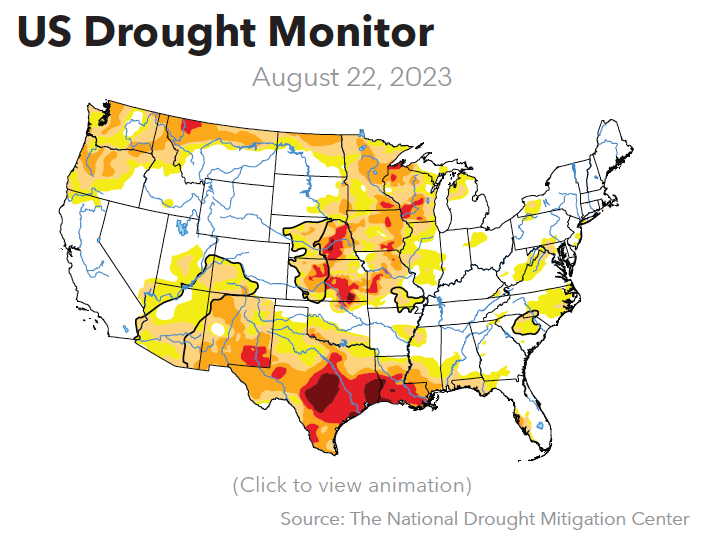
Last week’s rains contributed to a reduction in drought conditions across Iowa. Although nearly the entire state remained in drought ranging from moderate to extreme at mid-month, the areas of exceptional drought were no longer evident in the Oct. 19 US Drought Monitor.
Favorable fall weather aided the region’s harvest activities at mid-month, with harvest progress tracking ahead of average for most crops. The corn harvest as of Oct. 15 was 65% complete in Missouri and 42-44% complete in Iowa and Nebraska, with good or excellent ratings assigned to 51% of the acreage in Iowa and Nebraska and 33% in Missouri.
The soybean harvest had jumped to 70-74% complete in Iowa and Nebraska, compared with 46% in Missouri, with 42-48% of the regional crop rated as good or excellent. Growers also had 90% of Missouri’s rice and 45% of the state’s cotton in the bin by Oct. 15, with 57% of the cotton crop rated as good or excellent. Nebraska’s sorghum harvest was 35% complete with 59% of the crop rated as good or excellent.
California:

Harvest activities continued in California under favorable weather conditions. The state was almost entirely drought-free as of Oct. 19 following one of the wettest years on record.
According to the Western Regional Climate Center, California received 141% of its average annual rainfall for the Oct. 1 to Sept. 30 water year, its 10th wettest year since record keeping began 128 years ago. California’s snowpack this spring reached the deepest level recorded in at least 40 years. The surplus precipitation was fueled by back-to-back atmospheric rivers last winter and the heavy rainfall from Hurricane Hilary in August.
California’s cotton harvest was 10% complete as of Oct. 15, with 95% of the crop rated as good or excellent. Growers were also harvesting corn for silage, as well as rice, dry beans, and sunflowers in the Sacramento Valley. The harvest of a variety of fruit crops also continued, as did harvest activities on almonds, pistachios, and walnuts.
Pacific Northwest:
Pleasant weather was reported across much of the Pacific Northwest during the week, with only spotty rainfall and mostly clear, sunny skies.
The harvest of small grains and potatoes was mostly complete in the region by mid-October. Idaho growers had 31% of the sugar beets picked by Oct. 15, while winter wheat planting had progressed to 84-87% complete in the region.
Western Canada:
The fall harvest was starting to wind down in Western Canada and fall fertilizer application was going strong.
Manitoba’s overall harvest progress was 90% complete by mid-month, ahead of the average pace, with canola rated at 94% complete, soybeans at 81%, dry beans at 98%, flax at 54%, and sunflowers at 22%.
In Saskatchewan, the canola harvest was 90% complete, with soybeans and flax estimated at 68% complete across the province. Alberta farmers were approximately 88% finished harvesting all crops, with only a few acres of potatoes, flax, and canola left.