All posts by hlancey@bloomberg.net

CAN

Germany:

CAN prices slipped €10/mt lower this week, with ample availability reported in Germany from both domestic and Eastern European producers.

With recent rains causing fieldwork delays, some expressed concern that farmers may opt to skip winter wheat planting or switch to corn, which would favor urea over CAN. Still, sources closer to the supply side were quick to dispel such concerns, indicating that one major CAN producer was fully committed for March.

Potassium Sulfate

Southeast:

The latest SOP offers in the Southeast remained at the $600/st level FOB Wilmington and Tampa, Fla.

Northwest Europe:

SOP prices strengthened to €590-€620/mt CIF as European demand showed renewed activity. While one unconfirmed transaction in the low-€590s/mt set the low end of the range, the higher levels followed reports that several distributors expect demand to strengthen as April nears and producers cite limited availability.

Crops/Weather

Eastern Cornbelt:

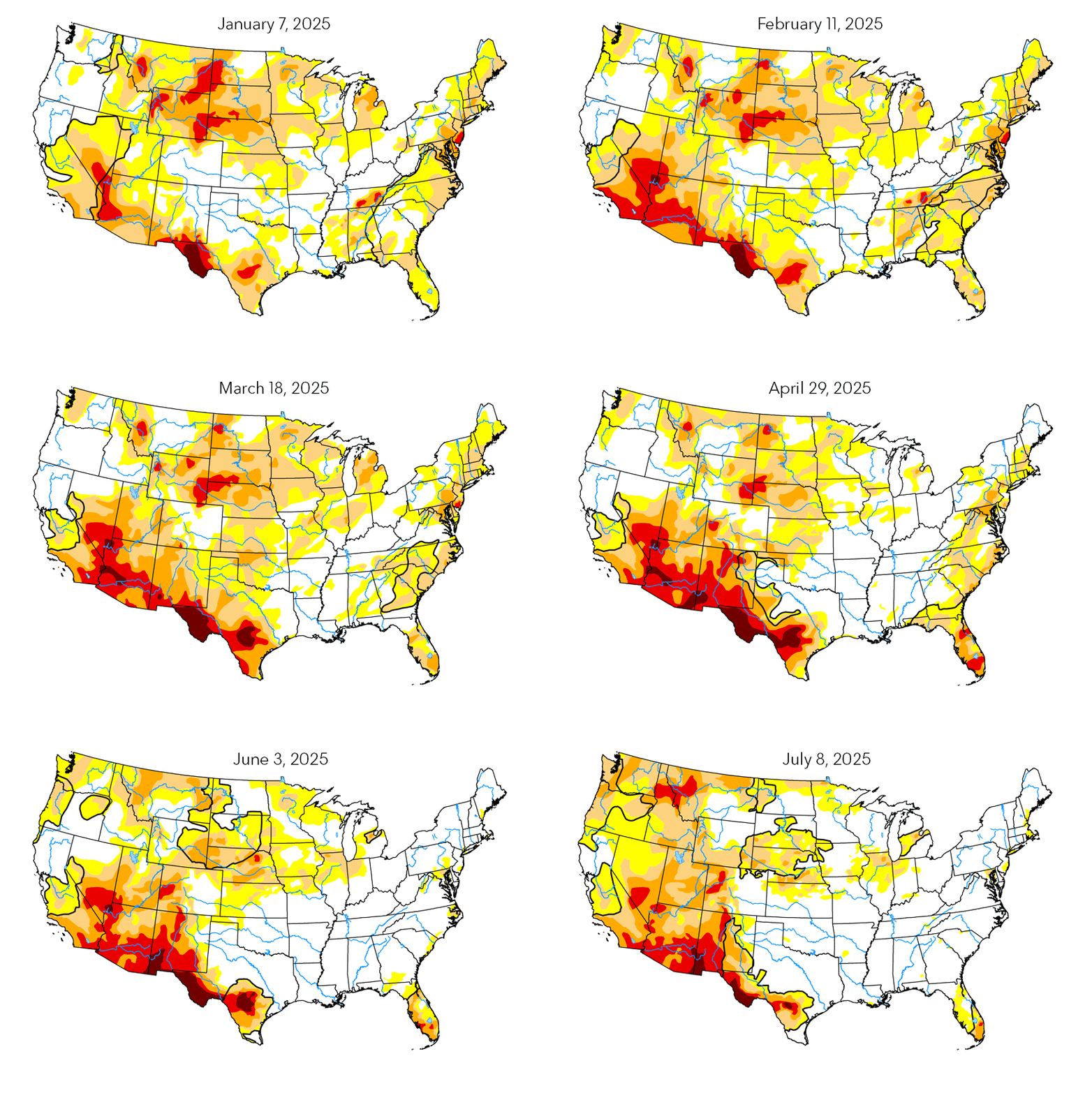
US Drought Monitor

Strong storms moved through the Eastern Cornbelt late in the week, bringing heavy rain, damaging winds, and large hail to some areas. At least one tornado touched down in Indiana’s Jefferson County, causing structural damage and power outages. A tornado watch was also posted for several Ohio counties late on March 14.

Drier weather was on tap for the weekend, though wet conditions limited fieldwork in the region at mid-month. Sources reported some ammonia application taking place in southern Illinois and in parts of Kentucky during the week, but most areas were stalled as this week’s storms worked their way through the region.

Western Cornbelt:

Thunderstorms brought rain to much of Iowa at midweek, with precipitation totals ranging from a half inch to nearly two inches in some locations. Drier weather was on tap for the weekend, but a cold front was expected to drop temperatures into the 40s across the state.

Severe thunderstorm warnings were in effect for parts of Missouri at midweek, with reports of large hail northeast of Kansas City. A severe thunderstorm watch was also in effect along the Nebraska-Kansas border on March 13-14.

Southern Plains:

Corn Wheat Soybean Index

Strong storms churned through the Southern Plains on March 13-14, generating tornados and large hail in some locations.

Hailstones ranging in size from golf balls to softballs hit parts of central, north-central, and eastern Kansas late on March 13, with unconfirmed reports of at least three tornadoes in several Kansas counties.

Tornado watches were also in effect for numerous counties in southern and eastern Oklahoma at midweek, with reports of hail and 70 mph winds in some locations. Forecasts warned of large hail, damaging winds, and periods of heavy rain in northern Texas as well.

New Mexico saw periods of rain and snow across northern, western, and central parts of the state at midweek, with more widespread precipitation expected in northeastern areas of New Mexico late in the week.

South Central:

After highs reached the 70s and low-80s for most of the week, much of the South Central region was bracing for severe weather on March 14-15.

A slow-moving cold front was expected to bring potentially strong thunderstorms to central and northern Arkansas on March 14, with forecasts warning of large hail, heavy rain, and damaging winds. The same system was taking aim at Tennessee and southern Kentucky late in the day and extending into March 15.

Louisiana and Mississippi were also expecting stormy weather as the week progressed, with 2-4 inches of rain possible in central and southern Mississippi, prompting flood watches for some locations. Both states were also at risk for damaging winds, hail, and possible tornados on March 15-16.

Southeast:

Warm, dry weather was reported over much of the Southeast during the week, with highs reaching the 80s in many locations and even touching the 90s in southern Florida.

An approaching cold front was expected to usher in precipitation as the week advanced, however, followed by much cooler weather. Forecasts in Virginia warned of wind chills in the teens and 20s by March 19-20.

Spring fieldwork and fertilizer application was off to a brisk start in the region, though wet conditions slowed the pace late in the week. “Pasture and hay land are being fertilized, small grains are starting to be topdressed, and by next week everything should be rolling,” said one Carolina contact at midweek.

Several sources said they expect corn acreage to be down this spring in the region due to low crop prices, with peanuts and cotton taking up the slack.

Transportation

US Gulf:

Guidewall repairs at Bayou Sorrel Lock, located at Mile 37 of the Port Allen Route, have been extended through Oct. 30, sources said. Waits were quoted up to 15 hours during the week.

Drawbridge repairs scheduled through April 12 at the West Canal’s Ellender Bridge were reportedly blocking weekday navigation from 7 a.m. to 5 p.m. Bridge repairs at Mile 63 of the Port Alen Route will leave travel unavailable through the site between 7 a.m. and 7 p.m. on April 19, 21, and 23.

Bayou Boeuf Lock repairs are scheduled for April, sources said. The lock will shut from 7 a.m. to 6 p.m. on April 1-30, and full closures are expected on April 2-5 and April 9-12.

Brazos Lock repairs and maintenance previously set to conclude on Feb. 29 continued during the week, with no updated completion date reported on March 13. Locking was unavailable from 7 a.m. to 7 p.m. Delays peaked around 20.5 hours on March 11-12.

Wait times were reported up to eight hours at Port Allen Lock, while Corps data showed Industrial Lock passages topping out around the 29-hour mark. Tows waited up to 11 hours to transit Algiers Lock, and intermittent 5-14 hour delays were reported at Calcasieu Lock.

Mississippi River:

Sources continued to report a 10% reduction in maximum loading drafts for barges transiting the St. Louis area due to low river levels. Drafts were reduced by 5-10% on travel between St. Louis and Cairo, Ill. The St. Louis river gauge showed 2.0 feet of depth on March 13.

Locks located between Mile 648 and 797 of the Upper Mississippi River were tentatively scheduled to open for spring travel on March 16, conditions permitting, marking a full return from the winter navigation season. The Sabula Railroad Bridge at Mile 535 was scheduled to resume passing vessels on March 11, while other locks were reported opening as early as March 4-6. Tows destined for Dubuque, Iowa, or above were expected to begin releasing from St. Louis this week.

Dredging in progress at Miles 0-22 of the lower river was slated to run 24/7 through April 1, with additional intermittent work possible through the end of August. Vessels were advised to pass at the lowest safe speed. Delays were noted at 4-11 hours through Lock 12.

Illinois River:

Loading drafts were reduced by 5-10% on the Illinois River, sources said, allowing for a maximum 9-10 feet of draft, depending on location. Delays were reported up to six hours at Marseilles Lock, and tows waited up to eight hours to pass Starved Rock Lock. Wickets were down at Peoria Lock, allowing vessels to pass the site without locking.

The river will be closed at Miles 296-296.7 for five hours daily on March 20-21 and April 3-4 for fish barrier testing. Daytime shutdowns are planned at Brandon Road Lock on March 19 and 20 for miter gate and brake assembly work.

Mechanical dredging began on March 11 at Dresden Island Lock and will run from 6:30 a.m. to 5 p.m., Monday through Thursday, until further notice. Dresden Island Lock will be offline for miter gate machinery installation during daylight hours on March 26 and 27.

Ohio River:

A main chamber shutdown at Meldahl Lock prompted wait times in a wide 4-24 hour range during the week, down from 27 hours at last report. Locking was available solely through the auxiliary chamber, and repairs were expected to continue into late March.

Greenup Lock valve repairs are underway through April 12, sources said, with minimal delays reported during the week. Planned work at Markland Lock and Cannelton Lock is scheduled for April 22 through June 7, while Markland Lock will close again on June 10-28 for miter gate repairs.

Racine Lock will undergo machinery work between June 1 and July 11, and miter gate repairs will delay Hannibal Lock travel between June 15 and Nov. 7. Belleville Lock will see alternating main and auxiliary chamber shutdowns lasting 30 days each during the second half of the year.

On the Tennessee River, wait times were posted up to 22 hours at Kentucky Lock, while tows waited as high as 19 hours to transit Wilson Lock. Old Hickory Lock, on the Cumberland River, will close to overnight travel on March 18-31, followed by a complete shutdown between April 1 and May 9.

Arkansas River:

Repairs to the Van Buren Bridge were rescheduled once again. Originally planned for February, the project was pushed back to March, then April, and is now slated to begin on Aug. 16. Work will run for about 18 days, and vessels will be cleared to pass the site after the ninth day of work. The bridge is located at Mile 300.8 of the Arkansas River.

LSB Delays El Dorado Fertilizer Capacity Expansion; Updates on Multiple Low-Carbon Projects

LSB Industries Inc. on March 5 announced that it is delaying its $400-$500 million capacity expansion at its El Dorado, Ark., complex. The company also gave an update on its multiple low-carbon projects.

“We have elected to delay the expansion of the production capacity of our El Dorado facility,” said Mark Behrman, LSB President and CEO. “After reviewing numerous factors, including current commodity market conditions and the other initiatives we have underway, we’ve determined that delaying the El Dorado expansion enables us to more effectively deploy resources to our other projects, while allowing us to maintain the strength of our balance sheet.”

Behrman told analysts in an earnings call that the full project would have cost $400-$500 million, but there are three pieces to it and the company does not have to do the whole project all at once, but can instead go “plant-to-plant.”

The three major components include debottlenecking the ammonia plant to increase capacity by 60,000-75,000 st/y, expanding the site’s large nitric acid plant, and building a facility that could produce 600,000-700,000 st/y of UAN.

Despite the delay, Behrman said LSB will continue to work with the USDA on timing and eligibility for a grant under the Fertilizer Production Expansion Program (FPEP) for the El Dorado expansion. The company has already completed an environmental assessment requested by USDA.

“We made meaningful progress in 2023 in achieving our vision to be an industry leader in the energy transition,” said Behrman, noting LSB’s collaboration with INPEX, Air Liquide, and Vopak Exolum Houston to develop a world-scale low-carbon ammonia production and export facility on the Houston Ship Channel (GM Oct. 6, 2023).

“This project will be transformative to LSB’s growth profile given the anticipated demand for clean energy,” Behrman said. “In the fourth quarter of 2023 we achieved an important step in the project development process when we selected KBR to provide the technology licensing and proprietary engineering design for the ammonia loop portion of the plant. We also recently selected an engineering firm to perform the pre-FEED on our ammonia loop. We expect to complete the pre-FEED during this year’s third quarter.”

The project would produce 1.1 million mt/y of blue ammonia, and LSB is working to secure offtake customers for the ammonia production. “Based on our ongoing conversations, we expect offtakers to come from Japan and South Korea,” Behrman said. “More recently, though, we have had conversations with potential European offtakers, and are encouraged, as we now believe Europe to be a viable target market as well.”

Behrman said LSB also continues to make good progress in the advancement of its carbon capture and sequestration project with partner Lapis Energy at LSB’s El Dorado facility (GM Feb. 24, 2023).

“We are focused on completing that project in the first quarter of 2026, subject to the EPA’s approval of our application for a Class VI injection well permit,” he said, adding that LSB has been receiving strong expressions of interest in potential long-term offtake agreements for the low-carbon products from El Dorado.

Lapis will capture and sequester more than 450,000 mt/y of CO2 produced at El Dorado. Behrman noted that Lapis will receive a 45Q tax credit of $85 per ton of CO2 sequestered, but they will also buy the CO2 from LSB.

“At the same time, we will be producing more than 375,000 mt/y of low-carbon ammonia, which we believe we will be able to sell at a premium,” he said. “All combined, this should equate to an estimated $15-$20 million in annual incremental EBITDA for LSB.”

LSB said it is also collaborating on the evaluation and development of a pilot program that would combine LSB’s low-carbon ammonia and Amogy’s ammonia-to-power engines (GM May 26, 2023). Amogy is to test a tugboat with an engine retrofitted for ammonia as a fuel during the third quarter.

Intrepid Posts 4Q Loss, Expects 2024 Uptick in Potash Production; XTO Deal Adds Boost

Intrepid Potash Inc. reported a fourth-quarter net loss of $37.3 million on sales of $56.7 million, compared to the year-ago $3.98 million and $66.7 million, respectively. Adjusted EBITDA was $7.1 million, down from the year-ago $23.1 million.

Intrepid reported a full-year net loss of $35.7 million on sales of $279.1 million, down from 2022’s net income of $77.2 million and sales of $337.6 million. Adjusted EBITDA was $41.6 million, down from 2022’s $141.8 million.

“Intrepid’s fourth quarter saw the continuation of strong demand for our potash and Trio® with our combined 2023 sales volumes up approximately 16% compared to 2022,” said Intrepid Executive Chairman Bob Jornayvaz. “Slightly lower fertilizer pricing and higher costs associated with our current potash production profile again proved to be headwinds to our margins in the fourth quarter, although we are on track to start to see the first step-change to higher potash production beginning in the second half of 2024. Moreover, fertilizer pricing has remained resilient, and we expect to see steady sales through the spring application season.”

Jornayvaz highlighted Intrepid’s December announcement that it had entered into the Third Amendment to the Cooperative Development Agreement with XTO (GM Dec. 15, 2023). He said Intrepid has already received the first $50 million for its commitments under the Amendment.

The Amendment also stipulates that Intrepid will receive an additional guaranteed, one-time $50 million payment upon certain events, Jornayvaz said, with XTO required to pay additional amounts in the event of certain additional drilling activities, up to a maximum of $100 million.

“This is a milestone development for Intrepid and the cash infusion significantly helps de-risk our outlook,” he said. “Our current balance sheet is close to fully funding our 2024 capital program, providing a cash runway until we see the positive impacts to our unit economics associated with the higher potash production rates.”

The company took a $42.8 million impairment charge during the quarter, with $31.9 million related to its conventional langbeinite mine (East Mine); $9.9 million related to the remaining assets at the West Mine, which has been in care and maintenance since 2016; and $1.0 million related to various water recycling assets.

“Intrepid’s primary strategic priority has been to revitalize our potash assets and I’m very pleased to share that we are on track to successfully achieve this goal,” he continued. “We still have a couple projects to bring online over the next few months, but our potash production outlook is improving, highlighted by the significantly improved brine grades we’re already seeing in our harvest ponds at HB from the Eddy Shaft project.”

Jornayvaz said Intrepid is still “a few quarters away from seeing the first inflection to higher production from our HB mine and we want to be clear that our investments are designed to sustainably support higher potash production over the long-term.” Jornayvaz told analysts in an earnings call that potash production will be up at least 10-15% in 2024 compared with 2023, with an additional 15-20% increase expected the following year and higher upside looking long-term.

“As for our other growth opportunities, we recently received the final permit for our sand project at Intrepid South and we continue to make progress on our lithium resource at Wendover,” he added. “Overall, we’re optimistic on Intrepid’s future and we’ll be laser-focused on getting appropriate value back in the stock.”

Intrepid CFO Matthew Preston told analysts that the company expects first-quarter 2024 sales volumes in the 65,000-75,000 st range at an average net realized sales price of $385-$395/st. He put first-quarter Trio sales volumes at 80,000-90,000 st at an average net realized sales price of $290-$300/st.

Potash  4Q-23 4Q-22 2023 2022
Sales ($000)   28,557  43,756 155,920 191,378 
Gross Margin ($000)4,33320,90735,04994,769
Sales Volume (000 st)45 50 258  222
Production Vol. 000 st)79 106224       270
Avg Realized Price ($/st) 431693 466   713
Trio 4Q-234Q-2220232022
Sales ($000)21,13017,265102,182 117,826
Gross Margin ($000)(2,378)3,429(3,995)39,123
Sales Volume (000 st)4928228197
Production Vol. 000 st)5751216226
Avg Realized Price ($/st)292  461321 479
Oilfield Solutions4Q-234Q-2220232022
Sales ($000) 7,0455,73221,31028,668
Gross Margin ($000)2,666 1,3155,7927,516

NextEra Eligible for Full $125 M Forgivable Loan for North Dakota Green Fertilizer Project

The North Dakota Industrial Commission on March 4 announced that NextEra Energy Resources Development has accepted terms for a $50 million forgivable loan under the state’s Clean Sustainable Energy Authority (CSEA) Fertilizer Development Loan Program, while Prairie Horizon Energy Solutions has declined the terms for a $75 million loan.

At its Jan. 24 meeting, the Industrial Commission approved a CSEA recommendation to authorize $50 million in loan funding to NextEra and $75 million to Prairie Horizon for fertilizer production facilities in Stutsman and Stark counties, respectively (GM Jan. 26, p. 1). The CSEA recommendation also provided for an applicant to receive the full $125 million if the other applicant were to decline funding.

“A subsidiary of NextEra Energy Resources LLC has accepted the conditional forgivable loan commitment,” a NextEra spokesperson told Green Markets. “Completion of the loan transaction is subject to execution of definitive documents. We look forward to the prospect of potentially producing anhydrous ammonia locally and at scale to benefit the North Dakota agriculture sector.” The company added that it is pleased with the allocation of the full loan amount.

The fertilizer loan was authorized by House Bill 1546 during the November 2023 special session, which required the production of hydrogen “by the electrolysis of water” and directed the CSEA to forgive the loan “upon completion of construction of the fertilizer production facility.” The forgiven loan will be paid from the Strategic Investments and Improvement Fund, which receives its funding from oil tax revenue and royalties from state-owned minerals.

CSEA’s Technical Committee had given Prairie Horizon a slightly higher rating than NextEra. Prairie Horizon received 41.75 out of 50, with NextEra’s receiving 39.13. Both projects were called “feasible with conditions.” Both Prairie Horizon and NextEra’s projects would be built with an eye toward eventually constructing a “bolt-on” urea plant.

NextEra’s $1.293 million facility is proposed for the Spiritwood Energy Park near Jamestown, producing 100,000 tons per year of green ammonia. Power would come from wind generation. NextEra is already heavily involved in the state, having invested $3.7 billion in North Dakota wind projects with another in the planning stages.

NextEra has been eyeing a possible fertilizer plant in the state for some time (GM June 2, 2023). It has also signed a Memorandum of Understanding (MOU) with CF Industries Holdings Inc. for a joint venture to develop a zero-carbon-intensity hydrogen project at CF’s Verdigris Complex in Oklahoma (GM April 28, 2023), and it is invested in clean technology developer and junior ammonia producer Monolith, Lincoln, Neb., which has plans to produce 275,000 mt/y of ammonia in Nebraska (GM July 15, 2022).

Though declining the terms of the loan, Prairie Horizon collaborator Marathon Petroleum Corp. (MPC) told Green Markets that the project will proceed. “The decision on this loan does not affect our current plans, which includes continued development of the Prairie Horizon project,” a spokesperson said.

Prairie Horizon’s $2.2 billion project would be sited in Dickinson and produce 419,750 tons of ammonia per year. Some 73,000 tons of ammonia production would come via electrolysis and be green. The project would also use natural gas, with that ammonia being blue. Capturing and storing carbon dioxide is part of the plans.

Prairie Horizon is a collaboration between MPC and TC Energy, both of which are a part of the Heartland Hydrogen Hub (HH2H), which was selected by the US Department of Energy for up to $925 million to produce low carbon hydrogen, decarbonize regional supply chains, and create clean energy jobs across Minnesota, Montana, North Dakota, South Dakota, and Wisconsin (GM Oct. 13, 2023). North Dakota already has one nitrogen plant. Dakota Gas Co., a subsidiary of Basin Electric Power Cooperative, Bismarck, produces 1,100 st/d of urea at its Great Plains Synfuels Plant near Beulah (GM May 25, 2018). It has ammonia capacity of 110,000 st/y and ammonium sulfate at 400,000 st/y. Diesel exhaust fluid (DEF) is produced there as well.