All posts by hlancey@bloomberg.net

Potassium Sulfate

US Imports:

SOP imports for December dropped 91.7% year-over-year, to 2,012 st from 24,216 st. Imports were 17,980 st for July-December, down 65.1% from 51,496 st in the prior year. Canadian imports stood at 14,267 st in July-December, topping 1,439 st from Taiwan and 767 st from Sweden. 

US Exports:

SOP exports firmed 10.2% in December, to 1,304 st from 1,183 st in December 2022. July-December exports slipped 51.6%, however, to 13,176 st from the year-ago 27,251 st. Mexico purchased 5,744 st of US product in July-December, followed by Canada with 4,699 st. Singapore received 2,142 st. 

Eastern Canada:

SOP was quoted in a broad range at C$1,085-$1,200/mt FOB in Eastern Canada.

Northwest Europe:

Potash prices in Northwest Europe were unchanged during the week, with some on the buy side expecting further declines through spring, making buyers motivated to defer purchases. With no updates about contract negotiations in the region, the SOP price remained in a wide range at €560-€610/mt CIF.

Crops/Weather

Eastern Cornbelt:

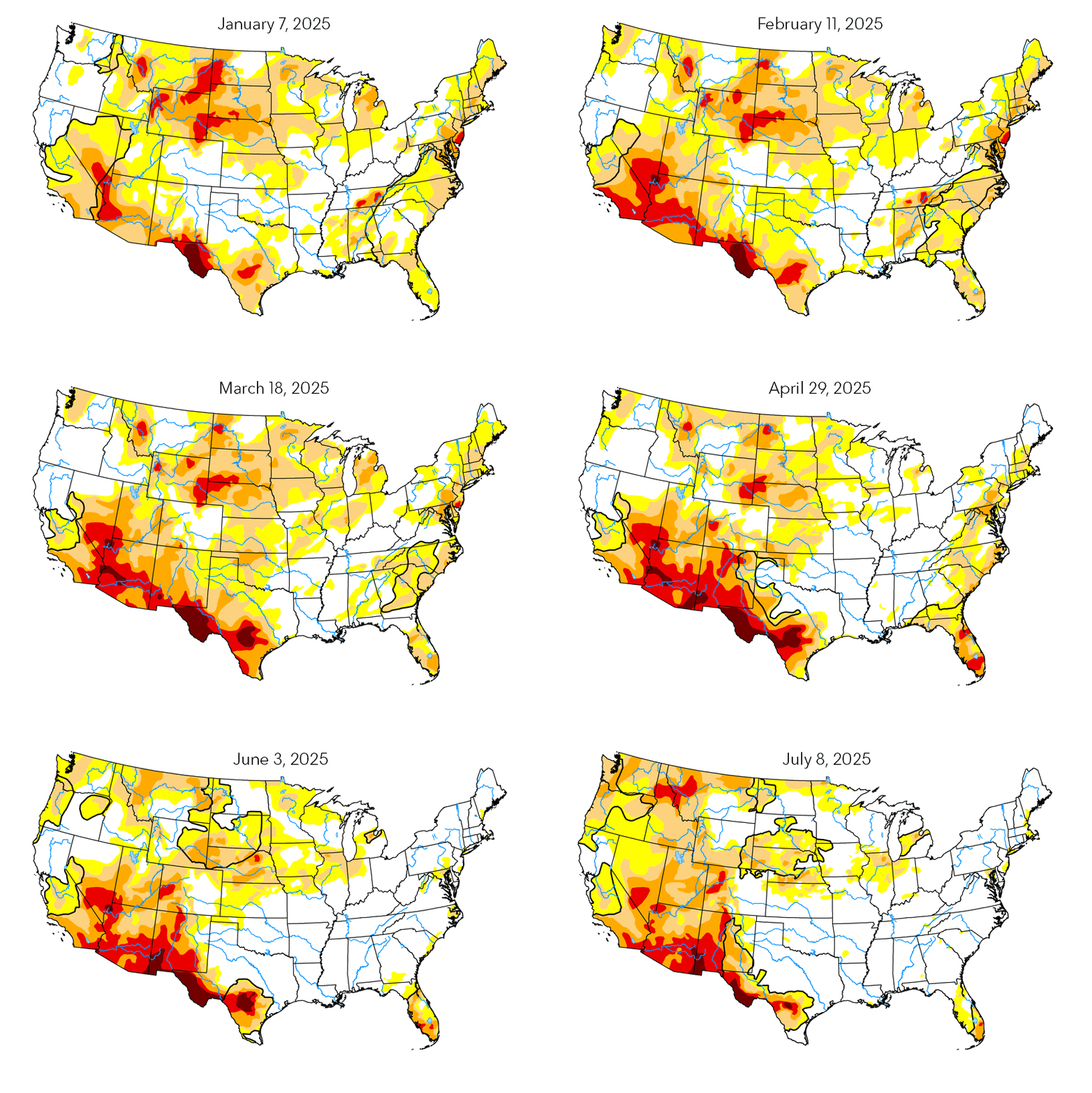
US Drought Monitor

Mild, breezy weather was reported across much of the Eastern Cornbelt during the week, but snow was expected to move into the region on Feb. 15-16.

Central Illinois was preparing for 1-4 inches of accumulation late in the week, while lesser amounts were expected across central and northern Indiana. After posting highs in the low-50s at midweek, Indiana was bracing for much colder weather by the weekend, with highs struggling to break out of the 20s by Feb. 17.

Light snow and windy weather were also in the forecast for northern Ohio as the week progressed, while Michigan was bracing for up to six inches of snow on Feb. 15, with a winter weather advisory covering much of the lower peninsula on Feb. 15-16.

Western Cornbelt:

Temperatures fell nearly 20 degrees in Iowa as the week progressed, with 2-4 inches of snow expected in many areas by Feb. 16. Colder weather was on tap for the weekend as strong winds were expected to push wind chills down to the single digits.

Winter weather advisories were also in effect for northern Nebraska late in the week, with forecasts warning of 2-5 inches of snow and low temperatures in the teens and 20s. Rain and snow were in Missouri’s forecast as well, with highs topping out in the upper-30s and low-40s by the weekend.

Forecasts called for another surge of warm air across the region during the following week, however, with highs once again climbing to the 50s and low-60s in many areas.

Corn Wheat Soybean Index

Northern Plains:

A winter weather advisory was in effect for parts of southern South Dakota and central Minnesota late in the week, with 2-6 inches of snow possible by Feb. 16, along with gusty winds.

The snowfall is long overdue as the region continues to experience one of the warmest and driest winters on record. Bismarck, N.D., notched an average temperature of 25.2 degrees from Dec. 1 through Feb. 12, the third warmest on record, with snowfall during that period totaling just 16.2 inches, less than half of normal.

Drought conditions ranging from abnormally dry to severe were reported across the northern half of North Dakota and Minnesota on Feb. 15, with moderate drought evident in parts of southern Minnesota.

Northeast:

A powerful nor’easter left thousands without power across the Northeast early in the week, with heavy snow reported in parts of New England and the Mid-Atlantic region. More than 1,200 flights were canceled in the region at the peak of the storm.

Snowfall totals by Feb. 13 included more than 15 inches in West Hartford, Conn., 14.5 inches in Tobyhanna, Pa., 10.5 inches in Scituate, R.I., and 6.2 inches in East Falmouth, Mass. Temperatures fell after the storm, with midweek lows in the teens reported in southern New England.

Eastern Canada:

Southern Ontario was under a winter weather travel advisory late in the week as a burst of heavy snowfall moved through the region. According to Environment Canada, Toronto was bracing for 5-10 cm of snow, with around 15 cm expected in the Muskoka area.

Unseasonably mild temperatures continued across southern Quebec at mid-month, though Montreal was expecting 5-10 cm of snow as the week progressed. The Maritimes were hit with a much more significant snowstorm earlier in February, with 2-3 feet of accumulation reported in parts of Nova Scotia on Feb. 3-5. Halifax recorded just over 33 inches of snow during the storm.

Transportation

US Gulf:

Drawbridge repairs will leave travel unavailable through the Florida Avenue Bridge, located between Miles 1 and 2 of the East Canal, from 6 a.m. to 10 p.m. on Feb. 24. Emergency dredging began on Feb. 14 at the West Canal’s Lapalco Bridge, blocking daily navigation between 7 a.m. and 6 p.m. through an estimated March 1.

Unplanned repairs at the Black Bayou Bridge, at Mile 238 of the West Canal, will limit daytime movements until further notice. Six-hour shutdowns are expected on weekdays, while the site will shut for four hours daily on Saturday and Sunday.

Bayou Sorrel Lock guidewall repairs blocked movements from 7 a.m. to 4:30 p.m., Monday through Friday. Delays were quoted up to 30 hours on Feb. 15. The project is expected to continue into June. Colorado Lock is due to begin dive operations on Feb. 26, restricting travel during daylight hours. The effort is scheduled to run for 10 days.

The BNSF Railroad Bridge at Mile 121.3 of the West Canal was closed to navigation from 8 a.m. to 1 p.m. on Feb. 13. Repairs underway since Feb. 5 at Ellender Bridge, located at the West Canal’s Mile 243, will block weekday travel from 7 a.m. to 5 p.m. through April 12. Maintenance operations at the St. Claude Avenue Bridge will halt movements from 6 a.m. to 10 p.m. on Feb. 24.

Bayou Boeuf Lock repairs, scheduled to begin in mid-March, will require the lock to shut for three separate closures lasting four days apiece. Additional daytime closures for timber replacement were anticipated both leading up to and running concurrently with the project.

Brazos Lock repairs are in progress through Feb. 29, limiting daytime travel. Lockages were restricted to one loaded barge or two empty barges during the week, pushing intermittent delays as high as 20 hours.

Port Allen Lock waits were noted in a 5-17 hour range, while Corps data showed Industrial Lock delays up to 18 hours on Feb. 14-15. Boats transiting Algiers Lock saw wait times up to 16 hours, and sporadic five-hour slowdowns were noted at Colorado Lock.

Mississippi River:                     

Following early week crests at or near action stage at several Lower Mississippi River locations, water levels were receding in most areas on Feb. 15. Depths were posted at 33.3 feet and falling at Vicksburg, Miss., after an action-stage 36.1-foot crest was recorded on Feb. 11. Following a peak at the 30-foot action stage on Feb. 13, levels slipped to 29.6 feet at Baton Rouge, La., on Feb. 15.

The Memphis, Tenn., area was again under a flood watch during the week due to the potential failure of the Arkabutla Dam, located in Mississippi’s DeSoto and Tate Counties. Channel work at Mile 249 of the lower river carried a risk of northbound slowdowns through Feb. 29, sources said.

With through-travel between St. Louis and St. Paul unavailable until mid-March, Locks 11-16 and 18-20 will remain open for weekday locking from 8:00 a.m. to 4:00 p.m. through March 9. Locks 21 and 22 are staffed for lockages 24/7.

Upper-river locks are scheduled to open for spring navigation on March 4-16, conditions permitting. Barges loading from New Orleans for locations below Dubuque, Iowa, were expected to begin releases in the second week of February. Cargoes headed above Dubuque will resume upriver travel in the second half of February, sources said.

Illinois River:

Delays were reported up to 12 hours at Marseilles Lock and Dam during the week. Elevated river levels left wickets in the lowered position at both LaGrange Lock and Peoria Lock, allowing tows to transit both sites without locking.

Ohio River:

An ongoing main chamber closure at Meldahl Lock forced long waits at the site. Locking was available solely through the auxiliary chamber, pushing most delays into the 50-75 hour range, above the prior week’s 36-62 hours.

Greenup Lock will shut for valve repairs between March 4 and April 12. Planned maintenance will limit movements at Markland Lock and Cannelton Lock from April 22 to June 7.

The Tennessee River’s Kentucky Lock was scheduled to return from upper guidewall replacement on Feb. 15. Midweek delays at Kentucky Lock were reported in a 4-16 hour range, while tows waited up to 15 hours to pass Wilson Lock.

On the Cumberland River, Old Hickory Lock will close to overnight travel on March 18-April 1. The lock will shut completely between April 1 and May 9.

Arkansas River:

Travel through the Van Buren Bridge, located at Mile 300.8 of the Arkansas River, will be unavailable on March 11-29. A single opening is planned for March 20 or 21 to clear waiting vessels.

Income, Revenue Drop for Yara’s 4Q, FY2023; Shares Up 8% After 4Q EBITDA Beats Estimates

Yara International ASA reported a 46% decline in adjusted EBITDA for the fourth quarter ended Dec. 31, 2023, to $576 million from $1.07 billion a year earlier, beating the average analyst estimate of $373.8 million (Bloomberg Consensus). Yara shares jumped as much as 7.9%, their largest intraday rise since 2020.

Net income attributable to shareholders of the parent was $244 million for the quarter, a 68% drop on the year-ago $769 million. Adjusted earnings per share were $0.88 against $2.46 per share a year ago. Fourth-quarter revenue was down 34% year-over-year, to $3.58 billion from $5.46 billion.

Yara said its results were impacted by significantly lower market prices and one-off position effects. To protect its margins amid subdued demand, the company curtailed some of its European production in the fourth quarter, equating to 11% of both finished fertilizers and ammonia capacity.

Many fertilizer plants were forced to shut or curtail production in 2022 as costs surged for natural gas. While prices have since retreated, the profitability of European producers is still under pressure. Yara pointed to the improving trend since the second quarter, however, and a positive market trend going into 2024.

“So far this season, nitrogen supply is lower than normal both in Europe and the US, indicating a tighter global balance for the first half of 2024,” said Yara International President and CEO Svein Tore Holsether in a company’s Feb. 9 earnings release.

“Fertilizer affordability has improved during the quarter, and optimal application rates for wheat in Europe are currently around 6% higher than a year ago,” Holsether continued. “The start of 2024 has seen increased buying activity and higher prices, signalling a potential volume catch-up into the main application season in the Northern hemisphere.”

Based on current forward markets for natural gas as of Jan. 31, 2024, and assuming stable gas purchase volumes, the company sees its gas cost for the first and second quarters of 2024 at an estimated $320 million and $100 million lower, respectively, than a year earlier.

Yara’s fourth-quarter ammonia production was 19% higher year-over-year, at 1.87 million mt versus 1.57 million mt. Production of finished fertilizer and industrial products, excluding bulk blends, was up 12% at 4.93 million mt versus the year-ago 4.40 million mt.

Crop nutrition deliveries in the fourth quarter were 4% higher than the prior year at 5.32 million mt versus 5.11 million mt. Crop nutrition deliveries increased for all regions except in Brazil and other Latin America and in Africa.

Deliveries increased by 6% in Europe, to 1.76 million mt versus 1.66 million mt in fourth-quarter 2022, which was impacted by a high-price environment and production curtailments. Overall Americas deliveries were down 1% year-over-year, to 2.38 million mt. Brazil deliveries were off 2%, at 1.38 million mt, due to reduced fertilizer demand in the second corn season, partly offset by increased commodity sales.

Industrial product deliveries were 8% lower than in fourth-quarter 2022, to 1.51 million mt from 1.65 million mt. The downturn was mainly in the chemical applications Europe and mining applications. Clean ammonia deliveries were down 10% from the prior year, with Yara citing a “distinct lack of downstream industrial and fertilizer demand.”

For the full-year 2023, Yara posted a 65% decline in adjusted EBITDA, to $1.71 billion from the prior year’s $4.89 billion. Revenue was down 35% year-over-year, to $15.55 billion from $24.05 billion. Full-year net income attributable to shareholders of the parent was $48 million against a net income of $2.78 billion for FY2022. Adjusted earnings per share were $1.11 versus $10.98 for full-year 2022.

Yara declared a dividend of NOK5 per share for 2023. This compares to a dividend of NOK55 for 2022.

Norne analyst Tomas Skeivys, as cited by Bloomberg, noted Yara’s positive outlook comments, adding that he is looking to “slightly raise” his EBITDA and revenue estimates. He sees volumes as likely picking up in the first half of 2024 and gas costs continuing to decline. However, Skeivys flagged Yara’s “rather weak” revenue and cash flow.

Yara Production and Deliveries

‘000 mt 4Q-2023 4Q-2022 FY2023 FY2022
Production1        
Ammonia 1,871 1,568 6,391 6,510
Finished Fertilizer and Industrial Products
(excluding bulk blends)1
4,933 4,403 18,437 18,332
         
Yara Deliveries        
Ammonia Trade 422 467 1,475 1,771
Fertilizer 5,315 5,114 22,283 22,687
Industrial Product 1,514 1,645 6,350 7,159
Total Deliveries 7,251 7,226 30,109 31,616

1 Including Yara share of production in equity-accounted investees, excluding Yara-produced blends

Yara Deliveries

‘000 mt 4Q-2023 4Q-2022 FY2023 FY2022
Crop Nutrition Deliveries        
Urea 1,141 995 4,690 4,700
Nitrate 1,069 1,027 4,462 4,442
NPK 2,025 2,131 8,355 8,498
CN 329 323 1,478 1,500
UAN 212 140 1,047 998
DAP/MAP/SSP 118 109 560 559
MOP/SOP 176 149 709 921
Other products 246 240 982 1,069
Total Crop Nutrition Deliveries 5,315 5,114 22,283 22,687
         
Europe Deliveries 1,760 1,661 7,705 7,455
Americas Deliveries 2,382 2,414 10,073 10,943
         
North America 646 641 2,811 2,814
Brazil 1,377 1,406 5,619 6,450
Latin America excluding Brazil 359 367 1,642 1,679
Africa & Asia Deliveries1 1,174 1,039 4,506 4,289
         
Asia 876 721 3,373 3,271
Africa 298 318 1,133 1,018
         
Industrial Solutions Deliveries 1,514 1,645 6,350 7,159

1 The Africa and Asia business also includes Oceania

India Updates on Rerouted Red Sea Fertilizer Shipments; Shippers Say Situation Deteriorating

India on Feb. 6 reported that seven ships carrying fertilizer to the country have been rerouted from the Red Sea so far due to disturbances, according to the Press Trust of India. Major shipping companies are warning that the security situation in the Red Sea continues to deteriorate despite efforts by the west to limit attacks by Yemen’s Houthi rebels, according to Bloomberg.

The bosses of A.P. Moller-Maersk A/S and D/S Norden A/S said on Feb. 8 that they felt the threat level was continuing to escalate in the region. It comes after Japanese shipping giant Mitsui OSK Lines Ltd. (MOL) said the disruption on the route could last for a year.

Swaths of the merchant fleet have been avoiding the waterway since attacks by the Houthis began in mid-November. The area grew even more volatile after the US and UK launched airstrikes last month, prompting major owners in all sectors to avoid the region.

“We’ve not seen the level of threat peak, to the contrary,” Maersk CEO Vincent Clerc said in a Bloomberg TV interview. “The amount or the range of weapons that are being used for these attacks is expanding and there is no clear line of sight to when and how the international community will be able to mobilize itself and guarantee safe passage for us.”

The shipping companies’ perceptions of risk matter because they will dictate when vessels return to the region. All of the owners said they will continue to reroute ships until it is safe to travel the Red Sea.

In addition to the airstrikes launched by the US and UK, there is also a defensive force operating in the Red Sea known as Operation Prosperity Guardian. Military ships in the region have been attempting to thwart missile strikes on merchant vessels over the past few weeks, but the Houthis have continued their attacks. There has also been a parallel uptick in Somali piracy.

Norden CEO Jan Rinbo said there needs to be signs of a period of stability with no further attacks before shipping companies will think about returning. “You need to have a de-escalating situation, and we are not at that point yet,” he said. “If anything, it just seems to escalate.”

Clerc said Maersk will continue to reroute its ships around Africa for several more weeks and has previously said the company would need to be “absolutely certain” the waterway was safe before sailing there again. MOL said its diversions will continue for at least the next two to three months, while Norden said it doesn’t expect an imminent resolution.

At the same time, dry weather has forced the Panama Canal – one of the world’s other vital maritime chokepoints – to reduce traffic due to low water levels, also forcing a large number of ship diversions.

“That really is unprecedented,” Norden’s Rindbo said. “I’ve not in my 29 years in shipping seen anything like this.”

Iowa Legislators Join Debate Over OCI/Koch Deal

Iowa legislators have joined the debate over the $3.6 billion deal in which Koch Industries Inc. would buy OCI Global’s Iowa Fertilizer Co., which has a nitrogen plant in Wever (GM Dec. 22, 2023). They follow Iowa State Auditor Rob Sand’s opposition to the deal (GM Feb. 2, p. 1), as well as that of some 18 agriculture and environmental groups (GM Jan. 26, p. 1).

“I am highly concerned about the $550 million in taxpayer incentives that were given away to increase competition in the fertilizer market that may now serve to the benefit of one of the largest players in that industry,” Iowa Representative Elinor Levin (D) told Green Markets. “Monopolies hurt Iowans, and our job is to help make Iowans’ lives better. We are simply asking other entities, including our AG, to do the job they are authorized to do by investigating the deal.”

Levin, along with Rep. J.D. Scholten (D), also weighed in with KBUR news radio in a Feb. 6 broadcast. “Ask any rowcrop farmer and fertilizer is one of the number one costs they’ll bring up as an issue,” Scholten said in the broadcast. “This issue is not new and this is what Governor Branstad did when he gave tax breaks to Iowa Fertilizer Co. over 10 years ago to create competition in the market.”

On the other side of the debate, Iowa State Senator Jeff Reichman (R) issued a statement to local media saying he was personally excited by the deal.

“Only ivory tower liberals would object to an American company purchasing a plant from an Egyptian company,” he said, adding that Koch Industries has a history of growth and investment that should be cause for excitement in southeast Iowa. He said Auditor Sand’s position was grandstanding and a slap in the face to southeast Iowa.

“Rob Sand is so beholden to the crazy coastal liberals obsessed with Koch Industries, he had to pander to them by opposing the sale of the fertilizer plant from OCI to Koch Industries,” Reichman said. “In the process, he showed he’s just another run-of-the-mill liberal despite his attempts to cast himself as something different.”

“Democrats have always opposed the fertilizer plant because they want to put government first, no matter how many jobs the project created,” Reichman added. He said their opposition to the plant contributed to them losing every legislative seat in southeast Iowa since construction started.

CF Industries Holdings Inc. – Management Brief

CF Industries Holdings Inc. on Feb. 5 announced that Christopher D. Bohn has been appointed Executive Vice President and Chief Operating Officer and has been elected to the company’s Board of Directors, effective Feb. 1, 2024. He will lead global manufacturing, distribution, sales, and supply chain, including CF’s clean energy initiatives. He will be accountable for operational excellence focused on safety, productivity, and long-term growth.

“Chris has experience leading most areas of our business and has been instrumental in developing and growing our clean energy strategy,” said Tony Will, CF President and CEO. “He will continue to drive operational excellence across the organization while managing a range of complex growth initiatives. This promotion and his election to the Board recognize his strong leadership and future contributions to CF Industries.”

Bohn is currently Executive Vice President and CFO with responsibility for strategic planning, business development, and investor relations. He previously served as Senior Vice President, Manufacturing and Distribution; Vice President, Supply Chain; and Vice President, Corporate Planning. He joined CF in September 2009, and has more than 14 years of experience in the nitrogen fertilizer sector.

Bohn will continue to serve as CFO until a permanent replacement has been appointed. An external search is underway.

Belarus Eyes Arkhangelsk, Astrakhan Ports for Potash Exports

Representatives from the Russian port city of Arkhangelsk and the Belarusian government have held talks about the potential of creating a specialized terminal for the transshipment of Belarusian cargo, in particular potash, Interfax reported.

Arkhangelsk lies within the Arctic Circle, more than 1,000 kilometers from Moscow. Belarus is interested in the possibility of using Arkhangelsk for cargo transshipment, given that its port allows access to the ocean without crossing the territorial waters of other states, Interfax reported, citing Arkhangelsk Mayor Alexander Tsybulsky.

The Russian government earlier approved a program for the accelerated development of the Arkhangelsk transport hub through 2035. The program provides an infrastructure project to construct a deep-water area that will be able to accept ships with a draft of up to 15 meters and handle cargo year-round. The port currently requires the deployment of icebreakers to remain navigable during the winter months.

Since the imposition of Western sanctions, Belarus has been forced to reorient the transshipment of its export cargo to Russian ports and has also increased exports to China by rail. Belarus currently ships the lion’s share of its seaborne potash volumes through the port of St. Petersburg (GM June 23, 2023).

Belarus still has plans to build a port near Murmansk in northwest Russia to handle its potash and fertilizer shipments, according to Murmansk Oblast Governor Andrei Chibis speaking to Interfax in December (GM Dec. 15, 2023). Chibis said the current proposal is a request from Belarus for a separate port with a transshipment capacity of 5-7 million mt/y.

Belarus is also reported to be looking at the possibility of establishing logistics corridors and routes to India through Russia and Iran, according to a Tass report, citing Dmitry Krutoy, the Belarusian ambassador to Russia. The aim is reportedly to find an effective average tariff for delivery to Astrakhan, a seaport situated on the delta of the Volga River, some 100 kilometers from the Caspian Sea, and for transportation to Iran’s Caspian seaports for shipment across Iran and possibly ending with a corridor to India.

Krutoy reiterated the importance of the Indian market to Belarus. India imported 992,377 mt of potash from Belarus in 2021, according to Trade Data Monitor, the last full year before Western sanctions started to bite. India’s potash imports from Belarus fell to 383,566 mt in 2022.

Belarus and Iran last year agreed on the supply of 400,000 mt of Belarusian potash, though neither the delivery period nor how much of the volume would be consumed in Iran was disclosed (GM Nov. 10, 2023). Iran consumed just 20,000 mt of potash in 2022, according to IFA data, and sources believed the bulk of the 400,000 mt was destined for other markets.

Belarus began reorienting transshipments of its potash exports after Lithuania’s government terminated the railway transit contract between the country’s state-owned railway company Lietuvos Geležinkeliai (LTG) and Belaruskali as of Feb. 1, 2022, over national security concerns (GM Jan. 14, 2022). The Lithuanian government’s decision came in the wake of EU and US sectoral sanctions on Belarus.

The removal of the Lithuanian rail route effectively blocked Belaruskali’s key export route. Before the imposition of Western sanctions, the Belarus producer and its marketing/export arm, Belarusian Potash Co. (BPC), shipped 10-11 million mt of potash annually through the Lithuanian port of Klaipėda.