All posts by hlancey@bloomberg.net

Sulfur

Tampa:

Sources reported slow negotiations for the first-quarter contract price of molten sulfur delivered to Tampa. Fourth-quarter 2023 contracts were valued at $102/lt CFR, an 85% increase from $55/lt CFR in the third quarter.

US Gulf:

US Gulf prill exports slid to $65-$70/mt FOB, off from $66-$72/mt FOB at last report.

Brazil:

Prices firmed to $97-$102/mt CFR at Brazil, lifting from $94-$99/mt CFR. CMOC is reportedly in the market for product shipping in February.

Vancouver:   

Vancouver export prices remained at $70-$75/mt FOB for the week, sources said.

Alberta:

Alberta netback estimates were unchanged at (-)$13-$30/mt FOB, and included molten sulfur cargoes contracted into the US market and prilled material exported through the Vancouver market.

West Coast:

West Coast solid sulfur prices remained even with Vancouver at $70-$75/mt FOB. Molten sulfur contracts were reported at $85-$90/lt FOB for loading in the fourth quarter.

China:

Prices pulled back slightly at China, to $100-$105/mt CFR from the last-reported $102-$105/mt CFR range.

ADNOC:

Sulfur produced by the Abu Dhabi National Oil Co. (ADNOC) was posted at $77/mt FOB Ruwais for January loading, down 11.5% from $87/mt FOB in December.

Qatar:

January Muntajat prices softened to $74/mt FOB Ras Laffan, a 12.9% decline from December’s $85/mt FOB posting.

Ammonium Thiosulfate

Eastern Cornbelt:

The ammonium thiosulfate market firmed to $255-$270/st FOB in the Eastern Cornbelt, up from the prior $245/st FOB low, with the low confirmed at Cincinnati and the high at Terre Haute, Ind.

In the Great Lakes region, Michigan terminal prices were reported in the $285-$300/st FOB range, depending on location.

Western Cornbelt:

Ammonium thiosulfate tightened to $250-$260/st FOB in the Western Cornbelt, with the low confirmed at Waterloo, Iowa.

Eastern Canada:

The ammonium thiosulfate market remained in a broad range at C$465-$545/mt FOB for the last confirmed offers in Eastern Canada.

Crops/Weather

Eastern Cornbelt:

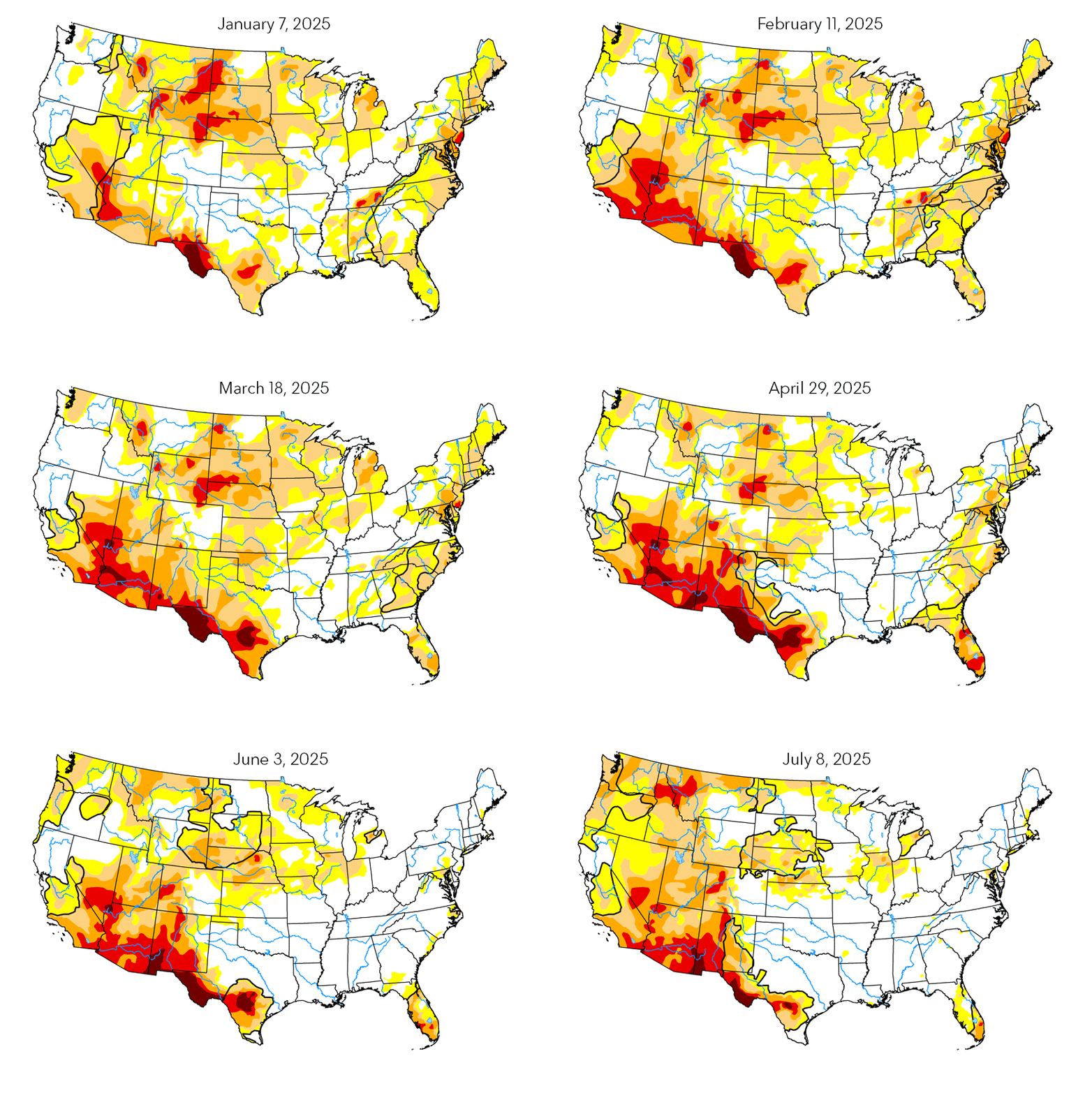
US Drought Monitor

The new year began with mostly dry conditions across the Eastern Cornbelt, with highs reaching the upper-30s. Freezing rain was reported in parts of northern Illinois on New Year’s Eve, with a small chance of rain and ice again on Jan. 4 in areas north of Interstate 80.

Parts of Indiana and Ohio were bracing for a wintry mix of precipitation over the coming weekend, with 1-2 inches of lake-effect snow expected in some locations. Michigan also experienced spotty snow flurries during the week, with temperatures falling to the mid-20s to low-30s as the week progressed.

Western Cornbelt:

Conditions remained dry in Iowa, with temperatures slightly above average for this time of year. The dry, mild weather followed the second warmest December on record for Des Moines, which notched an average 37.4 degrees for the month, well above the monthly norm of 27.7 degrees.

Des Moines also recorded just 0.2 inches of snowfall in December, a full 7.7 inches below the monthly average. Nebraska’s winter snowfall was also below average, though several systems were expected to drop an inch or two of accumulation in south-central areas of the state late in the week.

Missouri was also bracing for a mix of rain and snow by the coming weekend, with minimal accumulation expected.

Northern Plains:

Corn Wheat Soybean Index

Dense fog blanketed parts of central and southeastern South Dakota during the week, with lows dropping to the teens and 20s and highs reaching the low- to mid-30s.

Similar temperatures were reported in Minnesota and North Dakota, with snow flurries in the weekend forecast. Both states were hit with an ice storm over the holidays that caused power outages and road closures, including portions of Interstates 29 and 94.

Northeast:

Cold air pushed into the Northeast as the week progressed, with highs in New England dropping from the 40s at midweek down to wind chills in the single digits by the end of the week.

The cold front also ushered in the potential for snowfall, with 4-8 inches of accumulation possible in northern New England over the weekend. Pennsylvania and the Mid-Atlantic region were expecting mostly rain from the weekend system.

Eastern Canada:

Colder temperatures blanketed Ontario during the first week of 2024, which was a notable difference from December. In a Jan. 2 report, Environment Canada said Toronto posted its second-warmest December on record, with only 12 centimeters of snow recorded during the month, well below the average of 25 centimeters.

Snow flurries and blustery winds were reported in southern Quebec late in the week, with temperatures falling to subzero lows. The heaviest snowfall was expected in the Maritimes, where weekend totals of 15-25 cm were in the forecast for Nova Scotia. Much colder weather was also on tap in the Maritimes, with wind chills falling to double digits below zero.

Transportation

US Gulf:

Draft restrictions on northbound tows moving above New Orleans continued at 9.5 feet due to low water levels, while tows were limited to widths of six empty barges or four loaded barges. Maximum drafts were noted at 9.5 feet in the East and West Canals. Shoaling continued to be reported in the Galveston Harbor area, as well as in the Houston Ship Channel.

Repairs to the southwest guidewall at Bayou Sorrel Lock scheduled into March spurred intermittent travel outages between 7 a.m. and 4 p.m., Monday through Friday, pushing waits as high as 15.5 hours during the week.

Gate work at Bayou Boeuf Lock is loosely scheduled for mid-January, sources said, though no firm dates were announced as of Jan. 4. Sources expect at least three complete travel closures lasting four days each to complete the project.

Travel will be unavailable between 8 a.m. and 1 p.m. through the BNSF Railroad Bridge at Mile 121.3 of the West Canal on Jan. 16, 18, 23, 25, and 30, as well as on Feb. 1 and 6. Repairs to the Ellender Bridge, located at the West Canal’s Mile 243, will halt navigation from 7 a.m. to 5 p.m., Monday through Friday, between Feb. 5 and April 12.

Port Allen Lock wait times were reported up to 11 hours during the week, while tows transiting Industrial Lock faced intermittent 5-15 hour delays. Waits ran up to seven hours at Algiers Lock, and sporadic 5-16 hour wait times were noted at Colorado Lock. Corps data showed travel delays up to 38 hours at Brazos Lock. Harvey Lock is closed to overnight navigation due to low water levels, sources said.

Mississippi River:

Rising water levels allowed for softer restrictions on the Lower Mississippi River during the week. Loading drafts were reduced by 15-20% from normal levels on northbound travel, down from 20-25% at last report, while downriver movements continued to see a 10-15% reduction. Maximum towing widths increased to seven barges from the six barges noted previously.

The river gauge at Vicksburg, Miss., was pegged at a low-stage 4.4 feet and rising on Jan. 4. Forecasts predicted a crest at 7.0 feet on Jan. 8 before levels recede to 4.8 feet on Jan. 18. Memphis, Tenn., levels were forecast to peak above the area’s (-)5.0-foot low stage at (-)1.1 feet on Jan. 4-5, ahead of a projected fall to (-)6.0 feet on Jan. 18. Dredges were expected to return to work on the lower river during the week of Jan. 7.

Draft limits ran 10% below typical levels in the St. Louis area, sources said, while loading weights were reduced by 5-10% between St. Louis and Cairo, Ill. On the upper river, dredging was underway at Miles 166, 169, and 274.

While through-travel is unavailable on the upper river until mid-March, Locks 11-16 and 18-20 were scheduled to remain open on weekdays from 8:00 a.m. to 4:00 p.m. through March 9, conditions permitting. Locks 21 and 22 are staffed to pass vessels 24/7 throughout the winter. The upper river is scheduled to begin reopening for spring navigation on March 4-11.

Illinois River:

Loading drafts stood at a maximum 9-9.5 feet on the Illinois River, depending on location, up from nine feet reported previously. Wickets remained in the down position at both Peoria Lock and LaGrange Lock due to low water, forcing tows to lock through both locations. Dredging was in progress at Miles 226-228, sources said.

Ohio River:

Draft limits ran in the 9.5-10.5 foot range on the Ohio River, depending on location and direction of travel, off from 9.5-11 feet at last report. Tow lengths were permitted up to 15 barges.

Delays at Meldahl Lock continued due to an unscheduled lock shutdown, sources said, with waits clocked up to 14 hours for the week. Valve repairs will force shutdowns at Greenup Lock from March 4 to April 12, while work at both Markland Lock and Cannelton Lock are expected to limit movements between April 22 and June 7.

The Tennessee River’s Kentucky Lock is scheduled to go offline for upper guidewall replacement between Jan. 22 and Feb. 15. Waits at the site were quoted up to 11 hours, while boats transiting Wilson Lock were delayed up to six hours during the week.

OCI to Sell Iowa Fertilizer Co. to Koch for $3.6 Billion

OCI Global announced on Dec. 18 that it has entered into a binding equity purchase agreement for the sale of its Wever, Iowa-based Iowa Fertilizer Co. LLC (IFCo) to Koch Ag & Energy Solutions LLC (KAES) for $3.6 billion on a tax-free basis, subject to a customary cash, debt, and normalized level of working capital adjustment.

OCI is selling 100% of its indirect equity interests in IFCo and said the agreement follows a highly competitive process “with multiple rounds” and a strategic review launched earlier this year. The transaction does not require the approval of OCI shareholders and the company sees little regulatory risk to the sale.

The transaction is OCI’s second in less than a week. On Dec. 15, the company announced a binding agreement to sell its entire 50% + 1 share stake in its Abu Dhabi-based joint venture Fertiglobe Plc to UAE state-owned oil giant Abu Dhabi National Oil Co. (ADNOC), which already owns a 36.2% stake in the jv (GM Dec. 15, p. 1).

Responding to analyst questions at a company Investor Day call on Dec. 18 whether more asset sales can be expected, OCI CEO Ahmed El-Hoshy confirmed the company’s strategic review is now completed, and there would be no further asset disposals in the short term.

The Fertiglobe and IFCo sales, which remain subject to customary closing conditions and anti-trust approvals in their respective jurisdictions, will bring in $7.2 billion in tax-free gross cash proceeds for OCI. OCI expects the IFCo transaction to close around mid-2024 while the Fertiglobe deal is also expected to close in 2024.

The proceeds from the two sales will be used to significantly reduce holding company net debt, OCI said. The company’s net debt stood at $2.3 billion as of Sept. 30, 2023. OCI said it will continue to receive cash flows from IFCo until the transaction with Koch closes.

OCI launched its strategic review in March, with the objective of closing the discount to OCI’s intrinsic value and unlocking value for its shareholders. The review followed a request by one of its largest shareholders, activist investor Jeff Ubben of Inclusive Capital Partners, which owns 5% of OCI. Ubben urged OCI to explore strategic options, including asset sales, especially for its IFCo unit, amid shareholder concerns about the company’s stock prices.

Net proceeds after debt and closing adjustments, including transaction costs, are estimated to be in the €2.5-€2.6 billion range (approximately $2.7-$2.8 billion at current exchange rates), El-Hoshy told analysts and investors on Dec. 18. There is about $1 billion of debt and other adjustments related to the IFCo transaction.

“The transaction is expected to result in a reduction in holding company net debt and to allow for the return of capital to shareholders, which will be considered within the context of OCI’s capital returns framework and also will provide some firepower for potential continued growth, and if it makes sense, future investments,” he said.

OCI CFO Hassan Badrawi said the IFCo and Fertiglobe transactions unlock the equivalent of approximately €27 per share for OCI, notwithstanding the company’s continuing business. Badrawi said OCI has not yet discussed the detailed use of the sales proceeds in the wake of the two transactions, but he emphasized the company will have a well-capitalized balance sheet and a reduction of debt, in addition to a meaningful return of capital to shareholders through what they believe are tax efficient avenues available to them.

Commissioned in 2017 as a large-scale greenfield nitrogen fertilizer facility at a cost of $3 billion, IFCo has 195,000 mt/y of sellable anhydrous ammonia capacity, and production capacity for 1.5 million mt/y of UAN and 420,000 mt/y of urea. The plant also has diesel exhaust fluid (DEF) production capacity, which has increased from the original 315,000 mt/y to over 1 million mt/y, with the potential to achieve 1.3 million mt/y, OCI reported in February (GM Feb. 17, p. 33).

“We began developing IFCo in 2012, and at the time, it was the first greenfield nitrogen fertilizer plant to be built in 25 years. It revitalized the nitrogen fertilizer industry in the US Midwest, particularly since we focused on developing the surrounding region’s distribution logistics infrastructure to support the Midwest agricultural industry,” El-Hoshy said.

“As IFCo reached maturity with steady operating rates, we concluded it would be better served by a nitrogen-fertilizer focused company that can steer IFCo through its next phase of growth, and we launched a competitive process to unlock the intrinsic value of an unappreciated asset within OCI’s overall valuation” he added.

“Today’s announcement is an important step forward for KAES as we continue to invest in our fertilizer business,” said KAES President Mark Luetters. “This investment complements our existing business, and we look forward to advancing this transaction with OCI to completion.”

Once all closing and regulatory conditions are met, Koch said the Wever facility will be added to the existing Koch Fertilizer portfolio, which produces, markets, and distributes nitrogen fertilizers, DEF, and phosphate fertilizer products.

“We are excited about the opportunity the Wever plant will provide us to better serve existing and new customers with expanded products and services,” said Koch Fertilizer Executive Vice President Scott McGinn.

Neither Koch nor OCI confirmed whether the sale of IFCo includes any offtake agreements from the plant, including whether OCI would retain its share in N-7, the joint-venture marketing agreement between OCI, Dakota Gasification Co., and Dyno Nobel Inc. reached in December 2019 (GM Dec. 6, 2019).

“More details around N7 and how it will look post-transaction will be provided during the regulatory approval period,” El-Hoshy said. A three-year renewal of the N-7 marketing agreement was reached in November 2021 (GM Dec. 2, 2021).

OCI will retain two business hubs in the Netherlands and Texas after the IFCo and Fertiglobe sales. These include nitrogen fertilizer, methanol, and melamine production assets at its OCI Nitrogen site in the Netherlands. According to the Green Markets database, the site has 1.1 million mt/y of ammonia, 1.2 million mt/y of CAN, and 0.73 million mt/y of UAN capacity. The company is also adding CAN plus S to its product portfolio there.

OCI is also developing 300,000 mt/y of AdBlue/DEF production capacity at its Dutch production facilities (GM Feb. 17, p. 33), and is expanding its ammonia import capacity at the port of Rotterdam from roughly 400,000 mt/y to up to 1.2 million mt/y (GM June 17, 2022), which the company said will provide “the ability to distribute ammonia into the Dutch markets and Western European markets.”

OCI’s ammonia and methanol production facilities in Beaumont, Texas, include 0.3 million mt/y of ammonia capacity, according tothe Green Markets database. The company is also developing a 1.1 million mt/y blue ammonia facility at Beaumont, which it said is on track to start production in 2025 (GM Nov. 10, p. 27).

OCI believes the company’s continued business after the two transactions will generally have $600-$700 million of mid-cycle EBITDA.

“Today’s announcement marks an evolutionary step in our journey to create value for shareholders, and to enhance our focus on efforts in lower carbon initiatives,” said OCI Executive Chairman Nassef Sawiris. “Our strengthened balance sheet will support the acceleration of our strategy in the field of decarbonization projects, driving future growth and supporting the energy transition goals we share with many of our stakeholders, establishing us as a leader in the low carbon space.”

Green Markets Research Director Alexis Maxwell said the IFCo purchase price equates to $3.60 per unit of nitrogen and reflects a 58% premium to the Dec. 1 purchase by CF Industries Holdings Inc. of the 880,000 st/y Waggaman, La., ammonia production complex from Incitec Pivot Ltd. (GM Dec. 1, pg. 1).

“This reflects higher per-ton pricing for the upgraded fertilizers (urea, UAN, DEF) sold at Wever,” Maxwell said. She noted that CF expanded its US ammonia market share to 44% with the Waggaman deal, while Koch’s share of total US ammonia capacity will rise from 11% to 15.7% with the IFCo purchase.