All posts by hlancey@bloomberg.net

Sulfur

Tampa:

Fourth-quarter Tampa molten sulfur contracts were valued at $102/lt CFR, 85% above $55/lt CFR in the third quarter.

US Gulf:

US Gulf export pricing was steady at the week-ago $85-$90/mt FOB level, with players reporting soft sentiment in the market.

Brazil:

Brazil prices were unchanged from last week at $110-$117/mt CFR. Nearby demand was successfully covered in the last round of business, sources reported.

Vancouver:   

With market attention reportedly centered on China’s new export restrictions, Vancouver prill prices remained at $80-$90/mt FOB.

Alberta:

Estimated netbacks at Alberta remained at (-)$13-$30/mt FOB for the week. Both molten sulfur cargoes contracted into the US market and solid tons sold through the Vancouver export market were represented in the wide range.

West Coast:

Solid sulfur loading from the West Coast remained even with Vancouver at $80-$90/mt FOB. Fourth-quarter molten sulfur contracts were reported at $85-$90/lt FOB.

China:

China import prices were quoted at $105-$110/mt CFR, unmoved from the prior report. Citing the country’s new phosphates export restrictions and reports of high inventories, some market players expect prices to continue falling in China.

ADNOC:

Abu Dhabi National Oil Co. (ADNOC) sulfur was posted at $100/mt FOB Ruwais for November loading, a 9.9% decrease from $111/mt FOB in October. With current posted prices in the Arab Gulf described as economically unviable to any international destination, transactions from the region are likely concluding below posted levels, sources said.

Qatar:

November offer prices from Muntajat were noted at $98/mt FOB Ras Laffan, off from October’s $104/mt FOB posting.

Ammonium Thiosulfate

Eastern Cornbelt:

The ammonium thiosulfate market remained at $245-$270/st FOB in the Eastern Cornbelt, with the low confirmed at Terre Haute, Ind., and the high at inland terminals. The Cincinnati market was steady at $255/st FOB.

Western Cornbelt:

Ammonium thiosulfate was unchanged at $225-$260/st FOB in the Western Cornbelt, with the low reported at Waterloo, Iowa.

Southern Plains:

The ammonium thiosulfate market remained at $220-$250/st FOB in the Southern Plains, depending on location.

South Central:

Ammonium thiosulfate pricing was unchanged at $250-$255/st FOB Memphis.

Crop/Weather

Eastern Cornbelt:

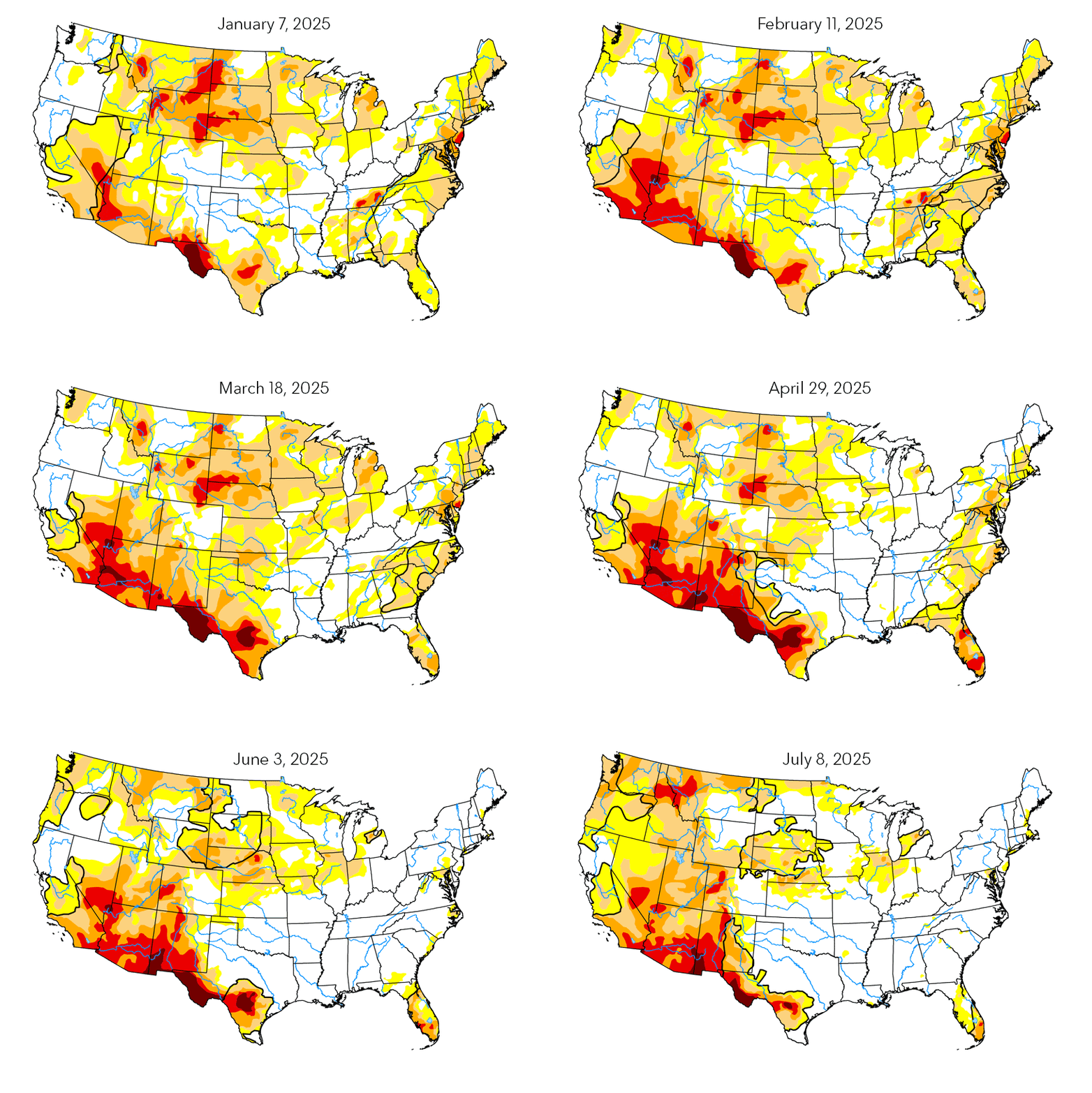
US Drought Monitor

Steady rainfall was reported across the Eastern Cornbelt early in the week, with temperatures topping out in the 40s and low-50s. Up to a half-inch of precipitation was recorded in northern Ohio, with periods of heavy rain also soaking northern Illinois on Nov. 20.

Growers were bringing in the last of the regional corn harvest in late November, with progress as of Nov. 19 estimated at 97% in Illinois, 90% in Indiana, 81% in Ohio, and 67% in Michigan.

Western Cornbelt:

Mostly dry conditions were reported across Iowa and Nebraska during the Thanksgiving week, with temperatures climbing to the 50s and 60s. Forecasts warned of potential snow in parts of western Nebraska late in the week, however, with 4-8 inches of accumulation possible across several eastern Wyoming and western Nebraska counties.

The regional corn harvest had progressed to 95-97% complete by Nov. 19, with all three states tracking ahead of their five-year averages. The cotton harvest was rated at 98% complete in Missouri, with the sorghum harvest at 95% complete in Nebraska.

Southern Plains:

Light rainfall was reported across eastern Kansas early in the week, with temperatures peaking in the upper-40s. The same system brought rain to parts of Oklahoma as well, along with gusty winds, with lows falling to the upper-20s and highs reaching the mid-50s by midweek.

Rain also hit parts of northern Texas on Nov. 20, but heavier precipitation fell in eastern areas of the state. Lows in the 30s and highs in the 50s were in the forecast for northern Texas for the balance of the week.

Much-needed rain was reported in parts of New Mexico over the prior weekend, along with snow at higher elevations. The moisture was followed by clear, cold weather, with highs in the 40s and 50s and lows dropping to the 20s and 30s.

The fall harvest was winding down in the Southern Plains, with 95-100% of the corn and sorghum in the bin as of Nov. 19. The cotton harvest was reported at 73-78% complete in Kansas and Oklahoma by that date, slightly ahead of the 68% harvest progress in Texas.

South Central:

Corn Wheat Soybean Index

A tornado watch was in effect for parts of eastern Texas, western Louisiana, and southwestern Arkansas on Nov. 20, impacting roughly 3 million residents. The system also brought severe storms to Mississippi as it tracked eastward, causing power outages and some structural damage.

Counties along the Tennessee-North Carolina state line were under a red flag fire warning on Nov. 21 due to high winds and worsening drought conditions. By contrast, a weather system brought scattered rains and cool temperatures to Kentucky early in the week, with highs topping out in the 50s.

The fall harvest was rapidly winding down in the South Central region, with 95-98% of the regional corn crop in the bin, along with 95-100% of the cotton.

Southeast:

Showers and thunderstorms were working their way through the Southeast early in the week, bringing heavy rain and gusty winds to southern Alabama and the Florida Panhandle on Nov. 21, along with several tornado watches.

The storm threat then shifted to Georgia and the Carolinas, where forecasts warned of strong winds and potential tornados on Nov. 21-22.

The harvest of cotton and peanuts was tracking close to the average pace in the region. Alabama growers had 89% of the cotton picked by Nov. 19, compared with 86% in North Carolina, 73% in South Carolina, 71% in Virginia, and 67% in Georgia. The peanut harvest was finished in Virginia and 91-97% complete in the rest of the Southeast by that date.

Transportation

US Gulf:

Algiers Lock is shut for gate repairs through Dec. 1, forcing detours through the Port Allen Route. Average travel times increased by 24-48 hours as a result, sources said.

A guidewall repair project at Bayou Sorrel Lock closed the site to navigation daily from 7:00 a.m. to 4:30 p.m., prompting waits up to 34 hours. Tows checking in before 4:30 p.m. were able to lock before work resumes the next morning, and the shutdowns were expected to pause whenever delays rise above the 24-hour mark. Lock operators were reported prioritizing southbound lockages during daytime hours, while northbound vessels received preference overnight.

Low head conditions continued to prompt long wait times at Harvey Lock, driving delays to 35 hours for the week, down from 85 hours at last report. Tows are capped at 300-foot lengths and 70-foot widths whenever head conditions sink below 1.5 feet, a Corps posting indicated. Reverse head conditions closed Harvey Lock completely between June 15 and Oct. 16.

Brazos Lock movements were limited between 7:00 a.m. and 7:00 p.m. daily, triggering intermittent 11-22 hour waits. Work at the site is scheduled to continue through Nov. 29. Slow-travel warnings at Bayou Chene are in effect through Nov. 30 due to dredging.

The Ellender Bridge was closed to navigation during daytime hours on Nov. 18-19. The bridge is located at Mile 243 of the West Canal.

Wait times at Port Allen Lock were reported up to 33 hours due to the Algiers Lock shutdown. Industrial Lock waits ran in a wide 5-21 hour range, while seven-hour delays were noted at Colorado Lock at midweek.

Mississippi River:    

Low water conditions persisted on the Lower Mississippi River, holding restrictions steady from week-ago levels. Loading drafts for both north- and southbound tows were reduced by 20-25% from typical levels, while towing widths were limited to five barges through Mile 921.

The river gauge at Memphis was posted at a low-stage (-)9.0 feet on Nov. 21. Forecasters expected levels to peek above the (-)5.0-foot low stage to (-)4.7 feet on Nov. 28-29, before receding to (-)7.3 feet on Dec. 5. Sources expected towing widths to tighten to five barges, off from the current six-barge limit, when Memphis levels move below (-)8.0 feet. The Vicksburg, Miss., gauge was noted at a low-stage 1.9 feet at midweek.

Dredging continued at Miles 738 and 486 of the lower river, prompting intermittent 24-hour delays at both locations.

Loading weights were reduced by 10-15% on travel through St. Louis, unchanged from last week, while maximum drafts were cut by 5-10% between St. Louis and Cairo, Ill. Maximum barge drafts continued at 9.0 feet between St. Louis and St. Paul, Minn., while maximum tow sizes remained at 12-15 barges, depending on location. Dredging was reported at Miles 274 and 69-70.

The St. Louis river gauge stood at (-)0.89 feet on Nov. 21. Forecasters expected levels to slip to (-)1.9 feet on Dec. 5.

Upper-river locks are scheduled to shut for the winter navigation season on Dec. 4, with reopening tentatively set to begin over the March 5-15 period. Locks 11-16 and 18-20 are currently scheduled to operate from 8:00 a.m. to 4:00 p.m., Monday through Friday, between Dec. 17 and March 9, while Locks 21 and 22 will remain open 24/7.

Illinois River:

Loading weights on the Illinois River were reduced by 5-10% due to low water levels. Maximum barge drafts were reported at 9.0 feet as of Nov. 10, while tows were allowed up to 15 barges on both up- and downriver travel.

Sources noted raised wickets at Peoria Lock and LaGrange Lock due to low water, forcing lockages through both sites. Dredging continued at Miles 226-228.

Ohio River:

Sources reported maximum loading drafts at 9-10 feet on the Ohio River, depending on location, down 10-15% from typical levels. Towing complements were capped at 15 barges in both directions.

The auxiliary chamber at John T. Myers Lock was closed through Nov. 22 for miter gate repairs. Corps data showed wait times in the 5-16 hour range for the week.

The Montgomery Lock main chamber was scheduled to return from maintenance on Nov. 22, briefly ending a spate of detours through the secondary chamber. The site’s auxiliary chamber is due to shut Nov. 22-26, followed by an additional main chamber closure on Nov. 26-Dec. 22.

Work at the Smithland Lock river chamber was also due to wrap up on Nov. 22. The Olmsted Lock river chamber was closed for maintenance through Nov. 23, forcing boats to transit through the land chamber.

On the Tennessee River, Kentucky Lock is due to go offline Jan. 22 through Feb. 15, 2024, for upper guidewall replacement. Delays ran up to 18 hours at Kentucky Lock, while boats transiting Wilson Lock waited up to 17 hours to pass.

Waggaman Deal Expected to Close on Dec. 1

Incitec Pivot Ltd. (IPL) on Nov. 15 announced that the US antitrust regulatory review process in relation to the sale of its ammonia manufacturing facility located in Waggaman, La., to CF Industries Holdings Inc. (CF) has now concluded. IPL and CF expect to complete the transaction on Dec. 1, subject to the satisfaction of other customary closing conditions.

The Australian company and CF in March reached an agreement for the sale of the Waggaman 880,000 st/y (800,000 mt/y) ammonia plant to CF (GM March 24, p. 1).

As previously announced, IPL said the gross proceeds from the sale are $1.675 billion, with cash proceeds (before tax, transaction costs, and purchase price adjustments) of $1.25 billion. CF expects to fund this amount from cash on hand.

After accounting for transaction costs, purchase price adjustments, and tax estimated at around $400 million, IPL said the net cash proceeds from the sale are expected to be approximately $850 million. The tax is expected to be paid in January 2025.

After transaction completion, IPL will commence the previously announced 25-year ammonia supply agreement with CF. The offtake agreement secures ammonia at producer cost and provides for the supply of up to 200,000 st/y of ammonia to support IPL’s Dyno Nobel Americas explosives business.

The ammonia will be priced on a gas-backed formula at a level commensurate with the current cost of production at the plant. In its Nov. 13 earnings statement this week, IPL put the value of the offtake agreement for accounting purposes at an estimated A$300 million, based on the current ammonia and gas price outlook.

IPL Interim CEO Paul Victor said the Waggaman sale delivers three key strategic objectives for the company: “achieving security of ammonia supply for Dyno Nobel’s US operations, delivering significant returns to our shareholders, and rebalancing our portfolio towards more reliable, recurring earnings.”

“Further, through securing the long-term supply agreement with CF, our US explosives business is well positioned to continue to deliver the high-value technical and service needs of our customers,” he said.

IPL has noted that the 200,000 st/y offtake is for a continuous supply of ammonia and is not subject to outages at Waggaman, saying that if you look at the economic benefits, they are much greater than the company had before the sale.

CF believes Waggaman will fit seamlessly into its network, as well as the company’s strategic focus on ammonia as a clean energy source, given its proximity and pipeline connection to CF’s Donaldsonville, La., complex, its distribution and logistics flexibility, and its favorable characteristics for the addition of carbon capture and sequestration (CCS) technologies to enable low-carbon ammonia production. IPL had already been advancing the plant toward blue ammonia production with a front-end engineering design (FEED) study for CCS.

Based on the contracts in place, CF estimates that the plant will generate gross margin per ton commensurate with its existing ammonia segment prior to synergies, which the company expects to capture through greater capacity utilization and operational and logistics optimization. Over the last five years, CF said its operational capabilities have resulted in ammonia asset utilization that is approximately 10% higher than the average utilization rate of the company’s North American peers.

Despite CF’s optimism, the Waggaman plant has not had the smoothest run since its 2016 startup. IPL had to deal with an original construction defect, which, along with other problems, caused significant downtime over the years (GM April 22, 2022; Feb. 25, 2022; Feb. 18, 2022; Nov. 19, 2021; Sept. 17, 2021; May 21, 2021; Nov. 15, 2019; April 5, 2019). As of November 2022, however, IPL said the plant had been running flawlessly since a production restart in April 2022 (GM Nov. 18, 2022). In addition, it exceeded nameplate capacity for FY2023.

Ammonia produced at the Waggaman facility today is distributed ratably to three customers – Trammo Inc., Cornerstone Chemical Co., and IPL’s DNA – with approximately 75% used in industrial applications. These medium- to long-term offtake agreements are expected to remain in place. In the meantime, American Plant Food expects to source ammonia from the Waggaman plant for its proposed 420,000 st/y ammonium sulfate plant (GM Oct 27, p. 1).

With the sale now expected to be completed in early December, IPL confirmed that it intends to return up to A$1 billion (approximately $650.8 million at current exchange rates) of the proceeds of the Waggaman sale to shareholders, as per its Nov. 13 announcement.

IPL said the capital returns will be undertaken through a combination of an on-market share buyback of up to A$500 million (in addition to the previously announced A$400 million buyback) and a distribution of up to A$500 million that will be allocated between a pro-rata capital return and a special unfranked dividend.

These additional capital returns will require shareholder approval, which IPL intends to seek at the upcoming 2023 AGM on Dec. 20.

Waggaman posted a 23% decline in EBIT in the fiscal year ended Sept. 30, 2023, to $264 million from the year-ago $343.8 million, IPL reported on Nov. 13. Revenue fell by 27%, to $456.6 million from $628.8 million.

FY2023 saw improved manufacturing reliability at the Waggaman plant, with ammonia production exceeding the 800,000 mt/y nameplate capacity. Production reached 822,500 mt, a 17% increase on the prior year’s 700,600 mt, according to IPL. Ammonia sales amounted to 829,600 mt, 11% more than FY2022’s 745,900 mt.