All posts by hlancey@bloomberg.net

Sulfuric Acid

US Gulf:

As negotiation season continues for 2024 contracts, US Gulf sulfuric acid prices softened to $105-$120/mt CFR, sources noted, down from $120-$125/mt CFR in the prior week. While OCP has reportedly ended its buying spree, the market remains well balanced, players said.

Brazil:

With no new transactions reported, the Brazil import sulfuric acid market was unchanged at $130-$138/mt CFR.

Ammonium Thiosulfate

Eastern Cornbelt:

The ammonium thiosulfate market was unchanged at $245-$270/st FOB in the Eastern Cornbelt, with the low reported at Terre Haute, Ind., and the high out of inland terminals in Ohio. The Cincinnati market remained at the $255/st FOB level in mid-October.

Western Cornbelt:

Ammonium thiosulfate was steady at $225-$260/st FOB in the Western Cornbelt, with the low reported at Waterloo, Iowa.

Southern Plains:

The ammonium thiosulfate market remained at $220-$250/st FOB in the Southern Plains, depending on location.

South Central:

Ammonium thiosulfate pricing was unchanged at $240-$245/st FOB Memphis for the last confirmed offers.

NPKS

Poland:

Grupa Azoty produced an estimated 64,000 mt of compound fertilizers in September, the company said, compared with 54,000 mt in August. Output of specialty fertilizers reached an estimated 15,000 mt in September versus 9,000 mt in August.

Crops/Weather

Eastern Cornbelt:

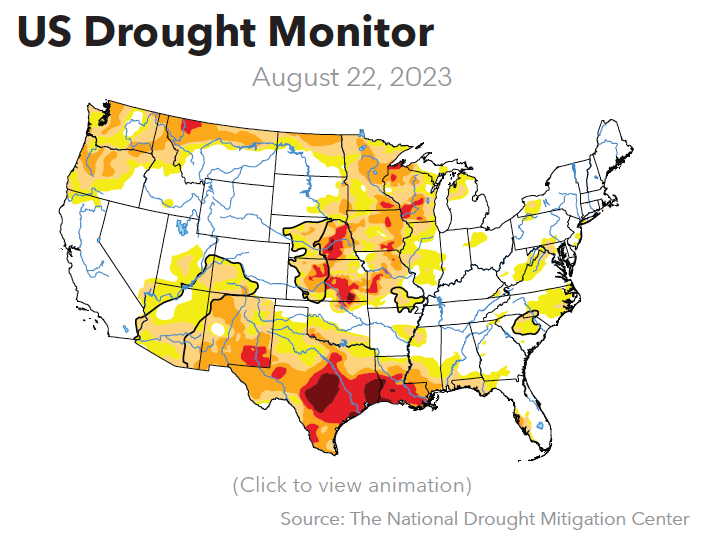
US Drought Monitor

A frost advisory was issued for parts of northern Ohio early in the week, while potentially strong storms were expected to track through Illinois on Oct. 13, with several inches of rain possible in northern Illinois and southern Wisconsin. The storm threat also included the potential for hail and strong winds.

The regional corn harvest as of Oct. 8 had progressed to 42% complete in Illinois, 21% in Indiana, 13% in Michigan, and 9% in Ohio, with good or excellent ratings assigned to 76% of the acreage in Ohio, 66% in Indiana, 58% in Illinois, and 55% in Michigan.

The soybean harvest was 44% complete in Illinois by that date, compared with 33% in Indiana, 24% in Ohio, and 17% in Michigan. Fully 73% of Ohio’s soybeans were rated as good or excellent, compared with 66% in Indiana, 58% in Illinois, and 51% in Michigan.

Western Cornbelt:

A tornado watch was in effect for portions of central Nebraska on Oct. 12 as strong storms churned through the region. Forecasts warned of possible flash flooding in northeastern Nebraska, southeastern South Dakota, and southwestern Minnesota from up to 3-5 inches of rainfall.

Parts of eastern Iowa were also bracing for up to two inches of rain from showers and thunderstorms that moved through the state on Oct. 11-13.

The corn harvest as of Oct. 8 had progressed to 56% complete in Missouri and 30-32% in Iowa and Nebraska, while the soybean harvest was 52% complete in Iowa and Nebraska and 27% in Missouri. USDA placed 48% of Iowa’s corn and soybeans in the good or excellent categories on that date, compared with 42-47% in Nebraska and 33-44% in Missouri.

Growers also had 23% of Missouri’s cotton, 79% of Missouri’s rice, and 18% of Nebraska’s sorghum crop in the bin by Oct. 8.

Corn Wheat Soybean Index

Southern Plains:

A late-week cold front brought gusty winds and spotty thunderstorms to parts of Kansas and Oklahoma, with forecasts warning of large hail and 60 mph gusts in some locations. Wind advisories and red flag fire warnings were in effect in both states on Oct. 12-13.

Harvest activities continued at a brisk pace on corn, soybeans, cotton, and sorghum in the Southern Plains, with drought and summer heat taking a toll on crop quality in Kansas, Oklahoma, and Texas.

The corn harvest as of Oct. 8 was 83% complete in Texas, 64% in Kansas, and 21% in Colorado, with good or excellent ratings assigned to 54% of the acreage in Colorado, 49% in Texas, and 33% in Kansas. Kansas growers also had 39% of the soybeans harvested by that date, with 20% of the crop rated as good or excellent.

Cotton showed the greatest impact from drought, with just 9% of Oklahoma’s crop rated as good or excellent on Oct. 8, compared with 15% in Texas and 39% in Kansas. The sorghum harvest was 88% complete in Texas, 32% in Oklahoma, 29% in Kansas, and 16% in Colorado, with good or excellent ratings assigned to 85% of the crop in Colorado, 45% in Texas, and 32-34% in Kansas and Oklahoma.

South Central:

Temperatures in the mid-70s to low-80s were common across Arkansas, Tennessee, and Kentucky during the week, but frosty lows were possible in some areas by the coming weekend. Coastal areas of Louisiana and Mississippi were hit with heavy rain during the week, with more than two inches reported in New Orleans.

Growers were chipping away at the fall harvest in mid-October. The corn harvest was estimated at 59% complete in Kentucky and 71% in Tennessee by Oct. 8, with 69-78% of the acreage rated as good or excellent.

The soybean harvest was 93% complete in Louisiana, 82% in Mississippi, 60% in Arkansas, 37% in Tennessee, and 27% in Kentucky, with good or excellent ratings assigned to fully 80% of the acreage in Tennessee, 68-69% in Arkansas and Kentucky, 52% in Mississippi, and 42% in Louisiana.

Louisiana growers had 84% of the cotton picked by Oct. 8, compared with 42% in Mississippi, 32% in Arkansas, and 15% in Tennessee. Good or excellent ratings were assigned to fully 81% of the acreage in Tennessee, 65% in Arkansas, 53% in Mississippi, and 48% in Louisiana.

Southeast:

Needed rainfall moved across parts of northern Florida, eastern Georgia, and the Carolinas on Oct. 12, with cool and breezy conditions expected over the coming weekend.

Strong thunderstorms were reported in central and northern Florida as the week progressed, with the storm threat moving into southern Florida on Oct. 13. Forecasts warned of several inches of rain in some Florida locations.

Growers were harvesting corn, soybeans, cotton, and peanuts in the Southeast in mid-October. North Carolina growers had 92% of the corn and 12% of the soybeans in the bin by Oct. 8, with 68% of the corn and 62% of the soybeans rated as good or excellent.

The cotton harvest was 20% complete in Alabama, 10% in Virginia, and 7-8% in Georgia and the Carolinas, with good or excellent ratings assigned to 47% of the acreage in North Carolina, 54-56% in Alabama and Georgia, 60% in South Carolina, and 96% in Virginia.

The peanut harvest was 55% complete in Florida, 47% in Virginia, 42% in Alabama, 23% in Georgia, 21% in South Carolina, and 15% in North Carolina, with good or excellent ratings assigned to 23% of the crop in Alabama, 41% in Florida, 55-61% in Georgia and North Carolina, 85% in South Carolina, and 91% in Virginia.

Transportation

US Gulf:

Gate work at Algiers Lock, needed to repair damage from a vessel collision in July, will completely block navigation at the site through Dec. 1. Tows were reported detouring through the Port Allen Route, resulting in 24-48 hour delays. The shutdown at Algiers kicked off on Oct. 2.

Bayou Sorrel Lock is scheduled to close from 7:00 a.m. to 4:30 p.m. daily for guidewall repairs. Long waits, as well as the shutdown at Algiers Lock, have forced lock operators to adapt, however, extending morning locking hours to include any vessel that arrived before 4:30 p.m. the prior day. The project is scheduled to run into March 2024. Waits were noted at 10-27 hours for the week.

Brazos Lock is closed to navigation between 7:00 a.m. and 7:00 p.m. daily through Nov. 29. Intermittent waits were observed in a wide 7-24 hour range through the week. Bayou Chene dredge work scheduled through Nov. 30 prompted slow-travel warnings in the area.

Port Allen Lock delays spiked above 50 hours late in the week due to excess traffic from the Algiers Lock shutdown. Corps data showed 42 tows waiting to lock on Oct. 12. Sporadic 5-12 hour waits were noted at Colorado Lock, while travel remained unavailable through Harvey Lock due to reverse head conditions caused by low water levels on the Lower Mississippi River.

Mississippi River:    

Water levels continued to recede on the Mississippi River and its tributaries during the week. Depths at Cairo, Ill., fell to 4.54 feet on Oct. 8, the gauge’s lowest point since 2.90 feet was recorded on Nov. 21, 1901, prior to the construction of the modern lock and dam system on the Mississippi and Ohio Rivers.

Cairo depths improved to 6.38 feet on Oct. 12, though forecasts predicted a drop to 4.60 feet on Oct. 13, ahead of a slow increase in levels projected to begin next week. Some shippers expected passage through Cairo to be suspended when levels fall below the five-foot mark.

Due to the conditions, towing widths were reduced to a maximum of four barges between St. Louis and Cairo, while five-barge widths were allowed between Cairo and Vicksburg, Miss., where depths were recorded at a low-stage 0.76 feet and falling slowly on Oct. 12.

Loading drafts were reduced by 5-10% between St. Louis and Cairo, sources said, while tows traveling southbound on the lower river were reduced by 20-25%. Northbound tows were restricted to 65-70% of normal capacity. Sources noted draft reductions of 30-35% through the St. Louis harbor, where depth readings showed (-)1.63 feet at midweek.

Groundings continued to be reported, including at Mile 920 of the lower river, and channel depths topped out at nine feet in some locations. Barge counts were restricted by 15-40% south of Cairo, depending on location and vessel horsepower. Memphis depths were reported at a low-stage (-)11.51 feet and holding steady on Oct. 12.

Dredging was underway at Miles 294, 538, and 742 of the lower river. Channel work was reported at the upper river’s Mile 11 and Mile 301, while work at Miles 221-225 was expected soon.

Many upper river locks are scheduled to close for the winter navigation season between Dec. 5 and March 11, 2024. Most NOLA loadings concluded in the first week of October for destinations above Clinton, Iowa, while cargos traveling south of Clinton were expected to continue releases through the third week of October.

Locks 18-27 are anticipated to remain open throughout the winter, conditions permitting.

Illinois River:

Low water levels persisted on the Illinois River, prompting draft reductions in the 5-10% range. Dredging was reported at Mile 40, while wickets were raised at Peoria Lock and LaGrange Lock. Corps data put Marseilles Lock waits at 15 hours during the week.

Ohio River:

Ohio River loading drafts were reduced by 10-15% due to low water levels. Monongahela River drafts continued at a maximum 8.5 feet.

Dredging at Miles 967-975 was extended once again, sources said. Originally scheduled to conclude on Sept. 24, the project is now tentatively slated to run through the end of the October. Southbound tows are currently able to transit the area during daylight hours, while northbound tows are restricted to overnight lockages.

The primary chamber at John T. Myers Lock is shut through Nov. 6 for repairs and maintenance, prompting tows to pass through the auxiliary chamber. The project was previously expected to wrap up on Nov. 17. Delays were reported in a wide 44-80 hour range through the week.

The secondary chamber at Montgomery Lock is closed through Oct. 17, after which the site’s primary chamber will go offline from Oct. 17 through Nov. 22. The secondary chamber will shut again on Nov. 22-26, followed by an additional primary chamber shutdown scheduled for Nov. 26-Dec. 22.

Canadian Official Withdraws from Event in India

The speaker of Canada’s senate won’t be attending a Group of 20 event hosted by India this week as diplomatic relations between the two countries remain tense, according to a Bloomberg report. Raymonde Gagne bowed out of the two-day parliamentary speakers’ summit starting Friday, Oct. 13, in New Delhi, a spokesperson for her office confirmed.

Two Indian officials confirmed Gagne won’t be at the summit, adding that no reason was given for her non-attendance.

Om Birla, speaker of the lower house of India’s parliament, had told the media last week that Gagne had agreed to participate. It’s not clear if Canada will have any representation at the meeting.

Relations between the two countries have deteriorated since Prime Minister Justin Trudeau publicly accused the Indian government of playing a role in the assassination of a prominent Sikh leader in Canada. New Delhi has staunchly denied any involvement.

As tensions escalate, India asked again on Oct. 12 that Canada take “more seriously their international obligation to provide security” to Indian diplomats and premises in the country.

Canadian Foreign Minister Melanie Joly said Oct. 11 the two countries are still in discussion over India’s request that Canada reduce its diplomatic presence. India reportedly wants Canada to cut its number of diplomats in India by 66%, or by 41 from the existing 62 (GM Oct. 6, p. 1). Both countries expelled senior diplomats soon after Trudeau linked Indian agents with the assassination. India also suspended visa services for Canadians and issued an advisory warning its residents against traveling to Canada.

“Diplomacy is always better when conversations remain private, and that’s the approach I will continue to take when it comes to India,” said Joly.

Earlier, India’s High Commissioner to Australia Manpreet Vohra said in an interview with Bloomberg that the allegations have barely affected the South Asian nation’s diplomacy in the Indo-Pacific. He said Canada should lay out its evidence to back up its allegations.

Trudeau’s claims come at a time of major outreach by the Indian government of Prime Minister Narendra Modi, as the South Asian nation widens and deepens its diplomatic and economic footprint across the world as part of the rise of what is being called the Global South.