All posts by hlancey@bloomberg.net

Muriate of Potash

US Gulf:

The NOLA potash market firmed to $345-$350/st FOB for confirmed new October-November business on reports of limited availability, up from last week’s $340-$345/st FOB range.

Eastern Cornbelt:

Potash was unchanged at $385-$400/st FOB in the Eastern Cornbelt, with the high reported out of inland warehouses and the low at river terminals. The Cincinnati market remained at $385-$395/st FOB in early October.

Western Cornbelt:

Potash edged up to $385-$400/st FOB in the Western Cornbelt, with the St. Louis market quoted in the $385-$395/st FOB range.

Northern Plains:

Potash was quoted at $390-$400/st FOB St. Paul, with delivered tons reported in the same range for 4Q shipment. The latest prices FOB Saskatchewan mines remained at $365-$371/st FOB, depending on grade.

Northeast:

Potash prices remained at $360/st FOB Baltimore, $370/st FOB Fairless Hills, and $400/st FOB East Liverpool in early October.

Eastern Canada:

The potash market in Eastern Canada was quoted at C$585-$590/mt FOB regional warehouses, up from August pricing in the C$545-$585/mt FOB range.

Thailand:

Potash imports to Thailand totaled 433,000 mt in January-August, according to Trade Data Monitor, a 34% decline from the year-ago 653,000 mt, with Laotian potash accounting for 20% of the market.

Laos has steadily increased in its share of the Thai potash market in recent periods, the data showed.August imports stood at 77,000 mt, a 25% decline from the 103,000 mt recorded in August 2022.

Brazil:

Imported potash prices were unchanged at $340-$350/mt CFR. Despite high inventory levels, reports of steady deliveries were expected to support prices. Potash was stable at $480-$485 FOB ex-warehouse in Rondonopolis, unmoved from the previous week.

Sulfur

Tampa:

Negotiations for fourth-quarter Tampa molten sulfur contracts were ongoing during the week. Market players anticipated a final price in the $97-$103/lt CFR range, above the third quarter’s $55/lt CFR contract.

US Gulf:

The US Gulf sulfur market was unchanged from last week at $95-$105. Players are reportedly awaiting the updated Tampa price before jumping into a new round of business.

Brazil:

Brazil import sulfur prices lifted to $132-$140/mt CFR, up from last week’s $127-$140/mt CFR range.

Vancouver:

Prilled sulfur loading from Vancouver moved higher during the week, to $100-$105/mt FOB from last week’s $90-$97/mt FOB range. Logistical bottlenecks from the port strikes that ended in August have continued to disrupt the flow of product, sources said.

Alberta:

Alberta sulfur prices lifted to (-)$60-$35/mt FOB, an $8/mt rise from the week-ago $27/mt FOB top. The range included both molten sulfur cargoes contracted into the US market and prilled material sold offshore through the Vancouver export market.

West Coast:

The West Coast solid sulfur market remained on par with Vancouver at $100-$105/mt FOB. Third-quarter molten contracts were $45-$50/lt FOB, down from $98-$106/lt FOB in the previous period.

China:

China sulfur imports were stable at $120-$126/mt CFR. With most offices either running on reduced staff or closed due to the Golden Week holiday, no new negotiations were reported.

ADNOC:

Abu Dhabi National Oil Co. (ADNOC) prills were posted at $111/mt FOB Ruwais for October loading. Sources reported fourth-quarter contracts at $103/mt FOB.

Qatar:

Muntajat October sulfur offers continued at $104/mt FOB Ras Laffan, market watchers said.

Sulfuric Acid

US Gulf:

As the 2024 contract negotiation season gets underway, US Gulf import prices were steady in the $120-$125/mt CFR range, with most players describing the market as balanced.

Brazil:

Import sulfuric acid prices narrowed in Brazil, to $130-$138/mt CFR from $130-$160/mt CFR at last report. A previously reported tender that was canceled due to high prices was noted limiting supply in the market.

Ammonium Thiosulfate

Eastern Cornbelt:

The ammonium thiosulfate market was unchanged at $245-$270/st FOB in the Eastern Cornbelt, with the low reported at Terre Haute, Ind., and the high out of inland terminals in Ohio. The Cincinnati market remained at the $255/st FOB level in early October.

Western Cornbelt:

Ammonium thiosulfate remained at $225-$260/st FOB in the Western Cornbelt, with the low reported at Waterloo, Iowa.

Eastern Canada:

The ammonium thiosulfate market remained in a broad range at C$460-$585/mt FOB for the last confirmed offers in Eastern Canada.

Crops/Weather

Eastern Cornbelt:

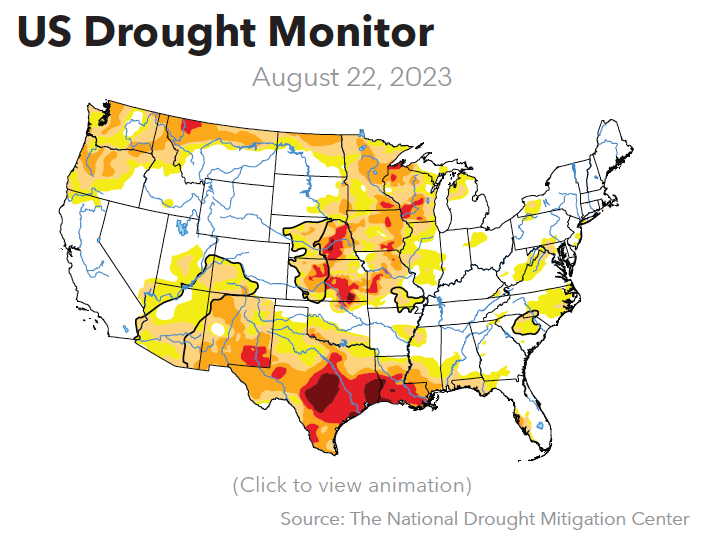
US Drought Monitor

The week began with warm, summer-like temperatures for much of the Eastern Cornbelt, with highs reaching the low- to mid-80s. A strong cold front was in the forecast for Oct. 5-7, however, dropping temperatures as much as 30 degrees and ushering in widespread rain in all three states.

The harvest of corn and soybeans was 19-23% complete in Illinois by Oct. 1, compared with 13-17% in Indiana, 4-7% in Ohio, and 5-7% in Michigan. Good or excellent ratings were assigned to 70-74% of the acreage in Ohio, 66% in Illinois, 64-65% in Indiana, and 49-51% in Michigan.

Western Cornbelt:

Highs across Iowa and Nebraska dropped from the 80s to the upper-60s and low-70s as the week progressed, with the potential for patchy frost in western Iowa on Oct. 6. Gusty winds and chilly temperatures were also in the forecast for parts of Missouri by the weekend.

The corn harvest as of Oct. 1 had progressed to 42% complete in Missouri, 22% in Nebraska, and 16% in Iowa, with good or excellent ratings assigned to 35% of the acreage in Missouri and 51-53% in Nebraska and Iowa. The soybean harvest was 12% complete in Missouri and 24-29% in Nebraska and Iowa by that date, with 47-47% of the crop rated as good or excellent.

Corn Wheat Soybean Index

Growers also had 10% of Missouri’s cotton and 14% of Nebraska’s sorghum in the bin by Oct. 1, with 65-68% of the acreage rated as good or excellent.

Northern Plains:

After highs in the 80s across the Dakotas and southern Minnesota during the first days of October, much colder weather moved in as the week progressed, prompting the first freeze watch of the season on Oct. 5-6 for western and central North Dakota. Lows were expected to drop to the mid-30s in Bismarck, N.D., on Oct. 6, well below the high of 88 posted on Oct. 1.

The corn harvest as of Oct. 1 was tracking ahead of the average pace at 18% complete in Minnesota, 16% in South Dakota, and 8% in North Dakota, with good or excellent ratings assigned to 75% of the acreage in the Dakotas and just 39% in Minnesota. The soybean harvest was 20-33% complete by that date, with 43-48% of the regional crop rated as good or excellent.

The sugar beet harvest was 16-17% complete in the Dakotas by Oct. 1, and South Dakota growers also had 11% of the sorghum crop in the bin by that date, with 51% of the acreage rated as good or excellent.

Northeast:

Summer weather conditions continued over much of the Northeast during the first week of October, with highs reaching the mid-80s in New England and Pennsylvania.

A Great Lakes cold front was expected to bring cooler temperatures and showers by the end of the week, however, and rainfall from Tropical Storm Philippe was likely to reach or exceed 3 inches in parts of the region on Oct. 7. Forecasts warned of localized flooding possible in northern and western New England, with highs dropping to the 50s by Oct. 8.

The harvest pace was picking up in the region in early October, with 7% of Pennsylvania’s corn crop in the bin by the first of the month. Plenty of heat and rain this summer contributed to excellent crop conditions, with fully 81% of Pennsylvania’s corn crop rated as good or excellent.

Eastern Canada:

Unseasonably warm weather was reported in Ontario and Quebec during the week, with multiple daily record highs recorded. Toronto posted a high of 28 C and a humidex in the low-30s on Oct. 3, but steadily cooler weather was on tap for the balance of the week.

In fact, a polar vortex was taking aim at Ontario and Quebec over the Thanksgiving weekend, with temperatures falling 8-10 C below seasonal levels. Forecasts warned of the potential for wet snow in parts of northern Ontario over the holiday weekend, while highs in Montreal were expected to top out at 11-13 C on Oct. 8-9.

The Maritimes were bracing for heavy rain and strong winds over the coming weekend as Tropical Storm Philippe makes its way toward Canadian waters. Special weather statements were issued for New Brunswick, Nova Scotia, and Prince Edward Island warning of 50 mm or more of rain, along with 80 km/h winds.

“Fall harvest is just underway and, depending on location, beans are anywhere from 10-50% harvested,” reported one contact. “Yields are looking good, with some areas above average in the 60-75 bushels range. On corn, only a few fields are off in the south as some growers had early contracts that needed to be filled. Most of the corn crop is still in the 32-26% moisture range.”

Transportation

US Gulf:

Transit remained unavailable through Harvey Lock due to reverse head conditions, a result of low water levels on the Lower Mississippi River. Guidewall repairs at Bayou Sorrel Lock shut the site from 7:00 a.m. to 4:00 p.m. daily, triggering delays up to 21 hours. The project is scheduled to run through March 2024.

Repairs at Brazos Lock closed the lock to navigation between 7:00 a.m. and 7:00 p.m. daily through an estimated Nov. 29. Intermittent delays were reported in a wide 5-23 hour range. Dredging at Bayou Chene, scheduled through Nov. 30, prompted slow-travel warnings in the area.

Emergency end gate work at Algiers Lock, needed to repair damage from a vessel collision in July, kicked off on Oct. 2, closing the lock to navigation through an estimated Dec. 1. Alternate routes are expected to add 24 hours or more to travel times.

Corps data showed delays up to 24.5 hours at Port Allen Lock on Oct. 5. Industrial Lock passages required up to 11 hours, while intermittent 6-13 hour waits were recorded at Colorado Lock.

Mississippi River:   

Low water levels prompted a 30-35% reduction in loading drafts through the St. Louis area, while tows moving between St. Louis and Cairo, Ill., saw 5-10% reductions in loading weight. Towing widths were reduced to a maximum of four barges between St. Louis and Cairo.

Loading drafts on northbound tows running between NOLA and Cairo were slashed by 25-30%, depending on horsepower, while barge loadings were reduced by 20-25% on southbound travel. Sources noted nine-foot depth readings in some locations, contributing to the tight restrictions. In addition, barge counts were reduced by 15-40% per string on the lower river, depending on location and horsepower, resulting in 48-72 hour delays.

The Vicksburg, Miss., river gauge was posted nearly four feet below the area’s low-stage threshold on Oct. 5, at 0.55 feet and holding steady. The Memphis, Tenn., gauge returned a low-stage (-)9.28-foot reading, while the St. Louis gauge was reported at (-)1.1 feet and falling at midweek.

A grounded vessel forced a halt to navigation at the lower river’s Mile 584 on Oct. 4, sources said. Dredging was underway at Miles 742, 621, and 541, prompting intermittent 24-hour shutdowns. Sources reported channel work at Mile 7 of the upper river, while a barge working on the Illinois River during the week was expected to move to Miles 221-225 of the upper Mississippi soon.

Upper-river locks are scheduled to shut for the winter navigation season between Dec. 5 and March 11, 2024. Final loadings from NOLA were expected to depart in the first week of October for tows traveling to Clinton, Iowa, or above, while loads destined for locations south of Clinton were projected to load through the third week of October. Locks 18-27 are likely to remain open throughout the winter, sources said.

Illinois River:

Loading drafts were reduced by 5-10% on the Illinois Waterway due to low river levels, and sources noted dredging underway at Miles 74-75. Wickets were raised at Peoria Lock and LaGrange Lock, forcing delays up to five hours.

A 120-day repair project comprising Brandon Road Lock, Dresden Island Lock, and Marseilles Lock has concluded, sources said. All of the affected locks had been reopened during the week, although sources reported widespread congestion and lengthy delays on Oct. 5, including waits up to 32 hours at Marseilles and 59 hours at Starved Rock.

Ohio River:

Ohio River loading drafts continued to see reductions in the 10-15% range. Monongahela River drafts were restricted to 8.5 feet, sources said.

Dredging at Miles 967-975 was set to continue through Oct. 10, more than two weeks beyond the previous Sept. 24 scheduled end. Boats traveling downriver were permitted to transit the area during daytime hours, while northbound tows passed overnight.

The John T. Myers Lock main chamber is closed through Nov. 17 for repairs and maintenance, prompting boats to detour through the secondary chamber. Delays were posted up to 44 hours for the week.

The Montgomery Lock auxiliary chamber is shut through Oct. 17. Following the current closure, the main chamber is scheduled to go offline on Oct. 17-Nov. 22 and Nov. 26-Dec. 22, while the auxiliary chamber will see an additional shutdown on Nov. 22-26.

The land chamber at Smithland Lock is shut through Oct. 21 for repairs and maintenance. The river chamber is due to close Oct. 22 through Nov. 20. Boats traveling southbound through Smithland were required to lock with an assist boat because of unpredictable outflows.

On the Tennessee River, Kentucky Lock delays were posted up to 12 hours, while boats transiting Wilson Lock waited up to 26 hours to pass.