All posts by hlancey@bloomberg.net

Crops/Weather

Eastern Cornbelt:

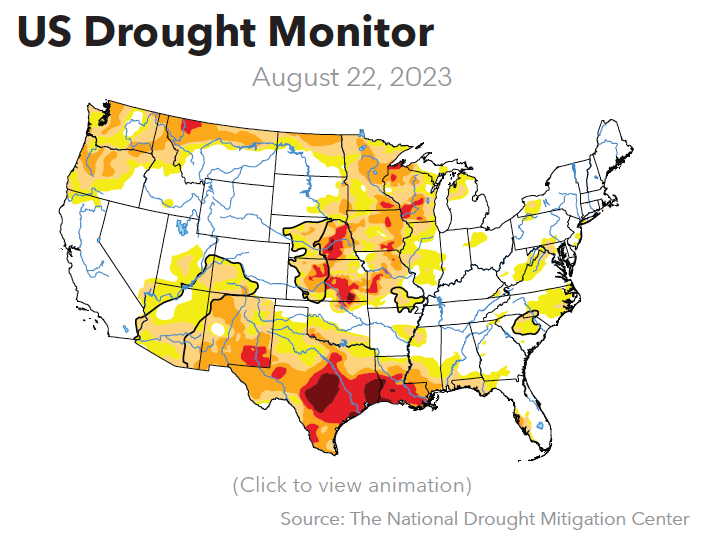
US Drought Monitor

High heat and humidity continued for much of the Eastern Cornbelt over the Labor Day weekend, with temperatures reaching the low-to-mid 90s and heat indices climbing to the upper-90s. Spotty thunderstorms moved through parts of Indiana and Ohio as the week progressed, however, with cooler weather on tap for the balance of the week.

The Illinois corn crop was 15% mature as of Sept. 3, compared with 2-4% in Indiana, Ohio, and Michigan. Good or excellent ratings were assigned to 76-80% of Ohio’s corn and soybeans on that date, compared with 66% in Indiana, 57-58% in Illinois, and 46-52% in Michigan.

Western Cornbelt:

Temperatures in the 70s and 80s were reported across Iowa during the week, along with smoky conditions from ongoing wildfires in Canada. Similar conditions were reported in Nebraska, although parts of the state were bracing for potentially strong thunderstorms late on Sept. 7.

Missouri Gov. Mike Parson on Sept. 6 requested a federal disaster declaration for 33 Missouri counties impacted by severe weather from July 29 through Aug. 14, including torrential rain and an EF-2 tornado on Aug. 4 in northeastern Missouri. Preliminary assessments by state and federal agencies estimate more than $14 million in damages and emergency response costs.

With 17-32% of the regional corn crop mature by Sept. 3, USDA assigned good or excellent ratings to 51% of the acreage in Nebraska, 49% in Iowa, and 32% in Missouri. Roughly 45-49% of the regional soybean crop also fell in the good or excellent categories, along with 75% of Missouri’s rice, 52% of Nebraska’s sorghum, and 67% of Missouri’s cotton crop.

California:

Corn Wheat Soybean Index

California’s remarkable drought recovery was aided by heavy rain from Hurricane Hilary in August. As of Sept. 7, virtually the entire state was drought-free for the first time in three years, with only a small slice of abnormally dry conditions reported on the northern edge of the state.

Crops have also benefited from the precipitation. Fully 95% of California’s cotton was rated as good or excellent on Sept. 3, compared with 75% in Arizona. California’s rice crop was 85% good or excellent on that date.

Pacific Northwest:

Warm, sunny weather was reported throughout the Pacific Northwest during the first week of September, with temperatures climbing to the upper-70s and low-80s. A weather system brought rain to parts of Montana and Idaho on Sept. 4, with scattered thunderstorms reported across western Montana for the balance of the week.

Drought conditions ranging from moderate to extreme were reported across northern and western Oregon, most of Washington, the Idaho panhandle, and the northern half of Montana in early September.

The region was gearing up for the potato harvest this month, while progress on small grains continued. Idaho growers had 63-71% of the spring wheat and barley in the bin by Sept. 3, compared with 82-83% in Washington and 85-86% in Montana.

Western Canada:

Thunderstorms moved through parts of southern Manitoba early in the week, but dry, smoky weather continued for most of Western Canada in early September. The dry conditions benefited harvest activities but did little to aid firefighting efforts.

All of Saskatchewan was under air quality advisories during the week, while the Alberta cities of Calgary, Edmonton, Peace River, Grande Prairie, and Cold Lake all posted records on Sept. 5 for the number of “smoke hours” recorded during the summer.

More than 430 wildfires continue to burn in British Columbia, with more than 2,070 fires reported this season that have charred in excess of 22,200 square kilometers.

Cinis, K+S Ink Long-Term Agreement

Swedish green tech company Cinis Fertilizer on Sept. 8 signed a long-term agreement with Germany’s K+S Minerals and Agriculture GmbH (K+S) regarding the purchase and delivery of potassium chloride to Cinis Fertilizer’s first two potassium sulfate (SOP) production facilities in Örnsköldsvik and in Skellefteå, Sweden.

“We are pleased that K+S chooses to confirm already now the previous declaration of intent (GM July 1, 2022) regarding cooperation regarding our important input product, potassium chloride,” said Jakob Liedberg, Cinis Founder and CEO. “The agreement safeguards our production plan. Furthermore, K+S confirms their interest to take the potassium sulfate fertilizer produced by Cinis Fertilizer from further plants.”

The first plant, outside the city of Örnsköldsvik, will produce around 100,000 mt/y of potassium sulfate starting in early 2024. The second plant will produce around 200,000 mt/y and will be built in the direct vicinity of the cooperation partner Northvolt in the city of Skellefteå and is scheduled to commence production in mid-2025.

Cinis is planning the synthetic production of SOP using the Glaserite process at several production sites in Scandinavia. In addition to potassium chloride supplied by K+S, the company will use residues from battery, pulp, and paper production as raw material and renewable energy. Salt is also generated as a byproduct in the SOP production.

Transportation

US Gulf:

Mandatory two-hour wait times remained in force between lockages at Leland Bowman Lock due to low water levels, sources said, resulting in 24-48 hour delays. Corps data showed 32 tows waiting to pass the site on Sept. 7.

Transit was unavailable at Harvey Lock due to reverse head conditions. Repairs to the BNSF railroad bridge at Morgan City, La., previously scheduled to start on July 17, were pushed back to Sept. 11-25. The bridge will close to navigation from 7:00 a.m. to 7:00 p.m. daily, resulting in 12-18 hour delays.

Algiers Lock is slated to shut for 45-60 days for repairs, beginning on Oct. 1. Algiers saw intermittent 4-7 hours waits during the week. Guidewall repairs at Bayou Sorrel Lock slowed travel from 7:00 a.m. to 4:00 p.m. daily, with minimal waiting reported for the week. The effort is on the books through March 2024.

Dredging underway through Nov. 30 at Bayou Chene prompted slow-travel warnings in the area. Brazos Lock repairs were underway daily between 7:00 a.m. and 7:00 p.m., triggering waits up to 12 hours.

Drought-related delays in the Panama Canal, which have slowed deliveries to the US Gulf in recent weeks could linger for up to 10 months, according to the American Journal of Transportation, citing an interview with shipping industry research analyst Chara Georgousi. Transit delays have been noted stretching to two weeks or more since August.

Mississippi River:   

Loading drafts were reduced by 15% in the St. Louis area due to low water levels. Mid-river drafts were also lowered by 15% from typical levels.

Tows traveling upriver between the US Gulf and Cairo, Ill., saw drafts slashed by 20%, while downriver movements were cut by 15-20%, depending on vessel horsepower. In addition, lower-river tows saw barge counts reduced by 10-15%, resulting in delivery delays of 24-48 hours.

The river gauge at St. Louis was noted at (-)2.95 feet on Sept. 7, while Memphis, Tenn., levels tracked at a low-stage (-)6.98 feet. The gauge at Vicksburg, Miss., was reported at 7.52 feet and falling on Sept. 7, and was projected to recede below the area’s 5.0-foot low stage early on Sept. 15. A heat advisory was in place at Baton Rouge, La., at midweek.

Dredging reported at the lower river’s Mile 538 was expected to wrap up on Sept. 8, sources said, while sources expected rolling 24-hour shutdowns at Mile 621 due to channel work. Sources reported a dredge operating at Mile 125 of the upper river. Old River Lock repairs and maintenance were scheduled through Sept. 15, prompting delays in the 4-6 hour range.

Upper-river locks are scheduled to close for the winter navigation season between Dec. 5 and March 11, 2024. Final loadings from NOLA were expected in the first week of October for barges traveling north of Clinton, Iowa, while tons destined for points south of Clinton were anticipated to load through the third week of October. Locks 18-27 are currently set to remain open for the duration of the winter season.

Illinois River:

Illinois River loading drafts were reduced by 15% due to low water levels, sources said. Wickets were raised at Peoria Lock and LaGrange Lock, necessitating lockages through both locations. Waits ran up to five hours at Peoria during the week.

Repairs and maintenance are scheduled through Sept. 30 at Brandon Road Lock, Dresden Island Lock, and Marseilles Lock, effectively closing the river to commercial navigation.

Ohio River:

Maximum Ohio River loading drafts held steady at 10.0-10.5 feet due to low water levels. Drafts on the Monongahela River, reported at critical low stage, continued at a maximum 8.5 feet, sources said.

The secondary chamber at John T. Myers Lock is scheduled to return from miter gate repairs on Sept. 10, after which the site’s main chamber will shut from Sept. 11 through Nov. 17, prompting detours through the secondary chamber. Delays ran in a wide 16-51 hour range through the week, according to Corps data. Olmsted Lock repairs were scheduled through Sept. 24, triggering waits up to 10.5 hours.

The Montgomery Lock auxiliary chamber was reportedly shut on Sept. 2-5, followed by a main chamber outage on Sept. 5-25. After the current closure, the main chamber is due to shut again on Oct. 17-Nov. 22 and Nov. 26-Dec. 22, while auxiliary chamber travel will be unavailable on Sept. 25-Oct. 17 and Nov. 22-26.

The land chamber at Smithland Lock is scheduled to close from Sept. 22 through Oct. 21 for repairs, after which the river chamber will be offline from Oct. 22 through Nov. 20. Assist boat usage was mandatory on southbound trips through the lock due to strong outflows, sources said.

Arkansas River:

Travel through the Port of Catoosa remained limited to daytime hours during the week. Joe Hardin Lock is scheduled to shut for repairs on Sept. 11-15. Travel through Webbers Falls Lock will be unavailable on Sept. 11-17.

Hurricane Idalia Has Minimal Impact on Fertilizer Operations

Nutrien Ltd., which has phosphate and nitrogen production facilities and retail outlets in the Southeast, reported no injuries or serious damage from Hurricane Idalia. The storm entered Florida on Aug. 30 as a Category 3 hurricane and by Thursday afternoon, Aug. 31, was exiting North Carolina as a tropical storm on its way to Bermuda.

“Hurricane Idalia impacted Nutrien’s White Springs, Fla., phosphate facility
shortly after making landfall on the morning of Aug. 30,” a Nutrien spokesman told Green Markets. “We are grateful that there were no injuries or serious damage to the facility.”

The White Springs facility maintained operations until Aug. 29, consistent with storm preparedness planning. “Efforts are underway to recommence mining operations, and while sulfuric acid operations are down subject to an as yet undetermined restoration of power by Duke Energy, once power is restored operations will start up again,” Nutrien said.

Nutrien said its Aurora, N.C., phosphate facility and Augusta, Ga., nitrogen facility were both operating. “Fortunately, we have had no injuries or serious damage to facilities at our retail operations in Florida or Georgia,” the company spokesman added. “We will continue to monitor conditions in close cooperation with state and local authorities while taking all actions necessary to maintain the safety of our people and integrity of operations.”

Florida was starting to dig out from the aftermath of Idalia, which weakened as it brought what some industry observers described as much-needed heavy rainfall to Georgia and the Carolinas. The hurricane caused billions of dollars in damage, left hundreds of flights grounded, and thousands without power.

Tampa International Airport was back in operation on Thursday morning. More than 1,000 flights were canceled into and out of the US on Wednesday, with many cancellations at Tampa and Atlanta airports, according to FlightAware, as reported by Bloomberg.

Reports of damaged buildings and flooding have poured in from Florida’s coastal counties, as well as at least one case of looting in Steinhatchee, about 16 miles southeast of where Idalia came ashore with 125 mph winds.

Some of the hardest-hit areas in the state had widespread power outages, with some businesses catching fire and others losing their roofs, said Kevin Guthrie, Executive Director of the Florida Division of Emergency Management. 

CSX suspended service on tracks across the region to assess any possible damage from the storm, including the I-95 route through Georgia and South Carolina; the Waycross, Ga.-to-Thomasville, Ga./Dothan, Ala. Bow line; and the CSX Manchester/Fitzgerald subdivision from Jacksonville through Mid-Georgia, according to Dow Jones.

Idalia was the second major hurricane to hit western Florida in a year. Last September, Hurricane Ian struck further south, killing at least 150 people and causing more than $112 billion in damage. At press time, Idalia’s Florida death count had been put at two. Wednesday’s storm came ashore in a sparsely populated area of the state’s Big Bend region and will likely cause $10-$20 billion in damage in Florida and across the US South.

“There were approximately 1 million people within 30 miles of landfall for Ian, while there are about 38,000 people within that distance for Idalia,” AccuWeather Inc. said. 

Hurricane Ian caused The Mosaic Co. to lose some 200,000 mt of phosphate production and forced it to take a week or two to make repairs (GM Oct. 7, Nov. 11, 2022).

Mosaic’s O’Rourke to Retire, Bodine to Step Up

The Mosaic Co. on Aug. 29 announced that James “Joc” O’Rourke intends to retire and that Mosaic’s Board of Directors has unanimously elected Bruce Bodine, 52, currently Senior Vice President – North America, to succeed him as the company’s CEO on Jan. 1, 2024.

O’Rourke relinquished the title of President effective immediately and will resign as CEO and a member of the Mosaic Board of Directors effective Dec. 31, 2023, after which he will serve as a Senior Advisor until mid-2024. Bodine has been elected President of the company and a member of the Mosaic Board of Directors effective immediately.

O’Rourke has helmed Mosaic since August 2015, when he succeeded James Prokopanko as President and CEO (GM May 18, 2015). He joined Mosaic as Executive Vice President – Operations in 2009 and added the role of COO to his title in 2012.

“Joc’s leadership over the past eight years strengthened Mosaic,” said Greg Ebel, Chairman of Mosaic’s Board of Directors. “The company today is larger, more geographically diverse, more resilient, and in excellent financial condition. My fellow directors join me in wishing him all the best as he transitions to a well-deserved retirement. The board has full confidence in Bruce and the other members of Mosaic’s talented Senior Leadership Team. Together they will build on Joc’s legacy of success on behalf of all Mosaic stakeholders.”

“I am proud of Mosaic’s accomplishments over the past decade, and I know Bruce will lead the company to still greater success,” said O’Rourke. “It has been a tremendous privilege to serve as President and CEO alongside Mosaic’s thousands of exceptionally talented people around the world.”

Bodine has worked for Mosaic and its predecessor company for many years and held several executive roles, including Senior Vice President – Potash, Senior Vice President – Phosphates, and Vice President – Supply.

Also on Aug. 29, Mosaic’s Board expanded its size from 11 to 12 seats and elected Bodine to fill the newly created vacancy and serve as a director for a term expiring at the 2024 annual meeting of stockholders.

Bodine also serves as a director of MVM Resources International BV, the general partner of Compania Minera Miski Mayo SRL, the joint venture that operates the Miski Mayo phosphate mine in Peru in which Mosaic holds a 75% interest.

EPA, Corps Issue Revised WOTUS Definition; Ag Groups Remain Highly Critical

The US EPA and Department of the Army on Aug. 29 announced a final rule amending the definition of “Waters of the United States” under the Clean Water Act (CWA). The revised rule comes three months after the US Supreme Court limited the agencies’ regulatory authority in its May 25 decision in Sackett v. EPA (GM May 26, p. 1).

The revised rule eliminates the “significant nexus” test that was part of the Biden Administration’s latest WOTUS definition, and also states that wetlands protected under the CWA must have a continuous surface connection to navigable waterways as required by the US Supreme Court’s ruling in Sackett.

The new rule implements the court’s opinion that the CWA protects only waters and wetlands that are relatively permanent and have a continuous surface connection to navigable waterways, leaving wetlands that aren’t directly connected to large rivers, streams, and coastlines either unregulated or regulated only by states.

“While I am disappointed by the Supreme Court’s decision in the Sackett case, EPA and Army have an obligation to apply this decision alongside our state co-regulators, Tribes, and partners,” said EPA Administrator Michael S. Regan. “We’ve moved quickly to finalize amendments to the definition of ‘Waters of the United States’ to provide a clear path forward that adheres to the Supreme Court’s ruling.”

EPA and the Corps said the changes are “limited” and apply only to those parts of the Biden Administration’s WOTUS definition that the Supreme Court ruled as invalid. The agencies said the Supreme Court decision “created uncertainty” for CWA implementation, and the revised rule will take effect immediately “to provide clarity and a path forward consistent with the ruling.”

EPA finalized the rule without issuing a draft for public comment, prompting criticism from several trade groups. The agency did so using the rarely-used “good cause” exception to notice-and-comment under the Administrative Procedure Act, which allows federal agencies to forgo public comment when officials think that a rule update is sufficiently urgent.

“The Fertilizer Institute (TFI) is disappointed in the continued lack of clarity in EPA’s newly released WOTUS rule, including the agency’s disregard both for the procedural need to invite public input for consideration and for May’s Supreme Court ruling determining which bodies of water fall under federal jurisdiction,” said TFI President and CEO Corey Rosenbusch in an Aug. 29 statement.

“It is unclear how a half-baked rule will provide any amount of durability or certainty to the regulated community,” Rosenbusch continued. “A recent survey of TFI members found that the number one concern for companies in the fertilizer industry surrounds regulatory certainty. By shortcutting the regulatory process, EPA fails to satisfy its stated intent. We want clear rules that facilitate long-term planning and the capital investments that allow us to continue providing the critical nutrients that feed the crops that feed our communities.”

“US corn growers are disappointed by EPA’s revised WOTUS rule,” said National Corn Growers Association President Tom Haag. “The agency failed to open the process to public comment and engagement, which would have been extremely valuable. Instead, the agency has released a rule that does not fully respect the holdings from the recent US Supreme Court case on WOTUS.”

“EPA had a golden opportunity to write a WOTUS rule that’s fair to farmers and stands the test of time, but instead chose to continue government overreach and revise only a small slice of the rule that was rejected by the Supreme Court,” said Zippy Duvall, President of the American Farm Bureau Federation.

“We’re pleased the vague and confusing ‘significant nexus’ test has been eliminated as the Supreme Court dictated,” Duvall added. “But EPA has ignored other clear concerns raised by the Justices, 26 states, and farmers across the country about the rule’s failure to respect private property rights and the Clean Water Act.”

“The ruling in Sackett v. EPA was a chance for EPA and the Army Corps to correct a deeply flawed, prematurely released rule and work to truly improve water quality outcomes,” said Ted McKinney, CEO of the National Association of State Departments of Agriculture. “It is baffling that the revised rule does not accurately address all the issues and questions raised by the Supreme Court in the Sackett decision, nor does it address many of the questions stakeholder groups raised about the WOTUS rule EPA released at the end of last year.”

The EPA and Corps will host a public webinar on Sept. 12 to provide information on the updated rule, but the link provided on EPA’s webpage indicates registration for the webinar is already closed. The agencies also plan to host listening sessions this fall with co-regulators and stakeholders to address any issues that may arise from the new rule.

Ceres Solutions, Co-Alliance Enter Due Diligence

Indiana-based cooperatives Ceres Solutions Cooperative, Crawsfordsville, and Co-Alliance Cooperative Inc., Indianapolis, on Aug. 25 announced that they are pursuing a three-month comprehensive due diligence process. Once complete, they will consider various strategic options.

The two are not strangers as the move comes after years of analyzing opportunities together and the successful performance of their joint venture, Endeavor Ag & Energy, which was formed three years ago (GM Sept. 25, 2020) and serves central Michigan in the areas of agronomy, propane, and feed.

“We believe that this collaborative effort will lead to mutual benefits for both cooperatives and their members,” said Rick Brubaker, Chairman of Ceres Solutions’s Board of Directors. “We are excited about the potential for growth and innovation that can emerge from this process.”

“This represents a significant step towards a more prosperous future for our members,” said Tim Burke, Chairman of Co-Alliance’s Board of Directors. “By assessing our capabilities and identifying synergies, we are poised to unlock new opportunities and enhance the services and support each cooperative currently provides to our respective members.”

Formed in 2007 as a partnership of local farmer-owned cooperatives, Ceres has 650 team members in 35 counties across Indiana and Michigan. It has 65 locations with approximately 41 providing agronomy and/or fertilizer. Ceres added T&T Fertilizer Inc., Goshen, Ind., in 2020 (GM Feb. 7, 2020). It also completed mergers with North Central Co-op, Wabash, Ind., in 2017 (GM Aug. 18, 2017), and Falmouth Co-op in northern Michigan.

Co-Alliance is the result of the merger of five cooperatives in 2002, but its roots date back to the 1920s. Co-Alliance said it is now one of the largest, most successful agribusiness and energy marketing and supply cooperatives in the Midwest. It has some 79 locations in Indiana, Michigan and Ohio, with approximately 51 of those dealing with agronomy.

Russia Weighs Unified Fertilizer Trader to Boost Pricing Power

Russia is considering setting up a unified trading company to export fertilizers in a bid to increase its pricing influence on global markets, according to Bloomberg, citing people familiar with the situation.

The idea was proposed in July by Uralchem PJSC’s founder Dmitry Mazepin and has since been discussed by Industry Minister Denis Manturov and Prime Minister Mikhail Mishustin. No final decision has been taken. It is not clear when the matter will be discussed again.

Spokespeople for the government didn’t respond to requests for comment. Uralchem’s press service said it’s unaware of the proposal.

While fertilizer companies haven’t been included in international sanctions over Russia’s war in Ukraine due to their importance for global food security, Baltic ports have stopped handling most products, contributing to a decline in shipments. An exodus of global shipping companies, some international banks, and insurers from Russia has also made it harder to send goods abroad.

Some large fertilizer makers don’t support the idea out of concern it will hurt business, two of the people said. Exports of most types of fertilizers have already recovered to their pre-war levels, so producers don’t see how the proposal will benefit them, the people said.

A unified trading company could give the government more control over export revenues and allow it to exert much greater influence over global pricing. Russia has been demanding smoother export conditions for its fertilizer producers in talks to restore a grain export deal allowing Ukraine to ship through the Black Sea. Moscow abandoned the deal last month (GM July 21, p. 1).

Companies currently trade their goods through Switzerland and other third countries. Russia previously had a potash trading alliance with Belarus that allowed it to control 40% of the nutrient’s global sales and prices via output caps. Potash prices slumped when the deal collapsed in 2013 (GM Aug. 5, 2013).

Lower Prices, Sales Volumes Impact PhosAgro

Russian fertilizer group PJSC PhosAgro on Aug. 29 reported a 49% decline in adjusted net income for the first six months, to RUB55.77 billion (approximately $581 million at current exchange rates) from last year’s RUB108.55 billion, missing analysts’ average estimate of RUB56.8 billion (Interfax Consensus).

Adjusted EBITDA declined 50% year-over-year, to RUB82.82 billion from last year’s RUB165.32 billion, also missing the analysts’ estimate of RUB84.8 billion. Revenue fell 37%, to RUB212.75 billion from RUB336.51 billion, with PhosAgro citing the drop in global fertilizer prices from their peak in early 2022.

Six-month production of mineral fertilizers and other chemicals increased 4% year-over-year, to 5.68 million mt from 5.45 million mt. PhosAgro said the production of MAP, DAP, and liquid complex fertilizers increased by 19%, to 2.4 million mt, driven primarily by an increase in production during the ramp-up to design capacity at its Volkhov production complex in southern Russia.

The group said Volkhov will reach its design capacity of 1 million mt this year. Volkhov also mastered the production of water-soluble MAP during the first half of the year and launched a project to increase the processing of phosphate rock. PhosAgro said it has invested a total of RUB34 billion in its Volkhov production site, where the first phase of production began in March 2021 (GM March 12, 2021).

PhosAgro’s total fertilizer sales in the first half of 2023 decreased by 4% year-over-year, to 5.52 million mt, mainly due to the stockpiling of mineral fertilizers for seasonal deliveries to markets in Latin America and Asia after meeting the needs of the Russian market. At the same time, its DAP/MAP sales rose 6% over the same period, driving high margins in the current price environment.

PhosAgro noted that sales volumes and regional product distribution in the second quarter of the year were in line with seasonal changes in demand, with increased sales of nitrogen-based fertilizer to markets in Russia, North America, and Europe. Overall, it said it increased fertilizer sales to North America, Latin America, and the CIS countries in first half of the year.

Looking ahead, PhosAgro noted that the third quarter has historically been marked by increased seasonal demand from key markets for nitrogen and phosphate-based fertilizers in India, Brazil, and other regional locations in Asia and Latin America. 

It believes the low levels of carryover stocks in North American and European markets will drive an earlier resumption of seasonal demand. As a result, prices have shown a strong increase since the start of the third quarter and may stabilize above second-quarter 2023 prices, the group said.

PhosAgro has earmarked what it says is a record RUB67 billion (approximately $698 million at current exchange rates) for its investment program this year and plans to invest more than RUB250 billion in the next five years.

Among its key projects, the group continues to develop its ore and raw material base, with the second start-up complex for the 10th horizon at the Kirovsky mine scheduled to come online in the fourth quarter.

In Cherepovets, a project has been launched to increase the processing of phosphate rock in addition to modernizing the ammonia, phosphoric acid, and sulfuric acid production facilities. And in Balakovo, projects will be completed in the fourth quarter to increase the production of feed phosphates and sulfuric acid as part of the third development stage at the complex.

PhosAgro’s Board of directors has recommended a dividend of RUB126 per share for the first half of 2023. The proposed dividend will be put to the vote at an EGM of shareholders on Sept. 30. The group said the payout could be RUB16.3 billion, “almost level with free cash flow of RUB16.7 billion for the second quarter.”

PhosAgro Production and Sales Volumes

‘000 mt 1H-2023 1H-2022 % change
Production      
Phosphate-based fertilizers and feed phosphates 4,226.9 4,054.0 +4
Nitrogen-based fertilizers 1,318.9 1,265.6 +4
Other products 138.8 130.7 +6
Total fertilizers 5,684.6 5,450.3 +4
Sales volumes      
Phosphate-based fertilizers and feed phosphates 4,117.9 4,335.3 (5)
Nitrogen-based fertilizers 1,316.2 1,346.4 (2)
Other products 82.9 82.0 +1
Total fertilizers 5.517.0 5,763.7 (4)

Acron Group Posts 55% Drop in 1H EBITDA

Moscow-based Acron Group posted a 55% drop in EBITDA for the first half of 2023, to RUB36.8 billion ($478 million) from the prior year RUB81.4 billion ($1.07 billion), the Russian fertilizer group reported on Aug. 28.

Six-month net profit dropped 74%, to RUB19.0 billion ($248 million) from RUB74.3 billion ($974 million) the previous year. Revenue was 40% lower year-on-year, to RUB87.96 billion ($1.14 billion) from last year’s RUB147.5 billion ($1.9 billion).

Acron reported a 7% increase in its fertilizer output in the six months ending June 30, 2023, to 3.67 million mt, up from 3.43 million mt in the same prior-year period (GM July 21, p. 28).

The group’s total commercial output, which includes apatite concentrate for sale to third parties and industrial products, increased 6% in the first six months, to 4.3 million mt from the year-ago 4.05 million mt. Sales volumes increased 1% year-over-year, to 4.208 million mt.