All posts by hlancey@bloomberg.net

Ammonium Thiosulfate

Eastern Cornbelt:

The ammonium thiosulfate market was unchanged at $245-$270/st FOB in the Eastern Cornbelt, with the low reported at Terre Haute, Ind., and the high out of inland terminals in Ohio. The Cincinnati market was quoted at the $255/st FOB level.

Western Cornbelt:

Ammonium thiosulfate remained at $225-$260/st FOB in the Western Cornbelt, with the low at Waterloo, Iowa.

Northern Plains:

The last confirmed offers for ammonium thiosulfate remained at $360/st FOB in central North Dakota.

Great Lakes:

The ammonium thiosulfate market was steady at $285-$300/st FOB in the Great Lakes region.

Eastern Canada:

Ammonium thiosulfate was quoted at C$460-$585/mt FOB for the latest offers in Eastern Canada.

Crops/Weather

Eastern Cornbelt:

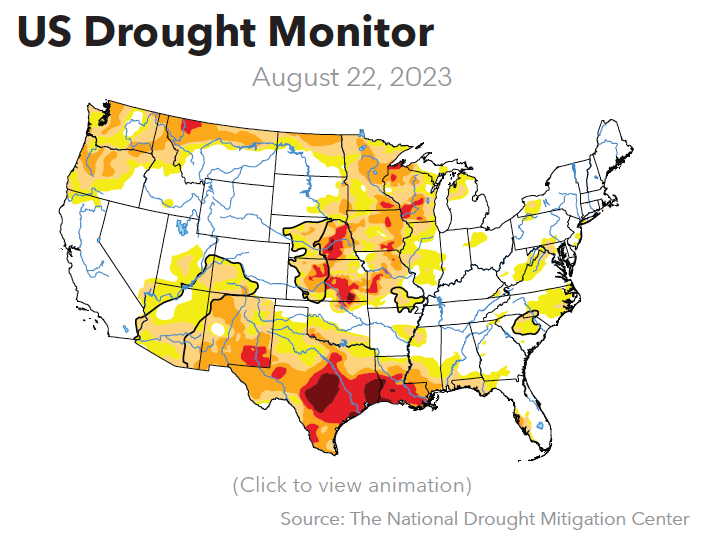
US Drought Monitor

Dangerous heat continued over much of the Eastern Cornbelt during the week, prompting heat advisories and school closures in some locations. Strong thunderstorms also pushed through parts of northern Ohio at midweek, carrying heavy rain and damaging winds.

Highs in the low to mid-90s were common across central Illinois, with humidex readings in the 105-115 range. Heat index values in northeastern Illinois climbed as high as 117 degrees on Aug. 24, with excessive heat warnings in effect until 8 p.m.

Similar conditions were reported in Indiana, with heat indices climbing on Aug. 24 to 110 degrees in Indianapolis and Bloomington, 111 in South Bend and Lafayette, 113 in Terre Haute, and 114 in Evansville.

The combination of adequate moisture and plentiful heat and humidity continued to benefit crops in the Eastern Cornbelt. Good or excellent ratings were assigned on Aug. 20 to 72-74% of Ohio’s corn and soybeans, compared with 66-68% in Indiana and 64-65% in Illinois.

Western Cornbelt:

Corn Wheat Soybean Index

Much of Iowa was under excessive heat warnings during the week. Several daily temperature records were set, including 100 in Des Moines on Aug. 23, 101 in Sioux City on Aug. 22, and 98 in Waterloo on Aug. 22.

Triple-digit highs were also reported in multiple Nebraska locations during the week, while much of Missouri saw temperatures reach the upper-90s during the week. High humidity pushed humidex readings to as high as 116 in Kansas City, 114 in Columbia, and 109 in Springfield on Aug. 22.

Patches of extreme-to-exceptional drought continued to be reported in eastern Nebraska and western Missouri during the week.

Good or excellent ratings were assigned to 35-44% of Missouri’s corn and soybeans on Aug. 20, compared with 58-61% in Nebraska and Iowa. Good or excellent ratings were also assigned to 74% of Nebraska’s sorghum crop, along with 70% of Missouri’s cotton and 75% of Missouri’s rice crop.

Northern Plains:

Heat advisories were issued for southern Minnesota and portions of South Dakota during the week, with temperatures soaring to the low-90s in Minnesota and the low-100s in South Dakota. Daily records were reportedly set in South Dakota on Aug. 21 at 101 in Pierre and 107 in Winner, with heat indices climbing to as high as 115 degrees on Aug. 23.

Drought conditions ranging from moderate to severe were reported across much of Minnesota and northern North Dakota. Just 45% of Minnesota’s corn was rated as good or excellent on Aug. 20, compared with 56-60% in the Dakotas. Soybeans in the good or excellent categories totaled 59% of the acreage in South Dakota, 53% in Minnesota, and 46% in North Dakota.

USDA reported that 39-46% of the barley was harvested in North Dakota and Minnesota by Aug. 20, while the spring wheat harvest had progressed to 75% complete in South Dakota, 41% in Minnesota, and 24% in North Dakota. Fully 87% of South Dakota’s oat crop was in the bin by Aug. 20, compared with 73% in Minnesota and 27% in North Dakota.

Great Lakes:

Heat advisories were in place across southern Michigan and southern Wisconsin as the week progressed, with forecasts warning of temperatures reaching the low-90s and heat indices climbing to 100-105 degrees.

The high heat and humidity sparked several strong thunderstorms across the region, with most of southeastern Michigan bracing for potentially severe storms carrying 60 mph winds and large hail late on Aug. 24.

Nearly all of Wisconsin was experiencing drought conditions in late August, with areas of severe-to-extreme drought reported in southern and western areas of the state. Drought conditions in Michigan were largely absent by the end of the month, though small areas of moderate drought persisted across northern parts of the state.

Good or excellent ratings were assigned on Aug. 20 to 54-55% of the corn crop in Michigan and Wisconsin, while soybeans in those two categories totaled 56-60% of the regional crop.

Northeast:

Parts of New England were bracing for another wet weekend as the remnants of post-Tropical Storm Hilary make their way into the region.

A Great Lakes system also brought scattered showers to Pennsylvania during the week, with high heat and humidity expected as the week progressed. The combination of heat and moisture benefited corn crops in the state, with fully 86% of Pennsylvania’s corn acreage rated as good or excellent on Aug. 20.

Eastern Canada:

Wet weather continued to take a toll on crop conditions across much of Eastern Canada. The latest system was expected to bring heavy rain to southern Ontario on Aug. 23-24, with nearly two inches predicted in some areas, along with the potential for large hail and damaging winds.

Portions of Quebec and the Maritimes were hit with heavy rain over the previous weekend, with nearly three inches reported in central Quebec and an inch or more in Halifax.

Transportation

US Gulf:

Travel through Harvey Lock remained unavailable during the week due to reverse head conditions. Planned repairs to the BNSF railroad bridge in Morgan City, La., are scheduled to begin in early September.

Side gate repairs at Algiers Lock are projected to close the site for 45-60 days, beginning in the second half of September. Wait times at Algiers were noted up to seven hours during the week.

Guidewall repairs at Bayou Sorrel Lock triggered daily shutdowns from 7:00 a.m. to 4:00 p.m., causing delays up to 11 hours. The lock was reported completely offline on Aug. 23. The project is scheduled to run into March 2024.

Dredging operations at Bayou Chene, expected to continue through Nov. 30, prompted slow travel warnings through the area. Brazos Lock started daily 7:00 a.m. to 7:00 p.m. repair shutdowns on Aug. 21. Intermittent delays were noted in the 8-19 hour range.

Sources reported travel delays through the Panama Canal due to low water levels, slowing deliveries to the US Gulf by up to two weeks. Larger vessels were said to face shorter delays.

Port Allen Lock saw 4-11 hour delays, while 12-hour wait times were noted at Industrial Lock. Colorado Lock delays were posted up to nine hours. Passages through Leland Bowman Lock ran in a wide 17-41 hour range, Corps data indicated.

Mississippi River:                             

A return to falling water levels on the Mississippi River led to tighter restrictions, sources said. Northbound barges destined for St. Louis or above were held to 10.5 feet of draft, while vessels traveling downriver from St. Louis were limited to 11.5-foot drafts.

Drafts were capped at 80% of normal capacity for both north- and southbound travel between the Gulf and Cairo, Ill., while sections of the lower river saw tow sizes reduced by 10-15% from typical levels. Delivery delays were predicted in the 24-48 hour range as a result.

The river gauge at St. Louis was noted at (-)0.02 feet and falling on Aug. 24, below last week’s 4.94 feet. Levels were expected to recede to (-)3.40 feet on Sept. 5. The gauge at Memphis, Tenn., was posted at 1.70 feet and dropping fast on Aug. 24, and was forecast to move below the region’s (-)5.00-foot low stage on Aug. 26 on the way to an expected (-)6.60-foot reading on Sept. 7. Memphis, Vicksburg, Miss., and Baton Rouge, La., were under an excessive heat warning at midweek.

Dredging shifted to the lower river’s Mile 540 during the week, sources said, where rolling 24-hour shutdowns could drive 24-36 hour delays. Dredging in progress at Mile 653 caused minimal waiting. Ongoing dredge work was reported at the upper river’s Mile 166.

Sources noted daytime travel outages at Old River Lock driving 4-6 hour delays. Navigation was completely unavailable through the site on Aug. 21-24.

Lock 25 is scheduled to shut between 6:00 a.m. and 6:00 p.m. on Aug. 25 and Aug. 31, with additional 12-hour shutdowns on the books in October, November, and December. Eight-hour travel closures were reported through the bridge at Ft. Madison, Iowa, on Aug. 19 and 20.

Illinois River:

Wickets were up at Peoria Lock and LaGrange Lock during the week due to low water conditions, prompting vessels to lock through both locations.

The Illinois River is effectively closed to commercial travel through an estimate Sept. 30 for repair and maintenance works at Brandon Road Lock, Dresden Island Lock, and Marseilles Lock.

Ohio River:

Sources noted Ohio River loading drafts reduced to 10.0-10.5 feet due to low water levels. Monongahela River drafts continued at 8.5 feet.

The secondary chamber at John T. Myers Lock is closed from Aug. 21 through Sept. 10 for miter gate repairs, prompting delays up to 12 hours. The site’s main chamber is scheduled to shut Sept. 11 through Nov. 17. Olmsted Lock repairs slated for Aug. 9 through Sept. 24 were noted driving minimal delays during the week.

Montgomery Lock will see alternating primary and secondary chamber shutdowns between Sept. 2 and Dec. 22. Primary chamber travel will be unavailable on Sept. 5-25, Oct. 17-Nov. 22, and Nov. 26-Dec. 22, while the secondary chamber will shut Sept. 2-5, Sept. 25-Oct. 17, and Nov. 22-26.

The Smithland Lock land chamber is due to close Sept. 22 through Oct. 21 for repairs. The site’s river chamber will be unavailable Oct. 22 through Nov. 20. Mandatory assist boat usage continued on southbound lockages through Smithland during the week.

Arkansas:

Sources reported daytime-only navigation restrictions in place through the Port of Catoosa. Webbers Falls Lock is scheduled to close on Sept. 11-17 for repairs, and travel will be unavailable at Joe Hardin Lock on Sept. 11-15 due to repairs and maintenance.

Manitoba Boosts Leases, Provides Loan for Province’s First-Ever Potash Producer

Potash and Agri Development Corp. of Manitoba (PADCOM) announced on Aug. 9 that the Government of Manitoba has awarded it Crown Mineral leases, which add more than 100 million mt of potash to the company’s lease and assets. The leases are in the North Block near PADCOM’s current mine near Russell-Bincarth, Man.

The province also announced a $1.03 million loan for a power line to the mine so it can eliminate reliance on diesel. The company said this would make it the lowest carbon emission fertilizer producer in the world. The electricity is generated by Manitoba Hydro.

PADCOM on June 9 officially commissioned the province’s first potash mine (GM June 16, p. 1). The mine will initially produce 50,000-100,000 mt/y using a selective solution mining process, which PADCOM expects will increase to up to 250,000 mt/y or more over an expected life of up to 100 years.

“PADCOM is pleased the Manitoba government has recognized and supported our efforts to develop Manitoba’s potash resource using a low-impact, green sustainable mining technique,” said Daymon Guillas, PADCOM President. “Access to explore more of the potash resource, in partnership with Gambler First Nation, will allow us to evolve from pilot stage to commercial production, including more investment in mining activity and logistics to get Manitoba potash to the world and this will benefit all Manitobans.”

The lease and loan align with Manitoba’s new Critical Minerals Strategy, as the mine both advances the growth of mineral development and is working to provide economic opportunities for First Nations. The strategy announced on July 25 lays out actions to guide the work of government, local communities, and the private sector, and maintains Manitoba’s momentum as a top destination for mineral exploration and production.

The strategy includes several pillars to strengthen resources that raise awareness of Manitoba’s significant critical minerals advantage, including advancing Indigenous partnerships; supporting geoscience research; streamlining regulatory processes; attracting value-added processing and manufacturing; and training a skilled workforce.

The strategy will be followed up with the Manitoba Minerals Action Plan, which will outline concrete and specific actions to achieve Manitoba’s mineral sector potential. It is expected to be released in spring 2024.

Manitoba claims it is home to 29 of the 31 minerals on Canada’s 2021 Critical Minerals List. This includes lithium, graphite, nickel, cobalt, copper, and rare earth elements, which are the six minerals recognized as having the greatest opportunity to spur economic growth and fuel domestic supply chains.

Manitoba said it has seen a substantial increase in mineral exploration over the last three years, with $67.7 million in expenditures in 2020, $99.2 million in 2021, and $170 million in 2022, the highest level of exploration expenditures in the history of the province.

The province ranked 14th for investment attractiveness in the Fraser Institute’s 2022 Survey of Mining Companies, a positive shift from 32nd in 2021, and 37th in 2020. Nearly 50 companies are currently exploring for critical minerals in Manitoba, and the Manitoba government is working to achieve a top 10 ranking in the coming year.

APC Surrenders Western Australia SOP Mining Leases; Shine Wears Off Australia’s Solar SOP Projects

ASX-listed Australian Potash Ltd.’s (APC) Lake Wells solar sulfate of potash (SOP) project this week became the latest casualty amid growing negative investment sentiment in the developing Western Australia (WA) potash sector.

The junior SOP producer announced on Aug. 15 that it was surrendering the project’s mining leases after it had not been able to secure further funding. The news came just weeks after another aspiring WA SOP producer, ASX-listed Kalium Lakes Ltd., went into receivership. In addition, Salt Lake Potash earlier bit the dust in its rush to produce SOP, entering administration in October 2021.

APC said in its Aug. 15 ASX statement that it had ceased “an exhaustive funding process” for its Lake Wells SOP project (LSOP), some 500 km northeast of Kalgoorlie, in WA’s northeastern Goldfields, and had taken the decision to surrender the LSOP mining leases, which it said have a high holding cost.

The company put the Lake Wells SOP project on ice in June to preserve its inherent value as it weighed the next steps for the project (GM June 16, p. 29). APC previously reported that it was undertaking a strategic review of the LSOP, which included providing several parties with access to due diligence material to enable potential investments in the development.

In this week’s ASX filing, however, the company said the strategic review process had not resulted in a transaction that was considered suitable for the company or its shareholders. “As such, considering that this process has been adequately exhausted, the directors have made the difficult decision to cease this process,” APC said in the statement.

“There is no doubt that recent company failures in the developing WA potash industry have created a negative perception of solar SOP projects in WA,” the company said. “The directors and management of APC are confident that work done on the LSOP to date demonstrates it to be a high value, well-engineered project.”

The company was targeting a potential production of 150,000 mt/y of SOP at the LSOP (GM May 25, 2021) and had binding offtake agreements in place for 100% of the project’s output. The offtakers included Germany’s Helm AG (GM Nov. 25, 2020), Australia’s Redox Pty Ltd. (GM March 20, 2020), Migao International (Singapore) Pte. Ltd. (GM April 17, 2020), and Mitsui & Co. (GM July 24, p. 28).

By the time the strategic process started more than 12 months ago, APC had completed detailed design and engineering and earlier had secured a A$140 million (approximately $90 million at current exchange rates) debt financing facility from the Northern Australia Infrastructure Facility (NAIF), subject to raising appropriate equity.

According to APC, the SOP project was effectively ready to go into construction once the equity was secured. APC retains its interest in the exploration license tenure it holds for Lake Wells. 

The company’s directors are “extremely disappointed that the demise of local high profile potash projects has largely contributed to the lack of investment support for the sector and the Lake Wells project,” said APC Chairperson Natalia Stretsova. She said the company remains committed to all opportunities to restart the LSOP, “but pragmatically will also pursue the Lake Wells Gold Project, Nexus REE and lithium project, and other opportunities.”

The company said its directors have received consideration of A$950,000 for the components of their Lake Wells camp accommodation units, wet and dry mess and water treatment equipment, and are holding discussions around the sale of bore-field inventory and other site assets. It said the consideration from the sale will be used to fund working capital and the company’s ongoing investigations and exploration on its other projects.

Restructuring firm McGrathNicol took control of Kalium Lakes on Aug. 4 after the aspiring SOP producer failed to find further financial support for its lower-than-expected Beyondie SOP project in WA, located some 160 km southeast of Newman.

Kalium Lakes reported in June that it would need additional long-term funding for the project due to a material increase in operational costs during the ramp-up to achieve targeted production of 90,000-100,000 mt/y of SOP (GM June 16, p. 29).Trading of its shares on the ASX were suspended in June as the troubled company sought “a clear pathway forward for shareholders, lenders, and other stakeholders.”

Like APC, Kalium has secured funding from NAIF to the tune of around A$83 million, as well as A$121.5 million in loans from the German export finance agency KFW IPEX Bank. A NAIF spokesperson cited in an Australian Financial Review report confirmed that Kalium had drawn down more than A$80 million of loans from the agency.

Kalium produced its first batch of SOP at Beyondie in October 2021, making it Australia’s first SOP producer (GM Oct. 8, 2021). Since then it had been producing SOP in small batches, reporting in June that it had achieved its best production to date, producing a combined total of some 2,079 mt of SOP in April and May. Despite last year’s high SOP prices, however, the company remained cash-flow negative.

The receivers said in an Aug. 4 ASX statement that they will continue on a business-as-usual basis at Kalium while an assessment is completed of the options for the sale and/or recapitalization of the company.

Another Australian SOP junior producer that had been jockeying for first-producer status, Salt Lake Potash Ltd., went into administration in October 2021 (GM Oct. 22, 2021). Salt Lake had been targeting production of up to 245,000 mt/y of SOP at its Lake Way potash project in WA.

Salt Lake was subsequently sold to Prague-based Sev.en Global Investments in October last year (GM Oct. 14, 2020) after Sev.en reached a deal with Salt Lake’s receivers and senior creditors on the purchase of its subsidiaries. At the time of the acquisition, Sev.en was targeting to start producing SOP at Lake Way in “around 12 months.” The company’s website could not be accessed this week for updates.

Another WA aspiring SOP producer, BCI Minerals Ltd., reported last summer that its Mardie salt and potash project on the Pilbara coast faced delays amid “significant” cost increases (GM July 15, 2022). The company is targeting production of about 5.35 million mt/y of high-purity salt and roughly 140,000 mt/y of SOP. BCI also at the time said the cost increases may result in asset sales to fund the Mardie project.

Nedlands-based Agrimin Ltd. is taking a slow and steady approach to its Mackay Potash Project in WA. The company was last heard to have secured three offtake agreements, including a binding offtake agreement with US-based Gavilon Fertilizer LLC for the supply of 50,000 mt/y of SOP (GM April. 8, 2022).

The three offtake deals are for a total of 315,000 mt/y of SOP, representing 70% of the Mackay Potash Project’s planned production capacity of 450,000 mt/y.

All of the SOP fertilizer currently used in Australia is imported.

Interior Department Sued Over Peak’s Utah Potash Mining Project

The US Department of the Interior allegedly failed to take a hard look at the environmental risks of potash mining in Utah’s West Desert and explore reasonable alternatives to the project, an environmentalist group said in a lawsuit filed in the US District Court for the District of Utah on Aug. 14, according to Bloomberg Law.

The Southern Utah Wilderness Alliance (SUWA) sued the Bureau of Land Management (BLM) over the agency’s decision to approve a large-scale surface mining project across the Sevier Lake bed. Sevier Lake sits in a largely undisturbed area of the desert and serves as an important stop-over habitat for millions of migratory birds, according to the complaint.

The mining project would allow Salt Lake City-based Peak Minerals Inc. to extract sulfate of potash for approximately 32 years. Peak eventually expects to produce as much as 372,000 st/y, according to the report.

SUWA alleged the BLM shirked its obligations under the National Environmental Policy Act (NEPA) to consider reasonable alternatives to the mining project. Though the BLM’s final impact statement contained five alternatives to the approved plan, SUWA said not one represents the “middle-ground” and instead offer only minor variations to largely the same plan.

The organization also said the BLM didn’t look closely enough at the impact mining could have on Sevier Lake’s water quality where it discharges at Fish Springs National Wildlife Refuge, as required by the NEPA.

SUWA asked the court to set aside BLM’s final impact statement and stop the agency from taking further action on the project until they comply with NEPA requirements. The BLM, which typically doesn’t comment on pending litigation, didn’t immediately respond to a request for comment on the allegations.

In March, Peak entered into a convertible loan agreement with a global strategic investor to invest $30 million in the continued development of the project (GM April 14, p. 1). The proceeds are to be used to fund front-end engineering and design (FEED), complete final permitting activities, prepare the site in advance of construction, refinance the company’s existing senior debt obligations, and for general corporate purposes.

As part of the loan agreement, Peak and the investor have also entered into a binding term sheet for the long-term supply of 65,000 st/y of SOP from Phase 1 of the project, which is targeting total initial SOP production of 215,000 st/y.

Peak is a wholly owned subsidiary of EMR Capital Resources Fund 1 LP, a natural resources focused investment fund managed by EMR Capital, a specialist resources private equity manager.

Peak, formerly known as Crystal Peak Minerals Inc., has been pursuing the Utah project since at least 2016 (GM July 1, 2016). In 2020, citing its lack of success in raising funds to proceed with the project, EMR, its largest shareholder, foreclosed and the company restructured. EMR said the process left the Sevier Playa project intact with its mineral leases unaffected (GM Oct. 23, 2020) and that it planned to continue to develop the project under private ownership.