All posts by hlancey@bloomberg.net

Sulfur

Tampa:

No changes were reported at Tampa. Molten sulfur contracts for the third quarter were valued at $55/lt CFR, $48/lt below the second quarter’s $103/lt CFR, a 46.6% decline.

US Imports:

June sulfur imports were counted at 187,780 st, down 20.4% from 235,873 st in June 2022. July-June exports stood at 2.71 million st, falling 14.5% from the year-ago 3.17 million st. Cargoes shipping from Canada totaled 1.42 million in July-June, followed by Mexico with 276,236 st. Iraq sent 221,946 st, ahead of 197,798 st from Saudi Arabia.

US Exports:

Sulfur exports for June stood at 90,898 st, falling 37.7% from the year-ago 145,806 st. July-June exports totaled 1.97 million st, however, up 24.0% from 1.59 million st logged in the previous July-June. Brazil purchased 937,778 st of US material in the 2022-2023 fertilizer year, ahead of 478,283 st to Mexico. Morocco bought 184,808 st, followed by 166,085 st to New Caledonia.

US Gulf:

The US Gulf market remains balanced-to-firm, sources said. Prices held at $65-$70/mt FOB, unchanged from last week.

Brazil:

Price ideas moved up to $85-95/mt CFR, from $85-$90/mt CFR reported last. While there is no demand expected for August, sources anticipated the market to be active in late September and the fourth quarter.

Vancouver:   

Sources noted prices firming to $80-$90/mt FOB, a $20/mt week-over-week increase, reflecting surging demand in China.

Alberta:

Alberta netback estimates firmed to (-)$60-$10/mt FOB from the week-ago (-)$60-$0/mt FOB. The price included both molten sulfur cargoes contracted into the US market and solid tons sold internationally through the Vancouver export market.

West Coast:

West Coast prills firmed to $80-$90/mt FOB, in line with Vancouver.

Molten sulfur contracts were reported at $45-$50/lt FOB for third-quarter loading, off from $98-$106/lt FOB in the prior period, a 53% decrease.

China:

Prices moved up $10/mt, to $110-$120/mt CFR. Phosphate production rates at China noted at a relatively high 65% of capacity are keeping sulfur demand high, sources said, while lingering logistics issues at Vancouver loading ports have added upward pressure to the market.

ADNOC:

Prilled sulfur produced by the Abu Dhabi National Oil Co. (ADNOC) was posted at $80/mt FOB Ruwais for August, up $12/mt from July’s $68/mt FOB posting.

Qatar:

The August Muntajat posted sulfur price was adjusted to $82/mt FOB Ras Laffan, down $4/mt from $86/mt FOB reported previously.

Sulfuric Acid

US Gulf:

Prices were unchanged at $60-$65/mt CFR. Players reported a tight market, noting a number of sulfur burners experiencing production interruptions.

US Imports:

Sulfuric acid imports for June moved 21.2% higher year-over-year, to 339,572 st from 280,239 st. July-June exports softened 3.1%, however, to 3.48 million st from 3.60 million st in the prior-year period. July-June imports from Canada were 2.01 million st, ahead of Mexico’s 690,479 st. Spain added 268,920 st.

US Exports:

June sulfuric acid exports fell 4.2%, to 17,767 st from the year-ago 18,538 st. July-June exports moved up 164.2%, however, to 859,895 st from 325,456 st in the prior year. July-June exports to Mexico were noted at 536,240 st, ahead of 162,261 st to Canada. Saudi Arabia bought 115,028 st.

Brazil:

The price range in Brazil firmed to $75-$85, from $75-$80/mt CFR at last check. While no new business has been concluded, high freight rates and availability in Europe are moving prices higher, players said.

Chile:

Spot business into Chile was reported at $95/mt CFR, above last-done levels. Prices in Asia have reportedly turned positive on thinning supply, as slowing steel production due to the economic downturn in Asia has kept a tighter balance in the market, sources said. The annual contract at Chile continued in a $142-$146/mt CFR range.

Ammonium Thiosulfate

Eastern Cornbelt:

The ammonium thiosulfate market was quoted at $245-$270/st FOB in the Eastern Cornbelt, with the low reported at Terre Haute, Ind., and the high out of inland terminals in Ohio. The Cincinnati market was pegged at the $255/st FOB level during the week.

Western Cornbelt:

Ammonium thiosulfate was steady at $225-$245/st FOB in the Western Cornbelt, with the low for recent fill offers at Waterloo, Iowa.

Southern Plains:

The ammonium thiosulfate market remained at $220-$250/st FOB in the Southern Plains, depending on location.

South Central:

Ammonium thiosulfate pricing was unchanged at $335-$340/st FOB Memphis in early August.

Sulfate of Potash

US Imports:

July-June SOP imports softened 31.3% year-over-year, to 119,544 st from 174,129 st. June imports were 2,616 st, down 36.9% from the year-ago 4,146 st. July-June imports from Germany totaled 66,387 st, ahead of 30,010 st from Canada. Belgium sent 18,874 st.

US Exports:

SOP exports fell 36.8% in July-June, to 44,201 st from the year-ago 69,939 st. June cargoes were counted at just 629 st, off 89.6% compared to 6,036 st reported one year earlier. Mexico purchased 28,043 st of US product in July-June. Canada took 7,187 st, and Colombia received 6,018 st.

Southeast:

The latest SOP offers in Florida were confirmed at the $710/st FOB level, down from the prior $750-$800/st FOB range, depending on grade.

Transportation

US Gulf:

Port Allen Lock, located at Mile 63 of the Port Allen Route, was reported closed for repairs on Aug. 8, triggering waits up to 12 hours. The West Canal’s Ellender Bridge has been reported shut to most marine navigation since Aug. 1 due to mechanical issues. Vessels with air drafts of 50 feet or less were permitted to pass during the week.

Transit remained unavailable at Harvey Lock due to reverse head conditions, sources said. Harvey has been closed to traffic since June 15. BNSF railroad bridge repairs in the Morgan City, La., area, previously scheduled to start on July 17, were pushed back to early September.

Algiers Lock was scheduled to close from 6:00 a.m. to 6:00 p.m. on Aug. 10-12 for gate repairs. Sources predicted 12-18 hour delays. Repairs to the side gates at Algiers are expected to force a complete lock shutdown in the fourth quarter lasting 45-60 days. Firm dates for the effort have not yet been announced.

Travel was unavailable through Bayou Sorrel Lock between 7:00 a.m. and 4:00 p.m. daily for ongoing guidewall repairs, prompting delays in a wide 9-28 hour range. The project is scheduled to continue into March 2024. In addition, Bayou Sorrel will shut for an 18-hour period on or around Aug. 14, sources said.

Dredging in progress at Bayou Chene necessitated slow travel speeds through the area. Previously set to conclude on July 30, the project was extended through approximately Nov. 30. Repairs were scheduled to kick off at Brazos Lock on Aug. 10, blocking travel daily between 7:00 a.m. and 7:00 p.m.

Port Allen Lock waits ran up to seven hours through the week, while intermittent Industrial Lock delays were counted up to 11 hours. Corps data showed seven-hour wait times at Algiers Lock on Aug. 9.

Mississippi River:                             

Lifting river levels prompted towing capacity increases in the St. Louis, Mo., area, sources said, although restrictions remained in place. Loading drafts were cut by 10-15% for the week, improving from 25-30% reported previously. Drafts remained at 95% of capacity between St. Louis and Cairo, Ill.

On the lower river, loading drafts were restricted by 20% between Cairo and New Orleans, La., while maximum barge counts were reduced by 10-15%, improving from last week’s 15-25% cut. A heat advisory was in place at Vicksburg, Miss., while an excessive heat warning was noted at Baton Rouge, La.

The softer restrictions could prove short-lived however. The river gauge at St. Louis, reported at 5.61 feet on Aug. 9, was forecast to recede to (-)2.30 feet on Aug. 23, while the Memphis gauge, expected to crest at 4.50 feet on Aug. 10, was likely slide to (-)4.00 feet on Aug. 23, forecasters said.

A dredge reported working at the lower river’s Mile 590 on Aug. 8 was scheduled to reposition to Mile 540 within days, while sources warned of upcoming 24-hour shutdowns at Mile 742 due to dredging. Dredging underway at Miles 166-173 of the upper river has minimally disrupted traffic to date, sources said.

Four-hour daytime shutdowns were noted through the bridge at Ft. Madison, Iowa, on Aug. 2 and Aug. 6-9. The site is scheduled to shut for eight hours each on Aug. 19 and 20.

Old River Lock is scheduled to close for repairs on Aug. 14-17 and Aug. 21-24. The lock is located at Mile 305 of the lower river.

Illinois River:

Sources continued to note a 5% reduction in loading drafts for vessels transiting the Illinois River. Wickets were raised at Peoria Lock and LaGrange Lock due to low water, forcing boats to lock through both locations.

Commercial navigation on the Illinois will remain unavailable through an estimated Oct. 1 due to repairs and maintenance at Brandon Road Lock, Dresden Island Lock, and Marseilles Lock.

Ohio River:

Maximum loading drafts remained at 10.0-10.5 feet on the Ohio River due to low river levels. Critical flow stages on the Monongahela River forced draft reductions to 8.5 feet, sources said.

Repairs to the floating mooring system at John T. Meyers Lock will close the site’s main chamber to navigation through Aug. 20. The secondary chamber will be offline Aug. 21 through Sept. 10 for miter gate repairs, followed by an additional main chamber closure between Sept. 11 and Nov. 17.

Outflows at Smithland Lock prompted mandatory assist boat usage on southbound lockages. The land chamber at Smithland is scheduled to go offline Sept. 22 through Oct. 21 for machinery repairs, followed by a river chamber closure between Oct. 22 and Nov. 20 for machinery replacement.

Delays were reported up to 11 hours at the Tennessee River’s Kentucky Lock. Corps data showed intermittent 7-26 hour waits at Wilson Lock.

Crops/Weather

Eastern Cornbelt:

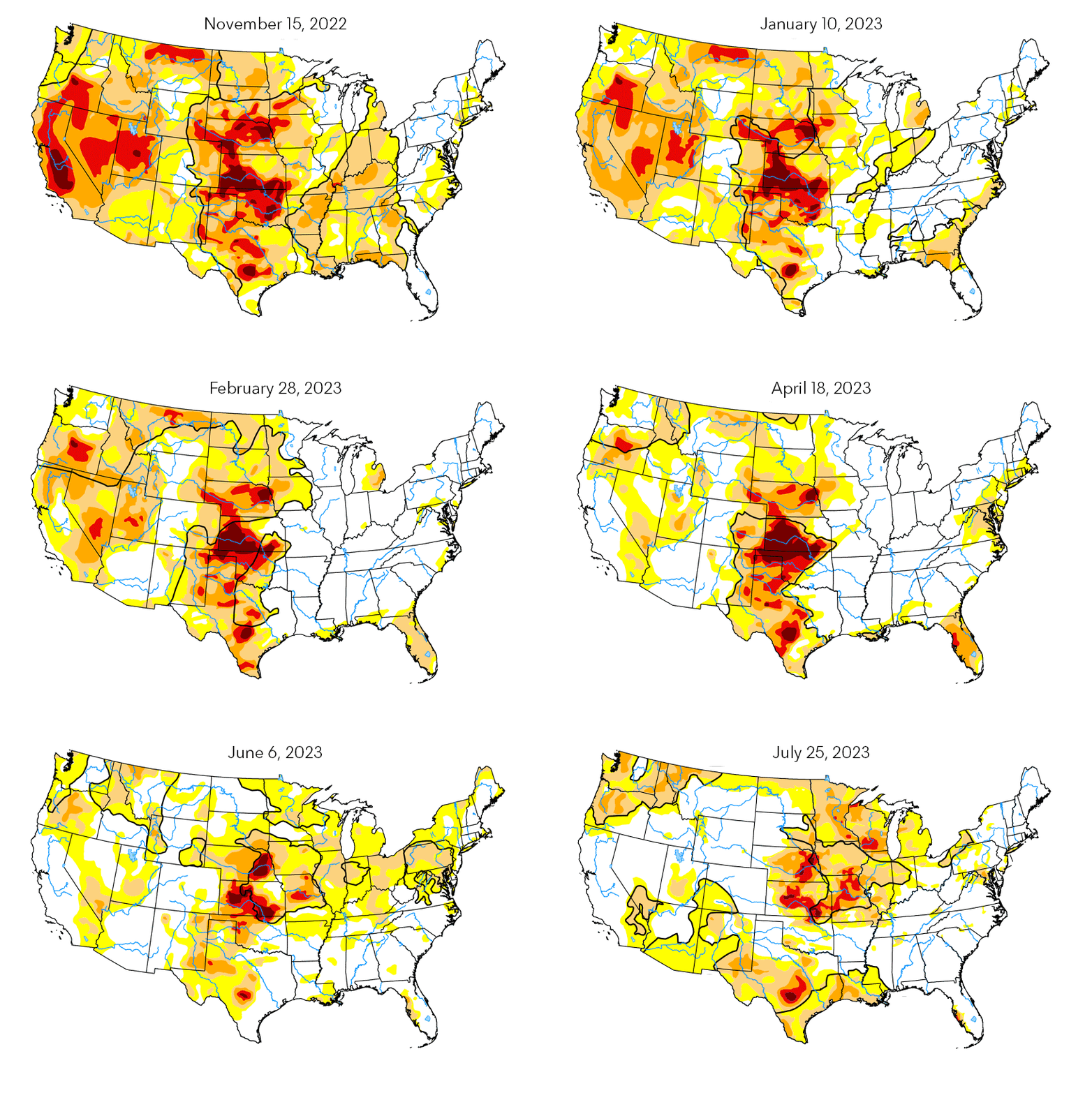
US Drought Monitor

An EF1 tornado was reported in southern Indiana early in the week, causing damage to buildings in Paoli. No injuries were reported, but another round of strong thunderstorms moved through central portions of the state at midweek.

Central and northern Illinois were bracing for potentially severe weather on Aug. 11, with forecasts warning of large hail, heavy rain, damaging winds, and the possibility of tornadoes. Storms were also reported in northern Ohio as the week progressed, with potentially severe weather expected in western Michigan on Aug. 11.

Crop development in the region was tracking close to or slightly behind the average pace in early August. Good or excellent ratings were assigned on Aug. 6 to 67-73% of the corn and soybeans in Ohio, 64-65% in Indiana, 58% in Illinois, and 42-46% in Michigan.

Western Cornbelt:

Corn Wheat Soybean Index

Parts of western and central Iowa were hit with heavy rain over the prior weekend, with 3-6 inches falling across multiple counties and as much as nine inches reported in the northwestern corner of the state.

Storms also churned through Missouri on Aug. 4-5, with a tornado reported near Russellville and heavy rain prompting flash flood warnings in some areas. Nebraska saw temperatures in the high-80s and low-90s during the week, with forecasts warning of the potential for severe storms in northeastern areas of the state late in the week.

Drought conditions continued to affect Missouri’s crop quality, with just 29-32% of the state’s corn and soybeans rated as good or excellent on Aug. 6, compared with 53-59% in Iowa and 56-61% in Nebraska. Good or excellent ratings were also assigned to 62% of Nebraska’s sorghum crop, along with 70% of Missouri’s cotton and 75% of the state’s rice crop.

Southern Plains:

Strong thunderstorms hit parts of Kansas, Oklahoma, and New Mexico during the week, while blistering heat remained in place over much of Texas.

A supercell blasted through northeastern Kansas on Aug. 5, producing 110 mph wind gusts and large hail. A powerful system also brought heavy rain to parts of New Mexico on Aug. 8, causing flash flooding in some locations. Storms then hit parts of eastern and southern Oklahoma on Aug. 9.

Sweltering heat remained in place over much of Texas, with Dallas-Fort Worth on Aug. 9 posting its 17th straight day of temperatures over 100 degrees. “The heat is brutal with no end in sight,” said one Central Texas contact at midweek. “If it’s not irrigated, then it’s not happening.”

The impact of heat and drought was especially evident on the Texas cotton crop, which was just 17% good or excellent on Aug. 6, compared with 42% in Oklahoma and 63% in Kansas. “The poor wheat crop in the hard red winter wheat region is impacting seed wheat availability,” commented one source. “Certified seed is/will be a problem for wheat growers.”

Soybeans in Kansas were 44% good or excellent, while corn in those two categories totaled 48% of the crop in Kansas, 62% in Texas, and 76% in Colorado. Fully 81% of Colorado’s sorghum crop was rated as good or excellent on Aug. 6, compared with 53-56% in the rest of the region.

South Central:

Tornado watches were in effect for central and northern Arkansas on Aug. 9-11 as strong thunderstorms pushed through the region. Earlier in the week, a series of storms battered parts of eastern Tennessee and eastern Kentucky with 70 mph winds, quarter-sized hail, and flash flooding.

Intense heat continued over Louisiana in early August, with New Orleans temperatures soaring to 100 degrees for three straight days through Aug. 7. Record triple-digit streaks were also reported in Alexandria, Lafayette, and New Iberia. Baton Rouge reached the triple-digit mark for 10 straight days through Aug. 7.

Crop conditions were favorable in the region in early August, with fully 70% of the corn in Tennessee and Kentucky rated as good or excellent. Soybeans in those two categories totaled 72% of the acreage in Arkansas, Mississippi, and Tennessee, 70% in Kentucky, and 63% in Louisiana.

Arkansas’ cotton crop was 84% good or excellent, along with 77% of the acreage in Louisiana, 70% in Tennessee, and 66% in Mississippi. The regional rice crop was 79% good or excellent in Texas, compared with 72% in Arkansas, 63% in Mississippi, and 59% in Louisiana.

Southeast:

Severe storms hit the western Carolinas on Aug. 7 with damaging winds, heavy rain, and several confirmed tornadoes, leaving thousands without power.

The same system fueled strong thunderstorms in central and southern Virginia early in the week, with reports of strong winds and golf ball-sized hail in some locations, along with torrential rains. Another wave of thunderstorms moved through northern and central Alabama and northern Georgia on Aug. 9-10, bringing heavy rain, large hail, and gusty winds.

The region’s heightened thunderstorm activity was accompanied by sweltering temperatures, with daily record highs in early August confirmed at St. Simons Island, Ga., Naples, Fla., and Key West, Fla.

Favorable crop conditions were reported in the Southeast in early August, with 68-77% of North Carolina’s corn and soybeans rated as good or excellent. Cotton in those two categories totaled 59-60% of the acreage in the Carolinas, 71% in Georgia, 82% in Alabama, and 95% in Virginia. Peanuts were also flourishing, with good or excellent ratings assigned to 76-90% of the regional crop on Aug. 6.