

US Gulf:
US Gulf sulfuric acid prices were steady at $130/mt CFR, unchanged from last week.
Brazil:
Brazil sulacid prices continued at the week-ago $130-$140/mt CFR level.
US Gulf:
US Gulf sulfuric acid prices were steady at $130/mt CFR, unchanged from last week.
Brazil:
Brazil sulacid prices continued at the week-ago $130-$140/mt CFR level.
Eastern Cornbelt:
The ammonium thiosulfate market was reported at $285-$300/st FOB in the Eastern Cornbelt, with the low at Cincinnati and the high in Indiana.
Western Cornbelt:
Ammonium thiosulfate was pegged at $280-$300/st FOB in the Western Cornbelt, depending on location, with the low confirmed at Waterloo, Iowa.
Great Lakes:
The latest ammonium thiosulfate offers were reported in a broad range at $275-$335/st FOB in the Great Lakes region, depending on location, with the low confirmed at Muskegon, Mich.
Eastern Canada:
Ammonium thiosulfate was unchanged at C$475-$545/mt FOB for the last confirmed offers in Eastern Canada.
Germany:
Yara this week announced a €15/mt price increase for CAN, moving the reference price to €280/mt CIF for July. Prior to the increase, CAN offers in Germany were reported in the €260-€275/mt CIF range, leaving the weekly range at €265-€280/mt CIF.
Cornbelt:
NPSZ pricing in the Cornbelt was reported in the $690-$730/st FOB range, depending on location.
Eastern Canada:
SOP pricing remained in a broad range at C$1,085-$1,200/mt FOB in Eastern Canada, depending on grade and location.
Northwest Europe:
Granular SOP prices were unchanged at €600-€620/mt CIF in Northwest Europe, with demand seasonally muted. Demand for water-soluble SOP is more robust, with indications around €660-€670/mt CIF.
Great Lakes:
Granular SOP Magnesia was pegged at the $435/st FOB level in Michigan for limited prompt tons in late May.
Eastern Canada:
SOP Magnesia was unchanged at C$690-$700/mt FOB in Eastern Canada.
Eastern Cornbelt:
Potassium thiosulfate was unchanged at $680/st FOB Terre Haute, Ind.
Western Cornbelt:
Potassium thiosulfate pricing remained at $680/st FOB Waterloo in late May.
Great Lakes:
The latest potassium thiosulfate offers in Michigan continued at $685/st FOB Muskegon.
Eastern Cornbelt:
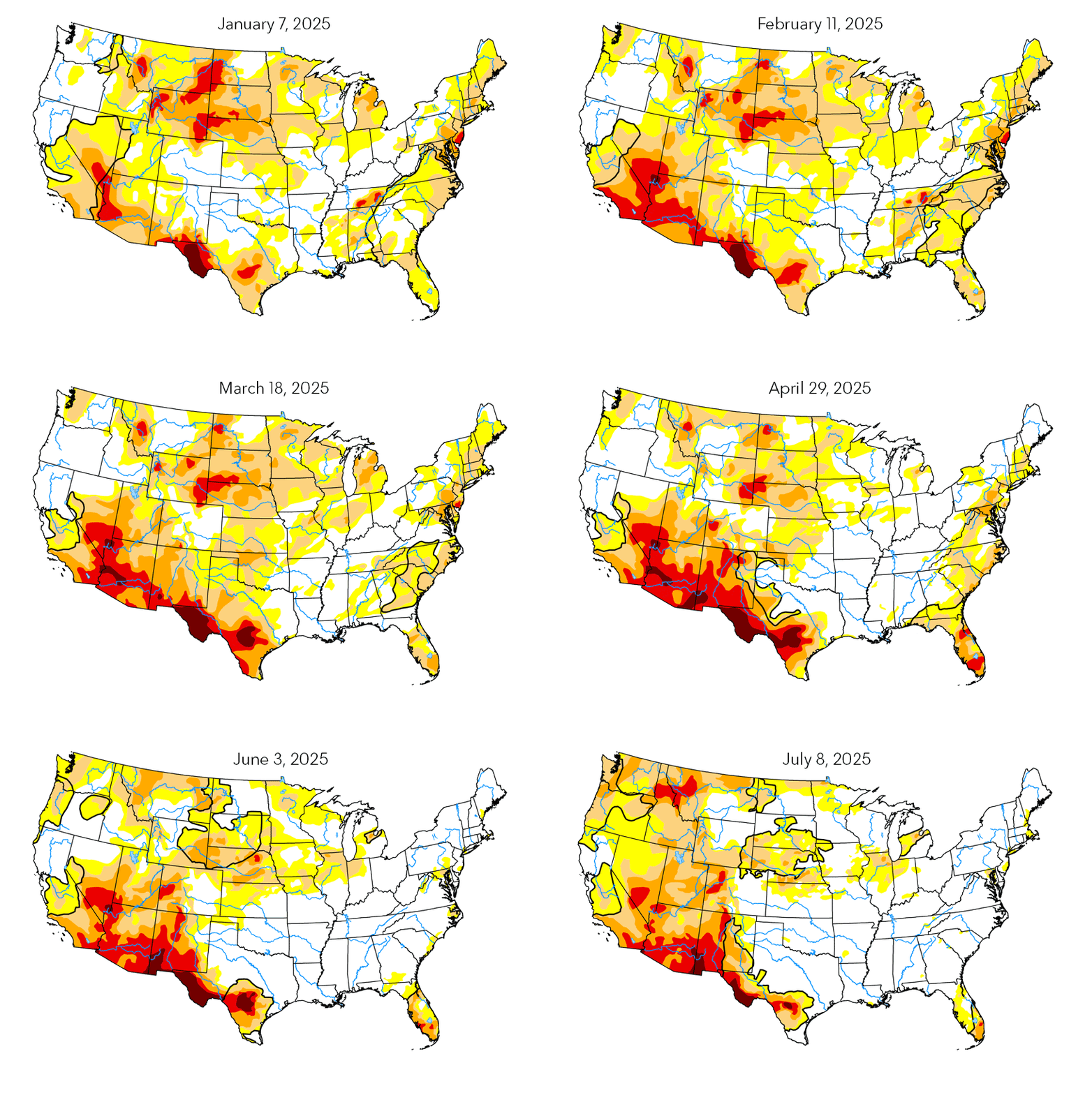
Illinois residents were bracing for another weekend of potentially stormy weather, just days after six tornadoes touched down in the southern half of the state over the Memorial Day weekend.
Thunderstorms and rain were in Indiana’s forecast late in the week as well after high heat and humidity blanketed the state. Showers and thunderstorms were also reported across Ohio during the week, limiting fieldwork in some areas.
Despite the weather delays, planting continued to track ahead of the five-year average in the region. Corn planting as of May 26 was 80% complete in Illinois, 79% in Ohio, and 73% in Indiana, while soybean planting by that date had progressed to 72% complete in Illinois, 69% in Indiana, and 67% in Ohio.
Western Cornbelt:
Strong storms surged through the Western Cornbelt over the Memorial Day weekend, spawning at least 18 tornadoes in Iowa and 16 in Nebraska on May 24. Most of the twisters were rated as EF-O and EF-1 in intensity, with an estimated peak wind speed of 110 mph recorded near Howells, Neb.
Parts of Missouri were hit with severe weather on May 26, causing widespread power outages as high winds, hail, and possible tornadoes moved through the Ozarks. Iowa was expecting rain late in the week, with up to an inch of precipitation possible in western areas of the state on May 31.
Corn planting as of May 26 had progressed to 91% complete in Nebraska, 88% in Iowa, and 87% in Missouri, with soybean planting estimated at 80% in Nebraska, 73% in Iowa, and 55% in Missouri. Missouri growers also had 92-96% of the cotton and rice planted by May 26, with sorghum planting estimated at 31% complete in Nebraska.
Northern Plains:

Scattered showers and cool temperatures were reported over much of the Northern Plains over the Memorial Day weekend, but weather conditions warmed as the week progressed, sparking a flurry of spring planting in late May.
Planting progress was tracking ahead of the average pace for nearly all crops in the region. Corn planting as of May 26 was 89% complete in Minnesota, 84% in South Dakota, and 75% in North Dakota, while soybean planting had progressed to 72% complete in Minnesota, 58% in South Dakota, and 52% in North Dakota.
South Dakota growers had 43% of the sorghum seeded by May 26, while the planting of oats, spring wheat, and barley was reported at 98% complete in South Dakota, 90-96% complete in Minnesota, and 75-84% in North Dakota. Sunflower planting was the only crop lagging at 28% complete in North Dakota and just 7% in South Dakota.
Great Lakes:
Strong storms on May 26-27 left thousands without power across southern Wisconsin, while heavy rain was reported in northern areas of the state early in the week. After a wet Memorial Day, weather conditions improved across Michigan, allowing planting to resume under mostly dry conditions and steadily clearing skies as the week progressed.
Corn planting as of May 26 was 75-78% complete in Michigan and Wisconsin, with soybean planting estimated at 66% complete in Michigan and 74% in Wisconsin. Both crops were tracking ahead of the five-year planting averages in the region, with the Wisconsin oat crop also ahead of average at 89% planted by May 26.
Northeast:
Overcast skies and spotty showers were reported over much of New England during the week, with strong storms tracking through parts of the region over the Memorial Day weekend. An EF-1 tornado touched down on Memorial Day in Pennsylvania’s Schuylkill County, with a tornado watch also in effect on that date for parts of Maryland.
The wet conditions have slowed planting in the Northeast. Pennsylvania’s corn crop was just 53% seeded by May 26, trailing the 66% five-year average. Sources in the state said the barley crop should be coming off in 7-10 days, with the planting of double-crop beans slated to follow.
Eastern Canada:
Central and southern Ontario, along with parts of Quebec, were hit with strong thunderstorms at midweek, fueled by unseasonably warm temperatures and high humidity. Forecasts warned of large hail, heavy rain, and gusty winds as the system moved through the region, with much cooler weather reported for the balance of the week.
“We are nearly wrapping up the planting season,” commented one regional source during the week. “All things go in between rains. Some areas are still struggling, but the majority of the crop is in the ground and we are moving to the next stage.”
US Gulf:
Bayou Boeuf Lock repairs are scheduled to kick off in late May and run for approximately 30 days, sources said, blocking weekday travel from 7 a.m. to 6 p.m. Two full shutdowns are expected during the project, completely stopping navigation for 83 hours at a time.
Repairs underway at Brazos Lock are anticipated to continue into October, limiting weekday navigation from 7 a.m. to 7 p.m., with delays running up to five days during the week. While just two tows were officially shown in line for locking at midweek, sources reported nearly 40 vessels unofficially queued for transit on May 28.
Guidewall repairs at Bayou Sorrel Lock in progress through Oct. 30 limited movements from 7 a.m. to 4 p.m., triggering delays up to 51 hours, above the maximum 38 hours reported last week. Repairs and maintenance reportedly shut Calcasieu Lock to weekday travel from 6 a.m. to 6 p.m. but were slated to conclude on May 31. Intermittent delays at Calcasieu were clocked up to 13 hours during the week.
Repairs to the San Jacinto River Bridge in Houston, Texas, began on April 22 and were expected to continue for 3-4 months. Traffic was limited to singlewide configurations through the western side of the channel and was completely unavailable through the channel’s eastern side.
Port Allen Lock waits were noted up to 11 hours during the week. Boats transiting Industrial Lock waited up to 35 hours to pass, while Algiers Lock movements were quoted up to 15 hours. Harvey Lock transits topped out around the nine-hour mark during the week.
Mississippi River:
Towing restrictions continued on the Lower Mississippi River due to high water levels. Barge-count reductions based on vessel horsepower remained in place, with southbound tows obligated to maintain a minimum of 240 horsepower per standard loaded barge, up to a maximum of 36 barges, or 550 horsepower per oversize barge.
Northbound tows were required to hold a minimum 3 mph of speed through the bridges at Memphis, Tenn., and Vicksburg, Miss, sources said. If unable to maintain speed, the use of an assist tug was required.
The river gauge at Vicksburg was noted at an action-stage 37.0 feet at midweek, with forecasts predicting a fall below the 35-foot action stage on June 13. The Baton Rouge, La., gauge stood at an action-stage at 32.6 feet on May 30. Levels were forecast to remain above the region’s 30-foot action through the full two-week forecast.
Loading drafts were limited to 11.5 feet on northbound travel through the St. Louis area, sources said. Southbound drafts were permitted up to 12.5 feet. Lock 8 was scheduled to shut for miter gate repair between 8 a.m. and 4 p.m. on May 30, while a second closure was expected in 1-2 weeks to complete the project.
Dredging reported at Mile 107 was scheduled to wrap up on May 26. The Rock Island Railroad and Highway Drawbridge, at Mile 482.9 of the upper river, will close to marine traffic on the morning of June 8 for the Quad Cities Heart Walk.
Illinois River:
Loading drafts on the Illinois River remained limited to 10 feet in both the northbound and southbound directions below Mile 160. Drafts were reduced to 9.5 feet for Miles 160-231, and nine feet above Mile 231. Sources reported otherwise normal operating conditions during the week.
Intermittent 4-6 hour delays were noted at Lockport Lock, and tows waited up to six hours to pass Marseilles Lock, according to Corps data. Wickets remained down at Peoria Lock and LaGrange Lock, allowing tows to pass both sites without locking.
Ohio River:
Draft limits on the Ohio River were noted in the 10-11.5 foot range, depending on location and direction of travel. Tows were capped at 15 barges.
Planned work at Cannelton Lock and Markland Lock was underway through June 7, with minimal delays reported. Markland Lock will experience a more intensive shutdown for miter gate repairs on June 10-28.
Machinery repairs are on the books for June 1-July 11 at Racine Lock, and slowdowns are expected at Hannibal Lock between June 15 and Nov. 7 for dewatering and miter gate repairs. Sources predicted a handful of 12-hour closures at Racine in the weeks leading up to the project.
The main chamber at John T. Myers Lock will close to navigation from Aug. 21 through Nov. 9. A similar outage in October 2023 resulted in four-day delays. Belleville Lock will see alternating 30-day main and auxiliary chamber shutdowns during the second half of the year.
Waits were reported up to 14 hours at the Kentucky Lock on the Tennessee River. Delays fell in a wide 4-19 hour range at Wilson Lock during the week.
Arkansas River:
Navigation through the Van Buren Bridge, at Mile 300.8 of the Arkansas River, will be unavailable on Aug. 16-Sept. 8 due to repairs, sources said. Vessels are expected to be allowed to pass the site following the ninth day of work.
BHP Group decided against making a firm offer for Anglo American Plc, instead walking away for now from what would have been the biggest mining deal in over a decade.
The May 29 announcement, which came less than one hour before a 5 p.m. UK deadline, marked an abrupt end to the five-week public battle between two of mining’s biggest names. It will ratchet up the pressure on Anglo CEO Duncan Wanblad to deliver on an ambitious turnaround plan, while his counterpart at BHP may have to look elsewhere for the copper growth that Anglo would have provided.
Anglo has repeatedly rebuffed proposals from BHP to partly break up and then acquire the 107-year-old company, but on May 22 agreed to extend the cutoff to allow for talks. The two sides were unable to agree on BHP’s complicated $49 billion deal structure and Anglo said earlier on May 29 that it saw no reason for another delay despite a last-minute appeal from BHP.
A successful takeover would have created a commodities powerhouse that towered over its closest rivals, significantly increasing BHP’s copper production at a time when miners and their investors are positioning for a prolonged period of tight metal supply and rising prices.
The pressure is now on CEO Wanblad to show that Anglo can generate more value for shareholders as a standalone company, after unveiling a radical plan to overhaul the business earlier this month. Analysts and investors have also suggested that BHP or another rival could still target Anglo in the future, particularly if the company succeeds in exiting some of its less attractive businesses. UK takeover rules require BHP to stay away for six months unless Anglo receives a rival bid.
Anglo’s shares fell 3.1% on May 29 but remain well above the levels seen before Bloomberg first reported the takeover interest. Prices for key commodities including copper and iron ore have rallied over the same period.
BHP first approached Anglo with a proposal in mid-April for the smaller company to spin off its majority stakes in two listed South African miners before an all-share acquisition of the rest of the group (GM April 26, p. 1). Anglo rejected the offer and instead rushed out a plan to overhaul its business by exiting diamonds, platinum, and coal, while slowing spending on a massive UK fertilizer project (GM May 17, p. 1).
Anglo has long been viewed as a potential target because of its lucrative copper mines, but the company’s complicated structure and unusual mix of niche commodities have largely kept suitors away. A series of setbacks sent its share price plunging late last year, leaving the company vulnerable to BHP and its CEO Mike Henry, who has been seeking a big deal to grow in copper.
But while BHP has twice increased the number of shares it was willing to pay for Anglo, Henry held firm in insisting on the spinoffs and refrained from adding a cash element to the deal.
Anglo’s objections to BHP’s proposal have centered on South Africa, which is home to some of Anglo’s biggest operations, employing tens of thousands of people, and the company has deep political and social ties to the country.
Anglo was concerned that BHP’s demand that it first exit Anglo American Platinum Ltd. and Kumba Iron Ore Ltd. could leave the newly independent Johannesburg-listed companies to carry the cost of any concessions imposed by South Africa, reducing their value and ultimately penalizing the current Anglo investors who would receive the shares in the spinoffs.
The multistep deal would require several layers of approval in South Africa, where deals are subjected to “public interest” assessment and authorities have a record of extracting substantial concessions from companies.
BHP argued that Anglo should extend the deadline for a second time and offered to discuss a breakup fee if the deal didn’t receive regulatory approvals, but the smaller company’s board said it didn’t see any reason to do so given the continued gulf between their two positions.
Anglo CEO Wanblad must now make good on a dramatic turnaround plan while under the scrutiny of predatory rivals, as well as shareholders who have just watched a 39% takeover premium walk out the door.
“I don’t want anything to get in the way of getting this done,” Wanblad said on May 30. “We want to demonstrate early progress, and continuous progress. It will get done.”
He has promised to save Anglo by breaking it apart, with an ambitious plan to exit platinum and coal, and either sell or spin off the De Beers diamond business. Perhaps the most controversial element in Wanblad’s plan is a decision to keep a giant fertilizer mine that Anglo is building in the UK, although he has slowed spending on the site (GM May 17, p. 1).
The Woodsmith fertilizer project, which would have cost $9 billion in total, is unpopular with many investors due to uncertainties about the market and the amount of capital it has sucked from the business. The company wants to bring in a partner to lower its share of the bills and risk. The project is currently still three years away from first production in 2027.
At the same time, Wanblad’s decision to indefinitely halt the fertilizer project has brought the ire of local UK politicians fearful of losing some 1,650 jobs.
So far, investors appear to be backing the Anglo CEO. Shares have barely reacted to BHP’s walking away and remain well above the levels seen before the bid became public.