

Eastern Canada:
SOP Magnesia was unchanged at C$690-$700/mt FOB in Eastern Canada in early May.
Eastern Canada:
SOP Magnesia was unchanged at C$690-$700/mt FOB in Eastern Canada in early May.
Eastern Cornbelt:
Potassium thiosulfate pricing continued at $680/st FOB Terre Haute, Ind., in early May.
Western Cornbelt:
Potassium thiosulfate pricing was steady at $680/st FOB Waterloo, Iowa.
Eastern Cornbelt:
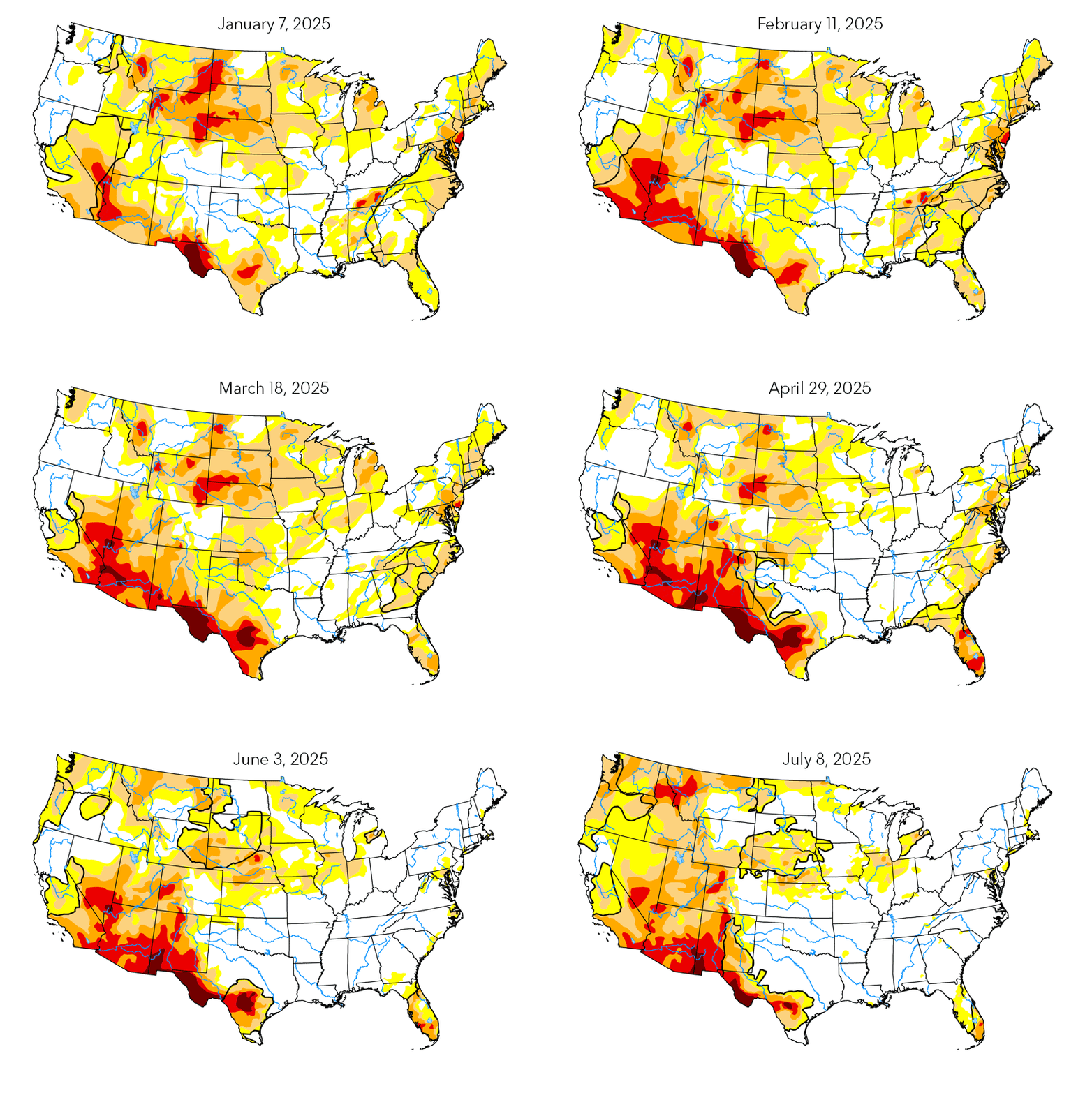
Heavy rain was reported in parts of Illinois and Indiana during the week, along with multiple tornado and severe storm warnings.
The severe weather outbreak on May 7 sparked an EF-0 tornado near Harvard, Ill., and as many as five tornadoes in Indiana, including an EF-0 near Greensburg, another EF-0 near St. Paul, and three additional tornadoes in Shelby, Decatur, and Rush Counties.
Ohio bore the brunt of the damage, however, with as many as 13 tornadoes reported in the state on May 7, including five in Warren County and others in Butler, Clinton, Mercer, Auglaize, Darke, Paulding, Jefferson, and Franklin Counties. Four tornadoes were confirmed in Michigan on May 7, including an EF-2 in Portage that packed 135 mph winds.
The wet weather continued to stall fieldwork and planting in the Eastern Cornbelt, though progress varied widely from region to region. Corn and soybean planting as of May 5 was reported at 31-32% complete in Illinois, 20-26% in Ohio, 20% in Indiana, and 13-16% in Michigan.
“We are still wet and haven’t got much done since Easter,” reported one Illinois contact. “Maybe our trade area is 35% planted, but that’s probably high. We have southeastern areas less than 5% planted with significant tons of preplant ammonia and dry P & K to go.”
Western Cornbelt:
The National Weather Service said four tornadoes touched down in eastern Nebraska and southwest Iowa on May 6 as strong storms pounded the region. These included an EF-0 tornado near Wymore, Neb., and three EF-1 tornadoes in southwest Iowa, including one that caused considerable damage near the towns of Minden and Shelby.
The severe weather early in the week was followed by heavy rain in northern Iowa on May 8, with precipitation totals including 1.84 inches in Iowa Falls, 1.5 inches in Humboldt, and 1.10 inches in Fort Dodge. Another system brought more funnel clouds and weak tornadoes to north-central Iowa on May 9.

Parts of Missouri also experienced severe storms and widespread power outages at midweek, including a tornado in Aurora that caused considerable damage.
The unsettled weather limited fieldwork and spring planting in the region. Corn planting as of May 5 was 67% complete in Missouri, 47% in Iowa, and 31% in Nebraska, while soybean planting had progressed to 30% in Iowa and Missouri and 18% in Nebraska. Iowa and Nebraska were trailing the average pace for both crops, while Missouri was tracking ahead of average.
Missouri growers also had 77% of the rice and 34% of the cotton planted by May 5, with both tracking ahead of the average pace.
Northern Plains:
Scattered rains were reported across southern Minnesota early in the week, with stronger storms expected as the week progressed. Highs in the low- to mid-70s were reported in the Twin Cities area at midweek.
Similar conditions were reported in the Dakotas, but the wet weather was clearing out as the week progressed. Highs in the 70s over the coming weekend raised hopes that spring planting would ramp up quickly once again across the region.
As of May 5, corn planting had progressed to 42% complete in Minnesota, 18% in South Dakota, and 11% in North Dakota, with soybean planting estimated at 17% complete in Minnesota, 10% in South Dakota, and 3% in North Dakota. South Dakota growers also had 16% of the sorghum crop planted by that date, while sugar beet planting was rated at 78-83% complete in Minnesota and North Dakota.
Small grains planting was advancing quickly in the region, with spring wheat and oats estimated at 75-79% complete in South Dakota, 51-57% in Minnesota, and 24-32% in North Dakota by May 5. Barley planting was rated at 37% complete in Minnesota and 23% in North Dakota.
Northeast:
Showers and thunderstorms moved through much of the Northeast during the week, with severe weather reported in some areas.
Parts of southern New England were hit with ping pong-sized hail at midweek, while tornado and flash flood warnings were in effect for western Pennsylvania. Maryland also saw thunderstorm activity at midweek, but calmer weather was in the weekend forecast for most of the region, with temperatures expected to peak in the 60s.
Pennsylvania growers had 23% of the corn planted by May 5, ahead of the 14% five-year average.
Eastern Canada:
Thunderstorms churned through southern Ontario and Quebec at midweek, producing heavy rain, large hail, and strong winds in some areas. More rain was in the forecast as the week advanced, though temperatures were warming.
The previous weekend brought heavy rainfall to eastern parts of the Maritimes, with additional rainfall reported in eastern Nova Scotia and Prince Edward Island at the start of the week. Some areas reportedly collected more than four inches of rain, though dry weather was expected for the balance of the week.
“Things are just starting to get going, but not wide open yet,” commented one Ontario contact at midweek. “We’ve had a lot of wet weather lately.”
US Gulf:
Extended delays continued at Industrial Lock during the week due to the unscheduled shutdown of Demopolis Lock on the Warrior-Tombigbee Waterway. Corps data showed wait times in the 2-4 day range, while 35 tows were queued at the site on May 9. In addition, navigation was completely unavailable for a four-hour stretch on May 7, sources said.
A Bayou Boeuf project previously scheduled for April is now set to begin in late May, sources said. The monthlong project is anticipated to block weekday navigation from 7 a.m. to 6 p.m., while two additional 83-hour shutdowns are expected during the course of the effort. Temporary repairs conducted on May 7 shut the site from 8 a.m. to 12 p.m.
Brazos Lock repairs underway through October triggered intermittent weekday lock closures from 7 a.m. to 7 p.m. Travel was also unavailable from 1 a.m. to 8 a.m. on May 7. Sporadic delays were noted in a wide 5-17 hour range.
Guidewall repairs at Bayou Sorrel Lock, located at Mile 37 of the Port Allen Route, are expected to run through Oct. 30, limiting weekday movements from 7 a.m. to 4 p.m. Most delays were quoted in the 10-27 hour range during the week.
Port Allen Lock delays were posted up to 27 hours., while tows waited 11 hours to pass Algiers Lock. Intermittent 6-8 hour waits were noted at Calcasieu Lock, while a handful of 6-12 hour delays were heard at Colorado Lock. Brazos Lock passages ran in a wide 5-17 hour range.
Mississippi River:
High flows continued on the Mississippi River, prompting towing restrictions. On the upper river, barge counts were reduced by 20% at Miles 1-200, while tows faced varying reductions below Cairo, Ill., depending on location and vessel horsepower, triggering delays of 2-3 days or more. Sources reported maximum 9.5-foot northbound loading drafts in the St. Louis area, while southbound drafts topped out at 10.5 feet.
The river gauge at St. Louis was expected to lift into action-stage territory on May 10. Forecasts called for a crest at 28.8 feet before dropping out of action stage on May 12. A flood warning posted for the St. Louis area on May 9 was set to remain in effect through May 15.
Depths were projected to push above action stage at both Baton Rouge, La., and Vicksburg, Miss., on May 10-12, with forecasts predicting the high levels to continue for at least 1-2 weeks. A May 9 flood warning reported for the Baton Rouge area was scheduled to expire on May 27.
Dredging at Mile 107 is slated to run through May 26. Waits were posted up to 15 hours at Lock 27 during the week.
Illinois River:
Sources continued to report high water levels and a corresponding 50% reduction in tow lengths on the Illinois River above Starved Rock Lock. The restrictions increased transit times and stretched locking windows, sources said.
Maximum loading drafts continued at 10 feet in both the northbound and southbound directions below Mile 160. Draft limits fell to 9.5 feet at Miles 160-231 and nine feet above Mile 231.
Ohio River:
Sources described falling river levels on the Ohio River system during the week, though draft restrictions remained in place. Loading reductions were noted in the 10-15% range on barges traveling southbound, leaving maximum drafts at 10-11.5 feet, depending on location and direction of travel.
The Willow Island Lock main chamber is offline through May 15 for repairs and maintenance, necessitating detours through the site’s auxiliary chamber. Delays were posted up to 20 hours, down from a maximum 81 hours at last report.
Repairs in progress at Cannelton Lock and Markland Lock were expected to slow travel through both sites until June 7, though minimal delays were reported for the week. Markland Lock will shut again on June 10-28 for miter gate repairs, with delays expected.
Racine Lock machinery work is slated to run from June 1 through July 11, and miter gate repairs will slow navigation at Hannibal Lock from June 15 to Nov. 7. The main and auxiliary chambers at Belleville Lock will close for 30 days each during the second half of the year.
A planned main chamber shutdown at John T. Myers Lock will run from Aug. 21 through Nov. 9. A similar closure in October 2023 resulted in four-day delays.
Intermittent 4-8 hour waits were reported at the Tennessee River’s Kentucky Lock., while tows waited up to seven hours to pass Wilson Lock. The Cumberland River’s Old Hickory Lock was scheduled to return from repairs and maintenance on May 9.
Arkansas River:
High-flow conditions reported on the Arkansas River prompted vessel stoppages and dock closures during the week, sources said. Regular operations were expected to resume in the week ahead.
Repairs to the Van Buren Bridge are scheduled to begin on Aug. 16. The project will run for approximately 18 days, with vessels cleared to pass the site after the ninth day of work. The structure is located at Mile 300.8 of the Arkansas River.
The Teamsters Canada Rail Conference (TCRC) announced on May 1 that close to 10,000 workers at Canadian National (CN) and Canadian Pacific Kansas City (CPKC) railways have voted to authorize strikes at both companies. Unless an agreement is reached, TCRC said a work stoppage can occur as early as May 22.
TCRC reported that 97.6% of conductors, locomotive engineers, and yard workers at CN voted to authorize a strike, while 99% of those workers at CPKC voted in favor of a strike. In addition, 95.3% of rail traffic controllers (RTCs) at CPKC voted to authorize the strike. At issue are collective agreements over safety-critical rest provisions, TCRC said.
The work stoppage would interrupt transport of products – including cars, coal, consumer goods, fertilizer, grains, minerals, and petroleum – as well as commuter services, which are run by the affected conductors, locomotive engineers, yard workers, and rail traffic controllers.
“After six months of negotiations with both companies, we are no closer to reaching a settlement than when we first began,” said TCRC President Paul Boucher. “Both companies are trying to strip our collective agreements of safety-critical rest provisions. We are at an impasse, with the companies failing to understand that the Teamsters will never compromise on safety or bargain with Canadian lives.”
Boucher warned that a simultaneous work stoppage at both CN and CPKC “would disrupt supply chains on a scale Canada has likely never experienced.” He said the union intends to go back to the bargaining table and work with federal mediators to reach a deal.
“I would like to make it very clear that provoking a crisis on that scale has not been, and never will be, our goal,” he said. “The reality is that we would very much like to avoid a work stoppage.”
CN said in a May 1 statement that negotiations with TCRC are ongoing, but the union “has made it clear that it will not agree to move toward a more modern agreement based on an hourly rate and scheduling that would have provided significant wage increases and offered scheduled consecutive days off, provisions for no layoffs, and reduced hours away from home.”
CN said it suggested a “simplified, alternative path” to achieve a deal prior to the May 22 strike deadline, but it claims TCRC “has made very few concessions towards a negotiated agreement and has been unclear on what it is seeking for employees other than to continue focusing on a list of approximately 200 local and regional demands unrelated to a modern consolidated agreement benefiting employees and customers alike.”
CN further stated that TCRC is unavailable to meet until May 13, leaving the railroad with a “cautious outlook” regarding the possibility of finalizing a deal before a labor disruption.
The Mosaic Co. on April 30 announced that it has entered into an agreement with the Saudi Arabian Mining Co. (Ma’aden) under which Mosaic will receive 111,012,433 shares of Ma’aden valued at approximately $1.5 billion in exchange for Mosaic’s current 25% stake in Ma’aden Wa’ad Al Shamal Phosphate Co., a joint venture between Mosaic, Ma’aden, and Saudi Basic Industries Corp.
“We have enjoyed a long and successful partnership with Ma’aden, and we look forward to continuing our work together under this evolved structure,” said Bruce Bodine, Mosaic President and CEO. “This transaction provides Mosaic with a transparent value for its investment in Ma’aden, greater capital flexibility in the future, and the ability to contribute expertise to Ma’aden’s phosphate operations.”
Mosaic’s cash investment in the jv was initially reported as being up to $1 billion (GM March 25, 2013). The agreement generally requires Mosaic to hold its Ma’aden shares for a minimum of three years, with one-third of the shares becoming transferable after the third, fourth, and fifth anniversary of the closing.
“Having formed our partnership with Mosaic in 2013, more than a decade on, this is an important evolution that we believe will create significant benefits for the growth of our phosphate business,” said Bob Wilt, Ma’aden CEO. “We look forward to working together with the Mosaic team to strengthen our phosphate business as we continue to build the mining sector into the third pillar of the Saudi economy.”
The transaction is subject to regulatory approvals, approval by Ma’aden’s shareholders, and other closing conditions that are customary for this type of transaction, and is expected to be completed by the end of 2024.
The Mosaic Co. posted first-quarter net earnings of $45 million, down sharply from $435 million in first-quarter 2023. Revenues were $2.7 billion for the quarter, off 26% from the first quarter of 2023, while adjusted EBITDA of $576 million fell from the year-ago $777 million.
Net earnings and revenues tracked below analyst estimates (Bloomberg Consensus) of $225 million and $2.8 billion, respectively, though adjusted EBITDA fell in line with expectations. Mosaic shares on May 2 fell to $27.88 in early trading, a 6.8% decline from the $29.93 prior-day close, the lowest share price since February 2021.
“Mosaic delivered a solid first quarter,” said Bruce Bodine, Mosaic President and CEO. “For the remainder of the year, we will focus on execution and the completion of previously announced low-capital-intensity initiatives that build on our strengths.”
Mosaic partially attributed its lower net earnings to an after-tax impact of items totaling $165 million, including a foreign currency transaction loss, an unrealized loss on derivatives, and an adjustment to environmental reserves. It also cited a sharp year-over-year decline in potash prices, as well as lower prices and sales volumes in the Phosphate segment.
In addition to the special after-tax losses, a 43% year-over-year decline in potash prices – to $241/mt from $421/mt in first-quarter 2023 – contributed to the earnings decline. The lower prices were partially offset by a 16% rise in sales volumes, to 2.2 million mt from 1.9 million mt, as well as a decline in Canadian resource taxes.
Due to the week potash market, the company in March announced a production curtailment at the Colonsay potash mine in Saskatchewan, intending to leave the mine idle until market conditions improve. Mosaic previously reported a commitment to flexibly managing its network to assure that lower-cost mines like Belle Plaine and Esterhazy operate at capacity, while Colonsay is utilized only when market conditions dictate (GM Feb. 23, p. 26).
Phosphate sales volumes fell 11% in the first quarter, to 1.6 million mt from last year’s 1.8 million mt. A 9% decline in the average DAP price, to $598/mt from $660/mt, helped drag net sales to $1.2 billion from the $1.4 billion posted one year earlier, a 14% decline. Finished phosphate production fell 14%, to 1.6 million, due to an increase in planned maintenance turnaround activities during the quarter.
Repairs to the Riverview phosphate fertilizer production facility in Florida were completed in late April, the company said, returning the plant to full production. Mosaic on March 27 reported limited damage to ancillary operations from a brush fire that week, predicting production impacts lasting four to six weeks. Riverview has capacity to produce approximately 30,000 mt of phosphate products per week (GM March 29, p. 31). At the time of the fire, the facility was reportedly configured to produce phosphate products primarily for export to Brazil.
“Some reduction” in second- and third-quarter sales volumes are expected as a result of the fire, though the company described the overall impact as minimized. “Our second-quarter guidance reflects the impacts of the fire, the ongoing turnaround activity, and the seasonal softening in the US, partially offset by improvements in Brazil,” said Bodine.
In the Mosaic Fertilizantes segment, the company reported first-quarter sales volumes of 1.7 million mt compared to 2.1 million mt in 2023, while net sales dropped 32% year-over-year, to $886 million from $1.3 billion. In a bright spot, gross margin firmed to $75 million in the quarter, up from a year-ago loss of $1 million, while both operating earnings of $42 million and segment adjusted EBITDA of $83 million firmed from a loss of $32 million and positive $3 million, respectively.
Other project updates included the first-quarter completion of an 800,000 mt MicroEssentials capacity conversion, with production slated to begin in May. In the longer-term, an effort to increase milling capacity by 400,000 mt at Esterhazy is on track for completion in mid-2025, the company said, while a 1 million mt blending facility under construction in Palmeirante, Brazil, is on schedule to be completed in 2025.
Mosaic expects its core fertilizer markets to strengthen during the second half of the year. “Despite the seasonal reset of the market as we transition out of North America planting season, our outlook for the year is positive,” Bodine said.
“Fertilizer market fundamentals remain constructive, and the phosphate supply and demand picture is particularly compelling,” he noted. “As the North America spring planting season winds down and fertilizer prices have moderated, fertilizer demand strength is now emerging in other key agricultural geographies, which will bode well for pricing in the second half of the year.”
For the second quarter, Mosaic expects potash sales volumes in the 2.2-2.4 million mt range with mine-gate prices of $210-$250/mt. Phosphate sales volumes are projected at 1.6-1.8 million mt, with ex-plant DAP prices forecast in the $530-$580/mt range. Conversion and turnaround costs for phosphate production will likely remain elevated in 2Q due to continued efforts to increase production volume, the company said.
Mosaic returned $178 million of capital to shareholders during the first quarter, representing 88% of its free cash flow, which included share repurchases totaling $108 million.
| Potash (millions) | 1Q-24 | 1Q-23 |
| Sales Volume (million mt) | 2.2 | 1.9 |
| Production Volume (million mt) | 2.3 | 1.9 |
| Gross Margin (million $) | 212 | 413 |
| Operating Earnings (million $) | 198 | 402 |
| Adjusted EBITDA (million $) | 281 | 474 |
| Net Sales (million $) | 643 | 907 |
| MOP Selling Price ($/mt) | 241 | 421 |
| Phosphates (millions) | 1Q-24 | 1Q-23 |
| Sales Volume (million mt) | 1.6 | 1.8 |
| Production (Finished) Vol. (million mt) | 1.6 | 1.9 |
| Gross Margin (million $) | 159 | 259 |
| Operating Earnings (million $) | 40 | 266 |
| Adjusted EBITDA (million $) | 277 | 382 |
| Net Sales (million $) | 1,200 | 1,400 |
| DAP Selling Price ($/mt) | 598 | 660 |
| Mosaic Fertilizantes (millions) | 1Q-24 | 1Q-23 |
| Sales Volume (million mt) | 1.7 | 2.1 |
| Gross Margin (million $) (loss) | 75 | (1) |
| Operating Earnings (million $) (loss) | 42 | (32) |
| Adjusted EBITDA (million $) | 83 | 3 |
| Net Sales (million $) | 886 | 1,300 |
| Avg Finished Price (Dest.) | 517 | 646 |
CF Industries Holdings Inc. reported a drop in first-quarter net earnings, to $194 million on net sales of $1.47 billion, down from the year-ago $560 million and $2.01 billion, respectively. Adjusted EBITDA was off at $459 million from $866 million.
CF cited severe cold weather and other maintenance events resulting in approximately $75 million higher maintenance expenses during the quarter.
“The CF Industries team faced a challenging quarter as severe cold in January and some unplanned maintenance disrupted our network significantly. However, our team did an outstanding job restoring our operations to normal utilization rates,” said President and CEO Tony Will.
“Longer-term, we remain confident in our ability to drive strong cash generation due to a global energy cost structure favorable to our North American-based production network and continued progress on our low-carbon clean energy initiatives,” Will said. “As a result, we believe we will be able to continue to create significant shareholder value from disciplined investments in growth opportunities and returning substantial capital to shareholders.”
CF reported first-quarter gross ammonia production of 2.1 million st, down from the year-ago 2.4 million st due to the impact of a significant planned turnaround event in the quarter, severe weather in January, and other unplanned maintenance. This was partially offset by production from the Waggaman, La., ammonia production facility (GM Dec. 1, 2023), which was not a part of the CF’s year-ago network.
Going forward, despite the first-quarter ammonia disruptions, CF expects full-year gross ammonia production of about 9.8 million st, up from 2023’s 9.5 million st. CF said first-half North American nitrogen demand should be positive due to the 91 million acres of corn expected to be planted in the US.
It expects urea supply availability and lower global urea prices to drive a 3% increase in Brazil’s urea consumption, to 8 million mt in 2024. It also expects Brazil urea imports to be 7.8-8.0 million mt due to limited domestic production.
CF expects Indian demand to remain strong due to a recovery in rice production and improved weather conditions. However, CF expects imports of urea to India in 2024 to be in the range of 5.5-6.5 million mt as recently revitalized plants and new facilities in the country operate at higher rates.
As of March, CF said some 35% of Europe’s ammonia and 25% of its urea production was in shutdown/curtailment and it believes operating rates will remain below historical averages over the long-term due to the region’s status as the global marginal producer.
CF thinks China’s urea exports will resume midyear following spring applications, with projected exports of 4 million mt. It said Trinidad’s ammonia production continues to run at 1 million mt below the 2018-2020 average due to higher natural gas prices and availability. CF expects Russian urea exports to increase in 2024 due to new production, but exports will remain restrained due to the closure of the Russia-Odessa pipeline.
| Production (000 st) | 1Q-24 | 1Q-23 |
| Ammonia | 2,148 | 2,359 |
| Gran Urea | 959 | 1,211 |
| UAN 32 | 1,631 | 1,598 |
| AN | 341 | 388 |
| Ammonia | 1Q-24 | 1Q-23 |
| Net Sales ($/M) | 402 | 424 |
| Gross Margin ($/M) | 65 | 144 |
| Sales Volumes (000 st) | 918 | 652 |
| Avg Selling Price ($/st) | 438 | 650 |
| Gas Costs ($/mmBtu) | 3.19 | 6.62 |
| Gran Urea | 1Q-24 | 1Q-23 |
| Net Sales ($/M) | 407 | 611 |
| Gross Margin ($/M) | 154 | 284 |
| Sales Volumes (000 st) | 1,092 | 1,323 |
| Avg Selling Price ($/st) | 373 | 462 |
| UAN | 1Q-24 | 1Q-23 |
| Net Sales ($/M) | 425 | 667 |
| Gross Margin ($/M) | 143 | 321 |
| Sales Volumes (000 st) | 1,611 | 1,662 |
| Avg Selling Price ($/st) | 264 | 401 |
| AN | 1Q-24 | 1Q-23 |
| Net Sales ($/M) | 114 | 159 |
| Gross Margin ($/M) | 9 | 55 |
| Sales Volumes (000 st) | 390 | 374 |
| Avg Selling Price ($/st) | 292 | 425 |
| Other | 1Q-24 | 1Q-23 |
| Net Sales ($/M) | 122 | 151 |
| Gross Margin ($/M) | 38 | 59 |
| Sales Volumes (000 st) | 513 | 524 |
| Avg Selling Price ($/st) | 238 | 288 |
Wholesale fertilizer distributor MacroSource LLC, Savannah, Ga., on May 2 announced that it has acquired the assets of Blick’s Phosphate Conversions LLC, a producer of ammonium polyphosphate and aqua ammonia based in Goddard, Kan. Blick’s owner Kenny Kalb has joined MacroSource as General Manager of Blick’s™, a new operating division of MacroSource.
According to its website, Blick’s operates five mobile polyphosphate conversion units, two mobile SPA railcar heating units, produces more than 500,000 tons of finished products per year, and manages the sample chain of custody and outsources a certified, third-party laboratory quality analysis with each production run.
In a statement announcing the deal, MacroSource said the acquisition includes the largest fleet of ammonium polyphosphate processing and super phosphoric acid railcar heating units in North America.
“Blick’s adds to our product portfolio a unique service model, which is an essential part of the fertilizer supply chain,” said Brent Harlander, President of MacroSource. “Kenny’s team will enable us to be a stronger distribution partner for our producer suppliers and regional customers alike.”
“I’m excited about joining the MacroSource network to provide our customers with a complete portfolio of products and services,” said Kalb. “Together we share common values, and our missions are aligned to not only meet but exceed the needs of highest quality, mobile phosphate conversions for the ag retailer.”
Formerly known as Gavilon Fertilizer LLC, MacroSource took on its new name in September 2022 (GM Sept. 30, 2022) following the sale of Gavilon Grain Co. and the Gavilon trademark by parent company Marubeni earlier that year (GM Jan. 28, 2022). Today MacroSource employs over 400 people at more than 75 facilities and offices worldwide.
LSB Industries Inc. reported first-quarter net income of $5.6 million on net sales of $138.2 million, down from the year-ago $15.9 million and $181 million, respectively, citing higher sales volumes and much lower prices. Adjusted EBITDA was $32.6 million, down from $51 million.
“Our first quarter results were consistent with our expectations for a significant improvement relative to our fourth quarter of 2023,” said Mark Behrman, President and CEO. “Selling prices remained lower relative to the prior year quarter as the spike in nitrogen prices experienced in 2022 kept prices elevated during the first quarter of 2023.”
Behrman said the lower selling prices were partially offset by a “solid increase” in sales volumes driven by strong demand for fertilizers, enhanced by LSB’s strategic commercial efforts. He said the company also benefited from a “healthy increase” in downstream production volumes.
“We generated solid cash flow in the first quarter, contributing to our ability to return value to shareholders through stock repurchases, while further de-risking our balance sheet by repurchasing bonds at a discount to market,” Behrman said. “We continue to make investments in the reliability and safety of our facilities that we expect to lead to greater production volumes.”
LSB said it plans to complete turnarounds at its Pryor, Okla., and Cherokee, Ala., production facilities in the second half of the year. Behrman added the company also plans to complete “multiple smaller projects that we believe will collectively lead to incremental EBITDA and improved shareholder value.”
Behrman said LSB is excited about its clean ammonia initiatives and the company is “committed to becoming a leader in the global energy transition through the production of low carbon ammonia and downstream products over the next several years.” He added that indications from the EPA remain “favorable” regarding the anticipated timeline for LSB’s Partner, Lapis Energy, to begin capturing and sequestering CO2 at LSB’s El Dorado, Ark., facility.
“Additionally, we are pleased with the interest we are seeing in offtake for low-carbon nitrogen products out of El Dorado when our project comes online,” he added. “With respect to our Houston Ship Channel project, we have signed an agreement with Samsung Engineering to perform the Pre-FEED on our ammonia loop adding another large, blue-chip partner to the group of companies developing the project.”
LSB said the market outlook for nitrogen fertilizer is favorable as current prices for ammonia and other products should prove attractive to retailers and farmers, with corn futures prices providing support for fertilizer demand for the 2024 application season.
LSB said strong ammonia demand and pricing has been stable due to robust agricultural demand in fourth-quarter 2023 and in first-quarter 2024, with ammonia imports into Europe from the Middle East constrained due to the disruption in shipping though the Suez Canal. It also noted that some new production capacity has been delayed.
LSB expects UAN demand and pricing to remain strong through much of second-quarter 2024, citing tight inventories in the US and lower import levels due to unplanned production issues. LSB said the industrial and mining business is robust, with steady demand for industrial products supported by a resilient US economy and demand for ammonium nitrate for mining steady due to attractive market fundamentals for quarry/aggregate production and US metals.
| Product Sales ($000) | 1Q-24 | 1Q-23 | % Change |
| AN & Nitric Acid | 48,435 | 58,272 | (17) |
| UAN | 41,192 | 46,590 | (12) |
| Ammonia | 39,530 | 63,415 | (38) |
| Other | 9,047 | 12,687 | (29) |
| Total | 138,204 | 180,964 |
| Sales Volumes st | 1Q-24 | 1Q-23 | % Change |
| AN & Nitric Acid | 128,801 | 122,745 | 5 |
| UAN | 134,933 | 113,026 | 19 |
| Ammonia | 94,831 | 88,997 | 7 |
| Total | 358,565 | 324,768 | 10 |
| Avg Selling Price $/st | 1Q-24 | 1Q-23 | % Change |
| AN & Nitric Acid | 319 | 417 | (23) |
| UAN | 265 | 379 | (30) |
| Ammonia | 403 | 703 | (43) |
| Other Factors | 1Q-24 | 1Q-23 | % Change |
| Avg Nat Gas ($/mmBtu) | 2.33 | 5.66 | (59) |
| Tampa NH3 $/mt | 466 | 728 | (36) |
| NOLA UAN $/st | 251 | 318 | (21) |