

Cornbelt:
NPSZ pricing in the Cornbelt was unchanged at $710-$750/st FOB, depending on location.
Cornbelt:
NPSZ pricing in the Cornbelt was unchanged at $710-$750/st FOB, depending on location.
Eastern Canada:
SOP remained in a broad range at C$1,085-$1,200/mt FOB in Eastern Canada, depending on grade and location.
Northwest Europe:
Granular SOP prices in Northwest Europe remained stable at €590-€620/mt CIF, with sources noting lower inventories following fairly brisk movement in April.
Great Lakes:
Granular SOP Magnesia was pegged at the $455/st FOB level in Michigan for limited prompt tons.
Eastern Canada:
SOP Magnesia was steady at C$690-$700/mt FOB in Eastern Canada at mid-month.
Eastern Cornbelt:
Potassium thiosulfate was stable at $680/st FOB Terre Haute in mid-April.
Western Cornbelt:
Thepotassium thiosulfate market remained at $680/st FOB Waterloo.
Great Lakes:
Potassium thiosulfate pricing in Michigan continued at $685/st FOB Muskegon.
Eastern Cornbelt:
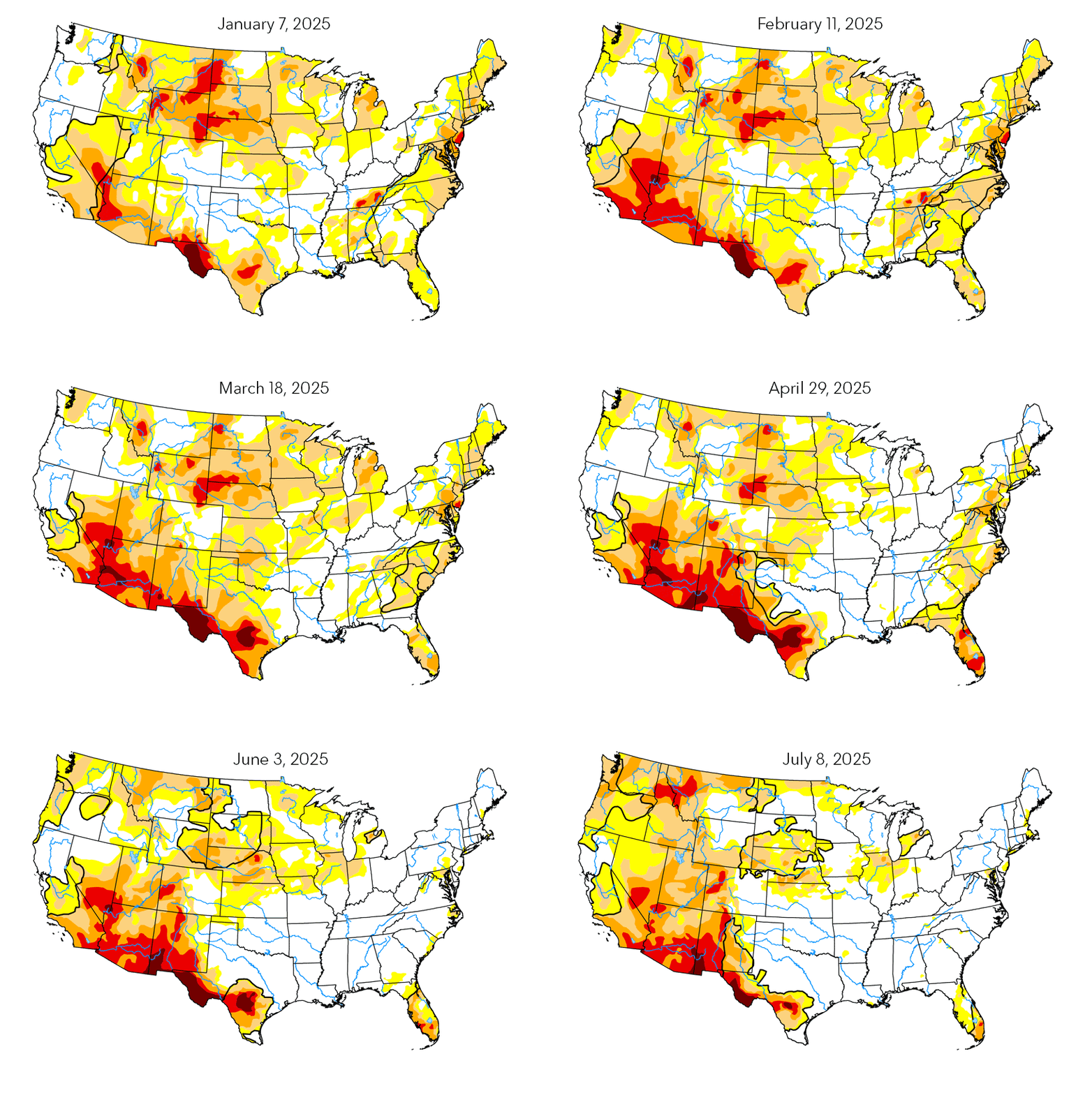
Parts of the Eastern Cornbelt were battered by strong storms during the week, with reports of heavy rain, damaging winds, and several confirmed tornadoes.
A band of thunderstorms brought torrential rain to parts of northern Illinois on April 16, while central areas of the state experienced gusty winds and dust storms that prompted the closure of a three-mile stretch of Interstate 72 for several hours.
A tornado watch was posted for parts of northern and central Indiana on April 17, with forecasts warning of strong winds, large hail, and isolated tornadoes across the region again late on April 18. Much cooler temperatures were on tap for central Indiana by the weekend, with highs in the mid-50s and lows in the 30s.
Multiple tornado warnings were also in effect for areas of northern Ohio on April 17, with an EF-1 tornado confirmed in Bucyrus, Ohio, that caused significant damage to several homes and businesses in the area.
Wet conditions continued to limit fieldwork in the region. Corn planting was 3% complete in Illinois and 1% in Indiana by April 14, while soybean planting was estimated at 4% complete in Illinois by that date. Ohio growers had 11% of the oats planted by April 14, well behind the 27% five-year average.
Western Cornbelt:
Strong thunderstorms on April 16 spawned several tornadoes in Iowa, Nebraska, and northern Missouri, as well as damaging winds, large hail, and heavy rain.
Multiple confirmed tornadoes were reported near the Iowa/Missouri border, with reports of spotty tornado damage in eastern Iowa as well. At least three tornadoes were reported in eastern Nebraska, though all were short-lived and did little damage.

Planting progress continued to track ahead of the five-year average for all crops in the region. Corn planting was 26% complete in Missouri by April 14, compared with 2-4% in Nebraska and Iowa, while soybean planting had progressed to 8% complete in Missouri and 2% in Iowa.
Missouri growers also had 35% of the rice and 2% of the cotton planted by April 14, with oats planting estimated at 66% complete in Iowa and 59% in Nebraska.
Northern Plains:
Cool temperatures and scattered rain and snow showers limited fieldwork in the Northern Plains at mid-month, though planting was underway for corn, soybeans, sugar beets, and oats.
Rain was reported across southern Minnesota as the week progressed, with snow flurries in northern areas of the state. After reaching the 40-50s in Minnesota at midweek, high temperatures were expected to drop to the 30s by April 19-20, with lows in the 20s.
A severe thunderstorm warning and tornado watch was in effect on April 16 for parts of southeastern South Dakota, while cool temperatures and scattered snow flurries were reported in North Dakota.
Corn planting as of April 14 was 3% complete in Minnesota and 1% in South Dakota, USDA reported, with soybean planting estimated at just 1% complete in Minnesota. Minnesota growers also had 2% of the sugar beets planted by that date, while oats planting had progressed to 30% complete in South Dakota, 17% in Minnesota, and just 1% in North Dakota. One southern Minnesota source estimated that planting progress was a full month ahead of last year’s pace at this date.
Most fertilizer application activities in the region were stalled by the weather. “We saw a little application over the weekend and Monday but got some rain today and some cooler temps this week, so things probably won’t get running hard until the weekend,” commented one regional source.
Great Lakes:
Severe weather was reported in parts of Wisconsin and Michigan during the week, with forecasts warning of heavy rain, strong winds, and a chance of tornadoes.
A line of thunderstorms brought an inch of rain to parts of southern Wisconsin on April 16, along with 40-50 mph winds and large hail in some locations. Another band of storms hit central and southern Michigan on April 17, bringing heavy downpours, lightning, and 60 mph gusts. Tornado watches and shelter-in-place warnings were also posted for numerous locations.
Wisconsin growers had 1% of the corn and 10% of the oats planted by April 14, USDA reported, while Michigan growers had yet to register any planting progress by that date.
Northeast:
Showers were expected to move through parts of New England late in the week, with the potential for severe weather in some locations.
Strong storms at midweek knocked out power to thousands of Pittsburgh, Pa., residents on April 17, with reports of heavy rain, strong winds, severe thunderstorm warnings, and tornado watches in effect for many communities in southwestern Pennsylvania.
After posting highs in the low-80s earlier in the week, temperatures in eastern New York were expected to drop to the 40s and 50s on April 18-19, with an increased chance of rainfall into the weekend.
Eastern Canada:
Wet weather limited fieldwork in Eastern Canada during the week, though the precipitation alleviated drought and wildfire concerns in some locations.
Multiple rounds of showers were reported across Ontario, pushing Toronto closer to a record level of April rainfall. As of April 15, Toronto had recorded 93.7 mm of rain for the month, approximately 150% of its typical April total of 63 mm. An additional 39.7 mm of rain this month will tie the record of 133.4 mm set in April 1992.
Wet weather also hit Quebec during the week, with light snowfall reported in some parts of the province. Mostly clear and cool weather prevailed over the Maritimes, but weekend rainfall was expected in southern New Brunswick, Nova Scotia, and Prince Edward Island.
Growers have been able to plant and apply fertilizer between showers, with estimates that as much as 60-70% of the nitrogen has been applied on wheat in southern Ontario. Very little preplant application has occurred on corn ground, however. “We really have not got started in any big way,” said one regional contact.
US Gulf:
Port Allen Lock, closed for emergency repairs since March 28, will force detours through Algiers Lock through an estimated April 24. Corps data showed vessels waiting up to 49 hours to pass Algiers Lock during the week. Due to the Port Allen Lock closure, a scheduled shutdown at Bayou Boeuf Lock has been postponed until further notice.
Following an unplanned March 30-April 8 closure at Industrial Lock, the lock shut again on April 14 for about 24 hours, sources said. Lengthy backups were reported following the site’s reopening on April 15, with tows waiting up to four days to lock at midweek.
Work to clear sand, silt, and oyster shells from gate recesses at Colorado Lock was extended through April 20, restricting weekday traffic from 8 a.m. to 5 p.m. Navigation shutdowns were limited to intermittent three-hour stretches, though a handful of 12-hour delays were reported.
The Corps continued to warn of gate problems at Brazos Lock, where mud and possible debris have prevented the South Sector Gate at the West Brazos Floodgate from closing fully. Vessels were advised to hug the north side of the chamber while passing the site to avoid the obstruction. Intermittent delays were reported up to 17 hours during the week.
Guidewall repairs at Bayou Sorrel Lock are set to run through Oct. 30, blocking travel from 7 a.m. to 4 p.m. daily. Delays were noted up to nine hours. Planned bridge repairs at Mile 63 of the Port Allen Route will shut the area to navigation from 7 a.m. to 7 p.m. on April 22, 24, and 26.
Extreme caution warnings were reported on travel through the Pascagoula Ship Channel’s Horn Island Pass due to pipeline dredging. The effort is slated to run through April 27. Harvey Lock delays were noted up to 13 hours, down from 31 hours last week.
Mississippi River:
Rising water levels impacted travel on the Lower Mississippi River, with sources reporting towing restrictions based on vessel horsepower. Delays ran up to three days as a result.
The river gauge at Vicksburg, Miss., reported at an action-stage 35.3-feet at midweek, was projected to crest at 36 feet on April 20-21 before falling out of action stage on April 26. An April 18 flood warning for the area was in effect until further notice.
Depths at Baton Rouge, La., were poised to cross above the 30-foot action stage on April 18. Following an expected peak at 31.9 feet on April 22-23, the gauge was forecast to hold above action stage through at least May 2.
Dredging at Mile 107 is scheduled to continue through May 26. Five-hour waits were reported at Mel Price Lock during the week, and delays tracked up to six hours at Lock 27.
Illinois River:
Marseilles Lock was shut for upper miter gate repairs between 7 a.m. and 3 p.m. on April 17, a Corps posting indicated.
Wait times cracked the six-hour mark at Dresden Island Lock, according to Corps data. Wickets were down at Peoria Lock and LaGrange Lock, allowing tows to pass both sites without locking.
Ohio River:
High water levels continued on the Ohio River during the week. Sources noted maximum loading drafts in the 10-11.5 foot range, depending on location and direction of travel. The Cincinnati gauge crested below the 52-foot minor-flood stage at 51.3 feet on April 15-16, and was posted at an action-stage 47.6 feet on April 18. Levels were projected to fall out of action stage late on April 19.
The main chamber at Willow Island Lock was shuttered on April 15 for scheduled maintenance, forcing tows to lock through the auxiliary chamber until May 15. Waits were recorded in a wide 5-22 hour range.
Scheduled work at Cannelton Lock and Markland Lock is expected to slow movements at both sites from April 22 to June 7. Markland Lock will see an additional closure on June 10-28 for miter gate repairs.
Racine Lock machinery repairs will run from June 1 through July 11, while planned dewatering and miter gate repairs are scheduled for June 15 through Nov. 7 at Hannibal Lock. A Belleville Lock project will trigger a shutdown of the site’s primary and secondary chambers for 30 days apiece during the second half of the year, sources said.
Willow Island Lock delays were reported up to 23 hours near the end of the week. On the Tennessee River, waits topped out above the 16-hour mark at Kentucky Lock, while six-hour delays were noted at Pickwick Landing Lock. Wait times were posted up to 18 hours at Wilson Lock.
Arkansas River:
The Van Buren Bridge, at Mile 300.8 of the Arkansas River, will close to navigation on Aug. 16-Sept. 8 for repairs. Waiting vessels will be cleared to pass following the ninth day of work, sources said.
Dallas-based Sunoco LP and NuStar Energy LP, San Antonio, Texas, on April 9 announced the expiration of the waiting period under the Hart-Scott-Rodino Antitrust Improvements Act of 1976 (HSR Act), in connection with Sunoco’s $7.3 billion acquisition of NuStar (GM Jan. 26, p. 1). They noted that the expiration is an important condition for the completion of the transaction.
A NuStar unitholder vote is scheduled for May 1. The transaction is expected to close shortly after unitholders give approval to the deal.
The acquisition will expand Sunoco’s crude oil transportation and storage. NuStar’s assets, which include pipelines and terminals for ammonia, oil, chemicals, and other fuel-related products, are mainly in the Midwest and West Coast.
Sunoco said the deal will allow it to diversify, increase its ability to use more of its own terminals, buy up a key part of its supply chain, and allow it to optimize fuel supply cost. It will also allow Sunoco to expand its presence across more of the US, the company said.
NuStar has 9,500 miles of pipeline and 63 terminals, while Sunoco is the largest US independent fuel distributor with 42 product terminals, serving motor fuel to approximately 10,000 convenience stores, independent dealers, commercial customers, and distributors located in more than 40 US states and territories.
Sunoco CEO Joseph Kim told analysts that the company would be able to accelerate expansion opportunities within the NuStar Ammonia System’s 2,000-mile ammonia pipeline. The company sees the potential due to the growing low carbon ammonia capacity, which benefits the pipeline and storage and export out of its St. James, La., facility.
“In fact, projects have been announced for construction in the US for low carbon ammonia production totaling about 38 million tons per year that will be in service between 2025-2030,” NuStar CEO Brad Barron told analysts in a Nov. 2 earnings call.
Barron said that because NuStar’s system runs through the Midwest down to the Gulf Coast, where the vast majority of the announced production capacity will reside, and because of NuStar’s decades of experience in ammonia transport, the company is ideally positioned to become the premier low carbon ammonia provider in the US and to provide export service to Asia, Europe, and other markets.
Barron said the company does not have to expand pipeline capacity but just add connections. Going forward he expects additional volumes from new demand, with firm space on the line garnering a premium. NuStar expects to announce a project with a large global ammonia producer in early 2024. The company spent $25 million for expansion in the segment in 2023.
NuStar was expected to connect a 14-mile ammonia pipeline to OCI Global NV’s Iowa Fertilizer Co. (IFCO) in Wever, Iowa, earlier this year (GM May 5, 2023). The 2,000 pipeline spans seven states from Louisiana, north along the Mississippi River to Missouri, and then northwest and east, to Nebraska and Indiana.
NuStar’s is the only US ammonia pipeline after Magellan Midstream Partners LP’s 1,100-mile line from Borger, Texas, to Mankato, Minn., gradually closed a few years ago (GM March 19, 2021; Aug. 9, 2019).
Boston-based Ginkgo Bioworks, which is building a platform for cell programming and biosecurity, and biological pesticides provider Certis Biologicals, Columbia, Md., have separately announced that they have bought assets from AgBiome, Research Triangle Park, N.C.
Ginkgo on April 11 said it has acquired AgBiome’s platform assets, including over 115,000 fully sequenced and isolated strains, over 500 million unique gene sequences, and relevant functional data and metadata, as well as AgBiome’s development pipeline.
“We are so excited to bring AgBiome’s incredible strain and metagenomic collection into Ginkgo,” said Michael Miille, Gingko Fellow. “This is a world class asset that will significantly expand our capabilities and can directly benefit Ginkgo’s customers in the ag biologicals space. In addition to the platform assets and capabilities, the product concepts pipeline that has been validated by AgBiome to date provides an exciting opportunity to give customers a head-start in their product development efforts.”
“These assets represent a massive, ground-breaking investment into exploring and characterizing microbial diversity for human benefit, and we can’t think of a better home for them than the Ginkgo platform,” said Laura Potter, Agbiome Chief Science Officer.
Ginkgo said the assets will be integrated into Ginkgo Ag Biologicals Services, established with the acquisition of a Bayer agricultural biologicals R&D facility in 2022, and will expand Ginkgo’s proprietary unified metagenomics database. It said combined, this creates one of the deepest and most advanced ag biological discovery and development platforms as well as a rich resource for the development of AI models for biological R&D.
Founded in 2012, AgBiome has worked to generate an extensive collection of biological products and technologies through its Genesis Discovery Platform, including agricultural products, bioactive ingredients, and gene editing tools.
AgBiome has successfully commercialized multiple biological products, including the Howler® and Theia® fungicide product lines, which, along with other “multiple assets,” are being bought by Certis, a wholly-owned subsidiary of Mitsui & Co, according to March 18 announcements by Certis and AgBiome. The two fungicides will be added to the Certis portfolio of more than 40 products that control pests, diseases, and weeds.
“Howler and Theia complement our existing portfolio of biofungicides, including Double Nickel® and our newest product for large-acre crops, Convergence®,” said Chris Judd, Vice President, North America, Certis Biologicals. “These products will constitute a fungicide portfolio that can provide unmatched control for all growers, from specialty and high-value crops to large-acre commodity crops.”
“AgBiome’s products, Howler and Theia fungicides, are the most effective biological fungicides with unique modes of action and efficacy similar to synthetic chemicals but with substantial environmental benefits,” said Scott Rabe, AgBiome Head of Product Development. “We are delighted that a company like Certis Biologicals, with a deep commitment to these products, will steward their future growth and development. More growers than ever will be able to see firsthand the benefits of these products.”
While AgBiome has received multiple major grants from the Bill and Melinda Gates Foundation and other investors, in October 2023 it said it was having trouble raising capital and was developing plans to lay off potentially all of its employees (GM Oct. 27, 2023). AgBiome had not responded to inquiries at press time.
Talc USA, Page, N.D., a developer, manufacturer, and marketer to talc-based ag products, announced on April 8 that it is preparing a new facility in Curran, Ill., to increase its production capacity in the US while reducing shipping costs to its end farmer customers.
Talc, which is majority-owned by specialty ag products producer Brandt, Springfield, Ill., said the production line is scheduled to be completed in third-quarter 2024 in time to supply the 2025 planting season. The new production line will manufacture all Talc products, including the company’s newest and most advanced HomeLAND™ products for corn and soybeans.
“As we continue to integrate our operations into Brandt, it makes good business sense to co-locate our manufacturing line in Illinois and take advantage of Brandt’s production expertise,” said Steve Johnson, Talc Founder. “And frankly, we needed to be able to produce more product as the demand for our cutting-edge technologies escalates. Farmers are seeing increased yield with smoother planting.”
The Curran production facility will fall under the supervision of the
Brandt Dealer Support group. Ultimately, when fully staffed, it will require
5-8 additional full-time employees. Brandt is currently searching for a plant
production manager to help recruit, train, and oversee the
team.
“Growth is always a good challenge to have, and I’m proud of this next
step in our business’ evolution,” Johnson said. “We are making a significant
investment with this move, but we’re doing it right with new, more advanced,
and bigger equipment than what we had in Page. We’re setting ourselves up for
the future.”
In addition to its domestic growth, Talc has plans for international
expansion and increased distribution as well. Subsequent
announcements are expected later this year.
Founded in 2008, Talc offers a range of micronutrients, microbials, inoculants, and seed treatments to growers, as well as a proprietary mixing system, in addition to its flagship talc products. The company’s products are distributed in the US, Canada, Mexico, Ukraine, and South Africa.
Brandt acquired a majority stake in Talc on Dec. 31, 2021 (GM Jan. 14, 2022).
Toronto-based Brazil Potash Corp. on April 9 announced that the Amazon State Environmental Protection Institute (IPAAM) has granted the mine Installation License for the Autazes Potash Project to the company’s 100%-owned Brazilian subsidiary Potassio do Brasil. It said this is a major milestone coming after several years of environmental, social, and technical studies, as well as the successful completion of consultations with Indigenous Peoples.
“We are thrilled to receive the mine installation license from the Amazon State Environmental Protection Institute,” said Adriano Espeschit, Potassio do Brasil President. “For several years, Brazil Potash has been waiting for this moment to show that [it] is possible to have a sustainable mining operation in the Amazon region. With the Autazes Potash Project’s support from the Mura Indigenous people, we can show the world that it is possible to have more development for local communities with a better quality of life. This truly marks a win-win for Brazil’s economy, its people, and the world.”
“I am very proud of the years of permitting, indigenous, government, and community relations work completed by our team in Brazil headed by our President Adriano Espeschit, which has resulted in securing the mine Installation License,” said Matt Simpson, Brazil Potash CEO. “This is a major milestone to advance and derisk the development of the Autazes Potash Project as we move closer to the start of project construction.”
The company said this will finally allow construction to begin and it expects to start construction with the awarding of contracts for mine surface works and shaft construction. The company said the mine will be able to produce 2.4 million mt/y with the ability to increase production. The last price tag put on the mine was $2.5 billion.
Brazil Potash said the deposit can be mined and processed, using proven off-the-shelf environmentally friendly technology, to extract the ore using room and pillar mining, separate out the potash using hot water, and return the remaining material (sodium chloride tailings) back underground.
From an environmental perspective, Brazil Potash said the project has positive greenhouse gas credentials considering it will operate with predominantly green produced electric energy. Brazil domestic production also eliminates 12,000-20,000 kilometers of shipping to reach Brazil’s large soybean farmers in Mato Grosso.
The company noted that Brazil imports some 85% of its fertilizer needs and 98% of its potash, half of which comes from countries currently at war or sanctioned, including Russia, Belarus, and Israel, while Brazil has a massive potash deposit in its own backyard.
Brazil Potash said the project will have a positive impact on the economy and environment of the Amazonas state by reducing greenhouse gases by approximately 1.4 million mt/y and creating an estimated 10,000 new jobs, making it the largest contributor to the GDP for the state of Amazonas. In addition, the project will produce potash locally and sell it in local currency, thus saving Brazil roughly $1 billion in currency outflows.
The company said it is also committed to supplying potash in small quantities to domestic farmers as they need it, and to supporting the initiatives of the Brazilian government to restore degraded land.
Brazil Potash has also signed binding agreements with Amaggi Exportação e Importação Ltda. (Amaggi), one of the world’s largest privately held soybean producers (GM Oct. 7, 2022). The offtake would include take-or-pay for 500,000 mt/y, a marketing agreement to sell Potássio do Brasil’s remaining 1.9 million mt/y, and a barge transportation agreement to ship the initial planned 2.4 million mt of potash to inland ports close to major farming regions.