All posts by hlancey@bloomberg.net

Crops/Weather

Eastern Cornbelt:

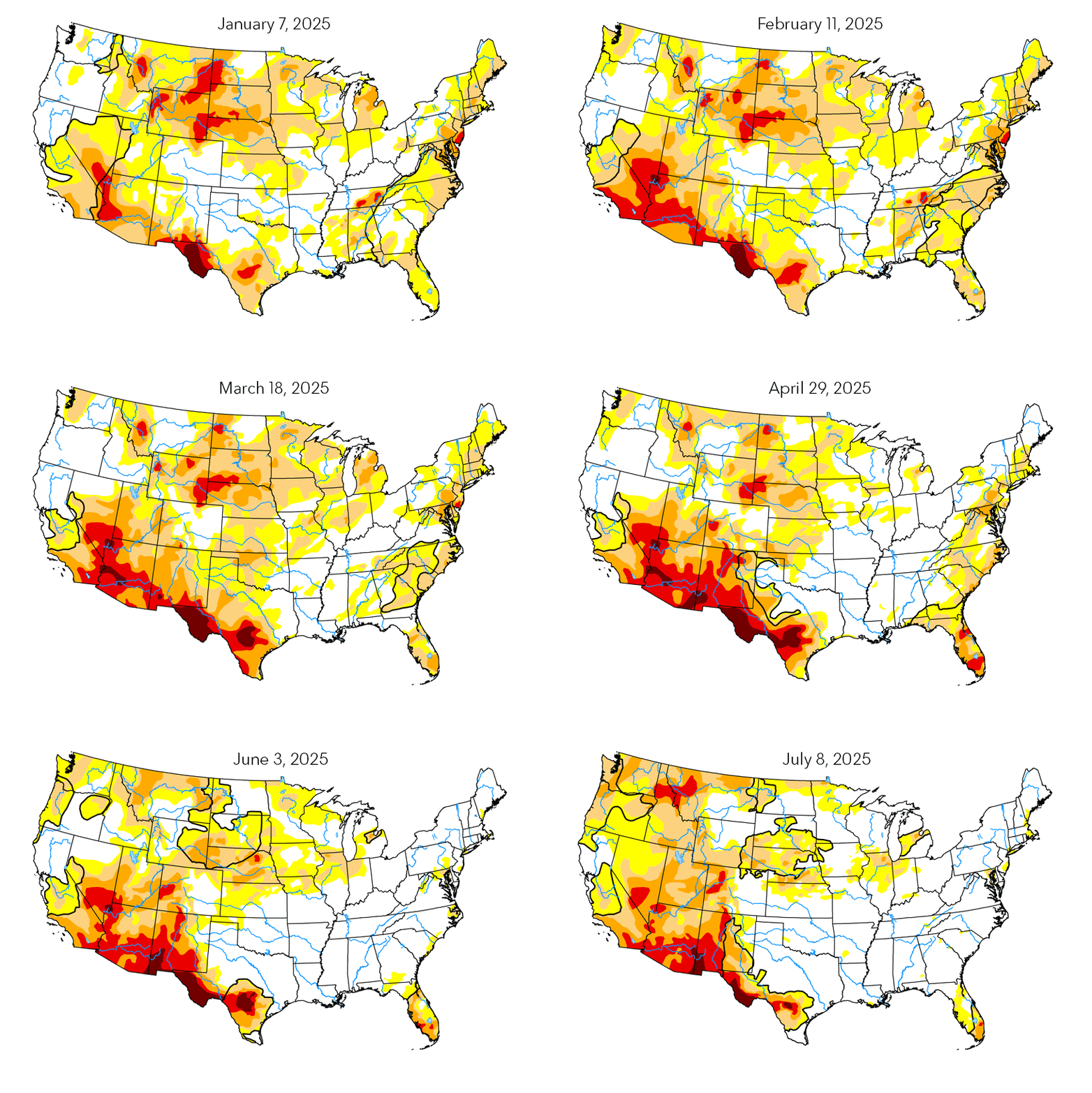
US Drought Monitor

Wet weather limited fieldwork in the Eastern Cornbelt during the week. Heavy rainfall was reported across northern Illinois and Indiana on April 10-11, with temperatures falling to the upper-40s ahead of a weekend warmup to the upper-60s and low-70s.

Flood warnings were in effect at midweek for multiple Indiana counties after 1-3 inches of rain fell in many areas. Flood watches were also posted for much of Ohio as the same system brought similar rainfall totals to the region. Strong winds were expected in parts of both states late in the week.

Corn planting as of April 7 was 2% complete in Illinois, with the planting of oats estimated at 7% complete in Ohio and 4% in Wisconsin. “Hopefully we won’t get too much weather so we can get a good start to the season now that the long-range temperatures look favorable next week and beyond,” said one regional contact at midweek.

Western Cornbelt:

Temperatures climbed to the 60s and low-70s in Iowa during the week, with highs expected to reach the low- to mid-80s in some areas by the weekend. The surge of warm weather was accompanied by 25-35 mph winds in central Nebraska, which prompted a red flag fire warning on April 11 due to dry conditions and humidity as low as 15%.

Corn planting progressed to 7% complete in Nebraska by April 7, with 14% of Missouri’s rice crop also seeded by that date. Oats planting was also tracking ahead of the average pace at 31-32% complete in Nebraska and Iowa as of April 7.

Corn Wheat Soybean Index

California:

California was bracing for another powerful Pacific storm system, which was expected to hit Northern California on April 12 before slicing into Central and Southern California on April 13.

While not carrying the same amount of moisture that poured into the state earlier this year from back-to-back atmospheric rivers, the storm prompted isolated flash flood warnings in Santa Barbara and Ventura counties, as well as forecasts for up to a foot of snow at higher elevations in the Sierra Nevada.

Precipitation since July 1, 2023, has ranged from 125-200% of average for much of Southern California, while sticking close to the historical average for Northern California.

The wet winter has left most of California’s reservoirs with water levels well above the historical average for April. The latest estimates from the California Department of Water Resources put current capacity at 122% of normal at Oroville, 121% at Millerton, 118% at Shasta, 116% at Folsom, 111% at Don Pedro, and 92% at Castaic.

Pacific Northwest:

Spotty showers and cooler temperatures were reported across western Oregon and Washington as the week progressed, with parts of central and eastern Oregon bracing for potentially stronger thunderstorms by the weekend.

Temperatures climbed to the upper-60s and low-70s across Idaho and Montana late in the week, giving growers ideal conditions for spring fieldwork and planting in some areas. Idaho growers had 12% of the sugar beets planted by April 7, trailing the 21% five-year average.

Western Canada:

Steadily warming temperatures were reported across Western Canada during the week, with highs in the low-20s C expected by the weekend in southern Manitoba and southern Saskatchewan.

Parts of Alberta saw highs climbing to the low- to mid-teens as the week progressed, but a weather system was expected to push temperatures down to the single digits and bring rain, snow, and wind by early next week.

“There is some seeding going on in Alberta, but just getting started,” commented one regional contact at midweek. “It will be ten days before anything goes in a big way.”

Transportation

US Gulf:

Port Allen Lock, closed for emergency repairs since March 28, was expected to remain offline through at least April 24, forcing detours through Algiers Lock. Corps data showed widely variable delays at Algiers during the week, with most tows waiting 25-60 hours to pass the site. Due to the shutdown at Port Allen Lock, a Bayou Boeuf closure scheduled for April 1-30 has been delayed until further notice.

Industrial Lock returned to service on April 8 after a broken miter gate hinge assembly forced an unplanned shutdown on March 30. The lock faced a large backlog on reopening, with tows waiting up to 10 days to pass. Corps data showed 33 tows in line to lock on April 11, down from 65 reported one week earlier.

Work at Colorado Lock was reported on April 3-10 to clear sand, silt, and oyster shells from gate recesses, a Corps posting indicated, resulting in intermittent delays up to 40 hours.

A buildup of mud and debris prevented the gate from opening fully at Brazos Lock starting on April 5, requiring vessels to track toward the north side of the western Brazos floodgate. Work to clear the obstruction was expected to wrap up by April 14.

Guidewall repairs underway at Bayou Sorrel Lock, located at Mile 37 of the Port Allen Route, are expected to run through Oct. 30, limiting weekday movements from 7 a.m. to 4 p.m. Daytime waits were quoted at 7-9 hours during the week.

Drawbridge repairs at the Ellender Bridge, at Mile 243 of the West Canal, were scheduled to wrap up on April 12. Bridge work planned at Mile 63 of the Port Allen Route will shut the area to daytime navigation on April 22, 24, and 26, three days later than originally planned.

Pipeline dredging at the Pascagoula Ship Channel’s Horn Island Pass was expected to run through April 27, prompting extreme caution warnings for vessels transiting the area.

Harvey Lock wait times were posted up to 31 hours during the week. Thunderstorms and heavy rainfall reportedly forced widespread navigation outages throughout the US Gulf on April 10, with delays noted up to 12 hours.

Mississippi River:

A security zone was in place at Miles 94.4-95.1 of the Lower Mississippi River on April 11-14 due to the French Quarter Festival in New Orleans, restricting travel through the area.

Dredging at Mile 107 is expected to continue through approximately May 26. Delays approached the five-hour mark at Lock 27 during the week.

Illinois River:

Marseilles Lock is scheduled to close for upper miter gate repairs from 7 a.m. to 3 p.m. on April 17, a Corps posting indicated.

Wait times were noted up to five hours at Dresden Island Lock, while Marseilles Lock delays were quoted as high as nine hours. Starved Rock Lock waits topped out at 14 hours, according to Corps data. Wickets were in the lowered position at Peoria Lock, allowing vessels to pass without locking.

Ohio River:

High water levels and large amounts of drift impacted travel on the Ohio River during the week, though vessel traffic had largely bounced back following last week’s flood-related shutdowns.

River levels at Cincinnati were posted at an action-stage 40.1 feet and falling on April 11, after cresting just shy of the 52-foot minor-flood zone at 51.7 feet on April 7. The gauge was projected to hold at or near action stage through at least April 15.

The Meldahl Lock main chamber reopened during the week, ending an unplanned shutdown that forced tows to detour through the site’s smaller auxiliary chamber since late 2023. Lengthy delays persisted during the week due to heavy drift, however, with Corps data showing vessels waiting up to six days to lock through the site, up from 33 hours reported one week earlier.

Valve repairs at Greenup Lock were scheduled to conclude on April 12, and planned work at Markland Lock and Cannelton Lock will run from April 22 through June 7. Markland Lock will be offline on June 10-28 for miter gate repairs.

Racine Lock machinery work is scheduled for June 1 through July 11, and miter gate repairs will limit navigation at Hannibal Lock between June 15 and Nov. 7. The Belleville Lock main and auxiliary chambers will close for 30 days each during the second half of the year.

Main chamber work at the Pickwick Landing Lock, on the Tennessee River, was scheduled to end on April 11. Waits ran up to 10 hours at Kentucky Lock during the week, and intermittent 9-13 hour delays were noted at Wilson Lock.

Arkansas River:

Repairs to the Van Buren Bridge are slated to begin on Aug. 16. The project will run for roughly 18 days, and vessels will be cleared to pass the site after the ninth day of work. The bridge is located at Mile 300.8 of the Arkansas River.

TFI, Shipping Company Downplay Impact of Baltimore Bridge Collapse

The destruction of the Key Bridge in Baltimore should have a relatively limited impact on US fertilizer trade, according to a March 28 statement from The Fertilizer Institute (TFI). TFI said that over the last five years, on average, about 1% of all US fertilizer imports have come in through the Port of Baltimore.

In 2023, fertilizer imports into Baltimore were valued at nearly $75 million, with more than 86% of those imports comprised of nitrogen fertilizers. Baltimore was the seventh most important port for imports of fertilizer from Russia in 2023, with imports of $33.5 million from that trade partner.

Fertilizer exports from Baltimore were more limited, TFI said, averaging about $7 million over the last five years. Less than 1% of US fertilizer exports in 2023 left from Baltimore.

The bridge collapse will have a “relatively small impact” on global shipping as crews work to clear debris hindering port access, according to John Wobensmith, CEO of Genco Shipping & Trading Ltd., in an April 3 interview with Bloomberg TV.

The two channels now open aren’t deep enough to allow Genco vessels to pass, Wobensmith said. “Hopefully in the next few weeks there will be deeper channels that are established,” he added. In the meantime, other East Coast ports have been modifying operations to absorb cargoes diverted from Baltimore.  

US Transportation Secretary Pete Buttigieg said the federal government should pay to get the bridge rebuilt before sorting out liability for the foreign-flagged cargo ship, a path that could face roadblocks from Republicans in Congress.

“That’s going to be pursued aggressively, but to me, that’s really something we need to take care of on the back end,” Buttigieg told reporters on April 2. “I don’t want to run any risk that that could add one day to the process of getting the port back open and the bridge back up.”

The Transportation Department has granted $60 million for immediate needs, in what Buttigieg called a “down payment.” He said the emergency relief account has about $950 million, and the department is researching any flexibility with limits to those funds. 

Some GOP House members are opposed to President Biden’s pledge to cover the cost of replacing the bridge. Pennsylvania Rep. Dan Meuser labeled the promise “outrageous,” while Rep. Jeff Duncan of South Carolina said the money should come from the Infrastructure Investment and Jobs Act Biden signed in 2021, adding “before we spend one more dime for domestic infrastructure, we must build a border wall.” 

Senate Minority Leader Mitch McConnell has come out in support of Biden’s pledge, saying it’s the government’s responsibility to cover the costs. “In situations like that,” he told a radio host in an interview, “whether it’s a hurricane in Florida or an accident like this, the federal government will step up and do the lion’s share of it.”

The most comparable situation to the Baltimore bridge came on Aug. 1, 2007, when the eight-lane I-35 bridge in Minneapolis, Minn., collapsed over the Mississippi River while loaded with rush hour traffic. Thirteen people were killed and 145 were injured.

It took Congress just three days to authorize $250 million in federal funds for repairs to the Minneapolis bridge. President George W. Bush promptly signed the bill, and the bridge was rebuilt and ready to roll within 13 months, three months ahead of schedule.

The federal government’s deep pockets have typically been part of the standard response to massive disasters such as Baltimore’s. When a train derailed in East Palestine, Ohio, in 2023, Washington covered upfront costs. Ditto for the Deepwater Horizon oil spill in the Gulf of Mexico off the Louisiana coast in 2010.

The owner of the ship in Baltimore is already seeking to limit its liability to about $43.7 million. The company, Grace Ocean, could face hundreds of millions of dollars in damage claims, legal experts say. On April 1 it filed a petition jointly with Synergy Marine, which was operating the Singapore-flagged ship. They claim the collapse of the bridge was “not due to any fault, neglect, or want of care” of the companies and that they shouldn’t be held liable for any loss or damage from the disaster.

But if they are held liable, it shouldn’t be for more than the current value of the ship and its cargo, they said. Following the crash, the total value has fallen from as much as $90 million to $43.7 million, according to the filing in federal court in Maryland.

The petition is a common move for ship owners in the wake of catastrophic crashes like the one in Baltimore. It invokes a 19th-century law once used by the Titanic’s owner to reduce the ship owner’s liability after a crash to the value of the ship and any pending freight.

The companies said they expect the liability limit they are seeking to be “substantially less than the amount that has been or will be claimed” in losses or damages. The petition comes less than a week after the March 26 crash and as parts of the ship remain stuck at the site of the accident. 

CHS Ag Segment Posts Strong 2Q Earnings; Improved Agronomy Margins, Volumes Cited

CHS Inc. reported a strong second-quarter ending Feb. 29 for its Ag segment, saying agronomy markets were stronger while grain and oilseed margins were stable. The segment reported pretax earnings of $56.9 million on revenues of $7.3 billion, up from the year-ago loss of $81.6 million and $9.1 billion, respectively. 

Ag reported improved margins for wholesale and retail agronomy products due to improved market conditions, while grain and oilseed margins were up due to the timing impact of market adjustments. Wholesale crop nutrient sales volumes were up 12.2% to 1.54 million st from the year-ago 1.37 million st.

Lower prices were reported across the Ag segment, including agronomy, with lower urea and UAN prices cited. Grain and oilseed volumes were up due to improved efficiencies and a more balanced global supply and demand environment.

CHS said performance was solid across all segments, although earnings were down from the year-ago record quarter. CHS-wide net income was $170.3 million on revenues of $9.1 billion, down from $292.3 million and $11.3 billion, respectively.

“The first six months of our fiscal year have delivered overall good financial results,” said Jay Debertin, CHS President and CEO. “Our supply chain investments and well-diversified portfolio, empowered by our people and technology, are helping us perform well as we connect farmers and local cooperatives with the inputs and services they need to help feed the world.”

Second-quarter Nitrogen Production earnings were off at $37 million from $81.7 million. CHS said the decrease reflected lower equity income from CF Nitrogen, which was attributed to decreased urea and UAN prices.

Second-quarter Energy earnings dropped to $51.6 million on revenues of $1.87 billion, down from the year-ago $264.8 million and $2.31 billion, respectively. CHS cited decreased refining margins due to lower market prices and less favorable pricing on heavy Canadian crude oil, partially offset by a lower cost for renewable fuel credits.

Lower margins for propane were also reported due to global market conditions. There was reduced demand for propane and refined fuels, primarily driven by warm weather conditions across much of the trade territory.

CHS-wide six-month net income was $693.2 million on revenues of $20.5 billion, down from the year-ago record $1.1 billion and record revenues of $24.1 billion, respectively.

Six-month Ag income was up at $226.6 million on revenues of $16 billion versus the year-ago $205.7 million and $18.8 billion, respectively. Wholesale crop nutrient sales volumes were up 14.2%, to 3.41 million st from the year-ago 2.99 million st.

Six-month Nitrogen Production income was off at $73.5 million from the year-ago $178.6 million, while Energy dropped to $318.4 million on revenues of $4.8 billion, down from $661.4 million and $5.7 billion, respectively.

CHS plans a 69% increase in capital expenditures in fiscal 2024, to $953 million from 2023’s $654.5 million. It said the increase is for investment in infrastructure to meet the evolving needs of owners and customers, enhance value for the cooperative system, and propel sustainable growth. It said for the first six months of 2024 it has already acquired $346.1 million of property, plant, and equipment. However, major maintenance is expected to drop to only $20 million from $217.4 million due to significantly reduced turnaround activities at its refineries.

Genesis Fertilizers, thyssenkrupp Ink Nitrogen Plant Pre-FEED Contract

Saskatoon-based Genesis Fertilizers LP and German engineering firm thyssenkrupp Uhde have signed a Pre-FEED (front-end engineering and design) contract to conceptually develop a long-planned integrated fertilizer complex in Belle Plaine, Sask.

The proposed plant will be designed to produce 1,500 mt/d of ammonia, 2,600 mt/d of urea/UAS granulation, nitric acid, and UAN, plus the ability to produce diesel exhaust fluid (DEF). The parties did not offer a current cost estimate or timeline for the project.

“Our primary goal is to ensure the supply of fertilizers to the farmers in Western Canada based on the most advanced technologies available with the lowest possible carbon footprint,” said Jason Mann, Genesis CEO and President. “We are pleased to be working with a strong industry partner that offers expertise in all the processes and technologies involved from a single source.”

Genesis was founded on a business model that allows farmers to be both the customers and majority owners of the proposed new fertilizer plant. The company has been developing a distribution network of “SuperCenters” across Western Canada (GM Sept. 29, 2023), and has long planned a urea plant for Belle Plaine. A predecessor company, Farmers of North America (FNA), first proposed a project in 2012 (GM Oct. 1, 2012) and selected a site in 2014 (GM June 23, 2014).

“This project is further proof that the transition of the fertilizer industry towards more sustainability has started,” said Lucretia Löscher, COO of thyssenkrupp Uhde. “Our expertise in clean fertilizer technologies and their integration is essential to support our customers on their journey to protect the climate.”

thyssenkrupp Uhde will provide engineering solutions with a key focus on minimizing plant emissions, noting that its EnviNOx® technology will almost completely eliminate nitrogen oxides from nitric acid production. In addition, the design of the plant will consider the potential use of renewable-based hydrogen and electricity.

Calamco, Partners Study Clean Ammonia for Maritime Fuel Use on US West Coast

California-based cooperative Calamco, along with four partners – American Bureau of Shipping (ABS), Fleet Management Ltd., Sumitomo Corp., and TOTE Services LLC – on March 29 announced the execution of a Memorandum of Understanding (MOU) to jointly conduct a feasibility study to establish a comprehensive and competitive supply chain for the provision of clean ammonia ship-to-ship bunkering on the US West Coast.

The study will be conducted at the ports of Oakland and Benicia, and at other major ports on the US West Coast. The study aims to explore the possibility to utilize Calamco’s existing ammonia storage terminal at Stockton for a pilot demonstration project of ammonia bunkering for car carriers calling at Port of Benicia and container vessels calling at Port of Oakland.

The partners described the study as a first step toward wide adoption of ammonia as marine fuel on the US West Coast. Benicia is one of the key vehicle-handing ports on the US West Coast, while Oakland also ranks among the top 10 of the largest US ports.

Calamco, which is the largest ammonia distributor in the state, will conduct a feasibility study of ammonia loading operations from its Stockton ammonia terminal to an ammonia bunkering articulated tug-barge (AB-ATB), leveraging its experience at the terminal.

“We are excited to support the exploration of ammonia bunkering in the US West Coast,” said Calamco President Dan Stone. “As one of the few ammonia storage and handling facilities in the geographical area, Calamco is well positioned to serve the growing needs of the maritime industry. Calamco has many years of safe and efficient operational experience at the Port of Stockton.”

“We embark on our ambition to build the first ship-to-ship ammonia bunkering base in the US West Coast in addition to Singapore, Oman, and the US East Coast, which highlight our commitment to offer our customers the best available and technologically proven solution to reduce the emission footprint from maritime transport,” said Koji Endo, General Manager of Sumitomo’s Energy Division. The company will structure, integrate, and promote the end-to-end clean ammonia supply chain, which includes sourcing, transportation, storage, and bunkering.

ABS will conduct risk assessment of ammonia ship-to-ship bunkering and lead in coordination with US authorities to establish port regulations and operational guidelines. TOTE will develop the AB-ATB and safe and reliable ammonia bunkering procedures from the AB-ATB point of view, leveraging their experience operating LNG bunkering in the US.

Fleet will work on the development of safe and reliable ammonia bunker procedures from a ship manager point of view, and provide technical support in the design development of the alternative fuel vehicle and AB-ATB.

Sumitomo, ABS, Fleet, and TOTE are participating in a similar study on the US East Coast, which includes the participation of Georgia Ports Authority, AP Moller-Maersk, Savage Services, and Maersk Mc-Kinney Moller Center for Zero Carbon Shipping. This study will be conducted at the Port of Savannah.

Nutrien Latam Divestments Eyed, Executive Exits Reported

Nutrien Ltd. has been eyeing the divestment of assets in Argentina, Uruguay, and Chile, and has ended its asset buying spree in Brazil, according to a Reuters report, which also said some eight senior Latam executives have been fired or left the company within the past year. The actions were reportedly in response to deep losses in the region and came from unidentified people with direct knowledge of the matter.

Nutrien told analysts last fall that it had paused additional investments in Brazil until there is greater stabilization of the market (GM Nov. 3, 2023). “We will utilize this period to integrate recent acquisitions and optimize our cost structure,” said Pedro Farah, Executive Vice President and CFO.

Farah said at the time that the company still believed the long-term prospects for agriculture in Brazil are strong and it sees opportunity for future growth of its retail platform. It reiterated this position in financial filings on Feb. 22, 2024.

In full-year 2023, Nutrien recognized a $465 million non-cash impairment primarily to goodwill relating to its Retail – South American assets, mainly due to the impact of crop input price volatility, more moderate long-term growth assumptions, and higher interest rates.

Brazil also saw continued margin compression due to decreased prices for certain crop protection products and the selling through of high-cost inventory.

As for the divestments and executive exits, Nutrien had less to say. “As a new business, structural and leadership changes are part of the growth journey,” Nutrien said in a statement to Reuters. However, it did not comment on its plans or staff changes.

“We’ll decline to comment on rumor and speculation,” a Nutrien spokesperson told Green Markets.

KBR Tech Selected for Egypt Fert Expansion

Houston-based KBR announced that its PurifierTM ammonia technology was selected for the expansion of El Nasr Company for Intermediate Chemicals’ fertilizer complex in Egypt.   According to the company, the Purifier process is energy-efficient and will result in a lower carbon footprint compared to other ammonia technologies. 

KBR will provide the technology license, proprietary engineering design, and proprietary equipment for the facility, which is projected to produce 1,200 mt/d of ammonia.

Loan Signed for Green NH3 Production in Lithuania

Nordic Investment Bank (NIB) and UAB LT Energija have signed a €100 million loan for a 264 MW wind farm in Pagegiai, in Lithuania. The loan will finance 40 wind turbines and associated infrastructure that will generate electricity for the production of green ammonia for AB Achema, the largest producer of fertilizers in the Baltic countries.

The European Union will support €43.5 million of the loan based on NIB’s InvestEU Framework Operation on Clean Energy Transition, which provides the EU with funding for its top policy priorities, including the European Green Deal. NIB is a financial institution co-owned by eight Baltic and Scandinavian nations.

The Pagegiai wind farm is expected to begin operations in the third quarter of 2026. It will generate over 600 GWh of renewable energy annually, which will be used by Achema to produce green hydrogen and green ammonia to be used in downstream fertilizer production.

The current Alchema production facilities expect to avoid 202,000 mt/y of CO2 emissions by substituting their natural gas feedstock with the renewable energy input.

Heringer 4Q Results Improve, Sales Volumes Up

Brazil’s Fertilizantes Heringer reported a fourth-quarter 2023 net loss of R$24.6 million on net revenues of R$1.43 billion, an improvement over the year-ago loss of R$70.2 million and R$1.6 billion, respectively. EBITDA was a loss of R$34.8 million versus a loss of R$86.3 million.

Despite the financials still being in the red, fourth-quarter sales volumes soared 58.4% to 679,028 mt, up from the year-ago 428,712 mt. Deliveries to coffee farmers remained the big seller for the company, but deliveries were also much improved for soybeans.

Most of the fourth-quarter increase was for conventional fertilizers, with volumes up 111.9% to 462,000 mt from 218,000 mt, while specialty edged up only 2.8%, to 217,000 mt from 211,000 mt.

Full-year fertilizer sales volumes were even better, up 63.3% to 2.94 million mt from 2023’s 1.4 million mt. Conventional products moved up 93.1%, to 1.52 million mt from 788,000 mt, while specialty were up 25.1%, to 772,000 mt from 617,000 mt.

Heringer announced that it would be making some changes in specialty fertilizers in 2024. Fernando Maeda, Head of Finance & Controller, said in an April 1 earnings call that some products would leave the specialty portfolio, while others would be added. And going forward, the company will be calling the segment premium products instead of specialty.

Despite posting an improved second-half, financials for the year moved further into the red. The full-year net loss was up 139.8%, to R$361 million on revenues of $5.3 billion, compared with 2023’s loss of R$150.6 million and $5.7 billion, respectively. EBITDA declined to a loss of R$322.1 million from a loss of R$26.3 million.

“I’d like to remind you of the first half when we were more impacted on our EBITDA and the main reason was the constant decline in prices that we had at the beginning of the year, basically, as a result of a decline that started in March 2022, which only ended in June of 2023,” Maeda told analysts. After that, he said prices have remained relatively stable and the company began presenting more positive margins.

Heringer said fertilizer deliveries to the Brazil market totaled 45.8 million mt in 2023, up 11.6% over 2022, supported by all-time high imports of 39.4 million mt. Domestic production fell by 8.8% from 2022, to 6.8 million mt.