All posts by mickeybarb@charter.net

Sulfate of Potash

California:

SOP pricing in the California market strengthened to $1,000-$1,010/st FOB, depending on location and supplier, up from $950-$1,000/st FOB at last report.

Pacific Northwest:

Granular SOP pricing in Washington remained at $990/st FOB in late September.

Iran:

As previously reported, Agricultural Support Services Co. (ASSC) closes a tender on Oct. 1 for the purchase of 150,000 mt of granular potassium sulfate for shipment in 30,000 mt, 40,000 mt, or 50,000 mt lots at the seller’s option (GM Sept. 9, p. 20).

Crops/Weather

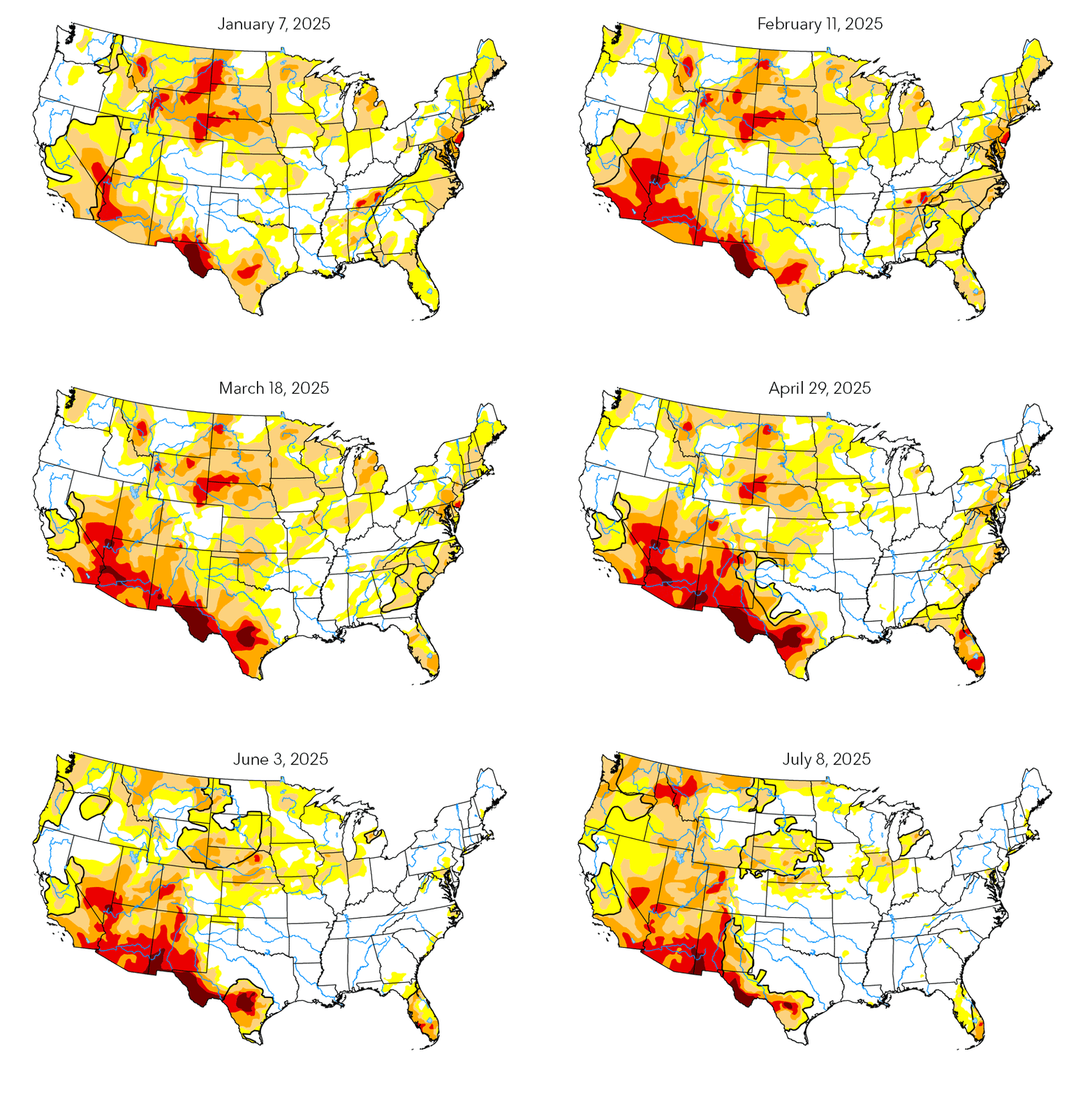
US Drought Monitor

Eastern Cornbelt:

Mild, dry weather created ideal harvest conditions across Illinois and Indiana during the week. A frost advisory was issued for parts of northern and western Illinois at midweek, with lows dropping into the 30s, but highs in the low- to mid-70s were expected for the balance of the week and into the weekend for much of Illinois and Indiana.

While spotty showers moved through Ohio earlier in the week, sunny and mild weather was on tap for the final days of September, allowing a flurry of harvest activity as the month concluded.

The corn harvest as of Sept. 25 was 6% complete in Illinois and Indiana and had yet to start in Ohio. The soybean harvest was estimated at 5% complete in Indiana, 3% in Ohio, and 2% in Illinois. All three states were trailing their average harvest paces for the week. Good or excellent ratings were assigned to 66-69% of the corn and soybeans in Illinois, 60-61% in Ohio, and 54-55% in Indiana.

Western Cornbelt:

Much of Iowa experienced its first frost of the fall early on Sept. 28, with temperatures dropping to the 30s in many locations and even falling into the upper-20s in parts of Northern Iowa. Mild daytime temperatures were reported across the region, however, with very little rain.

Highs rose to the mid- to upper-70s across Nebraska as the week progressed, jumping to the low-80s in some locations to close out the work week. No rain was in Nebraska’s weekend forecast, so growers were expecting to make rapid progress on the fall harvest.

Corn Wheat Soybean Index

All of Nebraska remained locked in drought, however, with extreme-to-exceptional drought covering a large area in the northeastern corner of the state.

The corn and soybean harvest was 13% complete in Nebraska by Sept. 25, with 38-41% of the state’s corn and soybean acreage rated as good or excellent on Sept. 25, compared with 47-48% in Missouri and 62-64% in Iowa. Iowa growers had 5-7% of the corn and soybeans in the bin by Sept. 28, compared with 1-3% in Missouri.

With 7% of the sorghum crop harvested in Nebraska, fully 65% of the acreage was rated as poor or very poor in late September. Missouri growers had 2% of the cotton picked and 35% of the rice harvested, with 52% of the state’s cotton crop rated as good or excellent.

California:

Heat warnings were once again issued for a large swath of Southern California early in the week. Highs in the upper-90s and low-triple digits were reported across the Inland Empire, Orange County, and the San Fernando Valley on Sept. 26-28, but cooler weather was on tap for the end of the week.

Severe-to-exceptional drought continued to cover the entire state in late September, with a wide band of exceptional drought covering the inland Central California region. “It still remains a very uncertain fall, with water supply and financial stress for a number of California commodities,” commented one source.

The cotton harvest was 15% complete in Arizona, but had yet to start in California as of Sept. 25. Fully 90% of California’s cotton was rated as good, while 85% of Arizona’s crop fell in the good or excellent categories. The rice harvest was 20% complete in California by late September, and 5% of the winter wheat crop was planted.

Pacific Northwest:

Rain finally arrived to parts of Oregon and Washington after weeks of dry weather and above-normal temperatures. Most of the precipitation was reported on Sept. 29, with up to a half inch expected in the Portland area. Highs in the 70s were expected late in the week.

Summer heat persisted in parts of Idaho, with Boise notching a record 95 degrees on Sept. 27 before temperatures dropped to the low 70s for the balance of the week. Similar conditions were reported in Montana, with scattered showers and cooler temperatures moving in as the week progressed.

The harvesting of potatoes, sugar beets, and small grains was well underway in the region. Idaho growers had 25% of the sugar beets picked by Sept. 25, while the spring wheat and barley harvests had progressed to 96-100% complete in the region.

“The weather has been exceptional. Growers are busy collecting their crops, and we are preparing for a fall season,” commented one regional source at midweek.

Western Canada:

Dry, mild weather was reported across Manitoba during the week, allowing growers to make strides on the fall harvest after earlier delays due to wet weather.

Manitoba’s harvest progress overall was estimated at 47% complete, well behind the five-year average of 79%, reflecting a lag of roughly three weeks. Saskatchewan’s harvest was fully 81% complete by contrast, slightly ahead of its 75% average pace.

Unseasonably hot weather resulted in 11 daily heat records in Alberta on Sept. 27, allowing growers across the province to wrap up 87% of the fall harvest by the third week of September.

“Farmers are just about finished harvesting in parts of Saskatchewan and Alberta,” said one regional contact. “Ammonia application has already started in both provinces in a modest way. The Manitoba crop is later, and they still need 5-10 days to finish harvesting canola. Crop yields are reported to be above average and there is some concern farmers’ bins may not have room for fertilizer storage until later in the fall. That could slow dry fertilizer movement.”

Transportation

US Gulf:

Sources on Sept. 26 said the industry was keeping a close eye on Hurricane Ian, but the storm’s projected landfall in western Florida was anticipated to minimally impact barge movements in the East and West Canals.

The Port of Mobile was set to Port Condition Normal on Sept. 28, while the Intercoastal Waterway was reportedly changed to Port Condition X-Ray for boats moving east of Panama City, Fla.

The Port of Tampa moved to Port Condition Zulu on Sept. 27, sources said, effectively halting operations due to the possibility of gale-force winds in Tampa Bay within a 12-hour window.

Guidewall construction noted in progress at Bayou Sorrel Lock was scheduled to continue through February 2023. The project prompted intermittent travel outages Monday through Friday, between 6:30 a.m. and 5:00 p.m., with normal operating hours returning on Saturdays and Sundays. Delays were reported at 3-6 hours on Sept. 25.

Following a second dredging attempt to fix extensive shoaling at Miles 113-117 of the Atchafalaya River, located near Morgan City, La., the Coast Guard on Sept. 22 announced the removal of all restrictions through that area. Towing drafts had previously been capped at 10 feet, lengths limited to 600 feet, and widths permitted up to 70 feet. In addition, all tows running longer than 400 feet were required to travel with an assist tug.

The successful dredging operation did not impact other restricted areas of the Atchafalaya, however, and commercial travel remained unavailable through Little Island Pass, Middle Island Pass, and Riverside Pass due to the presence of active underwater pipelines.

Tows traveling through Algiers Lock without industry assistance were subject to ongoing length and width restrictions, reducing lockages to four standard barges or two 30,000 mt tankers per pass. Larger tows could lock through in a single pass when accompanied by an assist vessel. Minimal wait times were observed on Sept. 26.

Belle Chasse Bridge construction, scheduled to run through the end of the year, was expected to cause sporadic navigational shutdowns, potentially halting traffic for up to 12 hours at a time.

Port Allen Lock delays were reported in a wide 5-28 hours. Boats transiting Industrial Lock saw wait times up to seven hours through the early week. Five-hour waits were noted at both Colorado Lock and Brazos Lock.

Mississippi River:

Water levels continued to decline on the lower Mississippi River, tightening travel restrictions.

Tows running in the northbound direction were limited to 9.5-foot drafts, down from 10.5 feet in the prior report, while southbound tows started the week at a maximum draft of 10.5-11 feet before reducing to 9.5 feet by Sept. 29. Dredges were dispatched to at least one location, while a number of vessel groundings, most recently reported at Mile 525, triggered localized transit stoppages of 12-48 hours. Additionally, maximum barge counts were reduced 15-25% below typical levels.

The river gauge at St. Louis returned a (-)0.68-foot depth reading on Sept. 28. Levels were expected to drop to (-)2.5 feet on Oct. 10.

Sources said dredging at Mile 485 was scheduled to begin on Sept. 30. The operation was expected to run for approximately two weeks, potentially triggering navigational shutdowns in the area.

Channel restoration efforts at Mile 618, set to begin on Sept. 26, were likely to necessitate daytime transit outages in the southbound direction through Oct. 10. A planned pipeline removal project at Mile 167 was anticipated to trigger daytime shutdowns on Oct. 6-23.

Ongoing repair work to the I-10 bridge prompted a blanket safety advisory for tows passing Miles 228-230 of the lower river. The advisory, as well as intermittent travel outages, were predicted at the site through June 2023.

Old River Lock was noted shutting to navigation on Aug. 30, completely closing the site to all traffic through Nov. 13 and limiting access to the Red River. Tows seeking access to that waterway were recommended to detour through the Atchafalaya River.

The winter seasonal shutdown of upper Mississippi River locks was expected to begin in November or December. Cargoes loading from NOLA and destined for Dubuque, Iowa, or above generally saw final release dates scheduled in the second week of October. Barges loading from NOLA and bound for upper river destinations below Dubuque were projected to continue releasing through the third week of October.

Lock 27 wait times were noted up to five hours during the week.

Illinois River:

Wickets continued to be reported in the raised position at Peoria Lock and LaGrange Lock for the week, forcing tows to lock through both sites. Wait times at Peoria Lock were noted up to eight hours during the week, while LaGrange Lock delays peaked at five hours on Sept. 26.

Dresden Island Lock waits were posted up to seven hours for the week.

Looking ahead to 2023, Brandon Road Lock, Dresden Island Lock, Marseilles Lock, and Starved Rock Lock are all slated to undergo shutdowns totaling 90-120 days each, starting on June 1, 2023, effectively closing the Illinois River to commercial navigation.

Ohio River:

Belleville Lock operators have reportedly been closing the site to daylight travel sporadically since Sept. 7 for maintenance, triggering intermittent waits of 4-7 hours. The project was tentatively scheduled to wrap up on Sept. 30.

Miter gate replacement efforts in progress at the Cannelton Lock main chamber triggered detours through the auxiliary chamber through Nov. 11. Delays were reported in the 15-26 hour range, falling from 41 hours in the prior week.

Hannibal Lock main chamber miter gate and quoin repairs were predicted to force detours through the auxiliary chamber until an estimated Oct. 8, with minimal delays expected.

Equipment repairs at the Tennessee River’s Kentucky Lock were scheduled to end on Sept. 26. Travel was reported unavailable from 6:00 a.m. to 6:00 p.m. daily since Sept. 6 while the project was underway.

Most Wilson Lock waits were reported in the 7-10 hour range through the week. Barkley Lock is scheduled to see a series of daytime travel shutdowns from Oct. 13 through Nov. 4 for dive inspections. The lock is expected to pass tows daily from 6:00 p.m. to 6:00 a.m.

Arkansas River:

The revised Norrell Lock shutdown calendar will see daytime travel outages continue through Nov. 30, shutting the site daily from 7:00 a.m. to 7:00 p.m. Overnight passage is available with a 70-foot width limit. The lock is scheduled for a full shutdown on Jan. 30-31, 2023.

Daylight-hour travel shutdowns that kicked off at Joe Hardin Lock on Sept. 12 were scheduled to conclude on Sept. 29. Travel will be completely unavailable Sept. 30 through Oct. 9. Sources said Emmett Sanders Lock will undergo a complete travel shutdown on Oct. 2-6.

Itafos Announces Debt Refinancing

Itafos Inc., Houston, on Sept. 22 announced that it has entered into credit facilities with a syndicate of lenders, led by RBC Capital Markets as sole bookrunner and sole lead arranger, pursuant to which the lenders have advanced a US$85 million term loan to the company and made available a US$35 million letter of credit (LC) facility and an US$80 million asset-based revolving credit facility (ABL).

Itafos said that together, the new credit facilities will provide enhanced financial flexibility and a non-dilutive source of capital, as well as the ability to refinance its existing debt.

“The refinancing announced today represents the achievement of another important strategic milestone for the company. The new debt facilities will improve the company’s financial performance because of the significantly reduced interest rates and creates more flexibility for funding of the long-term growth of the business,” said G. David Delaney, Itafos CEO.

The term loan, LC, and ABL all mature on Sept. 22, 2025. Upon closing the refinancing, the term loan will have an outstanding balance of US$85.0 million, the ABL US$65.0 million, and the LC US$32.8 million.

Interest shall accrue on outstanding borrowings at a rate equal to Term SOFR on the term loan and LC, plus a margin ranging from 4.25%-5.25% per annum based upon the total net leverage ratio of the company and its subsidiaries. The initial borrowings are at a rate of 4.25%.

ABL interest shall accrue on outstanding borrowings at a rate equal to Term SOFR plus a margin ranging from 2.25%-2.75% per annum, based upon the average excess availability under the ABL.

Previous interest rates ranged from 8.25% per annum plus LIBOR to 18%.

Galvani Updates on Fertilizer Projects, Expects to Spend R$2.5 billion ($486 M)

Brazil’s privately-held fertilizer company, Galvani Fertilizantes, Sao Paulo, recently gave an update on two major fertilizer projects (GM May 13, p. 36), saying it expects to spend R$2.5 billion ($482 million).

The company expects to spend R$200 million ($38.6 million) at its plant in Luis Eduardo Magalhães in Bahia state to double production to 1.2 million mt/y by 2024. In an interview with Bloomberg, Galvani CEO Marcos Stelzer said the value will come from equity contributed by the Galvani family.

Some R$2.3 billion ($443 million) will be invested at the Santa Quitéria phosphate-uranium project (GM Oct. 19, 2018) in Ceara. The amount will be a combination of Galvani equity, issuance of debt, and the share of a stake in the project, though the latter will not include an independent public offering (IPO).

When brought online, the Santa Quitéria project would produce 1.05 million mt/y of phosphate, which would serve the Matopiba region. In addition, the project is expected to produce 220,000 mt/y of dicalcium phosphate for the feed industry, which Galvani said represents 50% of all demand in the North and Northeast regions and 22% of national demand.

The Santa Quitéria project, which is expected up in 2026, is being carried out in partnership with Industrias Nucleares Brasileiras (INB), a state-owned company. Uranium production of an estimated 2,300 mt/y, which will be separated from the phosphate, would go to INB. The mine is currently in the environmental licensing phase.

Together, the two projects will boost Galvani’s fertilizer output to 2.2 million mt in 2026, up from 600,000 mt in 2021. That would represent more than one-third of the nation’s current phosphate output.

In addition to these two projects, Galvani said it also plans to start exploring for a phosphate mine in Irecê in Bahai. Phosphate from this project would be transported to the Luis Eduardo Magalhães unit, with the end product then shipped through the port of Pecem in Ceara. The total investment for this project is put at R$340 million ($65.6 million), which will come from Galvani’s own capital.

The Galvani family retained the production unit in Luis Eduardo Magalhães and the mining units in Angico dos Dias and Irecê, as well as the Santa Quitéria project, when it sold its minority stake in Galvani Indústria to Yara International ASA, Oslo, in 2018. The Galvani retained assets were valued at US$95 million as of Aug. 31, 2018.

According to Brazil’s Ministry of Agriculture, 85% of the fertilizers used in Brazil are imported. The National Fertilizer Plan, launched by the federal government earlier this year, aims to reduce Brazil’s dependence on imported products to 45% by 2030.

Salt Lake Potash Sale Reported

Sev.en Global Investments, Prague, a Czech Republic-based family-owned investment group, has recently signed a deal to buy ASX-listed bankrupt sulfate of potash (SOP) junior Salt Lake Potash (SO4), Perth, according to a Sept. 19 report in the Australian Financial Review. The sale price was not immediately available, and Sev.en had not responded to inquiries at press time.

Salt Lake had hoped to be Australia’s first SOP producer with its Lake Way project in Western Australia, however, mounting debt and a delayed ramp-up eventually caused creditors to take over last year (GM Oct. 22, 2021). At full production, SO4 had planned an output of 245,000 mt/y, and at one point it reported 224,000 mt/y of binding offtake agreements for five- and ten-year terms (GM March 26, 2021; Dec. 20, 2019).

Brussels Tightens Squeeze on Russian Potash, NPKs Export Trade

A tightening and clarification of the European Commission’s (EC) sanctions on Russia now makes it impossible to supply Russian potassium chloride and compound fertilizers to third countries that use European services, such as insurers and shippers. The new prohibition applies even if the cargoes are not transiting European Union (EU) territory.

The Commission on Aug. 29 published an updated text of clarifications on the application of its sanctions for certain fertilizers produced in or exported by Russia. This followed a tightening on Aug. 10 of the EU’s fifth package of sanctions against Russia that were announced and implemented in early April.

On April 8, Brussels imposed sectoral sanctions on the import into the bloc of potassium chloride (CN 3104 20) and NPKs (CN 3105 20) and PKs (3105 60) and other fertilizers containing potassium chloride of Russian origin (GM April 15, p. 1; April 8 p. 1). These sanctions were in the form of a cap on the volume of these products that could be imported into the EU.

The April 8 restrictions did not apply to shipments until July 10 under contracts signed prior to April 9, 2022, the day the sanctions came into force.

While the April 8 measures did not target any other types of fertilizers of Russian origin, they included an entry ban on Russian-flagged vessels and Russian-operated vessels from accessing EU ports. They also banned Russian and Belarusian road transport operators working in the EU.

That initial ban did not apply to the transit of Russian potash and compound fertilizers to third countries that used the bloc’s infrastructure. But on Aug. 10 the EC further tightened the sanctions by extending the ban to include European operators’ activities related to the transit of sanctioned Russian fertilizers – potash and compound fertilizers – that were heading for third countries through the EU’s Member States.

Now, under the new sanctions, the supply of Russian origin potash and compound fertilizers to third countries, even without the use of the EU’s territory and infrastructure, is understood to be considered a violation of sanctions.

All activities relating to the provision of transport, transshipment, and trading services by European companies, as well as related services, such as insurance, financial, and brokerage services, along with technical assistance, are prohibited under the new tightened sanctions.

The latest decisions by Brussels would appear to contradict the EC’s earlier statements about “making exemptions” for what it described as “essentials” cargo, such as agricultural and food products and humanitarian aid. That said, according to some sources, the latest EU measures continue to allow for some exemptions.

The move has taken insurers and shippers by surprise, and according to a circular sent out to its members by the UK P&I club, one of the world’s largest protection and indemnity insurance groups, as cited by the Insurance Journal, the insurance industry had previously assumed the ban on transits and services would not apply to export destinations outside the EU.

The UK P&I club is a member of the International Group of P&I Clubs, which collectively cover about 90% of the world’s oceangoing vessels for risks. Most of the P&I clubs that comprise the international group are subject to the jurisdiction of the EU, according to the circular as cited by the report.

As previously reported, Russian President Vladimir Putin has said Russia is prepared to donate 300,000 mt of fertilizer – mainly potash that has built up in some European ports – to developing countries free of charge (GM Sept. 16, p. 28).