All posts by mickeybarb@charter.net

Muriate of Potash

US Gulf:

NOLA potash barges were quoted in the $610-$620/st FOB range, down from the week-ago $625/st FOB. There were unconfirmed reports that a trade may have occurred as low as $600/st FOB.

US Imports:

MOP imports were off 28.8% in July, to 835,281 st from the year-ago 1.17 million st. Canadian imports for July stood at 745,956 st. Russia sent 70,110 st for the period, while material originating from Israel totaled 17,011 st.

US Exports:

Potash exported from the US in July softened 49.1%, to 219,093 st from the prior-year 430,291 st.

Eastern Cornbelt:

The potash market was tagged at $700-$725/st FOB in the Eastern Cornbelt. Warehouse pricing at Cincinnati reportedly slipped to the $700/st FOB level, down from last week’s $705-$710/st FOB, while Great Lakes sources confirmed new potash offers at $720/st FOB Toledo for September-October tons, and $735/st FOB for November-December.

Western Cornbelt:

Potash was reported at $700-$725/st FOB in the Western Cornbelt, down $10/st from last report, with the St. Louis market pegged at $700-$710/st FOB in mid-September.

Northern Plains:

Sources quoted potash pricing at $720-$730/st FOB and $750-$760/st rail-DEL in the Northern Plains. The latest prices FOB Saskatchewan mines were reported at $728-$740/st after netbacks, depending on grade and destination.

Northeast:

The potash market was pegged at $740/st FOB East Liverpool, with rail-DEL tons reported at the $760/st level in Pennsylvania, down $15/st from last report.

South Korea:

Imports of MOP for January-August 2022 were reported at 494,000 mt by Trade Data Monitor, down about 8% from the 540,000 mt imported during the same period in 2021. Canada dominated the market, sending 361,000 mt. The next highest supplier was Israel with 75,000 mt.

August 2022 imports were up dramatically, to 118,000 mt, compared with the 36,000 mt received in August 2021. Canada supplied about 80% of the material for August, with Israel taking up the balance.

Brazil:

High MOP inventories are keeping buyers from making any long-term buying decisions and giving them reason to keep asking for lower prices. The portside price is now reported at $700-$750/mt CFR, with more and frequent bids coming in at sub-$700/mt CFR.

Rondonopolis pricing is reported down to $820-$900/mt FOB ex-warehouse. Even with large reserves at regional distribution centers, some market observers are beginning to express concern that MOP supplies might drop, with fewer tons available for replacement.

A report from World Shipping Alliance showed that 28,000 mt of Belarus MOP is on its way to Brazil via a Russian port. The vessel is expected to arrive in Brazil later this month. The tonnage will be the first Belarus cargo sent to Brazil since February. Belarus shipments to Brazil stopped as the US placed sanctions against Belarus and many of its companies.

Sulfur

SULFUR

Tampa:

Repairs were reportedly completed at the BP Whiting, Ind., refinery during the week, marking a full return to production at the 435,000 barrel/d facility following an Aug. 24 shutdown due to fire.

Genscape reported the plant’s 70,000 barrel/d Pipestill 11A crude distillation unit (CDU) successfully restarting during the evening of Sept. 10, while a 24,000 barrel/d hydrotreater was restarted earlier that same day. The restarts marked the return of all monitored units to production.

An 85,000 barrel/d CDU was reported going offline on Sept. 11 at the Delek El Dorado, Ark., refinery. The unit restarted later the same day.

Early talks surrounding the fourth-quarter price of molten sulfur at Tampa were reported during the week, although nothing that was described as approaching a formal negotiation.

Potential pricing was noted in the $80-$100/lt CFR range, with the lower end of the spread reportedly entertained as a concession for the third quarter’s outsized contracts, signed just prior to a sharp decline in international values.

The second-quarter Tampa contract was concluded at $352/lt CFR, down $129/lt from the first-quarter $481/lt CFR agreement.

Refinery utilization lifted higher in the US Energy Information Administration’s (EIA) latest report. Capacity was tabbed at 91.5% for the week ending Sept. 9, a 0.6-point increase on the prior week’s 90.9%, and above both the year-ago 82.1% and the 88.4% five-year average.

Daily crude inputs moved to an average 16.022 million barrels/d for the period, a 93,000 barrel/d increase from 15.929 million barrels/d reported one week earlier.

US Imports:

Sulfur imports were down 24.3% in July, to 263,716 st from 348,448 st.

US Exports:

Sulfur exports moved 304.6% higher in July, to 213,269 st from the year-ago 52,712 st.

US Gulf:

Genscape on Sept. 12 reported a shutdown of the 66,000 barrel/d Ultraformer 4 catalytic reforming unit at Marathon’s Galveston Bay, Texas, facility. The outage was accompanied by elevated flaring.

Phillips 66 on Sept. 14 shut a 206,000 barrel/d CDU and a 71,000 barrel/d coking unit at the company’s Sweeny, Texas, refinery. The units began ramping up later the same day, but remained below normal operating levels. The plant’s 30,000 barrel/d FCCU3 fluidic catalytic cracking unit was noted going offline on Sept. 8.

Sources quoted recent US Gulf pricing at $75/mt FOB, an increase from $39-$56/mt FOB reported previously. Negotiations expected to conclude as early as Sept. 15-16 for Brazil business could see the market stretch as high as $110/mt FOB, sources said.

Brazil:

Players noted the recent Brazil market firming to $105-$110/mt CFR, increasing from earlier $90-$100/mt CFR indications. A $140/mt CFR cargo reportedly under discussion on Sept. 15 would signal a sharp increase, should an agreement be reached.

Vancouver:

Vancouver export pricing for the week was noted firming to the $95-$100/mt FOB range, up from $85-$90/mt FOB in the prior report.

Alberta:

Shell successfully restarted a hydrogen plant at its Scotford, Alta., upgrader on Sept. 10, according to Genscape. The unit was reported going offline on Aug. 31.

Based on rising values at Vancouver, Alberta sulfur netback indications moved to $25-$282/mt FOB, up from $15-$282/mt FOB reported one week earlier. The wide range included both molten tons contracted into the US market at the high, as well as solid sulfur traded international through the Vancouver export market at the low.

West Coast:

West Coast sulfur values trailed Vancouver to the $95-$100/mt FOB range, above the prior week’s $85-$90/mt FOB.

Contracts for the third-quarter price of molten sulfur loading from West Coast locations were reported at $370-$385/lt FOB, down $5/lt from $375-$390/lt FOB logged for the prior period.

China:

Sources reported China import sulfur pricing holding at the week-ago $125-$140/mt CFR level.

ADNOC:

Abu Dhabi National Oil Co. (ADNOC) sulfur postings were heard at $92/mt FOB Ruwais for September, a $7/mt increase from $85/mt FOB posted for August.

Qatar:

Solid sulfur loading from Qatar was posted at $89/mt FOB Ras Laffan for September lifting, sources said, rising $12/mt from $77/mt FOB in the prior period.

Sulfuric Acid

US Gulf:

Price ideas on sulfuric acid vessels imported to the US Gulf were unchanged at $160-$180/mt CFR, sources said.

US Imports:

July sulfuric acid imports fell 11.2%, to 293,012 st from the year-ago 329,988 st.

US Exports:

Sulacid exports were down 19.5% in July, to 23,549 st from 29,262 st in July 2021.

Gulf Coast:

Sulacid tons delivered by rail to Gulf Coast locations were contracted in the $195-$280/st DEL range for full-year contracts.

Midwest:

Midwest contracts for 2022 were reported at parity to the Gulf Coast in a wide $195-$280/st DEL range.

West Coast:

Sulfuric acid delivered to the West Coast was noted at $185-$270/st DEL for the full 2022 contract year.

Brazil:

Nothing new was heard on the Brazil sulfuric acid import vessel market, leaving price ideas unchanged at $170-$190/mt CFR.

Ammonium Thiosulfate

Eastern Cornbelt:

Ammonium thiosulfate pricing was unchanged at $400-$435/st FOB in the Eastern Cornbelt, with the low confirmed at Cincinnati.

Western Cornbelt:

Ammonium thiosulfate was pegged at $350-$400/st FOB in the Western Cornbelt, depending on location and supplier.

Northern Plains:

The ammonium thiosulfate market was pegged at $455/st FOB in central North Dakota at mid-month.

Crops/Weather

Eastern Cornbelt:

US Drought Monitor

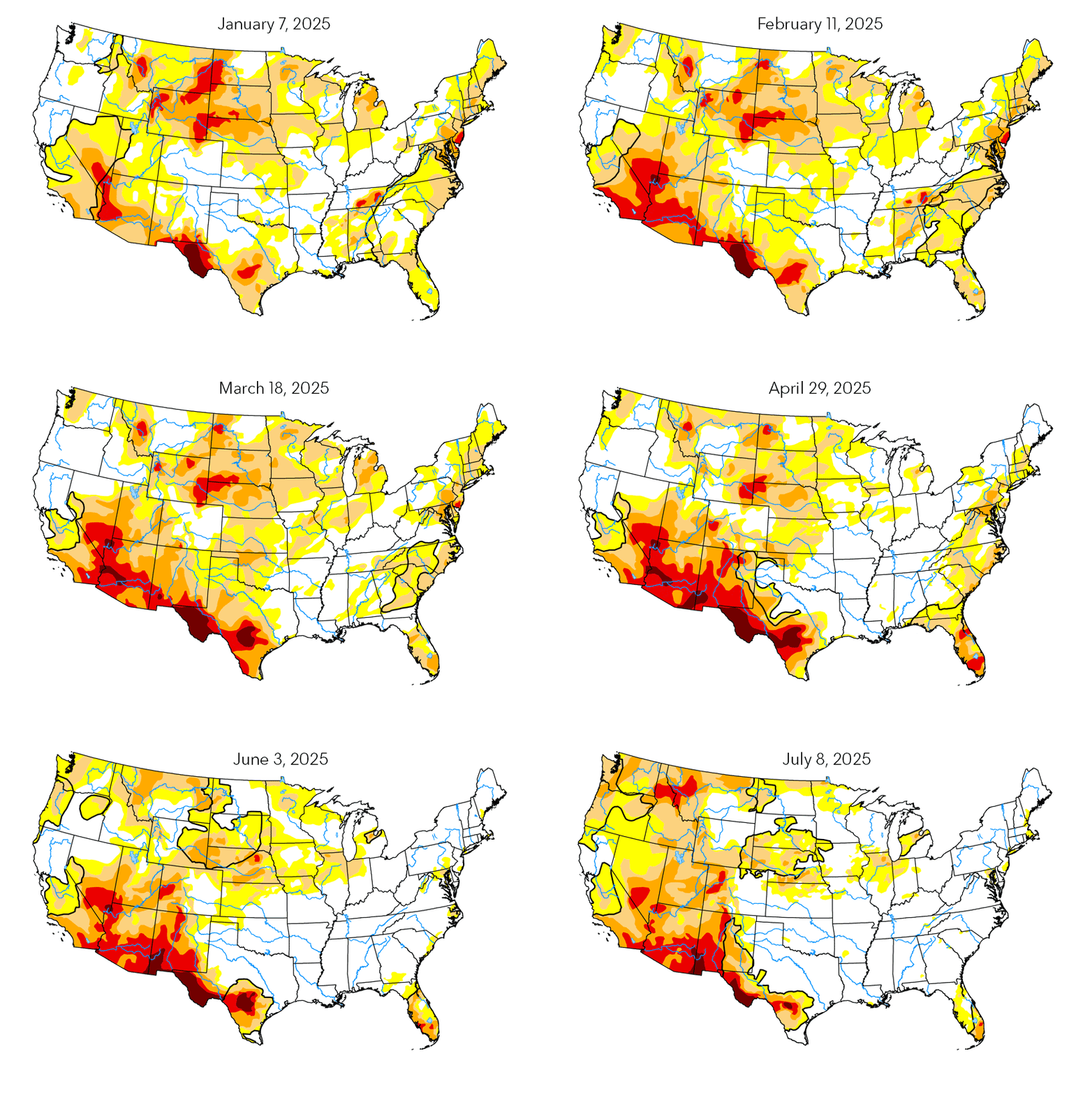
Dry, warm weather settled over much of the Eastern Cornbelt during the week, but strong thunderstorms hit northeastern Illinois over the previous weekend, prompting flash flood warnings for some areas on Sept. 11. Highs reached the low- to mid-80s in all three states as the week progressed.

Combines were starting to roll in Illinois at mid-month. USDA reported that 15-16% of the corn crop was mature in the region by Sept. 11, with 1% of the Illinois crop harvested by that date. As for soybeans, 14-21% of the regional crop was dropping leaves, slightly behind the average pace.

Crop conditions remained favorable in the region, with good or excellent ratings assigned to 67-72% of the corn and soybeans in Illinois, 61-62% in Ohio, and 54-56% in Indiana.

Western Cornbelt:

Spotty thunderstorms were reported in southern and central Nebraska at midweek, but much of the region enjoyed dry weather and above-normal temperatures. Highs across Iowa reached the mid-80s as the week progressed, with some locations expecting 90-degree temperatures over the coming weekend.

Corn Wheat Soybean Index

Growers had 5% of the Missouri corn crop in the bin by Sept. 11, compared with 1% in Nebraska. Corn rated as mature totaled 44% of the acreage in Missouri, 36% in Nebraska, and 23% in Iowa. As for soybeans, 43% of the Nebraska crop was dropping leaves by Sept. 11, compared with 9-10% in Iowa and Missouri.

Fully 63% of Iowa’s corn and soybeans were rated as good or excellent during the week, along with 49-50% of the acreage in Missouri and 42-43% in Nebraska. Drought conditions also took a toll on Nebraska’s sorghum crop, with 66% of the acreage rated as poor or very poor on Sept. 11.

Good or excellent ratings were assigned to 52% of Missouri’s cotton and 58% of the state’s rice crop at mid-month, with 2% of the rice harvested by Sept. 11.

Northern Plains:

Warm, humid conditions were reported across much of Minnesota and the Dakotas during the week, with highs reaching the upper-70s and low-80s. Rain was reported across northern Minnesota late in the week, and thunderstorms were also in the Twin Cities forecast on Sept. 16-17.

With corn maturation estimated at 18% in South Dakota, 12% in North Dakota, and 8% in Minnesota, USDA rated 62% of Minnesota’s acreage as good or excellent on Sept. 11, compared with 58% in North Dakota and 43% in South Dakota. Soybeans in the good or excellent categories totaled 65% of the acreage in Minnesota, 55% in North Dakota, and 50% in South Dakota.

South Dakota’s sorghum crop was 34% mature and 39% good or excellent on Sept. 11. The oat harvest was 90-99% complete in the Northern Plains by that date, while harvest progress on spring wheat had progressed to 100% complete in South Dakota, 79% in North Dakota, and 75% in Minnesota. The regional barley harvest was 78-89% complete by Sept. 11.

Great Lakes:

Temperatures in the 70s and 80s were common across the Great Lakes region at mid-month, with an increased chance of rain and thunderstorms over the coming weekend.

Approximately 10-13% of the corn crop was mature in Wisconsin and Michigan as of Sept. 11. Good or excellent ratings were assigned on that date to fully 77-78% of the corn and soybean crops in Wisconsin, compared with 61-65% in Michigan.

Northeast:

Strong storms early in the week resulted in flash flood warnings for parts of southeastern Massachusetts, Rhode Island, and the tri-state area as torrential rains and 50-mph winds pushed through the region on Sept. 13. Flash flood warnings were also issued for Baltimore County, Md., on Sept. 12.

Dry, warm weather was reported across Pennsylvania during the week, with highs reaching the upper-70s and low-80s. USDA rated 55% of Pennsylvania’s corn as good or excellent on Sept. 11, with just 4% of the acreage described as mature, well behind the 16% five-year average.

One Pennsylvania contact reported at midweek that yields varied widely in his trade area “due to rainfall or the lack thereof.” While corn silage harvesting was underway in mid-September, he said no harvesting for grain had started in that location. “It will not be an exceptional year on yield,” he added.

Transportation

US Gulf:

Industrial Lock was reported closed to navigation from 6:00 a.m. to 6:00 p.m. on Sept. 10 due to emergency guidewall repairs. Wait times were noted up to 25 hours in the aftermath of the shutdown, but fell below five hours on Sept. 12.

Work at Colorado Lock concluded on Sept. 9 after blocking navigation from 7:00 a.m. to 5:00 p.m., Monday through Friday. Wait times ran up to nine hours on Sept. 12.

Guidewall replacement efforts in progress since Aug. 1 at Bayou Sorrel Lock were reported to intermittently block Monday-through-Friday travel during daylight hours. The project was anticipated to continue through February 2023. Minimal delays were reported during the week.

Dredging to correct extensive shoaling at Miles 113-117 of the Atchafalaya River, in the Morgan City, La., area, was reported in progress through Sept. 15. While the effort is underway drafts are reportedly limited to 10 feet, while lengths and widths are capped at 600 feet and 55 feet, respectively. Tows with lengths above 400 feet are required to utilize an assist vessel, according to a Coast Guard safety bulletin. Captains were also required to check in with the VTS Berwick Bay at Mile 110 prior to arrival in the area.

Following the revelation of potentially hazardous underwater pipes during a recent hydrograph of the Atchafalaya River, navigation was rendered temporarily unavailable through Little Island Pass, Middle Island Pass, and Riverside Pass. Tows could bypass the river’s restrictions by detouring through the Port Allen Route.

Length and width restrictions persisted on unassisted lockages through Algiers Lock, limiting tows to four standard barges or two 30,000 mt tankers per pass. Larger turns were possible when traveling with an assist boat. Delays were heard up to five hours during the week.

A construction project underway at Belle Chasse Bridge through the end of the year was expected to trigger intermittent shutdowns lasting up to 12 hours at a time.

Port Allen Lock waits were routinely quoted in the 4-10 hour range through the week.

Mississippi River:

Reduced depths on the lower Mississippi River continued to impact towing capacity during the week. Maximum southbound drafts persisted at 11.5 feet between Cairo, Ill., and Rosedale, Miss., while tows traveling northbound were limited to a reported 10.5 feet of draft. Maximum tow lengths were also reportedly reduced by 10-15% from typical levels.

The river gauge at St. Louis was posted at 1.80 feet and falling on Sept. 14, down from 2.06 feet reported one week earlier. Levels were expected to fall below the 0.00-foot mark on Sept. 21, later than the prior Sept. 12 forecast.

Channel work at Mile 336 wrapped up on Sept. 8 after blocking most southbound travel daily from 7:00 a.m. to 5:00 p.m.

I-10 bridge repairs in progress at Miles 228-230 triggered a safety advisory for all boats passing through the area. The operation, slated to run 24 hours per day through June 30, 2023, was expected to prompt intermittent navigation stoppages as well.

Old River Lock, located at the lower river’s Mile 305, is shut to daytime navigation from Aug. 30 through Nov. 13 for planned miter gate installation, completely closing the site to navigation. Vessels seeking access to the Red River can detour through the Atchafalaya River while the project is underway.

Loading cutoffs for NOLA-departing barges destined for upper Mississippi River locations were slated for October, sources indicated. Tows destined for Dubuque, Iowa, and above were expected to see final releases during the second week of October. Cargoes heading to all points south of Dubuque were slated for final departures in the third week of October.

Illinois River:

A long-term repair project at Brandon Road Lock was reported to conclude on Sept. 8, ending a lengthy period of daytime travel outages, towing width limits, and outright shutdowns. Minimal delays were reported at the site during the week.

Shutdowns at Peoria Lock between 7:00 a.m. and 3:00 p.m. on Monday-Tuesday and Thursday-Friday produced delays up to 23 hours during the week. The shutdown were scheduled to allow testing of the lock’s invasive carp deterrent system, and will run weekly through Oct. 7.

Wickets remained in the raised position at both Peoria Lock and LaGrange Lock during the week, requiring tows to lock through both locations. Sporadic 4-10 hour delays were reported at LaGrange.

Ohio River:

The primary chamber at Cannelton Lock was reported shut for repairs and maintenance through Nov. 11, forcing passes solely through the site’s secondary chamber. With most tows requiring at least two passes to clear the lock, wait times were observed at 10-24 hours through the week, falling from 24-36 hours reported previously.

Repairs in progress to the main chamber quoin and miter gate at Hannibal Lock required a complete shutdown of the chamber through Oct. 8. Transit was available through the auxiliary chamber, with minimal delays reported through the week. Intermittent 6.5-hour wait times were noted at Greenup Lock.

Equipment repairs at the Tennessee River’s Kentucky Lock were scheduled for Sept. 6-26, closing the site daily from 6:00 a.m. to 6:00 p.m. Corps data showed delays at 15-43 hours for the week through Sept. 14. Wilson Lock wait times were reported in a wide 9-26 hour range, rising from 4-14 hours observed one week earlier.

On the Cumberland River, passage was unavailable through the US Highway 60 bridge on Sept. 12-14, between 5:30 a.m. and 10:00 p.m. daily. The bridge is located near the Ohio River interchange.

Barkley Lock was scheduled to undergo daytime travel shutdowns for dive inspections from Oct. 13 through Nov. 4. Passage through the site will be unavailable daily between 6:00 a.m. and 6:00 p.m. while the inspections are underway.

Arkansas River:

Norrell Lock was reported shut to daylight-hour navigation from Aug. 22 through Nov. 20, stopping travel daily between 7:00 a.m. and 7:00 p.m. Towing widths were capped at 70 feet on overnight travel. The lock was scheduled to close entirely on Jan. 30-31, 2023.

Joe Hardin Lock was slated to shut to navigation from 7:00 a.m. through 7:00 p.m. on Sept. 12-29. Passage through the site will be completely unavailable from Sept. 30 through Oct. 9.

Electrical work at Emmett Sanders Lock and Dam will force a complete travel shutdown on Oct 2-6.

Putin Seeks Sanctions Lift, Offers 300,000 mt of “Free of Charge” Fertilizer

Russian President Vladimir Putin on Sept. 16 urged the UN to exert pressure on the EU to lift restrictions it has imposed on Russian fertilizer exports to developing countries, according to Deutsche Presse-Agenur (DPA).

Speaking at the Shanghai Cooperation Organization (SCO) Summit in Samarkind, Uzbekistan, he said Russia was prepared to donate 300,000 mt of fertilizer to developing countries “free of charge,” noting that this quantity had built up at EU ports.