

Cornbelt:
The NPSZ market remained at $875-$905/st FOB in the Cornbelt, depending on location.
Cornbelt:
The NPSZ market remained at $875-$905/st FOB in the Cornbelt, depending on location.
U.S. Imports:
SOP imports for July-June were up 62.6% from the previous year, to 174,129 st from 107,085 st. June imports softened 69.0%, however, to 4,146 st from the prior 13,367 st.
U.S. Exports:
SOP exports were up 62.1% in June, to 6,036 st from the year-ago 3,724 st. July-June exports were 35.0% higher at 69,939 st, rising from the year-ago 51,798 st.
Southeast:
The SOP market was unchanged at $960/st FOB for the last reported business in Florida.
Southern Plains:
The last reference prices for Trio FOB Carlsbad included $480/st for standard, $515/st for granular, $540/st for premium, $555/st for OMRI standard and fine standard, and $590/st for OMRI granular.
Eastern Cornbelt:
Potassium thiosulfate pricing was unchanged at $780/st FOB Terre Haute, Ind., for the last confirmed offers.
Eastern Cornbelt:
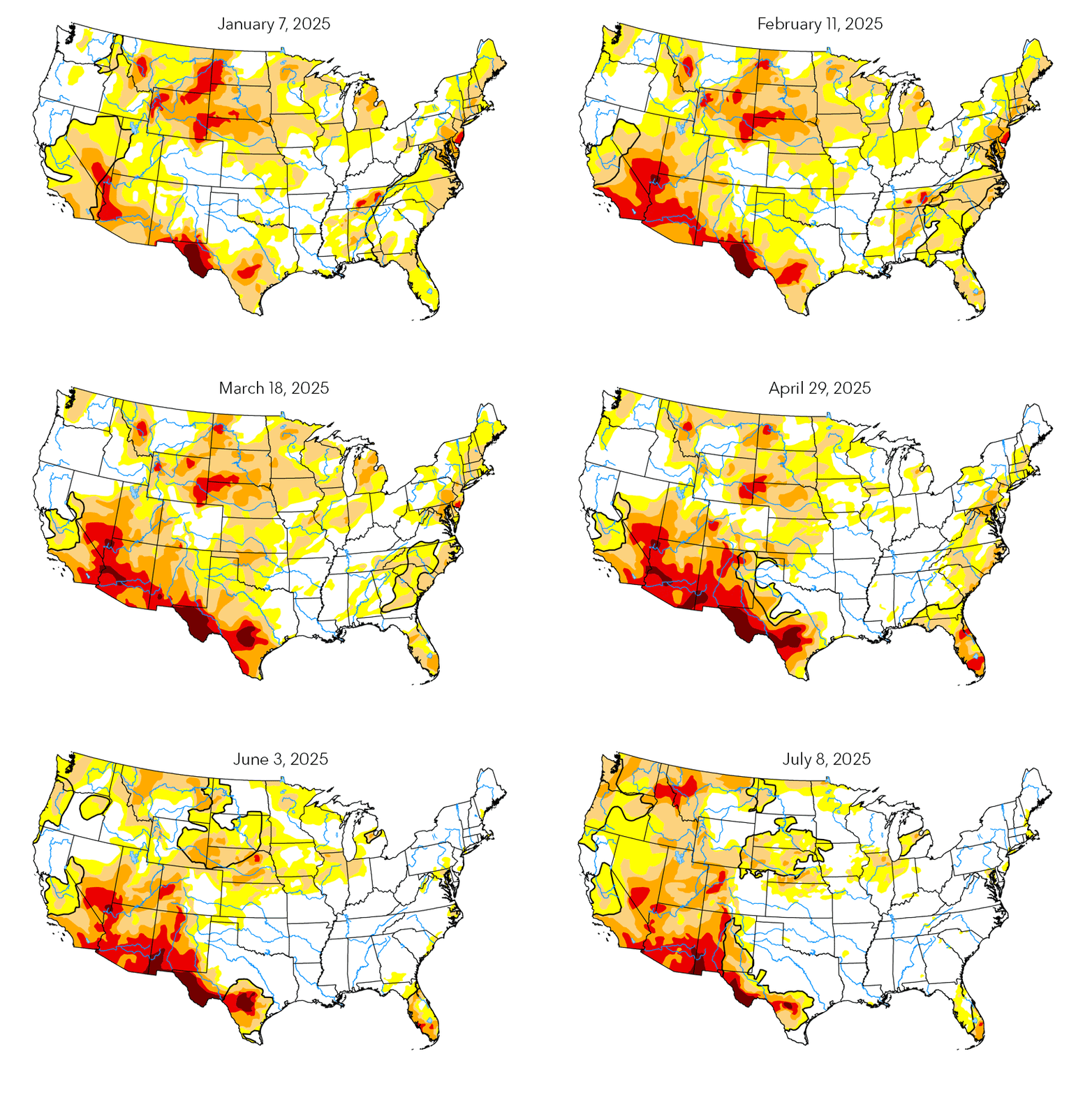
Showers produced heavy rain in parts of northern Illinois on Aug. 7, prompting flash flood warnings for certain areas. Slightly cooler temperatures followed and extended down into central and southern Illinois as well.
Moderate to heavy rainfall also drenched portions of central Indiana on Aug. 9-10, resulting in a hazardous weather outlook and a flood advisory for some locations. Cooler temperatures and lower humidity were reported in northern Ohio as the week progressed, although some areas were hit with heavy rain over the prior weekend.
The combination of heat and plentiful moisture continued to benefit crops in the region. Fully 70-75% of the corn and soybeans in Illinois were rated as good or excellent on Aug. 7, compared with 56-59% of the acreage in Ohio and 51-52% in Indiana.
“Overall, the crops in my market area look very good currently, and we are getting rain as we speak,” said one contact at midweek.
Western Cornbelt:

Scattered showers moved through Iowa as the week progressed, with cooler temperatures on tap for eastern Iowa over the coming weekend. Western and central areas of the state, however, were bracing for another hot and humid weekend, with highs in Des Moines expected to climb into the 90s.
A hot and humid weekend was also in store for much of Missouri and Nebraska. Drought conditions were expanding across Nebraska in August, with patches of extreme-to-exceptional drought showing up in northeastern and southwestern areas of the state and a large section of central Nebraska labeled in the moderate-to severe categories.
Fully 71-73% of Iowa’s corn and soybeans were rated as good or excellent on Aug. 7, compared with 50-54% in Nebraska and 49-51% in Missouri. Nebraska’s sorghum crop slipped to 25% good or excellent, with 39% of the crop rated as poor or very poor. Missouri’s cotton and rice were reported at 51% and 47% good or excellent, respectively.
Southern Plains:
Hot, dry weather was the theme for much of the Southern Plains during the week, with highs climbing to the 90s and low triple digits. Spotty thunderstorms were reported across central Oklahoma on Aug. 9, however, with reports of damaging winds and lightning in some areas.
Severe-to-exceptional drought continued to cover most of the region, with the most extreme drought conditions reported in Texas, southern Oklahoma, and western Kansas. “The corn harvest is wrapping up and bolls are beginning to open on cotton,” said one Texas contact. “Some will begin the cotton harvest in the next two weeks.”
Crop conditions in the region were deteriorating due to the drought and heat. Good or excellent ratings were assigned to 30-31% of the corn in Colorado and Kansas on Aug. 7, compared with just 17% in Texas, where fully 50% of the corn fell in the poor or very poor categories. The Kansas soybean crop was 41% good or excellent.
The cotton crop was particularly stressed, with good or excellent ratings assigned to 32% of the acreage in Kansas, 14% in Texas, and 5% in Oklahoma. Fully 47-48% of the cotton in Oklahoma and Texas was rated as poor or very poor on Aug. 7.
Sorghum quality was also dropping, with good or excellent ratings assigned to just 42% of the acreage in Colorado, 32-35% in Oklahoma and Kansas, and 16% in Texas. USDA placed 51% of the Texas sorghum crop in the poor or very poor categories on Aug. 7.
South Central:
More thunderstorms were in the forecast for parts of Kentucky and Tennessee as the week progressed, raising the potential for localized flooding. President Biden on Aug. 8 toured flood-damaged areas of Kentucky after last month’s deluge, which dropped 8-10 inches of rain in only 48 hours.
Thunderstorms also tracked through southern Louisiana and parts of Mississippi late in the week, prompting warnings of possible localized flooding.
Crop conditions continued to suffer in Kentucky and Tennessee, where just 31-33% of the corn fell in the good or excellent categories on Aug. 7. Soybeans rated as good or excellent totaled 75% of the crop in Louisiana, 64% in Arkansas, 56% in Mississippi, and 42% in Tennessee and Kentucky.
Cotton conditions showed a similar spread, with 67% of the acreage in Arkansas and Louisiana rated as good or excellent, compared with 47-48% in Mississippi and Tennessee. The regional rice harvest was 21-25% complete in Louisiana and Texas by Aug. 7, with good or excellent ratings assigned to fully 89% of Louisiana’s rice crop, compared with 73% in Arkansas, 64% in Mississippi, and 42% in Texas.
Southeast:
Hot, humid weather blanketed much of the Southeast during the week, although strong thunderstorms on Aug. 10 dropped 2-4 inches of rain on parts of Virginia, causing localized flooding. Severe weather was also reported in northern Georgia on Aug. 9.
While just 32% of North Carolina’s corn registered as good or excellent on Aug. 7, 47% of the state’s soybeans were in those two categories. Cotton rated as good or excellent totaled 53% of the acreage in North Carolina, 65% in Georgia, 70% in South Carolina, 74% in Alabama, and 87% in Virginia.
Peanuts were in even better condition, with good or excellent ratings assigned to 59% of the crop in North Carolina, 69% in Georgia, 82% in South Carolina, 87% in Alabama, 89% in Florida, and fully 92% in Virginia.
Sources continued to report fertilizer moving for hay and pasture fertilization in the region, with wholesale price increases reported for urea and UAN.
U.S. Gulf:
Colorado Lock delays noted during the week were expected to block navigation from 7:00 a.m. to 5:00 p.m., Monday through Friday, through Sept. 9. Corps data reported wait times up to 13.5 hours on Aug. 8.
A dredging project kicked off in mid-July was anticipated to prompt intermittent delays through Aug. 15 at Algiers Lock, Industrial Lock, and Harvey Lock.
Guidewall construction at Bayou Sorrel Lock was projected to limit Monday-through-Friday transit between 6:30 a.m. and 5:00 p.m., until February 2023. Despite wait times expected up to 12 hours, minimal delays were observed for the week through Aug. 8.
Repairs underway at Bayou Sorrel Bridge required Monday-through-Thursday shutdowns from 7:00 a.m. to 11:00 a.m., and again from 1:00 p.m. to 5:00 p.m. The project is expected to continue into the second half of August.
A Coast Guard posting attributed a persistent shoaling event for continued 10-foot draft restrictions at Miles 113-117 of the Atchafalaya River after a recent dredging attempt reportedly failed to correct the issue. Tows were also capped at 600-foot lengths, while all tows measuring longer than 400 feet were advised to travel with an assist boat. Width limits were noted at 70 feet.
Underwater pipelines revealed in a recent hydrograph of the Atchafalaya River prompted transit shutdowns at Little Island Pass, Middle Island Pass, and Riverside Pass. Tows could bypass the waterway’s myriad restrictions by detouring through the Port Allen Route.
Unassisted tows locking through Algiers Lock were subject to ongoing length and width restrictions during the week, described as effectively capping tows to four standard barges or two 30,000 mt tankers per turn. Lengthier tows were allowed to lock when accompanied by an assist boat. While most waits were seen topping out around 10.5 hours through the week, a handful of intermittent wait times clocked in above 25 hours on Aug. 7-8, Corps data indicated.
Intermittent travel restrictions at Belle Chasse Bridge were anticipated due to a construction operation scheduled to run through the end of the year. Transit stoppages were described up to 12 hours during the week. Belle Chasse Bridge is located at Mile 3 in the West Canal.
Delays at Port Allen Lock were clocked up to 20 hours through the week. Most tows were reported passing Industrial Lock in under six hours. Intermittent Brazos Lock delays were observed up to 13.5 hours.
Mississippi River:
Reduced river levels continued to impact travel on the middle Mississippi River, while restrictions were easing from Cairo, Ill., to the Gulf due to rainfall on the lower Mississippi River Basin.
Falling levels above Cairo forced a reduction in southbound draft limits to a maximum 10.5 feet, down from 11.5 feet reported previously. Barge counts below Cairo were previously reduced by 10-15%, while drafts were capped at 10.5-12.5 feet, depending on location and direction of travel.
A safety advisory was issued on Aug. 1 at Miles 228-230 of the lower river due to repair work at the I-10 Bridge. The effort is scheduled to run 24 hours per day, seven days per week, through the first half of 2023. In addition to the blanket safety advisory, intermittent transit delays were possible.
Channel work at Miles 336-337, reported halting southbound movements between 7:00 a.m. and 5:00 p.m. daily, were scheduled to conclude on Aug. 7, sources said. Dredging at Mile 740 was projected to wrap up on Aug. 8, ending a run of daytime navigation outages in the area.
Old River Lock is closed to daytime navigation through Aug. 29, blocking movements daily from 6:00 a.m. to 7:30 p.m. in preparation for a complete lock closure scheduled for Aug. 30 through Nov. 13. That shutdown, necessary for the installation of a new miter gate, will stop all travel through the site. Tows destined for the Red River will detour through the Atchafalaya River.
Due to the impending shutdown of the upper Mississippi River for the winter navigation season, last-call loading windows for barges releasing from NOLA were heard to land in the second week of October for cargoes destined above Dubuque, Iowa. Barges heading to all points south of Dubuque were expected to continue loading through the third week of October.
Wait times were reported up to 12 hours at Lock 20 during the week. Corps data pegged intermittent Lock 25 delays in the 3-5 hour range. Six-hour wait times were observed at Mel Price Lock.
Illinois River:
Repairs and maintenance in progress at Brandon Road Lock since May 9 are scheduled to continue through Sept. 8, a Corps posting indicated. Transit is restricted to overnight hours only through Aug. 14, after which the site will shut to navigation entirely from Aug. 15 through Sept. 4.
Overnight-only movements will resume at Brandon Road Lock on Sept. 5-8, followed by the return of 24-hour navigation on Sept. 9. A 70-foot width limit is in effect for the entirety of the operation. Most delays were noted topping out around the 20-hour mark during the week, rising from 14 hours reported previously.
Due to low water levels, wickets continued in the raised position at Peoria Lock and LaGrange during the week, prompting vessels to lock through both locations. Average wait times were counted under five hours at both sites. Intermittent delays were heard up to eight hours at Marseilles Lock and dam.
Ohio River:
Miter gate replacement work underway at Cannelton Lock was reported shutting the main chamber through an estimated Nov. 11, prompting tows to pass through the smaller auxiliary chamber. Corps data showed delays in a wide 16-31 hour range, rising from 12-19 hours noted previously.
Miter gate and quoin repair affecting the Hannibal Lock primary chamber is in progress through Oct. 8, limiting tows to passage through the secondary chamber. Minimal delays were reported through the week.
Planned maintenance at Olmsted, underway since July 18, was scheduled to wrap up on Aug. 6, ending a period of alternating closures between the lock’s main and auxiliary chambers.
The Tennessee River’s Kentucky Lock saw most wait times top out around 28 hours during the week. Kentucky Lock is in the midst of a long-term construction effort scheduled to run through 2024. Wilson Lock delays were quoted up to 19.5 hours through the week.
A potential structural issue uncovered at Pickwick Landing Lock in late May was noted forcing all traffic through the secondary chamber until additional inspections are performed. Minimal wait times were reported for the week.
Miter gate machinery repair operations that began on May 16 at the Cumberland River’s Cheatham Lock were scheduled to conclude on Aug. 5, ending a repeating run of alternating 11-days closed, three-days open travel windows.
Arkansas River:
A Norrell Lock daytime travel shutdown was reported in effect through Aug. 10 due to planned maintenance, halting lockages daily from 7:00 a.m. to 7:00 p.m. The outages were scheduled to recur on Aug. 21-Sept. 21; Oct. 20-Nov. 18; Nov. 29-Dec. 23; and Jan. 3-31, 2023. Norrell Lock is scheduled to undergo a complete shutdown from Sept. 30 through Oct. 9.
Planned Joe Hardin Lock repairs will block travel daily from 7:00 a.m. to 7:00 p.m. on Sept. 12-19, and again on Sept. 28-29. A complete shutdown is expected on Sept. 30 through Oct. 9.
US conglomerate J.M. Huber Corp., Atlanta, announced on Aug. 8 that it has signed a binding agreement to acquire full control of the Biolchim Group from two investment firms – NB Renaissance and Chequers Capital – as well as the Biolchim Group management team. Founded in 1972, Italy-based Biolchim is a producer and distributor of specialty plant nutrition products and biostimulants.
All the companies in Biolchim – including Biolchim SpA, Cifo, Ilsa SpA, Matécsa Kft, and West Coast Marine-Bio Processing Corp. – are within the scope of the purchase. Biolchim operates eight production plants globally, and its products – biostimulants, trace elements, and water soluble, liquid, and foliar fertilizers – are present in over 70 countries.
Upon close of the sale, Biolchim will become part of Huber Engineered Materials (HEM), a company within the Huber portfolio of businesses. Biolchim will be a key part of the strategic foundation of the Huber AgroSolutions (HAS) business unit of HEM, which currently includes Miller Chemical & Fertilizer (Miller), Hanover, Pa., which Huber acquired in 2019 (GM April 4, 2019; March 8, 2019). Miller, founded in 1937, manufactures and distributes crop protection and nutritional agrichemical products to more than 90 countries.
“I am excited and energized about this opportunity to combine two successful businesses, Miller and the Biolchim Group,” said David Riley, Senior Vice President and General Manager of HAS. “I am also thankful to Mr. Valenti for his leadership and support as we transition the Biolchim Group and Miller to the next phase of growth.”
Biolchim has been managed and headed by Galileo Quattro SARL. Leonardo Valenti, CEO of Biolchim since 2008, will remain committed to lead Biolchim through the next phase of growth and the integration, leveraging the synergy potential of the strategic combination of both entities.
HAS’ vision is to become a leading formulator of sustainable, high-performing agricultural products globally, and Huber said the Biolchim acquisition significantly helps meet that goal. Huber said the complementary sales footprint of both companies will enable expanded customer and product access into key agricultural regions globally.
HAS plans to advance the sales of Biolchim’s products through its relationships with US-based growers and its complementary distribution network in Latin America and select countries in Europe, the Middle East, and Africa, while Biolchim’s sales channels will advance various Miller products via its strength in Europe and its global subsidiary network.
Closing of the sale, anticipated to occur by the end of 2022, is subject to customary closing conditions, including the foreign direct investment approval in Italy.
Founded in 1883, family-owned Huber operates as a portfolio management company, with assets including HEM, CP Kelco, Huber Engineered Woods, and Huber Resources Corp. Businesses include specialty chemicals, minerals, hydrocolloids, engineered woods, and timber management.
Huber said it is a diversified, multinational company that creates products that are used in a broad range of consumer and industrial applications, including fire retardant additives and smoke suppressants, personal care, food, beverage, pharmaceuticals, and building materials.
CVR Partners LP reported second-quarter net income of $117.6 million ($11.12 per diluted unit) on net sales of $244 million, up from the year-ago $7 million ($0.66 cents per common unit) on net sales of $138 million. EBITDA was $147.2 million, up from the year-ago $51.5 million.
“CVR Partners achieved solid operating results for the second quarter of 2022, driven by strong global fertilizer industry conditions,” said Mark Pytosh, CEO of CVR Partners’ general partner. “While spring weather presented a challenge, planted grain acres were in line with USDA estimates. We also are pleased to announce a cash distribution of $10.05 per common unit for the 2022 second quarter.
“Looking ahead, we expect industry conditions to remain strong due to attractive farm economics and elevated nitrogen fertilizer prices driven by natural gas shortages in Western Europe and dislocations created by Russia’s invasion of Ukraine,” he added.
Six-month net income was $211.2 million ($19.90 per unit) on net sales of $466.9 million, up from the year-ago loss of $18.4 million ($1.72 per unit) and $198.9 million, respectively. EBITDA was $270.6 million, up from $56.1 million.
| Sales (000 st) | 2Q-22 | 2Q-21 | YTD-22 | YTD-21 |
| Ammonia | 52 | 80 | 91 | 112 |
| UAN | 287 | 370 | 609 | 609 |
| Plant Gate Price $/st | 2Q-22 | 2Q-21 | YTD-22 | YTD-21 |
| Ammonia | 1,182 | 403 | 1,127 | 373 |
| UAN | 555 | 237 | 524 | 206 |
| Production (000 st) | 2Q-22 | 2Q-21 | YTD-22 | YTD-21 |
| Ammonia – gross | 193 | 217 | 380 | 404 |
| Ammonia – net | 50 | 70 | 102 | 140 |
| UAN | 331 | 334 | 648 | 606 |
| Feedstock | 2Q-22 | 2Q-21 | YTD-22 | YTD-21 |
| Petroleum Coke | 49.91 | 36.69 | 53.06 | 39.73 |
| Natural Gas ($/mmBtu) | 7.34 | 3.04 | 6.48 | 3.07 |
U.S. Department of Labor’s Occupational Safety and Health Administration (OSHA) has proposed a penalty of $110,630 for Pilgrim’s Pride Corp. due to a Jan. 19, 2022, ammonia leak at a Canton, Ga., poultry processing plant that caused the hospitalization of two workers and led to the evacuation of about 50 workers. OSHA found that the incident might have been prevented had the company followed required safety standards.
OSHA issued nine citations for inadequately implementing and maintaining the process safety management program for controlling anhydrous ammonia hazards in industrial refrigeration systems. The company has 15 business days from receipt of its citations and penalties to comply, request an informal conference with OSHA’s area director, or contest the findings before the independent Occupational Safety and Health Review Commission.
Carlyle Group Inc., New York City, and Singapore’s sovereign wealth fund GIC Pte. made a “strategic investment” in Eneus Energy Ltd. to support the company’s push to develop green ammonia projects.
The backing allows Eneus Energy, which has registered offices in Edinburgh, Scotland, and Newcastle, Del., to continue to develop global projects involving ammonia made using renewable energy, starting with the U.S. and U.K., the companies said in a statement that did not disclose the initial amount invested.
The deal gives Carlyle and GIC the ability to invest more than $3 billion in Eneus Energy’s projects in the next five years, according to Pooja Goyal, Chief Investment Officer of Carlyle’s Infrastructure Group.
“We’ve taken a very focused view on energy transition in the last few years,” Goyal said in an interview. “When we think about economically viable options to reduce carbon molecules, we think ammonia is the most viable option today.”