All posts by mickeybarb@charter.net

Ammonium Thiosulfate

Eastern Cornbelt:

Ammonium thiosulfate fill pricing remained at $425-$435/st FOB in the Eastern Cornbelt from some suppliers.

Western Cornbelt:

Ammonium thiosulfate fill tons were reported at $425-$435/st FOB in the Western Cornbelt.

Northern Plains:

The ammonium thiosulfate market ranged broadly at $435-$610/st FOB in the Northern Plains, with the low reported for fill offers in Minnesota and the high for the last prompt business in central and eastern North Dakota.

Eastern Canada:

The ammonium thiosulfate market plunged to C$655-$705/mt FOB in Eastern Canada as new fill program offers circulated, down from the last reported C$765-$970/mt FOB range.

Crops/Weather

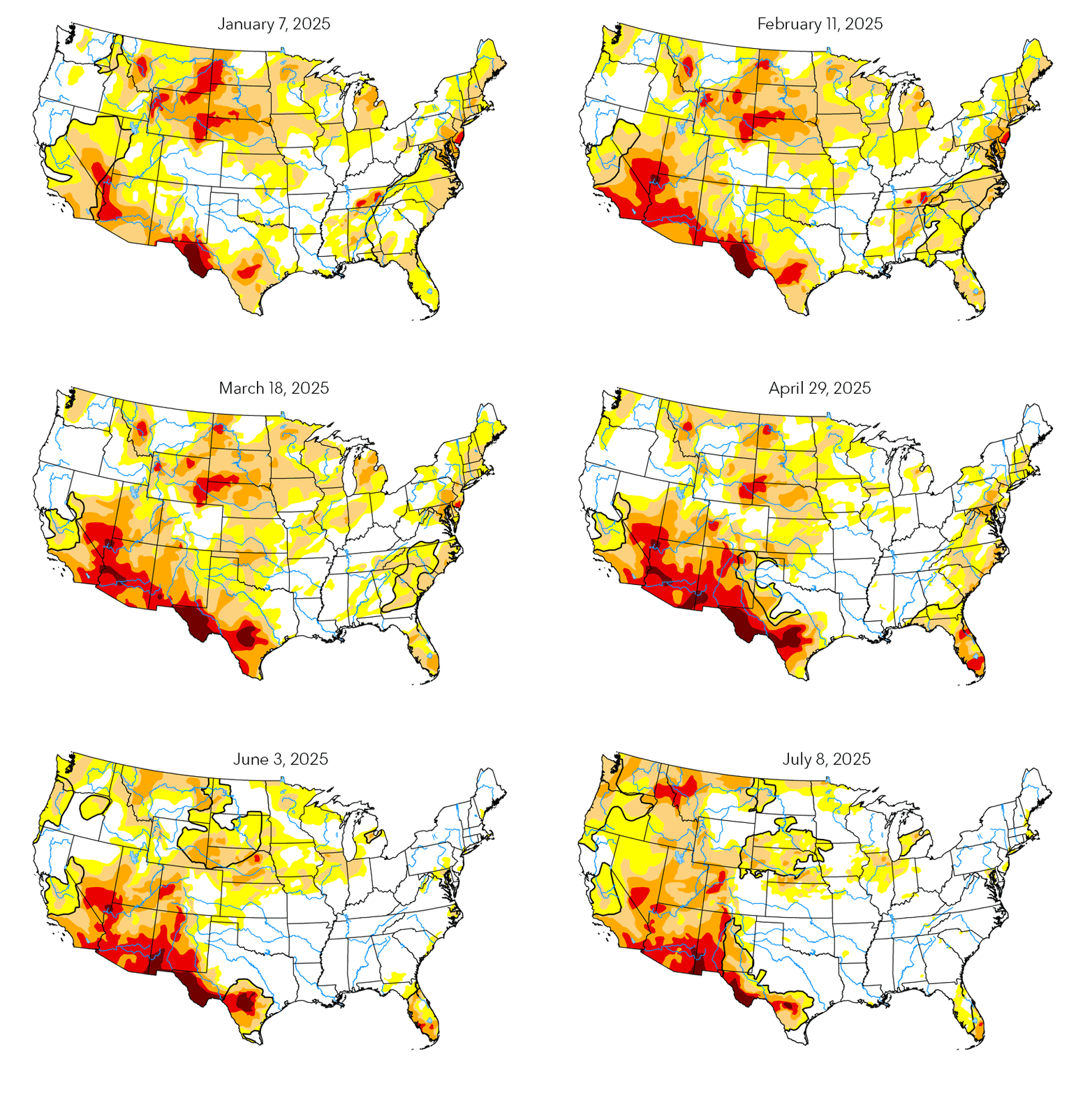
US Drought Monitor

Eastern Cornbelt:

Powerful thunderstorms brought damaging winds and torrential rain to parts of the Eastern Cornbelt and Great Lakes regions during the week.

Severe thunderstorm warnings were in effect for most of central Indiana on Aug. 1, with power outages affecting more than 13,000 residents. An overnight deluge in central and southern Illinois on Aug. 1-2 dumped as much as 8-12 inches of rain on some locations, prompted flash flood warnings stretching from Springfield to south of Effingham.

The storms were part of the same massive weather system that produced flooding in St. Louis, Mo., and eastern Kentucky in late July.

High heat and humidity in northern Illinois and Indiana prompted a heat advisory at midweek and sparked another round of thunderstorms on Aug. 3, with reports of power outages and spotty crop and structural damage due to strong winds, hail, and heavy rain.

Strong thunderstorms also rolled through Ohio and Michigan during the week, along with high temperatures that hit the 90-degree mark in northeastern Ohio. Severe weather across multiple southern and central Michigan counties at midweek resulted in torrential rains and reports of widespread power outages.

Crop conditions were mostly favorable in the Eastern Cornbelt and Great Lakes region in early August. Good or excellent ratings were assigned to fully 77% of the corn and soybeans in Wisconsin, 68-74% in Illinois, 56-64% in Michigan, 54-56% in Ohio, and 48-50% in Indiana.

Western Cornbelt:

Corn Wheat Soybean Index

Pleasant midweek temperatures in much of Iowa were expected to be followed by higher heat and humidity later in the week. Highs in the 90s were once again in the weekend forecast for western areas of the state. Nebraska was also bracing for more hot weather heading into the weekend, although isolated showers were popping up at midweek.

Barely a week after record rainfall hit the St. Louis, Mo., area, another powerful storm dropped 2-4 inches in parts of the city on Aug. 4, prompting more flash flood warnings for the western and southern suburbs. Some locations reported 1-3 inches falling in just one hour, along with 60-mph wind gusts.

Fully 73-76% of Iowa’s corn and soybeans were rated as good or excellent on July 31, compared with 54-57% in Nebraska and 49-52% in Missouri. Nebraska’s sorghum crop was 36% good or excellent, down from the prior week’s 39%. Missouri’s cotton and rice were reported at 53% and 56% good or excellent, respectively, with 64% of the cotton setting bolls and 32% of the rice headed.

Northern Plains:

Like much of the country, the Northern Plains endured blistering heat during the first week of August. Temperatures soared to 105 degrees in Sioux Falls, S.D., on Aug. 2, the highest reading in 27 years. Heat index readings in Minnesota climbed to 110 in Minneapolis and 115 in Hutchinson on the same day.

Hot, dry weather was also reported in North Dakota, where Bismarck notched a high of 97 degrees on Aug. 2.

The combination of heat and well-timed precipitation made for good crop conditions in the region, even after the late start this spring. With 7-13% of the regional corn crop in the dough, USDA assigned good or excellent ratings to 62% of the acreage in Minnesota, 65% in South Dakota, and fully 79% in North Dakota. The region’s soybean crop was 63-66% good or excellent as of July 31.

As for small grains, 80-82% of the spring wheat and 68-72% of the barley in Minnesota and North Dakota fell in the good or excellent categories, with South Dakota’s spring wheat and sorghum rated as 54-56% good or excellent. The oat harvest was 48% complete in South Dakota and 16% in Minnesota, with good or excellent ratings assigned to 64% of the acreage in Minnesota, 65% in South Dakota, and 81% in North Dakota.

Northeast:

Oppressive heat and humidity blanketed the Northeast during the week, but cooler temperatures and an increased chance of thunderstorms were in the weekend forecast for some areas. An earlier system produced at least two tornadoes in western Pennsylvania on Aug. 1.

Heat advisories were in effect for southern New England and parts of New York and Pennsylvania as the week progressed, with high temperatures reaching the 90s and heat index values climbing into the triple digits. Potentially strong thunderstorms were expected to move in on Aug. 5 and stick around through the weekend, with flash flooding possible in some areas.

Maryland also experienced intense heat during the week, prompting a Code Red Extreme Heat Alert for Baltimore on Aug. 4, with highs expected to reach the upper-90s and heat index readings climbing to 105 degrees.

The combination of heat and moisture contributed to generally favorable crop ratings in much of the region, with 63% of Pennsylvania’s corn rated as good or excellent on July 31.

Eastern Canada:

High heat and humidity sparked a string of strong thunderstorms across Eastern Canada during the week. The first round moved through Quebec and New Brunswick on Aug. 2, while a stronger system brought flooding rain and tornado warnings to southern Ontario on Aug. 3.

Temperatures in the mid-to upper-20s C were common across southern Ontario and Quebec during the week, with humidex readings climbing to the upper-30s. Environment Canada issued heat warnings across Nova Scotia and into southern New Brunswick at midweek.

Crop conditions varied significant across the region depending on the amount and timing of summer rainfall. “We have areas that have received adequate rainfall and crops look great,” said one source. “Other areas are suffering from lack of rain earlier in July. Other areas are showing stress now as storms pass around them and little rain is to be found.”

Added another contact: “Crops are hanging in there, but we could really use some rain. We have a big thunderstorm and tornado warning for this evening, so will get some moisture, but what we really need is a good all-day soaking rain.”

Transportation

U.S. Gulf:

The start of planned Colorado Lock repairs was reportedly pushed back to Aug. 1 from the previously scheduled July 26. Set to run through Sept. 9, the project was noted blocking Monday-through-Friday navigation between 7:00 a.m. and 5:00 p.m. Intermittent delays ran in the 5-15 hour range on Aug. 1-2.

Brazos Lock maintenance was heard to conclude on July 29, ending a spate of delays recently noted up to 16 hours. Wait times at the lock topped out around the five-hour mark early in the week.

Sporadic daylight-hour closures that began on July 20 were heard to conclude on July 30 at Port Allen Lock. Delays of up to 12 hours were reported during the period.

Dredging work expected to move between Algiers Lock, Industrial Lock, and Harvey Lock will trigger intermittent shutdowns at all three sites, projected to continue into mid-August.

Guidewall construction was heard to resume on Aug. 1 at Bayou Sorrel Lock, with work scheduled to run through February 2023. Travel was blocked Monday through Friday between 6:30 a.m. and 5:00 p.m., with normal navigating hours returning on Saturdays and Sundays. Delays were reported up to nine hours early in the week.

Bayou Sorrel bridge repairs in progress since July 5 were tentatively set to continue into second-half August, shutting down travel Monday through Thursday between 7:00 a.m. and 11:00 a.m., and again from 1:00 p.m. to 5:00 p.m.

Draft limits continued at Miles 113-117 of the Atchafalaya River due to persistent shoaling in the area, particularly at Miles 115.5-117. On top of the draft limits, 600-foot maximum tow lengths were also in effect, while widths were restricted to 70 feet. Tows running longer than 400 feet were advised to travel with an assist vessel.

Potentially hazardous underwater pipes forced a complete travel stoppage through Little Island Pass, Middle Island Pass, and Riverside Pass. Tows could avoid the restriction by detouring through the Port Allen Route.

Tows traveling without industry assistance through Algiers Lock remained subject to length and width restrictions, effectively reducing maximum lockages to four standard barges or two 30,000 mt tankers per turn. Larger lockages were available when utilizing an assist vessel. Most waits topped out around the five-hour mark through the week, although intermittent delays were reported at 24-25 hours on Aug. 1-2.

Construction scheduled through the end of the year at the Belle Chasse Bridge caused intermittent travel delays of up to 12 hours during the week, sources said.

Port Allen Lock wait times were noted up to 29 hours for the week. Most Industrial Lock waits were in the 3-11 hour range.

Mississippi River:

Multiple challenges to navigation were noted on the lower Mississippi River during the week, including the continuation of elevated heat levels that reportedly slowed outdoor commercial activities such as loading and unloading operations.

A heat advisory issued on Aug. 3 warned of 105-110 degree heat indexes in southeast Arkansas, northeast Louisiana, and western Mississippi. A separate heat advisory issued the same day described a 107 degree heat index for Illinois and parts of Missouri.

Heavy rains on the lower river offered a temporary buffer from reduced water levels that have restricted drafts between St. Louis and the Gulf in recent week, although restrictions remained in place on Aug. 3. Tows traveling to the north were capped at 10.5 feet of draft for the length of the lower river. Southbound tows continued to be restricted to 12.5-foot drafts from Cairo, Ill., to New Orleans, while draft limits were set at 11.5 feet between St. Louis and Cairo.

A flash flood warning was issued for the Baton Rouge, La., area on Aug. 3.

Channel maintenance operations that have reportedly limited downriver navigation at Miles 336-337 were expected to conclude on Aug. 7. Transit through the site was blocked daily from 7:00 a.m. to 5:00 p.m. while work was underway.

Daylight-hour travel shutdowns were reported at Mile 740 starting on July 29 due to dredging. Travel interruptions were scheduled to continue through Aug. 8.

Shutdowns that kicked off on July 28 at Old River Lock were projected to block navigation daily between 6:00 a.m. and 7:30 p.m. through Aug. 29. The current shutdowns will precede a complete travel outage scheduled for Aug. 30 through Nov. 13. Vessels looking to access the Red River during this time should detour through the Atchafalaya River, sources said.

Lock 21 wait times were noted up to seven hours. Delays of 3-6 hours were reported at Lock 27 for the week.

Illinois River:

Brandon Road Lock repairs and maintenance in progress since May 9 are scheduled to continue through Sept. 8. Navigation through the site is limited to overnight hours through Aug. 14, with tow widths capped at 70 feet.

The lock will shut to navigation entirely between Aug. 15 and Sept. 4, after which overnight-only travel will resume on Sept. 5-8. Normal operations were scheduled to return on Sept. 9. Delays tracked up to 14 hours through the early week.

Wickets remained in the raised position at both Peoria Lock and LaGrange Lock due to low water levels, necessitating locking through both sites. Peoria Lock wait times were reported up to nine hours, while LaGrange Lock delays peaked at seven hours on July 31.

Ohio River:

Planned Olmsted Lock maintenance, which began on July 18 and necessitated alternating closures between the main and auxiliary lock chambers, was projected to conclude on Aug. 6. Minimal delays stemming from the project were reported for the week.

Miter gate replacement at the Cannelton Lock primary chamber was expected to prompt detours through the secondary chamber through at least Nov. 11. As a result, wait times were typically observed in the 12-19 hour range through the week.

Main chamber miter gate and quoin repairs were underway at Hannibal Lock through an estimated Oct. 8. The work pushed vessels to pass via the auxiliary chamber, with minimal delays reported.

Travel delays lingered through the Tennessee River’s Wilson Lock after recently concluded guidewall repair. Waits peaked at 18 hours on July 31-Aug. 1.

Corps data showed Kentucky Lock passages as high as 23 hours during the week. Waits at Pickwick Landing Lock were counted up to seven hours.

Miter gate machinery repairs at the Cumberland River’s Cheatham Lock were anticipated to conclude on Aug. 5, ending a period of 11-days closed, three-days open travel windows that resulted in long delays during the project’s duration.

Arkansas River:

Norrell Lock maintenance efforts resumed on Aug. 1, closing the lock to navigation daily from 7:00 a.m. to 7:00 p.m. through Aug 10. Additional daytime shutdowns are on the books for Aug. 21-Sept. 21; Oct. 20-Nov. 18; Nov. 29-Dec. 23; and Jan. 3-31, 2023. Norrell Lock travel will be completely unavailable from Sept. 30 through Oct. 9.

Joe Hardin Lock was scheduled to close for repairs daily from 7:00 a.m. to 7:00 p.m. on Sept. 12-19, and again on Sept. 28-29, according to a Corps posting. The lock will shut completely between Sept. 30 and Oct. 9.

ICL, PlantArcBio Partner on Biostimulants

ICL, Tel Aviv, andpublic ag-biotech company PlantArcBio, Ltd., Givat Hen, Israel, on July 19 announced the development of a novel biostimulant technology platform that they said will improve crop yields while having a minimal impact on the environment.

The platform successfully uses RNAi technology to maximize a plant’s natural yield increase mechanisms without any genetic modification, and was the result of a multi-year research collaboration between the two companies.

In early-stage canola field trials, the platform significantly increased seed weight per hectare for canola crops, according to the parties, who said they are planning larger-scale field trials in 2022. These will include testing the new technology platform using both commercial sprayers and standard farming practices. Greenhouse trials for soybeans and rice are already in progress, with early results showing good potential.

“The use of novel biostimulants based on RNAi technology helps promote sustainability, by reducing the use of chemicals in agriculture,” said Hadar Sutovsky, Vice President of External Innovation and General Manager of ICL Planet. “This aligns perfectly with ICL’s long-term goal of creating impact and sustainable growth in the agriculture end-market, alongside ensuring food security.

“ICL and PlantArcBio have filed for a joint patent on the application for multiple crops,” added Sutovsky. “The application does its work, then rapidly disappears from both the plants and the environment, lasting no more than a few days, as it is highly biodegradable and also leaves no residual footprint.”

“The positive canola field trial results constitute another milestone in strengthening PlantArcBio’s capabilities in the development of RNAi-based products,” said Dror Shalitin, Ph.D., founder and CEO of PlantArcBio. “ICL, a market leader in crop nutrition products, is a great strategic partner for us to commercialize this sustainable technology worldwide.”

Earnings Preview: CF 2Q Net Income Expected to Quadruple; Mosaic Triple, Nutrien Nearly So

Major fertilizer companies are expected to see a huge increases in second-quarter earnings over the year-ago period, with the Bloomberg Consensus, the average estimates from major analysts, seeing a quadrupling for CF Industries Holdings Inc. to $1.3 billion, up from the year-ago $246 million.

The Mosaic Co. is expected to triple net income to $1.4 billion from $437.2 million, while Nutrien Ltd. will almost triple net income to $3.16 million versus the year-ago $1.11 million.

CF and Mosaic are scheduled to release earnings after markets close on Aug. 1, and Nutrien on Aug. 3.

Mosaic 2Q-22 Bloomberg Consensus 2Q-21 Actual
Revenues $5.67 billion $2.8 billion
Net Income $1.4 billion $437.2 million
Adj. EBITDA $2.18 billion $829 million
Nutrien 2Q-22 Bloomberg Consensus 2Q-21 Actual
Revenues $14.6 billion $9.76 billion
Net Income $3.16 billion $1.11 billion
Adj. EBITDA $4.9 billion $2.2 billion
CF 2Q-22 Bloomberg Consensus 2Q-21 Actual
Revenues $3.5 billion $1.59 billion
Net Income $1.3 billion $246 million
Adj. EBITDA $1.87 billion $599 million

Bion Works Toward Beef Joint Venture

Bion Environmental Technologies Inc., New York City, a developer of advanced livestock waste treatment technology, on July 25 announced that it has signed a Letter of Intent (LOI) with Ribbonwire Ranch to build a 15,000-head sustainable beef cattle feeding operation in Dalhart, Texas. Bion said the facility will include innovative barn systems, anaerobic digesters, and Bion’s waste treatment technology.

Bion and Ribbonwire will work together to create a definitive joint venture this fall, allowing plans to move forward to commence construction of the Dalhart sustainable beef facility during 2023. The LOI contains a provision to allow expansion of the project to four phases, representing 60,000-head capacity, or annual production of 180,000 head.

Bion said its patented technology will refine the waste stream into valuable coproducts that include clean water, renewable natural gas (RNG), and organic fertilizer products. It said the revenues generated from these new product lines will transform a cattle feeder from a marginally profitable business into a lucrative one.