

California:
The granular SOP Magnesia market was steady at $645/st FOB in California for the last confirmed offers.
Pacific Northwest:
The granular SOP Magnesia market was unchanged at $660/st FOB in the Pacific Northwest in mid-June.
California:
The granular SOP Magnesia market was steady at $645/st FOB in California for the last confirmed offers.
Pacific Northwest:
The granular SOP Magnesia market was unchanged at $660/st FOB in the Pacific Northwest in mid-June.
California:
Potassium nitrate prices in California were unchanged at $1,430/st FOB Stockton for bulk tons, $1,535/st FOB for bulk bags, and $1,555/st FOB for 50-pound bags.
Eastern Cornbelt:
Potassium thiosulfate pricing remained at $750/st FOB Terre Haute, Ind., for the last offers.
California:
The potassium thiosulfate market remained at the $725/st FOB level in California at mid-month. Sources said a reset is expected in July.
Eastern Cornbelt:
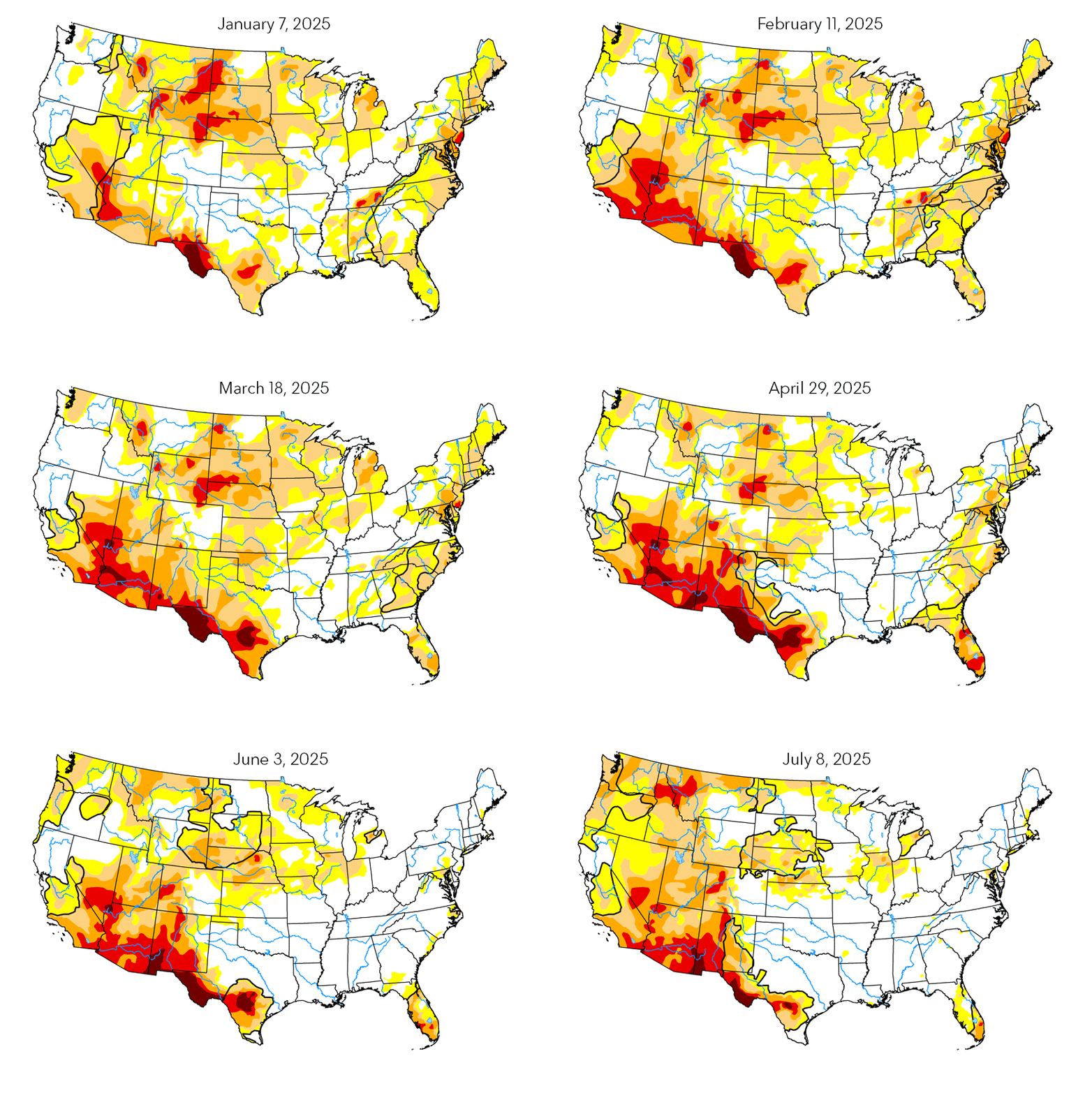
High heat and humidity sparked a number of strong thunderstorms in the Eastern Cornbelt during the week, including a supercell on June 13 that prompted tornado warnings across northern Illinois and northern Indiana. Highs in the mid- to upper-90s were common across Illinois and Indiana during the week, with heat advisories issued in both states.
The heat wave extended into Ohio, where midweek temperatures hit 93 degrees in Youngstown, 94 in Akron, and 98 in Toledo. Cooler weather was on tap for the coming weekend, however, with highs on June 18-19 expected to top out in the 70s across Ohio.
Corn planting was 93-98% complete in the Eastern Cornbelt by June 12, with progress tracking slightly ahead of the average pace in all three states. Corn emergence was also ahead of average at 96% in Illinois, 89% in Indiana, and 80% in Ohio.
Soybean planting was 92-94% complete in Indiana and Illinois, ahead of Ohio’s 80% progress. Soybean emergence was reported at 80-88% in Indiana and Illinois and 63% in Ohio as of June 12.
Western Cornbelt:

Strong thunderstorms rolled through eastern Nebraska and parts of western and central Iowa at midweek, with another round of potentially severe weather likely across southeastern Nebraska on June 16.
Much hotter temperatures were expected through the weekend and into the following week. Forecasts warned of triple digit highs across Iowa on June 19-21. Heat advisories were in effect across central Missouri during the week, with heat index readings in the triple digits.
Corn planting was 96-100% complete in the Western Cornbelt by June 12, with emergence estimated at 95% in Iowa, 92% in Nebraska, and 89% in Missouri. Soybean planting was 97-99% complete in Nebraska and Iowa and 71% in Missouri, with emergence reported at 89% in Nebraska, 84% in Iowa, and 56% in Missouri.
As for other crops, Missouri growers had 97% of the cotton planted by June 12, while Nebraska’s sorghum crop was estimated at 90% planted by that date.
California:
High heat blanketed much of California in mid-June. Triple-digit temperatures were common across the Central Valley during the week, with a number of daily record highs set on June 10.
Nearly all of California continues to experience severe, extreme, or exceptional drought, prompting a new set of mandatory water use restrictions from the State Water Resources Control Board for residents and businesses in Southern California. Areas of California that depend on the Colorado River for water have so far been spared conservation measures, although water levels in the river are also unusually low.
As of June 12, 85% of California’s rice crop was emerged, with 65% of the acreage rated as good or excellent. All of the cotton crop was planted in California and Arizona by that date, with good or excellent ratings assigned to 85% of the acreage in California and 80% in Arizona.
Pacific Northwest:
A weather event known as an “atmospheric river” brought relentless rains to much of the Pacific Northwest in early June, pushing area streams and rivers to flooding stage. In northern Wyoming and southern Montana, the raging Yellowstone River washed out highways and stranded or flooded certain communities, including Red Lodge and Gardiner, Mt.
An unusually wet June was accompanied by unseasonably cool temperatures, particularly in Montana. With planting complete, the emergence of spring wheat and barley was rated at 92-97% across the region, with good or excellent ratings assigned to 79-86% of the acreage in Idaho, 78-81% in Washington, and just 12-15% in Montana.
Western Canada:
Heavy rainfall inundated parts of British Columbia, Alberta, Saskatchewan, and Manitoba during the week, prompting flood watches, evacuation notices, and local states of emergency for some areas due to rapidly rising rivers and streams.
A powerful system produced heavy rain from Monday through Thursday across the region, with some areas receiving more than four inches of precipitation. Strong winds and much cooler temperatures accompanied the moisture. Reports of power outages and downed trees were common across southern Alberta and western Saskatchewan due to 70-90 km/h gusts.
U.S. Gulf:
Industrial Lock was reported shut for emergency repairs on June 9, with few delays reported. Earlier repair estimates pegged at several days would have triggered massive transit headaches in the region.
Daylight-hour travel restrictions at Calcasieu Lock were extended through late August, shutting down Monday-through-Thursday navigation between the hours of 7:00 a.m. and 6:00 p.m. Work at the site was noted kicking off on March 22. Corps data showed delays in a general 3-11 hour range during the week.
Port Allen Lock valve repair was completed as scheduled on June 7, sources said, ending an eight-day operation begun on May 31 that triggered delays up to 36 hours. Lengthy waits persisted through the site during the early week, Corps data indicated, with 11 queued vessels reported waiting up to 25 hours to lock on June 13. Some tows were noted rerouting to Algiers Lock while the project was underway, swelling delays at that location as well.
Elevated water levels in the West Canal were noted temporarily pausing a guidewall replacement project underway at Bayou Sorrel Lock. The effort, kicked off on March 17, will block navigation daily between 6:30 a.m. and 5:00 p.m. while work is underway. Construction is scheduled to run through February 2023.
Brazos Lock is closed to daytime travel weekly on Monday through Friday due to repairs in progress through June 30. Passage was unavailable 7:00 a.m. through 5:00 p.m., prompting delays in a wide 10-23 hour range. Normal movements were noted resuming on Saturdays and Sundays.
Shoaling reported at Miles 113-116 continued to impact Atchafalaya River travel during the week, a Coast Guard posting indicated, with 10-foot maximum draft limits in place on travel through the Morgan City area. In addition, tows were limited to 600-foot lengths, while strings measuring longer than 400 feet were advised to travel with an assist tug. Width limits of 70 feet were noted in effect. Tows were able to bypass the restrictions by traveling through the Port Allen Route, the Coast Guard advised.
Unassisted lockages continued to face length and width restrictions at Algiers Lock, effectively limiting tows to four standard barges or two 30,000 mt tankers per turn. Larger tows could lock when traveling with an assist tug. The restrictions, in addition to tows reportedly rerouted through Algiers due to long delays at Port Allen Lock, pushed wait times as high as 50 hours for the week.
Ongoing intermittent travel restrictions at Belle Chasse Bridge, attributable to construction work scheduled through the end of the year, were noted running up to 12 hours at a time. Belle Chasse Bridge is located at Mile 3 in the West Canal.
Delays at Industrial Lock were reported in a wide 8-33 hour range. Intermittent 4-9 hour delays were observed at the Colorado Locks system through the early week.
Mississippi River:
A heatwave working its way across the U.S. during the week was impacting river operations, effecting limited delays to commercial travel, infrastructure repair and maintenance efforts, and loading and unloading operations. An excessive heat warning was in place for the Mississippi and Ohio River Valleys on June 15. The warning was slated to expire at 8 p.m. CDT on June 16.
Travel restrictions were much improved on the lower river, with the waterway’s primary National Weather Service gauges showing levels below action stage during the week. Sources kept an eye on Vicksburg gauge, however, which returned a 34.5-foot reading on June 15, just shy of the 35-foot action stage threshold.
Old River Lock, the Red River’s primary access point from the Mississippi river, is scheduled to shut Aug. 30 through Nov. 13 for miter gate installation and lock chamber repairs, blocking all movement through the site. Vessels wishing to access the Red River will be recommended to detour through the Atchafalaya River, sources said. Old River Lock is located at Mile 305 on the lower river.
Rock-laying work begun on May 10 at the lower river’s Mile 807 was scheduled to conclude on June 10, ending a period of daytime blockages to southbound navigation.
Salvage operations near the upper river’s Mile 49 forced towing limits of 20-30 barges, dependent on vessel horsepower and travel direction. The effort, necessary to retrieve a barge reported sinking onsite in mid-May, was expected to run into late June.
Wait times were observed up to 11 hours at Lock 14 during the week. Intermittent Lock 25 delays were noted in an 8-29 hour range, while Mel Price Lock passages were clocked up to 10.5 hours on June 15. Boats transiting Lock 27 required up to six hours to pass.
Illinois River:
Repairs and maintenance underway since May 9 at Brandon Road Lock are set to impact navigation through Sept. 8, a Corps posting indicated. Passage through the site is currently restricted to overnight hours, as well as limited to 70-foot widths, until Aug. 14. Brandon Road will completely close to navigation Aug. 15 through Sept. 4, after which traffic patterns will return to overnight-only on Sept. 5-8. Normal 24-hour operation is scheduled to return on Sept. 9. Delays were noted up to 12.5 hours during the week.
Wickets continued to be reported in the raised position at Peoria Lock, prompting another week of lockages through that location. Wickets remained down at LaGrange Lock, however, allowing tows to transit without delay via the navigational pass.
Ohio River:
The Belleville Lock main chamber was noted closed to navigation May 1 through June 29 for repairs and maintenance, necessitating detours through the auxiliary chamber. Waiting was reported in a wide 11-41 hour range, expanding from 12-36 hours reported previously. Both the site’s main and auxiliary chambers will be closed entirely to navigation on June 22-24.
Greenup Lock repairs, also noted in progress for the week, were scheduled to follow a similar schedule to Belleville Lock. The Greenup main chamber is closed to navigation through June 29, prompting tows to pass through the auxiliary chamber instead. Corps data described waits in a 3-11 hour range, below 5-16 hours in the prior report.
The Cannelton Lock main chamber is scheduled to shut July 5 through Nov. 11 for chamber gate replacement, forcing tows to pass through the smaller secondary chamber. The secondary chamber was reported shut May 2 through July 1 for anchor arm replacement.
Planned Hannibal Lock primary chamber maintenance remained at the proposal stage during the week, sources indicated. If adopted, the Hannibal main chamber will close to navigation July 5 through Oct. 8.Montgomery Lock delays peaked at eight hours on June 14-15.
A sunken barge reported that the Tennessee River’s Kentucky Lock on June 11 forced a closure of the site, sources said. Salvage operations were due to begin as early as June 14, while tows were noted detouring through the Cumberland River, adding approximately 24 hours to travel times.
Wilson Lock delays were counted up to 12 hours, a decline from 59 hours reported previously.
Miter gate machinery repairs kicked off May 16 at the Cumberland River’s Cheatham Lock were expected to continue through Aug. 5. During that time, the lock is scheduled to follow a two-week pattern of 11 days closed, three days open, repeating through the project’s completion. Extensive delays were predicted.
Barkley Lock delays were seen up to 25 hours for the week, reportedly due to the deluge of vessels rerouted from Kentucky Lock.
Arkansas River:
Norrell Lock will close to daylight navigation on June 22-July 21 for planned maintenance, stopping travel daily between 7:00 a.m. and 7:00 p.m. The closures are scheduled to repeat on Aug. 1-10, Aug. 21-Sept. 21; Oct. 20-Nov. 18; Nov. 29-Dec. 23; and Jan. 3-31, 2023. Norrell is anticipated to undergo a complete shutdown running Sept. 30 through Oct. 9.
Repairs planned at Joe Hardin Lock will close that site to travel from 7:00 a.m. to 7:00 p.m., on Sept. 12-19. In additional, the lock will undergo a total shutdown from Sept. 20 until Oct. 9, a Corps posting indicated.
Uganda, which has East Africa’s third-largest economy, is seeking new investors for a stalled phosphate project focused on domestic fertilizer production, according to a Bloomberg report citing President Yoweri Museveni’s recent comments to lawmakers in Kampala.
The country wants a new backer after the initial Chinese promoters have struggled with financing for the 300,000 mt/y fertilizer project. Progress had halted as the COVID-19 pandemic froze access to loans.
Guangzhou Dongsong Energy Group said it planned to invest $620 million on production units for fertilizers, sulfuric acid, steel, and cement at its Sukulu development in the Tororo District (GM Feb. 12, 2016). Fertilizer production was initially planned to start in 2018.
“I have written to the president of China to get me another investor if the other one has problems, or, if not, I will get another solution,” said Museveni. “There are a number of offers,” he said without providing details.
Local output of fertilizer is key to increased productivity in the country, which relies on minimal use of the chemical and irrigation in its agricultural sector.
West African neighbors Mauritania and Algeria have signed a Memorandum of Understanding to undertake a feasibility study into expanding petroleum exploration in the sedimentary basins of Taoudenni and Tindouf, according to a Bloomberg report. In addition, the countries have agreed to conduct a study into the building of pipelines to transport gas between them.
The countries will also look into the possibility of Algeria supplying gas and petroleum products into the Mauritanian market, as well as rehabilitating liquefied gas storage facilities and developing phosphate and nitrogen fertilizer industries in Mauritania.
Scotts Miracle-Grow Co. shares tumbled as much as 12% on June 8, according to Bloomberg, after the maker of lawn and garden products said retailer “replenishment orders” were more than $300 million below its plans for May in the U.S. Consumer segment alone.
While Scotts said consumer purchases of its core lawn and garden brands surged in May, with unit volume now trending towards the company’s original assumptions for the season, a variety of factors prompted the company to lower its outlook for both sales and adjusted earnings for fiscal 2022.
“The recent improvement in consumer engagement has POS units trending toward our initial expectations, and we expect further gains as the year continues,” said Jim Hagedorn, Scotts Chairman and CEO. “POS dollars, however, will likely fall short of our initial assumption of flat from 2021 levels, due primarily to above average declines in lawn fertilizer and grass seed, which command higher prices and margins, but also tend to be more susceptible to poor spring weather. While there remains enough time in the year to see continued improvement in our controls and gardening categories, that is not likely to be the case with most of the products in our lawn care portfolio.
“This surprising trend has put significantly greater pressure on our fixed cost structure that, when coupled with the commodity cost increases we have experienced since the start of the war in Ukraine, will cause us to fall well short of the revised financial targets we established in March,” said Hagedorn.
Adjusted earnings per share are now expected in a range of $4.50-$5.00, compared to the $8.00 still thought to be achievable in March (GM March 11, p. 27). U.S. Consumer sales are expected to decline 4-6%.
Hawthorne sales are now expected to decline 40-45% for the year ending Sept. 30, 2022, compared to the March guidance of a 15-25% decline. Entering May, Hawthorne sales had begun to show signs of strengthening, but momentum in the business slowed again during the month as expected improvement in outdoor cultivation has been slow to materialize.
Scotts also said it is engaged in highly productive discussions with its lenders to obtain a temporary increase in the leverage ratio allowed. “Given the external factors currently impacting the business, we are seeking to adjust our debt covenants to allow for up to two additional turns of leverage in the near-term to maintain the appropriate level of flexibility in navigating the current market conditions,” added Hagedorn. “Obviously, we are focused on implementing aggressive plans to improve cash flow, reduce debt, and return leverage to our target levels as quickly as possible.”
Over the past month, Scotts said it has moved aggressively to reduce full-year SG&A through a series of organizational changes that created operational and management-level efficiencies. As a result, the company expects a year-over-year decline of 12-13% in SG&A for fiscal 2022. The company expects to incur restructuring charges in both the third and fourth fiscal quarters as a result.
Strike Energy Ltd., West Perth, reported on June 7 that it is moving its Project Haber 1.4 million mt/y granular urea project from its planned location in the Geraldton Port some 100 kilometers inland to Three Springs Shire in Western Australia. Strike said it has entered into a binding agreement to buy 3,500 hectares of freehold farming land under which the company’s 100% owned South Erregulla gas discoveries and carbon sequestration reservoirs sit.
Project Haber will be located in what Strike is calling the Mid West Low Carbon Manufacturing Precinct. Strike is hoping to attract other renewables developers and low-carbon manufacturing collaborators to the Precinct.
The move to Three Springs removes the 105 kilometer natural gas pipeline from Project Haber’s capital costs, reducing the expense by some A$85 million. It also eliminates the potentially lengthy process of obtaining pipeline access agreements.
Other benefits include wind and solar power generation at the site, the potential to use 1,500 hectares for a carbon farming project to generate carbon credits, and an R&D grain farm, which can facilitate the testing and consumption of Project Haber’s outputs as the facility evolves. The farming activity could also provide a complementary revenue stream during construction and over time.
Last month, Strike selected Koch Fertilizer LLC, a subsidiary of Koch Industries Inc., Wichita, as the preferred bidder for the offtake of 100% of Project Haber’s 1.4 million mt/y of urea production (GM May 20, p. 1).
Toronto-based exploration company Xplore Resources Corp. said on June 7 that it has entered into a definitive agreement to acquire a 51% interest in the Diamond Mountain Phosphate Project from Revival Gold Inc., Toronto. The project is 30 kilometers northeast of Vernal, Utah. The remaining 49% interest is held by Utah Mineral Resources LLC, Kaysville, Utah.
Diamond Mountain includes a 547-hectare State Mining Lease situated adjacent to Simplot Phosphates LLC, a current producer of phosphate concentrates, which are transported by pipeline to their fertilizer processing facility in Rock Springs, Wyo., for conversion into various fertilizer products.
“We are very pleased to have reached an agreement with Revival to acquire an initial 51% interest in the Diamond Mountain phosphate project,” said Xplore President and CEO Wes Hanson. “Our financial advisors suggest strong underlying fundamentals in phosphate supply and demand, with projected long-term demand growth of at least 2% per annum solely based on agricultural demand.
“This is one of the top ten undeveloped phosphate projects in the world that is not owned by a major fertilizer producer,” he continued. “Located in the state of Utah, in a resource-focused economic enclave where phosphate ores have been continuously mined since the 1960s, made this a compelling acquisition to consider. We see an opportunity to rapidly and cost effectively convert the currently identified inferred resource to the measured and indicated classification through systematic exploration drilling.
“We believe Diamond Mountain offers both short- and long-term value creation for our shareholders, especially in light of recent disruptions in global phosphate deliveries and a renewed increase in demand due to the resurgence of lithium-iron-phosphate (LFP) batteries for the burgeoning electric vehicle market,” Hanson added.
Xplore said the existing measured and indicated resource is estimated to be 26.8 million mt averaging 19.67% P2O5, in addition to an inferred resource estimated at 23.1 million mt averaging 19.67% P2O5. Phosphate mineralization at Diamond Mountain was originally identified by U.S. Steel Corp. in the mid-1960s, with additional drilling later conducted by Revival (formerly Strata Minerals Inc.).
Under the terms of the agreement, Xplore may acquire up to a 51% interest in the Diamond Mountain project by a C$250,000 cash payment on closing of the transaction; C$250,000 cash payment on the first anniversary of closing; and issuance to Revival of such number of common shares in the capital of Xplore as is equal to 19.9% of Xplore’s issued capital upon completion of the financing.
Closing of the transaction is subject to the completion of a minimum C$5 million financing by Xplore. Further financing details are to be released at a later date. Xplore said the closing of the transaction is expected to be completed by the end of June 2022.
The company noted that a financial advisory fee to an arm’s length party consisting of 2 million shares of Xplore will be issuable by Xplore as consideration for introducing Xplore to Revival and for other financial advice provided in connection with the acquisition, upon completion of the purchase of Revival’s interest in Diamond Mountain.
“Revival Gold has arranged to vend its noncore holding in Diamond Mountain to a growing new industrial minerals business in a transaction that will provide immediate cash proceeds and ongoing indirect participation in the asset,” said Revival Gold President and CEO Hugh Agro. “Upon closing, proceeds will be directed towards the company’s core focus in gold and advancing the Beartrack-Arnett gold project located in Idaho, USA.”
Revival Gold acquired its 51% interest in Diamond Mountain for exploration expenditures totaling approximately C$1.2 million through a joint venture earn-in agreement with Utah Minerals LLC in December 2014.