All posts by mickeybarb@charter.net

Crops/Weather

Eastern Cornbelt:

After a round or two of showers early in the week, dry conditions and steadily warming temperatures fueled a rapid spring planting pace across the Eastern Cornbelt.

Temperatures reached the upper-80s and low-90s in all three states on May 18-20, but a cold front was expected to move in for the coming weekend, bringing scattered showers and cooler temperatures. Highs on May 22 were expected to stay in the upper-60s across most of the Eastern Cornbelt.

Corn planting as of May 15 had progressed to 55% complete in Illinois, 40% in Indiana, and 31% in Ohio, with soybean planting reported at 38% in Illinois, 28% in Indiana, ad 18% in Ohio. While still trailing the average pace in all three states, planting progress was up dramatically from the prior week, when just 5-15% of the corn and 4-11% of the soybeans were seeded.

Western Cornbelt:

The Western Cornbelt experienced another week of summer-like temperatures that helped growers make huge strides on spring planting.

Highs in the 80s and low-90s were common across Iowa during the week, although forecasts warned of severe thunderstorms in central and northern Iowa on May 19. By the weekend, much cooler weather was on tap, with highs in Des Moines only expected to crack the 55-degree mark on May 21 Forecasts even warned of patchy frost in some parts of the state on May 21-22.

It was hot and windy across much of Nebraska as the week progressed. Temperatures ranged from the upper-70s to upper-80s in western Nebraska, while highs across eastern Nebraska reached the low- to mid-90s on May 19. Showers and thunderstorms were on tap for the coming weekend, however, with much cooler weather moving in after the precipitation.

In Missouri, highs in St. Louis were expected to hit the 90-degree mark on May 20 before a weekend cool down.

Corn planting was reported at 57-65% complete in the region as of May 15, still trailing the five-year averages for each state, but well ahead of the prior week’s 11-39% progress. Soybean planting also ramped up, with progress rated at 44% complete in Nebraska, 34% in Iowa, and 19% in Nebraska.

Missouri growers also had 47% of the cotton and 56% of the rice planted by May 15, while sorghum planting in Nebraska was reported at just 4% complete by that date, well behind the 17% five-year average.

Southern Plains:

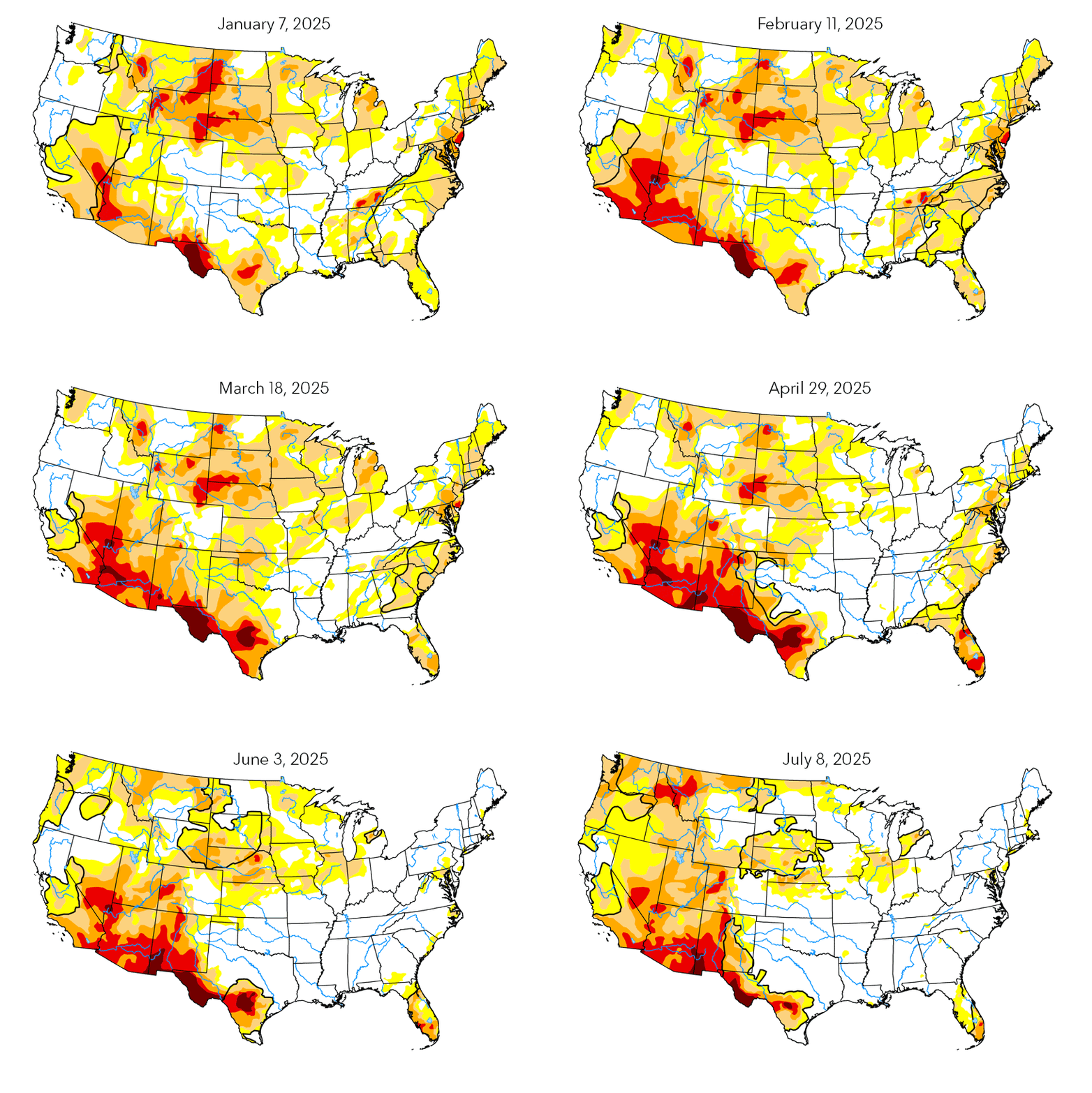
Extreme-to-exceptional drought continued to cover most of the Southern Plains in mid-May, with the worst conditions reported in New Mexico, western Oklahoma, and western and south-central Texas. The dry conditions were exacerbated by high heat, with parts of Texas notching 11 straight days of record heat at mid-month.

The combination of drought and heat pushed the Hermits Peak Fire in northern New Mexico to a record 465 square miles during the week. The fire was only 27% contained as of May 16.

Eastern Kansas, eastern Oklahoma, and eastern Texas were the only areas of the Southern Plains not experiencing some form of drought in mid-May. Strong thunderstorms rolled through northeastern Kansas once again on May 17, producing strong winds, hail, and heavy rain.

Highs in Colorado also reached the upper-80s and low-90s at midweek, but a drastic weather change saw temperatures fall more than 40 degrees from May 19 to May 20. Forecasts warned of snow down to 5,000 feet on May 20-21, with cold rain expected in the valleys. The colder weather was also taking aim at western Kansas. Sources there said weekend temperatures were expected to drop to the 30s, with a mix of rain and snow on May 21

Corn planting as of May 15 had progressed to 87% complete in Texas, 60% in Kansas, and 41% in Colorado, with soybean planting reported at 32% complete in Kansas. Kansas growers also had 41% of the cotton crop planted by that date, compared with 30% in Texas and 20% in Oklahoma. Sorghum planting was 73% complete in Texas, compared with just 5-7% in Kansas, Colorado, and Oklahoma.

The condition of the winter wheat crop illustrated clearly the impact of drought conditions in the region. While just 5-13% of the acreage in Texas and Oklahoma was rated good or very good, fully 81% of the Texas crop fell in the poor or very poor categories in mid-May, along with 52% of the acreage in Oklahoma. The Kansas wheat crop was 24% good or excellent, and 41% poor or very poor.

South Central:

High heat and scattered thunderstorms were common across the South Central region during the week. Severe weather in central Arkansas on May 15 left more than 50,000 customers without power, and another line of strong storms moved through Middle Tennessee and southern Kentucky on May 18, with reports of damaging winds and large hail in some locations.

Highs across much of the region tipped into the 90s as the week progressed, with some daily records expected to fall on May 20. The warm weather allowed planting to progress at a swift pace, with most crops tracking ahead of their five-year averages.

Corn planting as of May 15 was 65% complete in Kentucky and 84% in Tennessee, while soybean planting had progressed to 89% in Louisiana, 80% in Mississippi, 57% in Arkansas, and 36-41% in Tennessee and Kentucky. Cotton planting was also ahead of schedule at 80% complete in Louisiana, 55% in Mississippi, 53% in Arkansas, and 49% in Tennessee.

Growers were moving quickly on rice planting as well, with progress as of May 15 estimated at 96% complete in Louisiana, 92% in Texas, 84% in Mississippi, and 76% in Arkansas.

Southeast:

High heat blanketed much of the Southeast as the week progressed, which followed a round of strong thunderstorms and severe weather in mid-May.

Central North Carolina and parts of Georgia were under a severe thunderstorm watch on May 16, with reports of damaging wind and hail in some locations. By midweek, however, a ridge of high pressure pushed temperatures well into the 80s, with highs in the 90s expected on May 19-21 in Virginia, Georgia, Alabama, and the Carolinas.

Highs in the mid- to upper-80s were common across Florida during the week as well, along with scattered thunderstorms.

Sources in Georgia reported some cotton planting delays due to dry field conditions. “We are about 2-3 weeks behind getting cotton planted,” said one industry contact. By contrast, recent rains helped spark some fertilizer movement on pastures in Florida. “Hopefully that will continue,” added one Florida source.

Cotton planting as of May 15 was estimated at 54% complete in Alabama, 47-48% in the Carolinas, 39 % in Georgia, and 34% in Virginia. Peanut planting was tracking very close to the average pace at 60% complete in Florida, 56% in South Carolina, 51% in Virginia, 48% in Alabama and Georgia, and 40% in North Carolina.

North Carolina growers also had fully 95% of the corn planted by May 15, along with 44% of the soybeans.

Transportation

U.S. Gulf:

Ongoing high water levels at Baton Rouge, La., were noted restricting towing capacity above New Orleans. Softening forecasts at the river gauge at New Orleans suggest easing restrictions in the NOLA area, however. NOLA levels were no longer expected to move above the 12-foot mark, with forecasts calling for an 11.7-foot crest on May 21-24.

Calcasieu Lock daytime travel restrictions, previously expected to conclude in mid-May, were heard to extend through late August, blocking Monday-through-Thursday navigation between 7:00 a.m. and 6:00 p.m. The project kicked off on March 22.

Repairs underway at the Bayou Sorrel Bridge were expected to conclude in late May. Travel through the site was reportedly unavailable Monday through Friday, between 7:00 a.m. and 11:00 a.m., and again from 1:00 p.m. to 5:00 p.m. Normal navigation hours were available on Saturday and Sunday.

Weekday delays also persisted at Bayou Sorrel Lock during the week due to an ongoing guidewall replacement project, which is expected to continue into February 2023. Wait times were reported up to 25 hours during the week, unmoved from one week earlier.

Monday-Friday delays were reported at the Brazos Locks system. Navigation is reportedly unavailable between 7:00 a.m. and 5:00 p.m. through June 30.

Vessel navigation at Bayou Chene was blocked during overnight hours due to continued floodgate construction, a Coast Guard posting indicated. The waterway was shut to travel nightly between 7:00 p.m. and 7:00 a.m., while daytime navigation remained possible up to a maximum 600 feet of length. Widths were possible up to 54 feet. Delays were anticipated at 6-12 hours.

Shoaling impacted traffic at Miles 113-116 of the Atchafalaya River for another week, according to a Coast Guard posting, as 10-foot draft limits remained in place through the Morgan City, La., area. Barge strings were also capped at a maximum 600 feet of length, while tows longer than 400 feet were encouraged to travel with industry assistance. Width limits were observed at 70 feet. Tows could bypass the restrictions entirely by running through the Port Allen Route, the Coast Guard advised.

Unassisted tows were met with ongoing length and width restrictions at Algiers Lock, essentially limiting lockages to four standard barges or two 30,000 mt tankers per pass. Larger individual lockages were available when accompanied by an assist vessel. Delays for the week were reported in the 24-36 hour range, Corps data indicated.

Intermittent travel restrictions due to Belle Chasse Bridge construction were projected to run up to 12 hours at a time. The project is scheduled to continue through the end of the year.

Delays at Port Allen Lock were reported in the 5-15 hour range for the week, falling from up to 27 hours noted previously. While most Industrial Lock waits were counted up to 25 hours, additional intermittent waits were noted in the 35-50 hour range on May 14-16.

Mississippi River:

Operations to salvage a barge that sank near Mile 49 on the upper Mississippi River were projected to impact navigation through the area, possibly through the end of May. Reduced barge counts were in effect, while some larger tows were allowed to pass the location solely during daytime hours.

Improving river levels between St. Louis and the Cairo, Ill., interchange allowed for easing transit restrictions on overnight travel through the St. Louis area, although daylight-only travel limitations remained in force through a number of nearby areas during the week. The river gauge at Cairo was noted at an action-stage 35.32 feet and falling on May 18. Levels were expected to fall out of action stage on May 19.

Restrictions remained in place farther downriver, however, where rising waters were reported at both Vicksburg, Miss., and Baton Rouge. Vicksburg levels registered at an action-stage 39.55 feet and rising on May 18, while a 40.1-foot crest was projected for May 19-20. Baton Rouge’s action-stage 32.02-foot reading on May 18 was expected to peak at 32.4 feet on May 20-23. Both gauges were anticipated to remain at action stage into late May.

Channel reinforcement efforts that kicked off on May 10 at the lower river’s Mile 807 were scheduled to run through approximately June 10. The project was noted blocking southbound navigation at the location daily between 6:00 a.m. and 6:00 p.m. Delays were observed in the 3-6 hour range at Lock 14 during the week.

Illinois River:

High-water conditions were improving on the lower Illinois Waterway, easing travel restrictions and slowdowns described in the previous report. The river gauge at LaGrange Lock was reported falling below the 21.0-foot action stage on May 16, showing a 20.43-foot reading on May 18. A May 18 flood warning was in effect for the Havana and Beardstown areas.

A repair and maintenance project that began on May 9 at Brandon Road Lock will impact navigation through Sept. 8, a Corps posting indicated. Navigation is restricted to overnight hours and subject to maximum 70-foot widths until Aug. 14. The site will completely shut to traffic from Aug. 15 through Sept. 4, followed by a return to overnight-only passage on Sept. 5-8. Normal operation is scheduled to resume on Sept. 9. Delays were reported up to 14 hours during the week.

Wickets were reported on the lowered position at both Peoria Lock and LaGrange Lock, allowing tows to pass both sites through their nonlocking navigational passes.

Ohio River:

Heavy weekend precipitation swelled levels on the upper Ohio River, slowing movements and stretching pickup and delivery windows. Conditions were described as improved on the upper river, although the swell’s downriver push was heard to affect daytime-only movements through some mid-river locations.

The Belleville Lock primary chamber is shut to navigation from May 1 through June 29 for planned repairs and maintenance, prompting detours through the secondary chamber. Most delays were noted in the 2-4 day range, unchanged from the prior report.

Greenup Lock repairs were expected to follow a similar schedule to Belleville Lock, with the site’s main chamber going offline from May 1 through June 29, requiring tows to be routed through the auxiliary chamber. Wait times were noted up to 14 hours, Corps data indicated.

Navigation continued to be unavailable at Cannelton Lock during daylight hours on Wednesdays and Thursdays due to ongoing repairs and maintenance. The project began in late January and is slated to continue through May 26. Additional planned maintenance proposed for July 5 through Nov. 11 would similarly limit main chamber availability.

A proposed main chamber maintenance project at Hannibal Lock would run from July 5 through Oct. 8, limiting navigation to the use of the secondary chamber.

Travel through the Tennessee River’s Kentucky Lock was delayed up to a reported 19 hours during the week, rising from a maximum 15 hours in the prior report. Wilson Lock continued to show lengthy delays, with navigation posted in a wide 8-30 hour range.

Repairs to miter gate machinery at the Cumberland River’s Cheatham Lock kicked off on May 16. The project, slated to continue through Aug. 5, will see the lock shut for 11 days, followed by a three-day period of unrestricted access. The 14-day pattern will be repeated through the project’s conclusion.

Arkansas River:

Spiking water levels on the Arkansas River slowed travel on the waterway, while complete travel shutdowns were reported in some areas. The conditions were expected to persist through a possible 1-3 week period, depending on additional rainfall totals.

A Norrell Lock maintenance project is scheduled to close the site to navigation daily between 7:00 a.m. and 7:00 p.m. through a series of 10-day shutdowns continuing into January 2023. The blackout dates were tentatively scheduled for June 1-11; June 22-July 21; Aug. 1-10; Aug. 21-Sept. 21; Sept. 3-Oct. 9; Oct. 20-Nov. 18; Nov. 29-Dec. 23; and Jan. 3-31, 2023.

Stoller Rumored to be Exploring $1.5 Billion Sale

The owners of the agricultural chemicals company The Stoller Group Inc. are exploring a sale that could value it at as much as $1.5 billion, including debt, according to a Bloomberg report on May 12, citing people with knowledge of the matter.

The Houston-based company, which is controlled by the Stoller Foundation following the death of its founder Jerry Stoller in 2019 (GM June 21, 2019), is working with an adviser to look at strategic options for the company, including a sale, Bloomberg reported, citing sources who asked not to be identified because they were not authorized to speak publicly. Stoller will likely receive interest from other private equity firms and peers, the sources said.

The foundation has not made a final decision on which options to pursue and its plans could still change, said the sources. A representative for Stoller and the foundation did not respond to requests from Bloomberg for comment.

Stoller was founded in 1970 and has grown to include operations across more than 50 countries with 1,000 employees, according to the company’s website. The company, now led by President and CEO Guillermo de la Borda, has products designed to improve yields of row crops, tree nuts, fruits, vegetables, and turf, according to its website.

The company has made a number of strategic moves in recent years. Stoller joined CommoditAg’s online supply network in July 2020 (GM July 2, 2020), and in May 2021 the company announced that it has acquired a stake in Cromai, a Brazilian agri-tech startup (GM May 7, 2021). In November 2017, Stoller Enterprises Ltd, a Stoller Group subsidiary, signed a distribution agreement to market and sell ag products through Nexus Ag by Univar in Canada (GM Nov. 22, 2017).

According to data compiled by Bloomberg, chemicals dealmaking in North America has kept up to last year’s pace, with 176 deals worth a combined total of about $20 billion announced since January. That compares with 162 transactions for $22.6 billion at this point in 2021.

Some of this year’s most notable deals include Celanese Corp.’s $11 billion purchase of Dupont de Nemours Inc. mobility and materials arm and Dow Inc.’s acquisition of Hanseatic Energy Hub GmbH.

Brazil’s Galvani to Expand Fertilizer Output

Brazil’s privately-held fertilizer company Galvani Fertilizantes, Sao Paulo, is ramping up production and will double phosphate output at its plant in Luis Eduardo Magalhaes in Bahia state to 1.2 million mt in two years, CEO Marcos Stelzer said in an interview with Bloomberg.

While the expansion was planned before the latest fertilizer crisis began, the increased output will still be a welcome addition for local farmers struggling to afford the inputs they need in a runaway global marketplace.

Brazil, the top destination for Russian fertilizer shipments, currently imports around 85% of its fertilizer demand and 75% of its phosphate use. With Russia’s invasion of Ukraine causing prices to skyrocket, the Brazilian government has been looking for alternative suppliers from Canada to Iran; otherwise, it risks lower fertilizer use curbing yields and contributing to soaring food prices around the world.

In addition to the Luis Eduardo Magalhaes plant, Galvani is also a partner in an early-stage fertilizer project in the nation’s northeast, which is classified as strategic by the federal government. Known as Santa Quiteria (GM Oct. 19, 2018), the phosphate-uranium project is waiting for environmental and operation licenses to proceed, the CEO said.

If brought online, the Santa Quiteria project will introduce an additional 1.05 million mt/y of phosphate production. Together, the projects will boost Galvani’s fertilizer output to 2.2 million mt in 2026 from 600,000 mt in 2021. That would represent more than one-third of the nation’s current phosphate output.

The Galvani family retained the production unit in Luis Eduardo Magalhães and the mining units in Angico dos Dias and Irecê, as well as the Santa Quitéria project, when it sold its minority stake in Galvani Indústria to Yara International ASA, Oslo, in 2018 (GM Oct. 19, 2018). The Galvani retained assets were valued at US$95 million as of Aug. 31, 2018.

France Slashes Corn Planting

Corn farmers in France, the European Union’s top grower, will slash plantings to a four-year low, according to a Bloomberg report, the latest sign of how surging fertilizer costs are risking grain production. France will sow 1.46 million hectares (3.6 million acres) of corn this season, down 6% from last year, and plant more oilseeds instead, its agriculture ministry said May 10. That is an indication of the trade-offs farmers are making due to expensive fertilizers, which grains are more reliant on, it said.

Paris corn futures have soared 51% since the start of the year and are near an all-time high.

Corn farmers in the US are making similar planting cutbacks this year, according to the USDA. Ukraine, another major grower, will see its harvest sink due to Russia’s attack.

Paradeep Phosphates Proceeds with IPO

Paradeep Phosphates Ltd., Odisha, India, will sell new shares in the initial public offering (IPO) to raise a lower-than-planned 10.04 billion rupees ($130 million), while its shareholders – including the Indian government   will sell as many as 118.51 million shares, according to its red herring prospectus, cited by Bloomberg. The company filed draft papers for the IPO last fall (GM Oct. 22, 2021).

Proceeds from the sale are expected to repay debt, as well as partially finance the recent acquisition of the Goa nitrogen and NPK facility (GM Feb. 26, 2021), according to the Press Trust of India (PTI).

The shares will be sold in a range of 39-42 rupees, according to a stock exchange filing by Zuari Agro Chemicals Ltd., whose joint venture is selling shares in the IPO.

Zuari Maroc Phosphates Pvt., a jv of Zuari Agro Chemicals and OCP Group SA, owns 80.45% of Paradeep Phosphates; it will sell 6.02 million shares in Paradeep Phosphates, lower than the 7.55 million planned initially.

The Indian government, which owns the remainder in the fertilizer maker, or 19.55%, is selling about 112.5 million shares as planned. The government is selling its entire stake, according to PTI.

The IPO opens for sale May 17 and closes May 19; anchor investors can place bids on May 13.

Incorporated in 1981, Paradeep Phosphates is the second-largest maker of non-urea fertilizers among private sector companies in India, according to its prospectus. It has 1.2 million mt/y production capacity for DAP, NPK, and NP.

Unplanned Interruption Reported at Iowa Plant

OCI NV’s Iowa Fertilizer Co. reported that the Wever, Iowa, nitrogen plant experienced an unplanned interruption in production on May 9. The company hopes to return to normal operations later in the week.

The company told local residents to expect higher-than-normal flaring and noise levels, as well as steam venting, during the startup period. It said the flaring is harmless to the environment and that the company continues to meet and exceed all air quality permits and regulations regarding the flares.

Scotts Income Off on Late Season, Commodity Prices, Depressed Cannabis Market

Scotts Miracle-Gro Co., Maryville, Ohio, reported net income for the second quarter ending April 2 of $276.5 million ($4.94 per diluted share) on sales of $1.68 billion, down from the year-ago $310.2 million ($5.43 per share) and $1.83 billion, respectively. Adjusted EBITDA was $429.6 million, down from $478.9 million.

The company reported record second-quarter U.S. Consumer sales, though this was offset by an expected decline in Hawthorne Group sales, leading to company-wide sales that were 8% lower than the same period a year ago. As a result, the company has adjusted its total sales outlook to the lower end of guidance.

It said its previous guidance of $8 or more of non-GAAP adjusted earnings per share is likely unattainable. Scotts plans to further update the investment community the week of June 6.

“Spring weather, frankly, has been lousy in most markets and the season broke about two to three weeks later than normal,” said Jim Hagedorn, Chairman and CEO. “Still, we now believe the low end of our sales guidance range for U.S. Consumer of plus-or-minus 2% from last year’s performance is our most likely outcome.”

“At Hawthorne, while organic sales in the second quarter were in line with what we expected, recent trends also lead us to conclude the low end of our sales guidance range is a best-case outcome for this business,” he added. “We are taking steps to proactively reduce costs within the Hawthorne operation, with a focus on returning the business to at least its previous level of profitability as quickly as possible.” This includes shrinking the size of its supply chain network and reducing staffing levels.

Company-wide, Scotts plans to pull back on some discretionary spending and hiring decisions for the rest of the year.

Hagedorn added that over the last two years, the continued pressure from commodity prices has led to a significant margin decline despite multiple pricing actions. The company expects to boost prices again in the fourth quarter, which will be the fourth increase within a year. The company said a surge in commodity prices is expected to pressure earnings per share (EPS) in the second half.

On May 3, the company told analysts that it has about 80% of its raw materials costs locked in for the year, 90% on urea. It said diesel and pallets are the largest area of exposure. “Even if commodity prices start to ease, it will take a few years to claw back the margin we’ve lost,” added Hagedorn.

“If we sit back and wait for the commodity market to give our margins back, we could be waiting a while. So we are not going to wait. We’re going to swiftly move to make changes and better positon us for success.”

The company is currently forecasting commodities to represent 32% of cost of goods sold (COGS) this year, up from 19% in 2020.

Another problem for the company is swollen inventories, estimated at $600 million, with half of that in U.S. Consumer and half in Hawthorne. Two-thirds of that is units, and one-third cost. Hawthorne hopes to move some of that to Australia via its recent Cyco acquisition (see related story).

Hagedorn, citing Scotts own economists, is preparing for a recession, but said while not recession-proof the company is recession-resistant, noting that it has a lot of experience coming through recessions.

Six-month net income was $226.4 million ($4.02 per share) on sales of $2.24 billion, down from the year-ago $335.3 million ($5.87 per share) and $2.58 billion, respectively. Adjusted EBITDA was $421.1 million, down from $554.3 million.

  2Q-22 2Q-21 1H-22 1H-21
Net Sales ($/millions)        
US Consumer 1,379.8 1,374 1,722.2 1,782.2
Hawthorne 202.6 363.8 393.2 673.2
Profit ($/millions)        
US Consumer 428.9 435.9 439.6 481.2
Hawthorne 3.3 41.4 (2.0) 81.8

Scotts’ Hawthorne Acquires Australian-Based Cyco

Scotts Miracle-Gro Co., Marysville, Ohio, announced on May 3 that its Hawthorne Group has acquired Cyco, Adelaide, South Australia, for $34 million plus contingent consideration of up to $10 million. The transaction marks the fifth Hawthorne acquisition in the past year.

Cyco is a brand of premium nutrients, additives, and growing media products that are used by growers of all sizes in the hydroponic market. Hawthorne has been the exclusive U.S. distributor of Cyco products, which also are sold primarily in Canada and Australia through select retailers and distributors.

Under the terms of the deal, Hawthorne has acquired the brand and business assets of Cyco. Although the acquisition is small – about $15 million in annualized sales – Scotts said Cyco is a strategic move to expand Hawthorne’s Signature line of nutrients and growing media, including General Hydroponics, Botanicare, Terpinator, and Mother Earth.

Hawthorne intends to expand the availability of the Cyco brand in North America, and through an arrangement with the current Australian distributor will make other Hawthorne products available to hydroponic growers in that market. Scotts told analysts on May 3 that it hopes to move some of its current excess inventories to Australia.

Despite the Cyco acquisition, Scotts said it now has a pretty limited appetite for M&A, as it is not looking for cash to go out the door. “Anything would be highly strategic and probably non-cash,” Jim Hagedorn, Chairman and CEO, told analysts.

Correction

Correction: Nutrien Ltd., Saskatoon, reported that contrary to a story in Green Markets on April 29, p. 29, it has not committed to being carbon-neutral by 2050. The reference came from an April 25 press release issued by AirCapture, Berkeley, Calif., and OCOchem, Richland, Wash.