

California:
Potassium nitrate prices in California were reported at $1,430/st FOB Stockton for bulk tons, $1,535/st FOB for bulk bags, and $1,555/st FOB for 50-pound bags.
California:
Potassium nitrate prices in California were reported at $1,430/st FOB Stockton for bulk tons, $1,535/st FOB for bulk bags, and $1,555/st FOB for 50-pound bags.
Eastern Cornbelt:
Potassium thiosulfate pricing was steady at $750/st FOB Terre Haute for the most recent offers.
California:
The potassium thiosulfate market remained firmly at the $725/st FOB level in California at mid-month.
Eastern Cornbelt:
Wet, windy weather prevailed across much of the Eastern Cornbelt during the week, further delaying spring fieldwork and preplant fertilizer applications.
Damaging winds, large hail, and heavy rain hit parts of central Illinois at midweek. Although highs reached the low 70s earlier in the week, temperatures fell into the 50s on April 14-15.
Severe weather was also in the midweek forecast for central Indiana, although most areas experienced only gusty winds and heavy rain. A wind advisory remained in place for northern Indiana on April 13-14.
Highs in northern Ohio reached the mid-60s at the start of the week, but steady rain moved into the region as the week progressed, with temperatures dipping to the mid-40s. Conditions remained windy for the balance of the week, with slightly warmer temperatures, but continued showers.
Growers had yet to make a mark on corn planting in the region as of April 10. “We are still at a standstill, with nothing done for this cropping season,” complained on Ohio contact. “It’s very wet, and more rain and cool temperatures are on the way.”
Western Cornbelt:
Severe weather moved through eastern Nebraska and western Iowa on April 12, producing damaging winds and large hail in some areas, and prompting a number of tornado warnings.
At least eight tornadoes were confirmed in Iowa on Tuesday, with the strongest reported as an EF2 near Gilmore City. As a result, Gov. Kim Reynolds issued a disaster proclamation for Cerro Gordo, Hancock, Humboldt, Mitchell, Pocahontas, Winneshiek, and Worth counties.
Unsettled weather conditions continued as the week advanced. A wind advisory was in effect for eastern Nebraska on April 14, with wind gusts reaching 40-50 mph across the state.
Strong thunderstorms also battered parts of Missouri during the week. Along with spotty reports of wind damage, as much as 2-3 inches of rain fell in some southern parts of the state, resulting in reports of flash flooding. Parts of Missouri were under a frost advisory on April 14.
Just 1 percent of Missouri’s corn crop was planted by April 10, compared with a five-year average of 4 percent by that date. Corn planting progress had yet to register in Iowa and Nebraska, while oats planting was reported at 13 percent complete in Iowa and 44 percent in Nebraska.
California:
Northern California endured a weather whiplash in early April. Temperatures reached a record 92 degrees in Sacramento on April 8 before tumbling to the low-60s on April 11-14, with nighttime lows falling to the upper 30s during the week.
The cold weather was accompanied by rain and snow across Northern California on April 11. Forecasts warned of a foot of snow in the central Sierra Nevada range early in the week, with rainfall measuring from a tenth of an inch to a half-inch in the Sacramento Valley.
Temperatures ranged in the 60s and low 70s across much of Southern California during the week, along with gusty winds. Highs were expected to reach the upper 70s and low 80s by Easter, however, with the warm, dry weather extending into the following week.
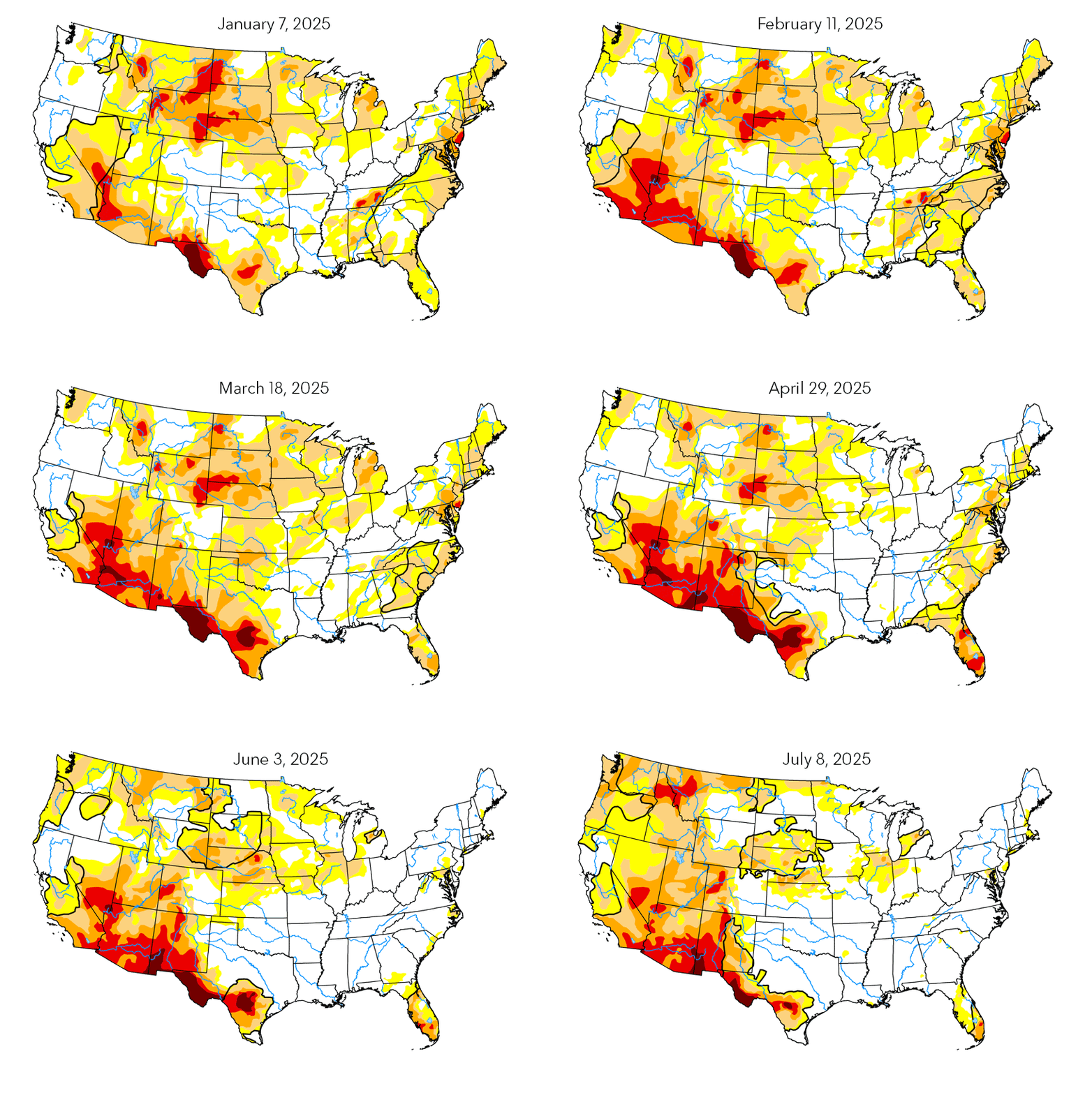
Mostly severe-to-moderate drought covered California in early April, with the worst drought conditions reported in broad patches across the central, northern, and inland southern regions of the state. The dry conditions helped growers get a jump on cotton planting in the state, which had progressed to 35 percent complete by April 10, well ahead of the 6 percent five-year average.
Pacific Northwest:
A powerful winter storm brought snow, ice, gusty winds, and bitterly cold temperatures to much of the Pacific Northwest during the week.
Residents in Oregon and southwestern Washington woke up to widespread power outages and road closures on April 11 due to snow accumulation and strong winds. Another round of scattered rain and snow showers hit the region at midweek, with highs only expected in the 40s across the Willamette Valley as the week progressed.
Most of Washington was missed by the heavy winter precipitation, although the Seattle area saw cold winds and scattered rain showers during the week. In Idaho, 2-11 inches of snow was reported across eastern areas of the state early in the week, along with 35-mph winds. Parts of southern Idaho were hit with more rain on April 14.
Some of the storm’s most significant impacts were felt in Montana, with reports of 12 inches of snow in valleys across southwestern and central Montana, and 20 inches or more at higher elevations. Some locations saw considerably more, with up to three feet of snow reported in Pony, Mont. As the storm churned to the east, multiple road closures were reported across eastern Montana at midweek due to blowing and drifting snow.
Spring fieldwork and the planting of sugar beets and spring grains was underway in the region prior to this week’s storm. “Activity in the PNW varies greatly by geography,” said one regional contact. “It has been start-and-stop, with unusual weather patterns the past few weeks. Snow across the territory this week will halt things for a week or so.”
Idaho growers had 35 percent of the sugar beets planted by April 10, while the planting of spring wheat and barley had progressed to 24-32 percent complete in Washington, 23-26 percent in Idaho, and 7-8 percent in Montana. All states were tracking ahead of their five-year averages.
Western Canada:
A massive spring storm brought heavy snow to southern Manitoba on April 12-14, with reports of 30-50 cm of accumulation in some locations. The snowfall was accompanied by 70 km/h winds that produced blizzard warnings, widespread power outages, and numerous road closures across the province.
The heaviest snowfall in Manitoba was expected around Riding Mountain and Turtle Mountain, where models suggested as much as 80 cm of accumulation was likely by the time the storm moved out.
The system also expanded into southern Saskatchewan on April 13-14, with 3-6 cm of snow reported in Saskatoon and up to 10-20 cm across southeastern areas of the province, along with 60-70 km/h winds. Temperatures dropped to the negative single digits C across Saskatchewan for the balance of the week, and lingering snow flurries and cold temperatures were expected to continue through the Easter weekend.
Strong winds and cold temperatures also hit much of Alberta during the week, while parts of British Columbia endured strong winds, hail, and thunderstorms.
Sources reported virtually no fertilizer demand in the region, prompting one contact to describe the current markets as “hard to quote.” The only location reporting limited fieldwork during the week was southern Alberta.
“Last week there was lot of talk about wanting to get going this week, but the weather has put a halt on that,” said one contact. “I think most of our stuff will go down with seed, as everyone is cutting back because we have not got much required moisture.”
U.S. Gulf:
With river levels moving below the 12-foot mark on April 8 at New Orleans, expectations were raised for a swift end to travel restrictions in the NOLA area. Towing restrictions and horsepower minimums were in effect between NOLA and Baton Rouge, La., while river levels remained high. The gauge was reported at 11.58 feet and falling slowly on April 11.
Calcasieu Lock access was unavailable during daylight hours on Monday through Thursday, blocking navigation between 7:00 a.m. and 6:00 p.m. Normal operations were scheduled to resume on May 19.
Brazos Lock is reportedly shut to daytime navigation through mid-April. Locking was described as unavailable from 7:00 a.m. to 5:00 p.m., Monday through Friday. The actions drove widely variable delays counted up to 35 hours during the week.
The West Canal’s Brazos Lock was shut to daylight travel on weekdays, blocking access daily from 7:00 a.m. to 5:00 p.m. Wait times were expected to run 12 hours or more.
In-progress repairs to the Bayou Sorrel Bridge were observed limiting navigation daily between 7:00 a.m. and 11:00 a.m., and again from 1:00 p.m. to 5:00 p.m. The operation is scheduled to run through late May.
Guidewall construction activities at the nearby Bayou Sorrel Lock were scheduled through May 31, blocking Monday-through-Friday travel between 6:30 a.m. and 5:00 p.m. Most waits were observed in the 5-11 hour range on April 11, falling from 20-44 hours in the prior report.
Overnight travel through Bayou Chene remained unavailable due to floodgate construction, leaving the waterway accessible daily between 7:00 a.m. and 7:00 p.m., subject to 600-foot maximum lengths. In addition, tows measuring wider than 54 feet were required to travel with an assist vessel. Delays were expected at 6-12 hours.
Atchafalaya River drafts were posted at a maximum 10 feet through the Morgan City, La., area, located at Miles 113-116, due to shoaling. Tow lengths were capped at 600 feet, while an assist vessel was recommended for strings measuring longer than 400 feet. Widths were permitted up to 70 feet. Tows could bypass the restrictions entirely by taking the Port Allen Route.
Unassisted lockages at Algiers Lock were subject to length and width requirements, sources noted, effectively limiting tow lengths to four standard barges or two 30,000 mt tankers per pass. Larger strings were possible when locking with an assist vessel. Delays were noted in the 11-16 hour range for the week.
Construction underway through late 2022 at the Belle Chasse Bridge triggered sporadic delays expected to last up to 12 hours at a time. The bridge is located at Mile 3 in the West Canal.
Most Port Allen Lock movements were delayed in the 9-24 hour range for the week, according to Corps data, while wait times at Industrial Lock ran up to 26 hours. Calcasieu Lock waits were heard up to six hours, and boats passing the Colorado Locks system observed intermittent 5-8 hour waits.
Mississippi River:
Elevated water levels continued to impact movements on the lower Mississippi River during the week, reducing barge counts and prompting daylight-only travel through some urban areas when moving in the downriver direction.
The river gauge at Vicksburg, Miss., was at an action-stage 35.66 feet on April 13. River levels were predicted to climb to 37.6 feet on April 24, while remaining above the 35-foot action stage through at least April 27.
High water levels at New Orleans triggered ongoing towing restrictions and reduced barge counts on movements below Baton Rouge.
The Baton Rouge river gauge was posted at an action-stage 31.58 feet and falling on April 13, with levels expected to return to safe levels on April 16. An April 12 flood warning posted for the region was slated to remain in effect through April 30, however.
Channel reinforcement efforts announced for the lower river’s Mile 807 are expected to run from May through July, prompting expected daytime travel stoppages.
Lock 15 delays were posted up to six hours during the week. Wait times at Lock 25 were observed in the 3-6 hour range.
Illinois River:
Illinois River movements were slowly recovering from the previous week’s high water limitations, which slowed or halted movement altogether. Impacts continued to be felt in the form of travel slowdowns, however.
Additional rainfall boosted water levels on the lower river, with the gauge at Peoria measuring 18.28 feet on April 13, above the 18-foot minor-flood threshold. Levels there were expected to crest at 18.7 feet on April 17-18, while remaining at flood stage through at least April 20. The LaGrange river gauge was also projected to stay at minor-flood stage through at least April 20.
Upriver, the Ottawa gauge was below the flood zone on April 13 but expected to push into action-stage territory in the week ahead, with a 46.1-foot crest expected on April 15-16.
Repairs and maintenance at Brandon Road Lock are scheduled for May 9 through Sept. 8. Navigation will be limited to overnight hours between May 9 and Aug. 14, with tow widths permitted at a maximum 70 feet. Navigation will be stopped completely from Aug. 15 to Sept. 4, followed by a return to daytime shutdowns on Sept. 5-8. Normal movements are scheduled to resume on Sept. 9.
Wickets were reported down at both Peoria Lock and LaGrange Lock due to high water levels, allowing tows to pass without locking through both locations.
Ohio River:
Main chamber repairs in progress since Feb. 22 at Emsworth Lock prompted detours through the auxiliary chamber during the week, which were limited to a single barge per turn, leading to lengthy delays. Lockages were reported in the 4-6 day range during the week, unmoved from the prior week. The project was scheduled to wrap up on April 16.
Daytime travel at Cannelton Lock was reported to be unavailable on Wednesdays and Thursdays through May 26. Additional maintenance proposed for the July 5 through Nov. 11 period would similarly limit primary chamber access.
The main chamber at Belleville Lock is slated to close to navigation from May 2 through June 22 for planned repairs and maintenance, forcing detours through the auxiliary chamber.
A Hannibal Lock repair proposal would see the site’s primary chamber shut down from July 5 through Oct. 8.
Dashields Lock wait times were noted up to 20 hours for the week. Corps data put Cannelton Lock delays up to eight hours.
Extensive delays persisted at Wilson Lock, located on the Tennessee River, due to main chamber work in progress through April 28. Movements have remained possible through the secondary chamber, subject to lengthy delays. Wait times were reported in the 3.5-4.5 day range for the week, falling slightly from 4-5 days reported previously.
Boats passing Kentucky Lock were subject to wait times in the 9-24 hour range, climbing from 4-9 hours one week earlier.
On the Cumberland River, miter gate machinery repairs are expected to substantially impact Cheatham Lock travel from May 16 to Aug. 5. The project is expected to proceed on a repeating two-week pattern, in which work will run for 11 days, followed by a three-day period of resumed navigation.
Arkansas River:
A planned Norrell Lock maintenance effort will prompt a series of transit shutdowns running into January of 2023, sources said. The lock will be closed during daytime hours on June 1-11; June 22-July 21; Aug. 1-10; Aug. 21-Sept. 21; Sept. 30-Oct. 9; Oct. 20-Nov. 18; Nov. 29-Dec. 23; and Jan. 3-31, 2023.
Nutrien Ltd. has announced that current Director of Retail Operations in Brazil Carlos Brito will occupy the position of Director of Retail Operations for all of Latin America and expand its scope of activities to the regions of Argentina, Brazil, Chile, and Uruguay. Brito will continue reporting to Nutrien Latin American President André Dias.
“This is an important step in our management model, which will allow us to achieve greater integration between the countries where we are present in Latin America,” said Brito. “We have evolved our work to look at the opportunities we have across borders, which has allowed us to create opportunities to better serve farmers in the region.”
Brazil Foreign Minister Carlos Franca said during a hearing that he would be negotiating the possibility of easing the embargoes against Iran with the current U.S. Secretary of State Antony Blinken. Franca’s main interest would be to facilitate the flow of fertilizer imports to Brazil, as today many Brazilian companies avoid any kind of relationship with Iran to avoid U.S. sanctions. Currently, commercial conditions are limited to barter payments.
Iran is a major producer of urea and ammonia, with an estimated annual capacity of 7.7 and 5.8 million tons, respectively, for 2022, according to Bloomberg Intelligence. Under current trade relationship conditions, Iran exports about 9 percent of its production, approximately 350,000 mt of urea, throughout the year to Brazil. This amount represents 3-4 percent of the total volume of Brazilian urea imports.
Since the visit of former Agriculture Minister Tereza Cristina to Tehran in January, there has been interest from both sides in strengthening trade relations, and by that time the Iranian authorities had already pointed out possibilities to export a greater volume of urea to Brazil.
In this context, there is an opportunity for Brazil to reduce its dependence on Russian urea, as Iran still has idle productive capacity to supply much of the Brazilian demand. Currently, Russia accounts for about 18 percent of Brazil’s urea consumption (1.4 million mt), and a redirection of demand to the Iran market could lessen the impact of sanctions imposed against Russia in the current conflict scenario in Europe.
The U.S. Environmental Protection Agency (EPA) on April 12 released its first-ever comprehensive workplan to address pesticide risks to endangered species. EPA said the plan establishes four overall strategies and dozens of actions to adopt those protections while providing farmers, public health authorities, and others with access to pesticides.
“Today’s workplan serves as the blueprint for how EPA will create an enduring path to meet its goals of protecting endangered species and providing all people with safe, affordable food and protection from pests,” said EPA Administrator Michael S. Regan. “The workplan reflects EPA’s collaboration with other federal agencies and commitment to listening to stakeholders about how they can work with the agency to solve this longstanding challenge.”
EPA said it has an obligation to improve how it meets its duties under the Endangered Species Act (ESA) when it registers pesticides under the Federal Insecticide, Fungicide, and Rodenticide Act (FIFRA). For most of its history, EPA said it has met these duties for less than five percent of its FIFRA decisions, resulting in more than 20 ESA lawsuits against the agency. EPA said this creates “uncertainty for farmers and other pesticide users, unnecessary expenses and inefficiencies for EPA, and delays in how EPA protects endangered species.”
EPA said it currently has more than 50 pesticide ingredients, covering over 1,000 pesticide products, with court-enforceable deadlines to comply with the ESA or in pending litigation alleging ESA violations.
“Completing this work will take EPA past 2040, yet the work represents less than five percent of all the FIFRA decisions in the next decade for which ESA obligations exist,” the agency said. “This is an unsustainable and legally tenuous situation, in which EPA’s schedule for meeting its ESA obligations has historically been determined through the courts. The workplan must provide a path for the agency to meet those obligations on its own, thus protecting endangered species while supporting responsible pesticide use.”
The strategies outlined in the plan include identifying FIFRA actions that are of the highest priority for fulfilling EPA’s ESA obligations, including court-enforceable deadlines and new registrations of conventional pesticides; improving approaches to identifying and requiring ESA protections, particularly for species that face the greatest risk from pesticides; improving the efficiency and timeliness of the ESA consultation process for pesticides, in coordination with other federal agencies; and engaging stakeholders more effectively to better understand their pest control practices and implement species protection measures.
EPA said the workplan establishes an ESA-FIFRA program that focuses on protecting species under the ESA, while minimizing regulatory impacts to pesticide users, supporting the development of safer technologies to control pests, completing timely FIFRA decisions, and collaborating with other agencies and stakeholders on implementing the plan.
EPA said it will engage with a wide range of stakeholders and federal and state agencies over the coming months to identify opportunities for collaboration and will continue seeking input on more effective and efficient ways to meet its ESA obligations. The U.S. Department of Agriculture (USDA), Fish and Wildlife Service, and National Oceanic and Atmospheric Administration (NOAA) all expressed support for the workplan.
“USDA appreciates the steps EPA is taking today,” said USDA Undersecretary for Farm Production and Conservation Robert Bonnie. “We are confident that EPA can streamline ESA consultations around pesticides in a way that continues to conserve wildlife while allowing farmers access to the tools they need to produce the food and fiber that all of us rely on.”
The workplan follows the establishment in November 2021 of a new ESA-FIFRA Interagency Working Group with EPA, USDA, Department of Interior, Department of Commerce, and the White House Council on Environmental Quality. EPA also announced in January that it will now meet its ESA obligations before registering any new conventional pesticide active ingredient.
In March EPA announced that it will begin taking steps to protect endangered species in response to the U.S. Fish and Wildlife Service’s biological opinion for the insecticide malathion, representing the first-ever completed nationwide consultation between the two agencies.
President Joe Biden on April 12 announced the suspension of a federal rule that prohibits the sale of E15 blended biofuels between June 1 and Sept. 25 in an effort to combat inflation and high fuel prices. E15 sales are typically banned during the summer under the Clean Air Act because of air pollution concerns.
The decision was hailed by the ethanol and corn industries. Corn futures were up 0.9 percent in pre-market trading after the announcement.
“Corn growers thank President Biden for ensuring drivers continue to have access to a lower-cost fuel choice and acknowledging how renewable ethanol helps reduce prices, lower emissions, and improve our nation’s energy security,” said Chris Edgington, President of the National Corn Growers Association (NCGA). “Farmers are proud to contribute to cleaner, less expensive fuel choices.”
The Labor Department on April 12 reported that consumer prices in March were 8.5 percent higher than a year ago, the sharpest increase since December 1981. Gas prices are up 48 percent since last year, in part because of instability in global markets after Russia’s invasion of Ukraine. On April 12, AAA’s national gas average was $4.09 a gallon.
According to NCGA, ethanol has been priced an average of 80 cents less per gallon than unblended gasoline at wholesale through March, and drivers currently save up to 20 cents or more per gallon where E15 is available. Bloomberg reported, however, that only 2,300 of the nation’s more than 150,000 filling stations sell E15, which is currently 5-10 cents cheaper per gallon than the much more common E10.
Biden said more than $100 million will be dedicated to build a biofuels infrastructure that supports farmers and the farm economy, provides more jobs, reduces reliance on foreign oil, and offers consumers a choice at the pump. The ethanol industry estimates summer sales this year could account for about 250 million gallons of E15.
As part of the Pandemic Assistance for Producers, the White House said USDA will also provide up to $700 million in funding through a Biofuel Producer Program to support agricultural producers that rely on biofuels producers to maintain a “viable and significant” market for agricultural products.
Corn use for ethanol has more than tripled since 2005, when President George W. Bush enacted the Renewable Fuel Standard that compels refiners and fuel importers to use a variety of biofuels. Ethanol now accounts for about 10 percent of U.S. gasoline usage, Bloomberg reported, up from less than a 10th of 1 percent in 1993.
In 2019, President Donald Trump attempted to allow E15 to be sold year-round, but the decision was overruled by a federal court, which said EPA exceeded its authority in making the decision.
Many oil companies have battled the use of E15 for years, Bloomberg noted, warning about potential engine damage from motorists inadvertently pumping the fuel into vehicles and other equipment not approved to use it. Some automakers have also warned that car warranties would be voided if motorists use E15. In addition, several environmental groups have pushed against E15, arguing that it will drive the production of more corn and more water pollution from agricultural runoff.
In August 2021, CHS Inc. announced that it would offer E15 at an additional 19 fuel terminals in Minnesota, Wyoming, Iowa, Nebraska, Missouri, and Kansas (GM Aug. 6, 2021). CHS is registered with the U.S. Environmental Protection Agency as an E15 manufacturer and sells E15 as an approved grade of fuel through its Cenex® brand retail locations.
Tecnimont SpA and Tecnimont USA, part of the leading Italian engineering and technology group Maire Tecnimont SpA, have been awarded two new contracts worth a combined $415 million in the U.S. by the same company for a blue ammonia plant and a urea diesel exhaust fluid (DEF) plant.
The first award, made last month, is for the provision of engineering, procurement, and construction management services for the blue ammonia plant with a capacity of 3,000 mt/d. Maire Tecnimont put the contract value at approximately $230 million.
The second award, announced by Maire Tecnimont on April 11, will see Tecnimont provide technology from Stamicarbon (part of the Maire Tecnimont Group) for the urea DEF plant, which will have a capacity of 1,500 mt/d, plus the necessary utilities and facilities, including a CO2 purification plant. The ammonia feedstock will be supplied from the aforementioned blue ammonia plant.
Maire Tecnimont did not disclose the location of the two plants or the identity of the awarding company, describing the company only as “a leading global chemicals producer, developing its energy transition industrial vision.”
A construction contract or contracts will be awarded separately to an external party not belonging to Maire Tecnimont Group, and will be directly awarded by the client.
The completion of the two projects is expected in 2025.
The European Union (E.U.) Council on April 8 agreed to adopt a fifth package of sanctions against Russia in response to the recent reports of atrocities committed by Russian troops in Bucha and other areas of Ukraine.
The new sanctions include an entry ban on Russian flagged vessels and Russian-operated vessels from accessing E.U. ports, as well as “an anti-circumvention” measure against potash imports from Belarus. The exact nature of this measure is yet unclear, but it would seem to imply the banning of imports of potassium chloride into the E.U. from Belarus through Russia.
The new sanctions package has six elements, including an import ban on all forms of coal from Russia. According to a European Commission (E.C.) press statement on April 8, this affects one fourth of all Russian coal exports, amounting to a roughly €8 billion (approximately $8.7 billion at current exchange rates) loss of revenue per year for Russia.
The E.C. also indicated it and the European External Action Service (EEAS) are working on additional proposals for possible sanctions, including on oil imports from Russia. According to the statement, the E.C. is assessing some of the ideas presented by Member States in this regard, including taxes or specific payment channels such as an escrow account.
“Beyond sanctions, the E.U. has made it clear that reducing our dependence on energy imports from Russia is an urgent imperative,” the E.C. said in its statement. The E.C. said work has started to implement a strategy announced in its “REPower Communication” on March to reduce the E.C.’s dependence on Russian fossil fuels.
E.U. Member States are divided on whether to impose a ban on Russian oil and gas imports. The E.U. currently relies on Russian gas for around 40 percent of its needs. Some Member States, including Germany, Hungary, Austria, and Bulgaria, are more dependent on Russian gas than others.
Magnus Brunner, Austria’s Federal Minister for Finance, was cited by CNBC this week as saying Austria is against sanctions on oil and gas because the country “is very much dependent” on the Russian gas and “all sanctions which hit us more than the Russian’s wouldn’t be good for us.” Hungary is also reported to oppose sanctions against Russian fuel.
According to the European statistics office, Eurostat, Austria is estimated to have imported almost 59 percent of its natural gas from Russia in 2020, while Hungary, Bulgaria, the Czech Republic, and Latvia imported an even higher share of natural gas from Russia that year.
Lithuania has fully abandoned imports of Russian natural gas starting from April 1, according to a report by Russia’s Prime Business news agency, citing Lithuanian President Gitanas Nausėda on his Twitter page on April 2.
In a separate move, the European Parliament on April 7 passed a nonbinding motion demanding a total ban on all Russian energy imports into the E.U., according to an Agence France Presse report. MEPs voted 513 in favor, with 22 against and 19 abstentions, on an “immediate” ban on Russian coal, gas, and oil, as well as nuclear fuel, according to the report. Parliament Speaker Roberta Metsola called it a “very important moment” that sent the “strongest messages” to Ukraine on the degree of E.U. support.
The fifth round of sanctions against Russia has also extended import bans worth €5.5 billion on Russian products, including cement, rubber products, wood, spirits (including vodka), liquor, and high-end seafood (including caviar).
The E.C. statement announcing the new sanctions makes no mention of a reported proposal to place a cap on imports of Russian potash into the E.U., which was reported by Dow Jones earlier this week.
Last year, the E.U. imported 5.4 million mt of potash, of which 14.5 percent – or some 783,243 mt – was sourced from Russia, according to Trade Data Monitor. In March, the E.C. widened its sanctions on Belarusian potash, effectively banning imports into the E.U. of all grades of Belarusian potash. The move, part of wider new sanctions package against Belarus, was in response to the country’s role in supporting Russia’s invasion of Ukraine (GM March 4, p. 30).
The new sanctions include an entry ban on Russian-flagged vessels and Russian-operated vessels to E.U. ports. A full ban will also apply on Russian and Belarusian road transport operators working in the E.U. However, there is no mention of any ban on rail freight from Russia into the E.U.
“This ban will drastically limit the options for the Russian industry to obtain key goods,” the E.C. said. However, according to the statement, “certain exemptions will cover essentials, such as agricultural and food products, humanitarian aid, as well as energy, among others.” It is unclear if the “agricultural products” exemptions will include any Russian fertilizers.
An E.C. spokesperson contacted by Green Markets earlier this week said as per previous sanctions packages, he could not provide further details until this latest sanctions package is adopted by E.U. Member States and published in the E.U.’s Official Journal.
New financial measures in the sanctions package include a full transaction ban and asset freeze on four key Russian banks, among them VTB, the second largest Russian bank. “These four banks, which we now cut totally off from the markets, represent 23 percent of market share in the Russian banking sector,” the E.C said, adding that this will further weaken Russia’s financial system.
In addition, providing high-value crypto-asset services to Russia is now prohibited, as is providing advice on trusts to wealthy Russians, which the E.C. said would make it more difficult for Russians to store their wealth in the E.U.
Further targeted export bans are also being imposed against Russia, worth €10 billion, “in areas in which the country is vulnerable.” They include, for example, quantum computers and advanced semiconductors, and also sensitive machinery, transportation equipment, and chemicals. The export ban also includes specialist catalysts for use in the refining industry.
The E.C. said these measures will continue to degrade Russia’s technological base and industrial capacity. It also added jet fuel and fuel additives to the existing export ban list, noting that these products may be used by the Russian army.
A full prohibition is now imposed on the participation of Russian nationals and entities in procurement contracts in the E.U., although it said limited exceptions may be granted by competent authorities where there is no viable alternative.
The E.C. has also added an additional 217 individuals and 18 entities to its sanctions list. These include all 179 members of the so-called “governments” and “parliaments” of Ukraine’s Donetsk and Luhansk regions. In total, the E.U. has sanctioned 1,091 individuals and 80 entities as part of its Russian sanction measures since 2014.
“Russia is waging a cruel and ruthless war, not only against Ukraine’s brave troops, but also against its civilian population. It is important to sustain utmost pressure on Putin and the Russian government at this critical point,” said E.C. President Ursula von der Leyen in a statement
“The four packages of sanctions have hit hard and limited the Kremlin’s political and economic options,” she added. “We are seeing tangible results. But clearly, in view of events, we need to increase our pressure further. Today, we are proposing to take our sanctions a step further. We will make them broader and sharper, so that they cut even deeper in the Russian economy.”