All posts by mickeybarb@charter.net

Sulfur

Tampa:

The second-quarter contract price of molten sulfur at Tampa was set at $481/lt CFR, up $199/lt from the first quarter’s $282/lt CFR contract.

Operable refinery capacity pressed higher for the week, the U.S. Energy Information Administration (EIA) reported. Total U.S. refining capacity lifted to 92.5 percent for the week ending April 1, a 0.4 point increase from 92.1 percent noted previously. The current rate remained ahead of both the year-ago 84.0 percent and the 86.6 percent five-year average.

Crude inputs were also up, the EIA noted, moving to an average 15.948 million barrels/d for the period, a 35,000 barrel/d increase from the previous week’s 15.913 million barrels/d rate.

U.S. Gulf:

Activity levels from the 95,000 barrel/d DCU-2 coking unit at Motiva’s Port Arthur, Texas, refinery returned to normal on March 31, Genscape reported. Falling levels were noted at the unit starting on March 29.

Valero on April 1 successfully restarted a 50,000 barrel/d hydrocracker and 14,000 barrel/d ULSD hydrotreater at its Houston, Texas, refinery. Both units were noted going offline on March 30.

Shell restarted a 44,000 barrel/d hydrocracker at the company’s Norco, La., facility on the evening of April 3, following a unit shutdown reported on March 29.

Restarts of a 48,000 barrel/d catalytic reformer and an 80,000 barrel/d distillate hydrotreater were observed at the Marathon Garyville, La., refinery on April 2. The units were shut March 26 and March 31, respectively.

TotalEnergies on April 6 powered down the 80,000 barrel/d ACU-2 crude section at the company’s Port Arthur facility, Genscape reported.

Following Brazil higher, sources quoted U.S. Gulf sulfur pricing in the $460-$480/mt FOB range, rising from $420-$430/mt FOB reported previously.

Brazil:

Players reported new spot trades into Brazil for the week landing in the $510-$530/mt CFR range, rising from $480-$485/mt CFR one week earlier.

Sulfur consumers in Brazil reported second-quarter contracts settling ahead of the new spot sales, with quarterly values described in the $480-$485/mt CFR range. Buyers were generally said to eschew supply contracts in the first quarter, relying instead on the spot market to meet their needs. Brazil contracts were reported at $234/mt CFR in 4Q 2021.

Vancouver:

Last-done at Vancouver continued to be noted in the $400-$410/mt FOB range. Fresh increases reported at China for the week were expected to lift Vancouver in the next round of business.

Alberta:

Albert sulfur netback indications were steady in the $330-$411/mt FOB range, unmoved from the prior report, encompassing both molten material contracted into the U.S. and prilled tons selling on the Vancouver export market.

West Coast:

West Coast prills continued to be indicated at $400-$410/mt FOB, steady from the prior report.West Coast molten sulfur contracts were quoted settling in the $375-$390/lt FOB range for the second quarter, a $145/lt increase from $230-$245/lt FOB in 1Q.

China:

Sources reported new China import pricing in the $465-$470/mt CFR range during the week. Values were previously noted at $435-$445/mt CFR.

ADNOC:

ADNOC prill offers stood at $420/mt FOB Ruwais for April loading, sources indicated, an increase of $85/mt from the March price of $335/mt FOB.

Qatar:

Prilled sulfur produced by Qatar Petroleum was reportedly posted at $430/mt FOB Ras Laffan for April, rising $97/mt from $333/mt FOB in the prior offer period.

Sulfuric Acid

U.S. Gulf:

Gulf import sulacid vessel price ideas were last noted in the $260-$265/mt CFR range.

Gulf Coast:

Gulf Coast-delivered tons were quoted in the $195-$230/st DEL range for 2022 contracts.

Midwest:

Sources quoted the Midwest market on par with the Gulf Coast at $195-$230/st DEL for the 2022 contract year.

West Coast:

West Coast agreements for 2022 fell in the $185-$220/st DEL range, sources said.

Brazil:

Recent import values at Brazil were heard in the $270-$275/mt CFR range, unmoved from one week earlier.

Ammonium Thiosulfate

Eastern Cornbelt:

The ammonium thiosulfate market in early April was pegged at $675-$700/st FOB in the Eastern Cornbelt,

Western Cornbelt:

Ammonium thiosulfate pricing was steady at $675-$725/st FOB in the Western Cornbelt, with the high reported in the Iowa market on a spot basis.

Southern Plains:

Ammonium thiosulfate prices firmed to $550-$600/st FOB in the Southern Plains, with the Houston market reported at $550-$575/st FOB, up from $500/st FOB in mid-March.

South Central:

The ammonium thiosulfate market was pegged at $575-$580/st FOB Memphis, up another $20-$25/st from last report.

Crops/Weather

Eastern Cornbelt:

US Drought Monitor

Wet, windy weather dominated across the Eastern Cornbelt for much of the week, limiting fieldwork and further delaying preplant fertilizer applications in many areas.

Temperatures in the 50s were common across Illinois, Indiana, and Ohio at midweek, with reports of heavy showers over parts of central Indiana. Gusty winds also battered all three states, and much colder weather was on tap for the end of the week. Forecasts warned of a mix of rain and snow across the region on April 8, with temperatures staying in the 40s.

Western Cornbelt:

Unseasonably cold and windy conditions were reported across much of Iowa during the week, with a mix of rain and snow in some locations late in the week. Much warmer weather was on tap for the coming weekend, however, with sources expressing optimism about getting in the field.

Strong winds also battered much of Nebraska during the week, with gusts of 55-65 mph reported. The state experienced colder than normal temperatures for early April, with some areas seeing a mix of rain and snow during the week.

Wet, windy weather hammered Missouri as well, with parts of the state bracing for a freeze by the weekend. Temperatures were expected to drop into the upper-20s on April 8-9 in some areas of the state.

Oat planting was reported at 14 percent complete in Nebraska and 7 percent in Iowa by April 3, with both states tracking at or slightly ahead of the average pace. Nebraska’s winter wheat crop was rated at 27 percent good or excellent, compared with 58 percent in Missouri.

Southern Plains:

Strong winds, along with critically dry conditions, prompted red flag fire warnings in western Kansas, eastern Colorado, western Oklahoma, central and northern Texas, and much of New Mexico during the week.

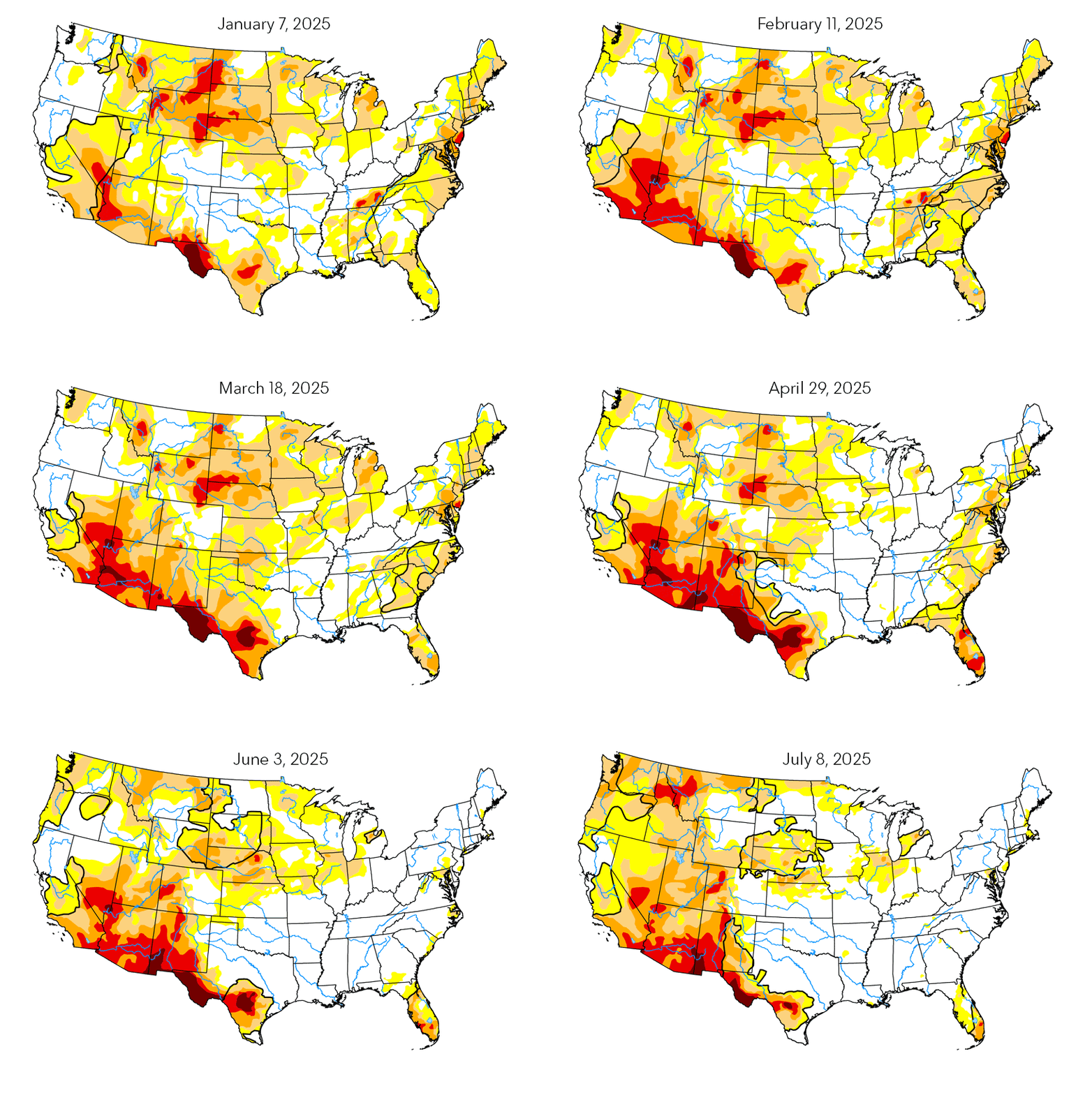
Except for eastern areas of Kansas, Oklahoma, and Texas, the entire Southern Plains region was in some form of drought in early April, with most of the region experiencing severe-to-extreme drought conditions. Broad patches of exceptional drought – the worst drought category – were also evident across Texas, New Mexico, and Oklahoma.

Winds of 30-60 mph hammered western Kansas, Colorado’s Front Range, and northern and western Oklahoma during the week. Severe weather rolled through northern Texas early in the week, producing four confirmed tornadoes but little precipitation. The dry cold front also brought strong winds and low humidity to central Texas.

Temperatures across New Mexico were 10-20 degrees above normal during the week, with highs reaching the 80s in eastern areas of the state. Low humidity, dry vegetation, and gusty winds prompted fire weather warnings for most of the state during the week.

The worsening drought was most evident in the region’s winter wheat ratings. As of April 3, fully 81 percent of the Texas wheat crop was rated as poor or very poor, along with 44 percent of the crop in Oklahoma, 30 percent in Kansas, and 29 percent in Colorado.

As for spring planting, Texas growers had 43 percent of the sorghum, 6 percent of the cotton, and 54 percent of the corn crop planted by April 3, while the Kansas corn crop was rated at just 2 percent planted. “Corn planting is wrapping up here and moving to cotton,” said one Texas source. “Application on pastures and hayfields is very limited thus far.”

“Planters are running in the central part of Kansas, but wet fields in the eastern third are limiting what can go,” added a Kansas source. “Western Kansas is dry, and wheat is going backwards. Nothing sounds promising in the weather forecast for moisture.”

South Central:

Heavy rain, tornadoes, and damaging winds were reported across the South Central region during the week.

Strong thunderstorms battered southern Arkansas as the week began before moving into Middle Tennessee and southern Kentucky, with reports of heavy rain and strong winds on April 5-6. Temperatures across Middle Tennessee were expected to fall at the end of the week, with highs only reaching the 40s and 50s and widespread frost likely on April 9-10.

A band of thunderstorms on April 5-6 hit southeastern Louisiana with 60 mph winds and 1-3 inches of rainfall, and also generated at least six tornadoes in Mississippi and three in Texas. Flash flood warnings were in effect for multiple Mississippi counties at midweek, with another 2-3 inches of rain possible in some locations.

Spring planting was underway, but lagging the average pace in the region. Rice planting as of April 3 was reported at 49 percent complete in Louisiana, 43 percent in Texas, 3 percent in Mississippi, and 2 percent in Arkansas, with all four states trailing their five-year averages.

Southeast:

Powerful storms brought tornadoes, damaging winds, and heavy rain to many parts of the Southeast during the week.

More than two dozen tornadoes were reported across the South during the week, with ten confirmed in South Carolina alone on April 5. As of midweek, the number of confirmed tornadoes since Monday was put at 11 in South Carolina, five in Georgia, and two in Alabama.

The storms also produced heavy rain, resulting in numerous flood watches and warnings across southwestern and south-central Georgia, southeastern Alabama, and northern Florida. The National Weather Service warned that Tallahassee, Fla., could see 4-6 inches of rain by April 7-8.

Sources reported some fieldwork and planting underway in the region, as soil and weather conditions allowed. “Planting has slowed because we are getting rain, but before that folks were busy planting,” said one Georgia contact. “Application is wide open.”

Three percent of North Carolina’s corn crop was planted by April 3, equal to the five-year average. “It’s a little cool and wet, but they are working right now,” said one source in that state. “It’s kind of late, but not too bad.”

Sources continued to comment on potential application rate reductions this spring. “Tonnage in Florida is down due to high input costs and low citrus returns due to freeze damage and diseases,” said one source. “Low beef prices have contributed to lower fertilizer demand for pastures and hayfields also.”

Transportation

U.S. Gulf:

Fleet and towing restrictions remained in effect in the New Orleans area for the week due to persistent high water levels.

The river gauge at New Orleans was reported at 12.44 feet and falling slowly on April 4. Forecasts showed the gauge receding below the 12-foot mark on April 10, likely marking an end to regional restrictions.

Daytime travel was reported unavailable Monday through Thursday at Calcasieu Lock, through May 19. Closures at the site were expected to run from 7:00 a.m. to 6:00 p.m.

Located at Mile 401 in the West Canal, Brazos Lock was reported shutting to traffic Monday through Friday, 7:00 a.m. to 5:00 p.m., through at least mid-April. Corps data revealed delays up to 16 hours for the week.

An ongoing repair project at the Bayou Sorrel Bridge prompted daily marine travel shutdowns between 7:00 a.m. and 11:00 a.m., and again from 1:00 p.m. to 5:00 p.m., Monday through Friday. Work at the site was projected to continue into late May.

Guidewall construction operations at Bayou Sorrel Lock, expected to persist through late May, were noted limiting site access from 6:30 a.m. to 5:00 p.m. on weekdays. Wait times were generally reported in the 20-44 hour range, rising from 20-32 hours in the prior week.

Bayou Chene navigation was limited to the hours of 7:00 a.m. through 7:00 p.m. daily due to ongoing floodgate construction, according to a Coast Guard posting. Tows were capped at 600 feet of length, while an assist boat was required for tows measuring wider than 54 feet. Intermittent daylight-hour shutdowns were also anticipated due to dive operations, with 6-12 hour delays expected.

Shoaling noted at Miles 113-116 in the Atchafalaya River necessitated ongoing draft restrictions through the Morgan City, La., area, a Coast Guard bulletin indicated. Maximum drafts were noted at 10 feet, while tow lengths were capped at 600 feet. Vessel widths were permitted up to 70 feet, while strings running longer than 400 feet were encouraged to use an assist vessel. Captains could sidestep the restrictions by detouring through the Port Allen Route.

Length and width restrictions continued on travel through Algiers Lock, capping unassisted lockages at four standard barges or two 30,000 mt tankers per pass. Tows passing the site with an assist tug were permitted to lock larger configurations, however. Waits were reported in a wide 11-26 hour range, with 22 vessels in the locking queue on April 4.

The ongoing Belle Chasse Bridge construction project, scheduled to run into late 2022, was heard to result in intermittent transit stoppages lasting up to 12 hours at a time.

Wait times at Port Allen Lock were reported up to six hours for the week. Industrial Lock delays swelled to the 24-48 hour range, while boats passing Calcasieu lock were delayed up to eight hours.

Mississippi River:

Persistent high-water conditions left towing restrictions in place for another week on the lower Mississippi River, sources said. Reduced barge counts were reportedly in effect, while larger southbound tows were limited to daylight-only travel through some urban areas, determined on a case-by-case basis.

Levels at the Vicksburg, Miss., river gauge were observed at an action-stage 38.63 feet and falling slowly on April 6. Forecasts called for river levels to fall out of action stage on April 14.

The Baton Rouge, La., gauge was noted at an action-stage 33.4 feet on April 6, after cresting shy of the 35-foot minor-flood stage at 34.8 feet on March 31. Projections showed Baton Rouge exiting restricted territory on April 16. A flood warning in effect for the area was slated to expire on April 15.

Illinois River:

Heavy rains and elevated river levels were noted impacting freight operations on the Illinois Waterway during the week. Marseilles Lock delays jumped to the 5-11 hour range as a result, while slowdowns were heard spreading downriver on April 6, prompting navigation delays and travel slowdowns.

The river gauge at Ottawa, Ill., showed water levels bouncing in and out of action stage during the week. Depths were noted at 460.58 feet on April 6, just shy of the 461-foot action-stage threshold, but were expected to crest at 461.5 feet on April 7.

The Peoria gauge was quoted at a minor-flood 18.36 feet and rising on April 6. Following a 19.0-foot crest expected on April 9-10, the gauge was projected to remain above the minor-flood limit through at least April 13.

Repairs and maintenance scheduled for Brandon Road Lock from May 9 through Sept. 8 will effect wide-ranging impacts to navigation. Overnight-only travel will be in place between May 9 and Aug. 14, followed by a complete lock shutdown on Aug. 15 through Sept. 4. Nighttime navigation will return on Sept. 5-8, with the lock scheduled to resume normal operation on Sept. 9. A 70-foot width limit will be in effect on all navigation through the site while work is in progress.

Wickets remained in the lowered position at Peoria Lock and LaGrange Lock, allowing boats to pass both locations without locking. Lockport Lock delays were noted up to six hours for the week. Starved Rock waits were reported in the 4-9 hour range.

Ohio River:

Primary lock chamber repairs in progress at Emsworth Lock since Feb. 22 limited vessels to the auxiliary chamber, with tows capped at one barge per lockage. As a result, delays were recorded in a wide 3-6 day range for the week, below the 4-6 days reported previously. The project is scheduled to conclude on April 16.

The Dashields Lock main chamber was expected to exit a repair and maintenance shutdown on April 8, ending a bout of redirection through the site’s auxiliary chamber. Waits were noted at 40-65 hours on April 6, falling from 2-4 days reported previously.

Daylight-only travel limitations are in effect at Cannelton Lock on Wednesdays and Thursdays through May 26. An additional Cannelton Lock shutdown proposed for July 5 through Nov. 11 would require detours through the secondary chamber.

Belleville Lock is slated to undergo a main chamber shutdown from May 2 through June 22 for repairs and maintenance. Traffic is expected to pass through the secondary chamber while the project is underway.

A proposed main chamber shutdown at Hannibal Lock would impact transit through the lock from July 5 through Oct. 8, according to a Corps notice.

The Tennessee River’s Wilson Lock remains in the midst of a main chamber shutdown, forcing lengthy detours through the site’s auxiliary chamber. Wait times, expected to persist through the project’s scheduled April 28 end date, were observed in the 4-5 day range for the week, with some predicting an increase to seven days or more as the project moves closer to completion.

Kentucky Lock waits were quoted at 4-9 hours for the week. Kentucky Lock is engaged in a long-term construction project slated to run through 2024.

Cheatham Lock miter gate machinery repairs booked for May 16 through Aug. 5 are expected to see substantial delays. Work at the site will run on an 11-days-on, three-days-off schedule, effectively establishing a single three-day opening window per two-week period.

Arkansas River:

Norrell Lock maintenance and repairs will block daylight-hour travel through the lock on June 1-11; June 22-July 21; Aug. 1-10; Aug. 21-Sept. 21; Sept. 3-Oct. 9; Oct. 20-Nov. 18; Nov. 29-Dec. 23; and Jan. 3-31, 2023. Navigation will be unavailable daily between 7:00 a.m. and 7:00 p.m. while work is in progress.

Agribusiness Association of Iowa – Management Brief

The Agribusiness Association of Iowa (AAI) on March 28 announced that Bill Northey, former Secretary of Agriculture for Iowa, has been named as its new CEO. Northey will succeed Joel Brinkmeyer, who served for nine years as AAI’s CEO and will retire on May 1, 2022.

An Iowa State University graduate, Northey’s public service began as a District Commissioner for the Dickinson County Soil and Water Conservation District. He then worked for the Iowa Corn Growers Association (ICGA) and the National Corn Growers Association (NCGA), serving as President of NCGA in 1995-1996. Northey was elected three times as Secretary of Agriculture for Iowa in 2006, 2010, and 2014. Most recently, he served as Under Secretary for Farm Production and Conservation for the U.S. Department of Agriculture. His USDA term ended in January 2021.

“Bill’s passion for agriculture and extensive breadth of experience in Iowa agriculture are unparalleled,” said Kevin Drury, Chair of the AAI Board of Directors. “His interests in soil conservation and water quality will serve AAI and its membership well. His experience at the Iowa Statehouse, as well as in Washington D.C., will be invaluable as AAI addresses the challenges its members face. The AAI Board of Directors is delighted to have Bill on board.”

AAI thanked Brinkmeyer for his leadership, noting that both the Iowa Nutrient Research and Education Council (INREC) and the Agricultural Legal Defense Fund were formed while he was at the helm of the association.