All posts by mickeybarb@charter.net

Muriate of Potash

US Gulf:

NOLA potash barges remained flat at $390-$400/st FOB.

Eastern Cornbelt:

Potash prices dropped again in the Eastern Cornbelt, to $435-$460/st FOB from last week’s $440-$480/st range, with the low confirmed at Cincinnati and the high out of inland warehouses.

Western Cornbelt:

Potash remained at $425-$445/st FOB in the Western Cornbelt, with the low confirmed at St. Louis. The St. Paul, Minn., market was pegged at the $460/st FOB level during the week.

California:

Potash pricing in California was steady at $605-$615/st FOB or DEL in late May.

Pacific Northwest:

Potash in the Pacific Northwest remained at $525-$540/st FOB, with reference pricing steady at $560/st FOB/DEL for 60% MOP and $570/st FOB/DEL for 62% MOP.

The last potash postings FOB Moab and Wendover, Utah, included $505/st for 60% white standard and $515/st for 60% white granular.

Western Canada:

Potash pricing for truck tons at the mine in Saskatchewan remained in the C$680-$695/mt FOB range, depending on grade.

India:     

Imports of potash for January-March were counted at 360,00 mt, according to Trade Data Monitor, a48% decrease from 696,000 mt recorded in first-quarter 2022. March imports were 95,000 mt, up 39% from the year-ago 56,000 mt. Canada supplied 52,000 mt in April, followed by 42,000 mt from Turkmenistan.

China:   

January-April potash imports firmed 20% year-over-year, Trade Data Monitor reported, to 3.5 million mt from 2.9 million mt. April imports were put at 940,000 mt, up 14% from 215,000 mt received in April 2022.

Laos registered as China’s fourth-largest potash supplier in April, sending 136,000 mt, a notable increase from the year-ago 47,000 mt. Laos is garnering a greater share of the Chinese potash market with its new potash facilities.

Brazil:   

Potash prices keep falling. The latest move took levels to $330-$380/mt CFR, a drop of $20/mt from the previous week’s sales. Sources said that material from Belarus represents the lower end of the range, while the upper end is dominated by tonnage sourced from non-sanctioned countries.

The inland market price also continued to slide. Sources now put Rondonopolis at $470-$490/mt FOB ex-warehouse, off from $490-$500/mt FOB reported last week. There were unconfirmed reports of material from Belarus selling at $440/mt FOB. This price would fit with the $330/mt CFR noted from the receiving ports, although many inland sellers are refusing to accept this level. There was a push for $500/mt FOB pricing, but with no takers reported.
Sulfur

Tampa:

The second-quarter contract price of molten sulfur delivered to Tampa closed at $103/lt CFR, $27/lt below the first-quarter $130/lt, a nearly 21% decrease. Reports of reduced run rates and planned summer turnarounds from phosphate producers were noted suppressing demand.

US Gulf:

Multiple sources reported prices moving lower, to $75-$85/mt FOB from the week-ago $80-$90/mt FOB. Players cited both an absence of demand and a buildup of inventory for the softening sentiment.

Brazil:

Sources noted that Brazil spot pricing remains in a $110-$120/mt CFR range. The market remains covered, players said, although logistics constraints continued at the market’s primary discharge terminals.

Vancouver:   

Vancouver prices remained in the $80-$85/mt FOB range, unchanged from last week. A lack of demand from China continued to be blamed for a slight negative sentiment in the market.

Alberta:

Based on both molten sulfur cargoes contracted into the US market and solid tons sold through the Vancouver export market, Alberta sulfur netback estimates were unchanged in a (-)$12-$33/mt range.

West Coast:

West Coast prills were indicated on par with Vancouver at $80-$85/mt FOB, steady from last week.

Molten sulfur contracts for loading in the second quarter were reported at $98-$106/lt FOB, falling from $125-$135/lt FOB in the prior period.

China:     

China spot sulfur continued in a $105-$110/mt CFR range. Sources reported a lack of interest from buyers, building phosphate inventories, an increase of sulfur inventories at the ports, and the steep decline in global phosphate prices as weighing on the market.

ADNOC:

Prilled sulfur produced by the Abu Dhabi National Oil Co. (ADNOC) was posted at $84/mt FOB Ruwais for May loading, $31/mt below $115/mt FOB reported in April.

Qatar:

May Muntajat solid sulfur cargoes were posted at $86/mt FOB Ras Laffan, sources said, a $24/mt drop compared to April’s $110/mt FOB posting. The May price represents a nearly 22% month-over-month decline.

Sulfuric Acid

US Gulf:

No changes were reported in the US Gulf market. Sources estimated prices in a $65-$80/mt CFR range, depending on specification.

Brazil:

Brazil prices were estimated at $70-$80/mt, unchanged from last week.Due to reports of a delayed startup at Unigel’s new 450,000 mt/y sulfuric acid production plant, sources expected increased demand for July shipment.

Crops/Weather

Eastern Cornbelt:

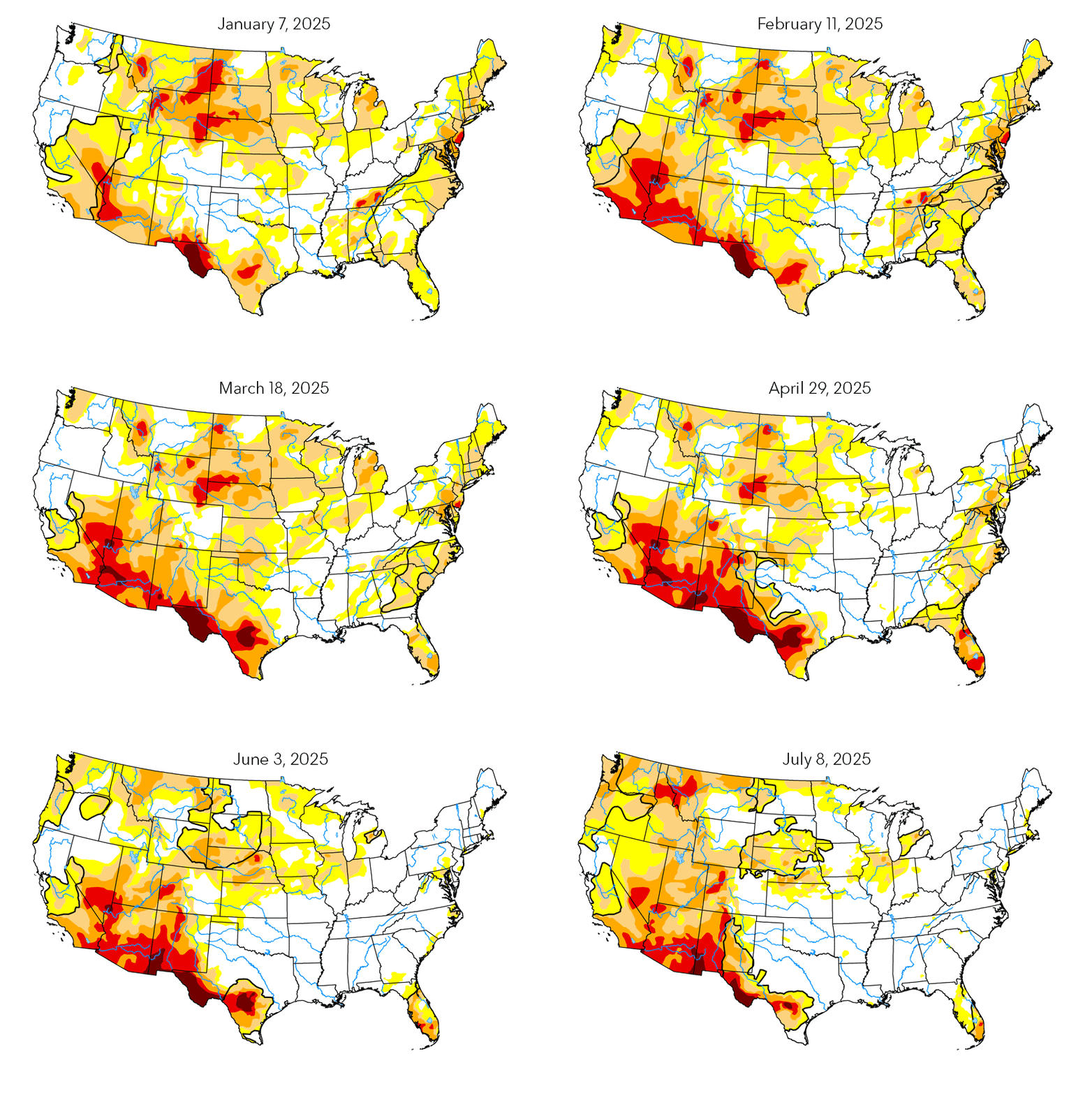
US Drought Monitor

Warm, dry weather across much of the Eastern Cornbelt continued to fuel a rapid planting pace, with sidedress fertilizer and post-emergence herbicide applications also picking up steam.

Below-normal rainfall for April and May has resulted in abnormally dry conditions spreading across central Illinois, with some forecasts warning of a “flash drought” if summer heat arrives early. Temperatures in the 70s and low-80s were common across the region in late May, with slightly cooler weather reported on May 25.

Corn and soybean planting was tracking ahead of the average pace in all three states. Corn planting as of May 21 was 91% complete in Illinois, 77% in Indiana, and 66% in Ohio, while soybean planting was estimated at 85% complete in Illinois, 72% in Indiana, and 63% in Ohio.

Western Cornbelt:

While parts of Iowa received spotty showers at midweek, most locations enjoyed dry weather with temperatures in the 70s and low-80s. Missouri sources also reported a “quiet” weather week.

Nebraska was expecting spotty showers over the Memorial Day weekend, which would be welcome as drought continues to grip the state. Severe drought blanketed most of the state in late May, with the eastern third experiencing extreme-to-exceptional drought conditions.

Planting was ahead of the average pace for nearly all crops in the region. Corn planting as of May 21 was 87% complete in Nebraska and 95-97% in Iowa and Missouri, while soybean planting had progressed to 84% in Iowa, 79% in Nebraska, and 74% in Missouri. Missouri growers also had 97% of the rice and 81% of the cotton crop planted by that date.

California:

Corn Wheat Soybean Index

With the exception of the desert region in Southern California, where temperatures reached the 90s during the week, much of the state enjoyed cool, dry weather in late May.

Drought conditions were all but eliminated in California after the onslaught of atmospheric rivers that soaked the state this winter. The latest Drought Monitor showed only small areas of abnormally dry-to-moderate drought in the Southern California interior, as well as a small patch of abnormally dry conditions on the northern edge of the state.

California’s cotton crop was 95% planted by May 21, nearly equal to the average pace, while rice planting in the state lagged at 60%, well behind the 86% five-year average.

Pacific Northwest:

After record-breaking heat earlier in the month, Oregonians enjoyed more seasonal May temperatures during the week, with highs warming from the 60s to the 70s and low-80s as the week progressed.

A smoky haze from wildfires in Alberta continued to blanket much of eastern Washington, Idaho, and Montana during the week, though Idaho and Montana received plenty of moisture. Torrential rain and large hail in southern Idaho caused flash flooding in Idaho Falls, Blackfoot, and Rexburg on May 23.

The wet weather delayed planting in parts of Montana and Idaho. The spring wheat and barley crops were 72-78% planted in Montana and 87-90% in Idaho by May 21, with both states trailing their five-year averages. Washington, by contrast, had 95-98% of the spring wheat and barley seeded by that date, with both tracking slightly ahead of the average pace.

Western Canada:

Thunderstorms churned through much of Western Canada during the week, bringing much-needed rain to parts of Alberta and British Columbia, where up to 84 wildfires were raging in late May.

Local reports said at least 23 of those fires were uncontained as the week began, with 2,500 firefighters reportedly deployed and more than 10,000 residents forced to evacuate homes as the fires advanced.

Southern Saskatchewan and southern Manitoba were bracing for potentially severe storms late in the week, with forecasts warning of 100km/h winds, large hail, and the potential for localized flooding.

Transportation

US Gulf:

A blue-water vessel with a 50-foot reported draft was noted running aground in the Southwest Pass, the primary shipping channel through the Mississippi Delta, due to shoaling. While the vessel was able to free itself without assistance, the incident triggered expectations that the industry would assess the area for possible draft restrictions.

Algiers Lock maintenance was scheduled to conclude on May 26, ending a period of Monday-through-Saturday daytime navigation shutdowns. Delays were counted up to 10 hours through the week.

Colorado Lock repairs were projected to continue through June 2, blocking travel 7:00 a.m. through 7:00 p.m. daily. Sporadic delays were observed up to 16 hours.

Intermittent shutdowns were expected at the Morgan City Railroad Bridge, located at the West Canal’s Mile 121, through the end of June. The Union Pacific Railroad Bridge was reported shutting to vessel traffic on May 21-22 for repairs. The bridge is located at Mile 64.3 of the Port Allen Route

Travel closures at Bayou Sorrel Lock were scheduled to kick off on June 6, sources noted. Navigation will be unavailable daily from 7:00 a.m. to 6:00 p.m. due to guidewall repairs. Corps data showed delays up to six hours through the week.

Port Allen Lock waits were counted up to 45 hours, while most Industrial Lock delays topped out at 23 hours. Intermittent Brazos Lock wait times were reported in a 15-18 hour range.

Mississippi River:

Despite ongoing rain and flood conditions noted from some sections of the Upper Mississippi River basin, sources did not report a return to navigation restrictions above St. Louis.

The river gauge at St. Paul peaked at a minor-flood 14.90 feet on May 21, just shy of the area’s 15.0-foot moderate-flood threshold. By May 24, levels were posted at an action-stage 12.77 feet and falling, with the gauge forecast to drop completely out of action stage on May 27. A flood warning was in effect for the area on May 24.

On the lower river, a flash flood watch continued for parts of Mississippi and Tennessee due to the potential failure of the Arkabutla Dam, located in Mississippi’s Tate and DeSoto counties. The watch was due to expire on June 10.

Rock placement work begun on May 13 at Miles 931-933 was on hold for the May 19-27 period due to a contractor request, sources said. When underway, work at the site was noted to block southbound navigation daily from 7:00 a.m. to 6:00 p.m. The effort is currently scheduled to continue through July 13, though it was unclear whether the delay would force an extension.

Mel Price delays were noted up to 14 hours for the week.

Illinois River:

Sources reported raised wickets at Peoria Lock due to falling water levels, triggering intermittent wait times as high as 10.5 hours. Wickets remained down at LaGrange Lock, however, allowing tows to pass the site without locking.

Repair work planned at Brandon Road Lock, Dresden Island Lock, and Marseilles Lock will effectively close the Illinois River to commercial transport starting on June 1. The project is scheduled to run through late September.

Dresden Island Lock delays peaked at seven hours on May 23, according to Corps data.

Ohio River:

Dredging at RC Byrd Lock was said to slow travel for 18 hours daily, between 6:00 a.m. and 12:00 a.m., on May 22-26. Minimal delays were reported on May 24.

At the JT Meyers Lock, repairs to the floating mooring system were anticipated to continue through Aug. 20, prompting sporadic shutdowns of the site’s main lock chamber. The JT Meyers auxiliary chamber will close Aug. 21 through Sept. 10 for miter gate repairs, followed by an additional main chamber closure running Sept. 11 through Nov. 17.

The primary chamber at Dashields Lock returned from maintenance on May 20, seven days ahead of the previously-expected May 27 end date. The effort was reported slowing travel to and from both the Allegheny and Monongahela Rivers, prompting multiday delays.

The Melville Lock secondary chamber is closed through Aug. 4 for maintenance. The McAlpine Lock north chamber shut for planned miter gate machinery repairs on May 15, forcing tows to lock through the site’s south chamber. The project is expected to continue through June 15.

The land chamber at Smithland Lock is due to go offline Sept. 22 through Oct. 22 for machinery repairs. The Greenup Lock main chamber will close July 5 through Aug. 14, forcing tows to pass through the secondary chamber. Repairs at Winfield Lock, slated for July 10 through Sept. 15, are unlikely to impact navigation, sources said.

Dive inspections kicked off on May 21 at Olmsted Lock, sources said. Due to falling water levels, wickets were expected to be raised at the site by May 29.

Wait times at the Tennessee River’s Kentucky Lock were posted up to 18.5 hours during the week. Boats transiting Wilson Lock saw delays in a 4-9 hour range.

Anuvia to Suspend Operations, Liquidate

Specialty fertilizer producer Anuvia Plant Nutrients, Winter Garden, Fla., has made the decision to suspend operations and liquidate their assets, according to a post on LinkedIn by Chief Commercial Officer Hugh McGillivray. According to the post, the company has terminated all its employees other than a select few to wind down the operation.

MacGillivray, who joined Anuvia in 2015 (GM July 20, 2015), has also left the company.

Calls to Anuvia and The Mosaic Co. had not been returned at presstime.

Under a ten-year strategic agreement inked in 2019 (GM Sept. 27, 2019), The Mosaic Co. and Anuvia agreed that Anuvia would lease and operate Mosaic’s idled Plant City, Fla., phosphate plant to produce bio-based sustainable and environmentally friendly plant nutrients. Mosaic also took an equity stake in Anuvia. Mosaic was also to sell ammonia, sulfuric acid, and phosphoric acid for use at Plant City.

Mosaic also licensed Anuvia’s SymTRX10S product for sale in the US under the name Susterra™ (14-24-0-10S), the phosphate maker’s first bio-based fertilizer (GM Sept. 25, 2020). It contained up to 15% of recycled organic matter.

Anuvia made bio-based fertilizers for the agriculture, turf, and consumer markets.

Prior to producing product at Plant City, Anuvia made product at a plant in Zellwood, Fla., where it had both financial and environmental problems (GM Dec. 31, 2020).

Initial work for what eventually became Anuvia originated back in 2008 with a company called VitAG Corp., which was backed by Denham Capital (GM Aug. 11, 2008). VitAG received funding in 2014 to build the Zellwood plant (GM July 21, 2014).