All posts by mickeybarb@charter.net

Calcium Ammonium Nitrate

Germany/Benelux:

Yara on Jan. 13 posted its list prices for February deliveries of CAN-27 (YaraBelaNitromag) in Germany and Benelux. The new postings were €627/mt bulk CIF for Germany and €632/mt bulk CIF for Benelux.

Yara also announced new postings for February deliveries of YaraBelaSulfan for both destinations, setting the prices at €637.50/mt bulk CIF for Germany and €644/mt bulk CIF for Benelux. Yara once again warned that only limited volumes would be available.

Sulfate of Potash

U.S. Imports:

November SOP imports were up 3.2 percent, to 30,896 st from 29,928 st in the prior year. Imports firmed 74.0 percent for July-November, to 87,662 st from the year-ago 50,370 st.

U.S. Exports:

SOP exports for November stood at 7,718 st, lifting 3.7 percent from the year-ago 7,443 st. July-November exports were reported at 24,977 st, however, off 2.3 percent from the prior-year 25,575 st.

Southeast:

The SOP market in the Southeast reportedly jumped to $925-$930/st FOB in the Florida market following a price increase at the first of the year.

Crops/Weather

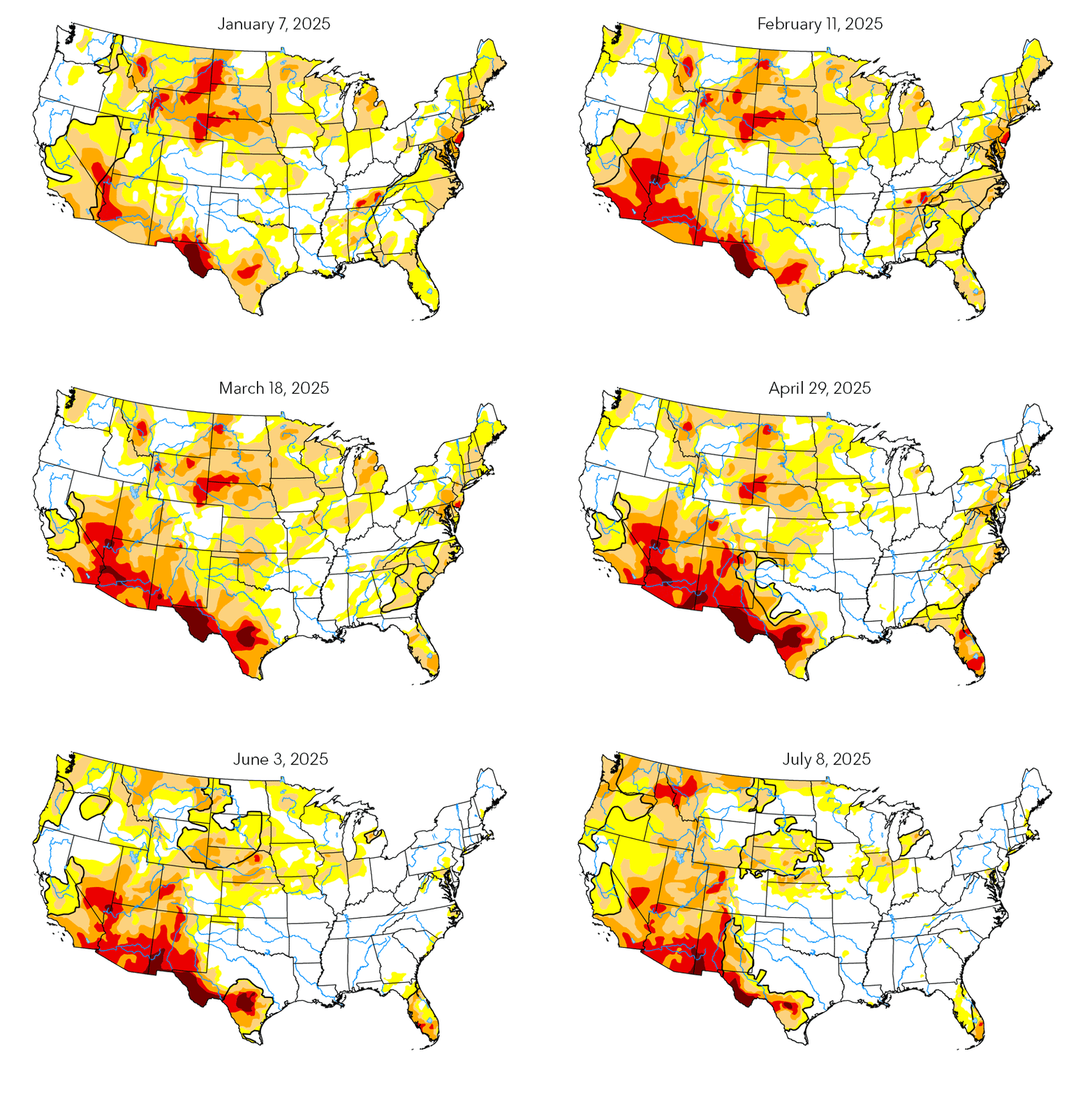
US Drought Monitor

Eastern Cornbelt:

Winter Storm Izzy was expected to bring 1-3 inches of snow to central Illinois by the weekend, with parts of northern Ohio likely to pick up an additional 3-5 inches of accumulation. Colder temperatures were also moving in as part of the strong weather system, with highs in central Indiana topping out in the mid-30s by the end of the week.

Izzy follows a band of lake-effect snowstorms early in the week that blanketed parts of northern Ohio with 3-5 inches of snow.

Western Cornbelt:

Parts of the Western Cornbelt enjoyed mild temperatures at midweek, but cold weather and potentially heavy snowfall were in the weekend forecast as Winter Storm Izzy churned through the region.

Temperatures fell from the mid-40s and 50s to the mid-30s in Iowa, with 8-10 inches of snow expected in the Des Moines area by Jan. 15. Eastern Nebraska was also bracing for potentially heavy snow, along with gusty winds that were expected to produce whiteout conditions on Jan. 14-15.

Northern Missouri was also in the storm’s path, with a mix of rain and snow on Jan. 14. Some parts of the state were expecting 2-5 inches of snow by Jan. 15.

Southern Plains:

Temperatures in the 60s were reported across Kansas and Oklahoma at midweek, but the weekend forecast called for gusty winds, much colder weather, and a chance of rain and snow. The windy weather prompted a number of red flag fire warnings, with a wide area of severe-to-extreme drought covering much of central and northern Texas and most of Oklahoma.

Severe-to-extreme drought was also reported across northern New Mexico and eastern Colorado at midweek, with highs climbing to the 50s in Denver and 60s across eastern Colorado earlier in the week. The unseasonably mild temperatures came after a period of cold, snowy weather in Colorado at the start of the year.

Sources reported minimal fieldwork in the region, although seed corn was being processed and prepared for shipment to the farm in Texas, where some corn planting normally begins by Valentine’s Day. Texas sources also reported a high interest in cotton seed for 2022, as well as expectations of a busy wheat topdress season this winter due to higher acreage this year.

South Central:

Much of the South Central region was bracing for a dose of winter weather by the coming weekend, marking a big change from some record-high temperatures at the start of the year.

A mix of rain, sleet, and snow was expected across Arkansas, Tennessee, and Kentucky by the Martin Luther King Jr. Day weekend, with forecasts calling for up to three inches of snow in some Kentucky locations. Even parts of Louisiana and Mississippi were expecting light snow showers and chilly temperatures, coming just weeks after record highs in the 80s were posted in a number of Mississippi locations on New Year’s Day.

Southeast:

Winter Storm Izzy was expected to bring snow to the north Georgia mountains and parts of southwestern Virginia by the weekend, with sleet and freezing rain likely for central Georgia, much of North Carolina and Virginia, and northern South Carolina. Rain was in the weekend forecast for areas closer to the coastal Carolinas and southeastern Virginia.

Strong winds were also possible on Jan. 16 for parts of the Southeast, with inland areas of Florida expecting nighttime lows in the mid-40s on Jan. 14-15.

Transportation

U.S. Gulf:

Weekday navigation through Bayou Boeuf Lock continued to be limited to the hours between 7:00 p.m. and 7:00 a.m., with 24-hour availability on Saturdays and Sundays.

A Coast Guard posting noted the end of draft restrictions in the Houma Navigational Canal during the week. Shoaling at Mile 7 of the waterway had previously required 11-foot maximum drafts at Miles 6-10.

Floodgate work at Bayou Chene restricted travel to 7:00 a.m. to 7:00 p.m. daily. Tows were limited to 600 feet of length, with an assist tug required for strings larger than 54 feet wide. In addition, dive operations were expected to cause intermittent shutdowns for up to 6-12 hours at a stretch.

Towing restrictions remained in force at the Atchafalaya River’s Mile 113-116, centered in the Morgan City area, due to shoaling. Maximum drafts were limited to 10 feet, Coast Guard documents indicated, while tows were capped at 600-foot lengths and 70-foot widths. Tow lengths above 400 feet were strongly advised to utilize an assist tug. Vessels were encouraged to bypass the restrictions via a detour through the Port Allen Route.

Length and width restrictions remained in effect for Algiers Lock travel, effectively capping unassisted movements to four standard barges or two 30,000 mt tankers per turn. Larger lockages were possible when accompanied by an assist vessel.

Belle Chasse Bridge construction was noted triggering intermittent navigational shutdowns up to 12 hours at a time. The bridge is located at Mile 3 in the West Canal.

Port Allen Lock wait times were noted in a general 8-12 hour range, while Corps data showed intermittent Bayou Sorrel Lock delays falling in the 16-24 hour range. Sporadic Industrial Lock waits were quoted at a wide 6-24 hours, and intermittent 24-36 hour delays were reported through the Colorado Floodgates.

Mississippi River:

Low water conditions in the St. Louis area were noted further tightening draft restrictions on the lower Mississippi River during the week, with limits of 9.5-10 feet reported at various points along the lower river.

Depths at St. Louis were observed at (-)0.08 feet on Jan. 12, rising from (-)0.6 feet reported previously. Forecasts called for a quick increase to 0.7 feet on Jan. 13, followed by a decline to (-)2.0 by Jan. 25.

Channel reinforcement work underway at Mile 642 on the lower river is scheduled to run into late February. The project was likely to delay southbound vessels up 12 hours through the area.

The upper Mississippi River’s Locks 1-21 were reportedly shut for the winter navigation season on Jan. 11. Lock 25, previously scheduled to close for seasonal maintenance on Jan. 1-31, continued to pass tows during the week, Corps data indicated, with wait times noted up to 5.5 hours. Lock 24 was also closed to navigation for the week.

Lock reopenings for the spring season were scheduled to begin on March 3 with Lock 15, followed by Locks 5 and 7 on March 11. Locks 5A, 8, and 10 were slated to resume lockages on March 17, while Lock 4 was set to reopen on March 21, conditions permitting.

Illinois River:

Worsening ice conditions on the Illinois Waterway impacted river travel during the week, with LaGrange Lock and Peoria Lock seeing the worst of it. Wait times at LaGrange were clocked up to four days on Jan. 11. Temperatures were expected to improve in the short-term, although forecasts suggested significant slowdowns heading deeper into January.

Ice couplings were required through all Illinois River Locks during the week. Wickets were noted in the raised position at both Peoria Lock and LaGrange Lock.

A repair and maintenance project at Brandon Road Lock is scheduled to run from May 9 through Sept. 8, with major impacts to navigation expected. The work will block daytime travel from May 9 through Aug. 14, followed by a complete lock shutdown between Aug. 15 and Sept. 4.

Daylight-hour closures at Brandon Road Lock will resume on Sept. 5-8, followed by a planned reopening on Sept. 9. A 70-foot width limit will be in effect while work is underway. Corps data estimated delays as high as 12 hours for the week.

Ohio River:

Elevated water levels resulted in towing restrictions and delays on the Ohio River during the week.

The secondary chamber at Dashields Lock was reportedly closed to navigation due to an underwater obstruction interfering with operation of the lower miter gate. Lockages remained possible through the primary chamber, however.

A proposed Hannibal Lock main chamber repair project is likely to impact travel through the site between July 5 and Oct. 8. Cannelton Lock is also facing a proposed shutdown, set to run from July 5 through Nov. 11, forcing lockages through the auxiliary chamber.

On the Tennessee River, main chamber repairs scheduled for Feb. 23 through April 28 at Wilson Lock are anticipated to trigger detours through the site’s secondary chamber, likely resulting in delays. The main chamber is tentatively scheduled to open for a single window during the project, on March 18-23.

Kentucky Lock waits were quoted up to five hours for the week. Wilson Lock delays peaked at 5.5 hours on Jan. 9, falling from 22 hours reported one week earlier.

Barkley Lock, located on the Cumberland River, will experience daily shutdowns between 6:00 a.m. and 6:00 p.m. on Jan. 15-30 due to planned maintenance to the site’s bio-acoustic fish fence (BAFF) system. Work proposed at Cheatham Lock will likely result in navigation disruptions between May 16 and Aug. 4.

Navigation through Lock 6 on the Allegheny River remained unavailable due to a damaged miter gate anchorage.

Ammonium Sulfate

U.S. Gulf:

TheNOLA barge market was described as quiet, with the most recent business reported in the $525-$550/st FOB range, despite higher inland postings released by AdvanSix.

Eastern Cornbelt:

Although there were reports of granular ammonium sulfate offers on the table for as low as $550/st FOB Ottawa, Ill., most sources quoted the market firmly in the upper-$500s to low-$600s, with Cincinnati pricing reported solidly at $590/st FOB.

Michigan sources pegged the market at $615/st FOB terminals for January-March tons and up to $635/st FOB for Q2 offers.

AdvanSix on Jan. 6 raised its prices for granular ammonium sulfate by $30/st, with new postings at river warehouses firming to $615-$620/st FOB and inland warehouses priced at traditional premiums to river warehouses. The company said availability is limited.

Western Cornbelt:

Ammonium sulfate pricing in the Western Cornbelt was pegged at $575-$615/st FOB in early January, with the high reflecting new river terminal postings from AdvanSix on Jan. 6.

Northern Plains:

Granular ammonium sulfate prices firmed to $610-$615/st FOB St. Paul, with delivered pricing in North Dakota pegged at $610/st for 1Q tons and up to $635/st DEL for 2Q shipments.

Northeast:

The granular ammonium sulfate market was quoted at a firm $575/st FOB Lancaster at midweek. AdvanSix on Jan. 6 announced a $30/st increase for granular ammonium sulfate, with new reference pricing firming to $550/st FOB Hopewell, Va.

Eastern Canada:

Sources reported a firming ammonium sulfate market in Eastern Canada, with prices quoted at C$745-$850/mt FOB in the region in early January, up considerably from the last reported C$690-$770/mt FOB range.

China:

Even with limited production, producers are pushing to clear out their stockpiles before the Lunar New Year starts on Feb. 1. This seems to have pushed prices down to $365-$380/mt FOB for caprolactam ammonium sulfate.

Prices could see a rebound in February, because much of the production that turns out amsul as a byproduct will be closed for the Lunar New Year celebrations, and then again as part of the Chinese government’s efforts to limit air pollution during the Winter Olympics games.

Brazil:

Sources reported a one-off deal that dropped the low end of the landed price to $450/mt CFR. Other deals showed pricing closer to $500/mt CFR. The price shift, said sources, was in line with a general feeling that nitrogen prices are coming off for February and March.

The Rondonopolis price remained steady at $670/mt FOB ex-warehouse. Sources reported little activity, as buyers watch to see what happens with urea pricing.

Scotts Expands Hawthorne with More Acquisitions

The Scotts Miracle-Gro Co., Marysville, Ohio, said on Jan. 4 it has acquired Luxx Lighting, Los Angeles, and True Liberty Bags, Sonoma County, Calif., in order to strengthen The Hawthorne Gardening Co. business segment.

“These strategic acquisitions reinforce our commitment to provide commercial cannabis cultivators in state-authorized markets with a complete set of solutions driven by insight and innovation,” said Chris Hagedorn, Hawthorne President.

“While the cannabis market continues to see near-term challenges from an over-production in recent months, we see the current reality as an opportunity to further distance ourselves from the competition and strengthen our business for long-term success,” he continued.

“The True Liberty transaction gives us our first offering in this niche market, however, the acquisition of Luxx bolsters a lighting portfolio that is now several times larger and more diverse than our nearest competitor,” he said. “Luxx has deep roots in the cannabis industry with lights that were designed, tested, and refined in collaboration with the team at Jungle Boys, a company run by a group of some of the best cannabis cultivators in the world. We look forward to an ongoing relationship with Jungle Boys to support the sales and marketing efforts of the Luxx brand.”

Luxx joins a product lineup that also includes the Gavita and Sun System brands, and Scotts said this provides the opportunity for significant cost synergies and process improvements across the portfolio.

Scotts acquired the Luxx assets for $215 million. Hawthorne, which previously did not distribute Luxx, will expand the marketing and distribution of the brand in emerging markets, including the East Coast. The acquisition, which closed Dec. 30, 2021, adds approximately $100 million in sales and $20 million in operating income to Hawthorne on an annualized basis.

While approximately $75 million of revenue from Luxx is expected in the remainder of fiscal 2022, the transaction is expected to be neutral to earnings for the year due to the impact of purchase accounting and one-time deal costs.

True Liberty, which was acquired for $10 million, introduced storage solutions directly to the hydroponic market, developing a full offering of liners and storage solutions to dry and cure plant products. Hawthorne has been the primary U.S. provider of True Liberty brands, which expands Hawthorne’s harvest portfolio.

These deals follow the August 2021 acquisitions of HydroLogic Purification Systems (GM Aug. 6, 2021), which moved Hawthorne into the water reclamation and purification category, and Rhizoflora (GM Aug. 20, 2021), whose Terpinator and Purpinator brands expanded Hawthorne’s nutrient offering.

Scotts Retains Earnings Guidance Despite Expected Decline in Hawthorne Sales

ScottsMiracle-Gro Co., Marysville, Ohio, said on Jan. 4 it is maintaining its full-year company-wide outlook for adjusted earnings per share ($8.50-$8.90 per share) despite a greater-than-expected decline in Hawthorne sales for the fiscal first quarter, which ended Jan. 1. First-quarter sales in Hawthorne are expected to decline approximately 40 percent, caused by a slowdown in the cannabis market, as well as supply chain disruptions that have delayed the sale of certain product lines.

“We are optimistic the supply chain disruptions we’ve experienced will be corrected by the end of January and we’ll be able to meet the continued demand we’re seeing for our industry-leading signature products,” said Cory Miller, Scotts CFO. “We’re also encouraged by the year-over-year increase we’ve been experiencing in pre-orders for growing media products for delivery to commercial growers in the second and third quarters.

“However, the decline we’ve seen in the first quarter, against a 71 percent growth comparison a year ago, is greater than we had anticipated,” he continued. “Based on our current view of the market, we are lowering our full-year sales guidance for Hawthorne to a range of 0 to minus 10 percent on a year-over-year basis, including the expected benefit from Luxx (see related story). This range assumes a return to growth during the second half of the year.”

The company said its U.S. Consumer segment continues to perform well, with POS growth in both dollars and units in every major product category and continued support in all retail channels. “Consumer purchases, in units, were up 3 percent in the quarter against a 40 percent growth comparison a year earlier, and POS dollars increased 9 percent in the quarter,” Miller said. “Retail inventory levels are appropriate for this time of the year, and we remain optimistic about the potential for the segment as we prepare for the upcoming lawn and garden season.”

U.S. Consumer segment sales in the first quarter are expected to decline less than 20 percent, which is better than originally anticipated. Miller said it was too early to raise guidance for this segment, though he said current trends and continued optimism about the upcoming season, coupled with a focus on expense control in both Hawthorne and U.S. Consumer, allow the company to maintain per share guidance.