All posts by mickeybarb@charter.net

Ammonium Thiosulfate

Eastern Cornbelt:

The ammonium thiosulfate market remained at $395-$430/st FOB in the Eastern Cornbelt, with the low reported for the last offers at Terre Haute, Ind., and the high for prompt tons FOB Cincinnati.

Western Cornbelt:

The ammonium thiosulfate market remained at $375-$400/st FOB in the Western Cornbelt, with the low reported at Waterloo, Iowa, for the last confirmed prepay business.

Northern Plains:

No current prices were reported for ammonium thiosulfate in the Northern Plains.

Eastern Canada:

Ammonium thiosulfate pricing remained at C$512-$535/mt FOB in Eastern Canada, unchanged from last report.

Brineflow Opens New U.K. Liquid Terminal

Yarmouth, U.K.-based Brineflow Ltd., a manufacturer and distributor of liquid nitrogen fertilizers under the Nitrosol brand name, has opened its new £3 million distribution and storage hub at the Port of Sunderland, according to the Sunderland Echo. Ground was broken on the project late last year (GM Dec. 11, 2020).

The first phase of the terminal will allow the company to store 10,000 mt, with later phases approved to 38,000 mt. The company also has a 25,000 mt terminal at Great Yarmouth in Norfolk. As a result, its sites are located to provide national coverage from Scotland to the South Coast from two East Coast ports that are close to international strategic supply lines.

Van Iperen, Cinis Partner on SOP Project

The Netherlands-based Van Iperen International BV announced on Oct. 19 an exclusive agreement with Cinis Fertilizer, Lund, Sweden, a clean technology startup, to produce and market sustainable and circular, high-quality potassium sulfate (SOP) fertilizer based on salts that are recovered from the Swedish paper industry as well as from the newly-build battery manufacturer Northvolt.

Van Iperen said some 200,000 mt/y of sodium salts recovered as a byproduct from the paper industry and Northvolt will be upcycled with a close zero carbon footprint, and powered by clean energy to make a clean, high-tech and green SOP.

Cinis plans to build two fertilizer factories in northern Sweden, one in Ornskoldsvik and one in Skelleftea next to the Northvolt gigafactory, over the next four years for a total investment of over E100 million and with an SOP capacity of 300,000 mt/y.

Van Iperen will be the exclusive marketer of the SOP under its umbrella product line GreenSwitch ®, which represents new fertilizer technologies with close-to-zero carbon footprint. The first GreenSwitch SOP is planned to be on the market at the end of 2023.

Earlier this year, Van Iperen launched GreenSwitch Original, a potassium nitrate solution derived from organic manure, with a first production plant in The Netherlands.

Crops/Weather

Eastern Cornbelt:

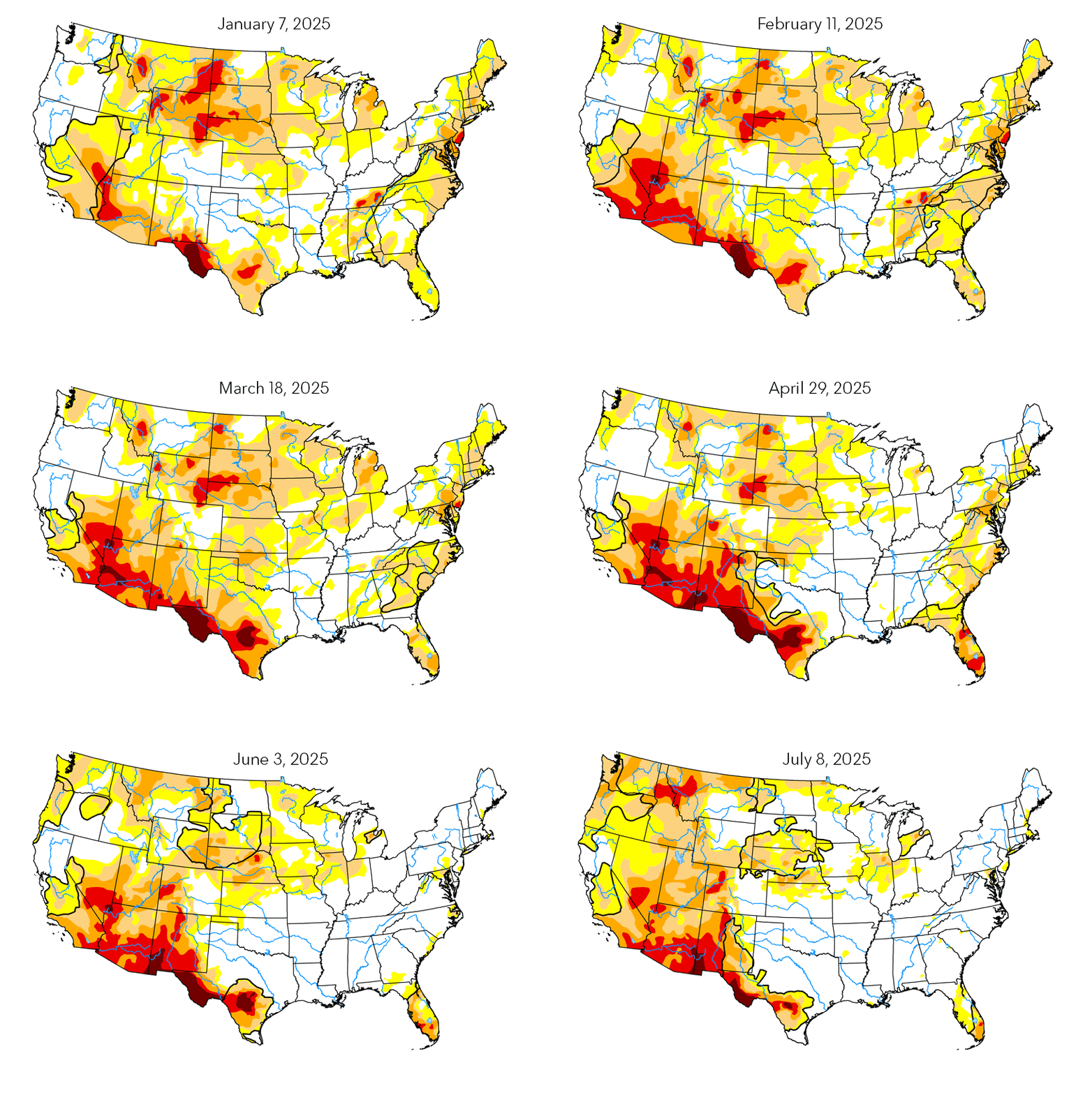
U.S. Drought Monitor

Cooler weather moved through the Eastern Cornbelt as the week progressed, along with an increased chance of rainfall.

Midweek temperatures dropped to the 40s in central Indiana, with highs topping out in the 70s. Scattered showers were expected later in the week, with highs dropping to the high-50s and low-60s in many locations.

Similar conditions were reported in northern Ohio, where high temperatures dropped to the mid-50s during the week, with widespread rain expected by the weekend.

The corn harvest as of Oct. 17 had progressed to 62 percent complete in Illinois, 45 percent in Indiana, 32 percent in Michigan, and 25 percent in Ohio. Sources continued to report excellent crop conditions, with good or excellent ratings assigned to 74 percent of the corn in Ohio, 70 percent in Illinois and Michigan, and 69 percent in Indiana.

The soybean harvest was rated at 54 percent complete in Ohio, 49-51 percent in Indiana and Illinois, and 39 percent in Michigan. Winter wheat planting was also well underway in the region, with progress as of Oct. 17 estimated at 59 percent in Ohio, 53 percent in Michigan, 51 percent in Illinois, and 48 percent in Indiana.

Western Cornbelt:

Much cooler weather blanketed all three states in the Western Cornbelt during the week, prompting a frost advisory for southwestern Iowa, southeastern Nebraska, and northwestern Missouri early on Oct. 22.

A number of thunderstorms preceded the cold temperatures, with reports of rain and light snow at midweek in northern Nebraska. High temperatures at midweek struggled to break into the low-40s in parts of northern Nebraska, while highs in southeastern areas of the state topped out in the low- to mid-60s.

The corn harvest as of Oct. 17 had progressed to 74 percent complete in Missouri and 41-43 percent in Nebraska and Iowa, with all three states tracking ahead of their average paces. The soybean harvest was 70-76 percent complete in Iowa and Nebraska, compared with 30 percent in Missouri. USDA placed 63-69 percent of the regional corn crop in the good or excellent categories on Oct. 17.

Missouri’s rice harvest was 76 percent complete by Oct. 17, while cotton growers in the state had 32 percent of the crop picked with 67 percent of the acreage rated as good or excellent. Nebraska’s sorghum harvest was 58 percent complete by that date, and winter wheat planting had progressed to 93 percent complete in Nebraska and 35 percent in Missouri.

Northern Plains:

Rainfall and much cooler weather was reported in parts of southern and western Minnesota at midweek, with highs expected to top out in the 50s for the remainder of the week and into the weekend. Parts of the state were expecting a hard frost on Oct. 21-22.

Cool, windy weather was also reported in the Dakotas during the week, with reports of light snowfall in some locations. Highs in the upper-40s were expected in North Dakota by the weekend.

The harvest of corn, soybeans, and sorghum was tracking well ahead of normal in the Northern Plains due to extremely dry conditions. Fully 51-53 percent of the corn was already in the bin in South Dakota and Minnesota by Oct. 17, compared with 42 percent in North Dakota. As for soybeans, 81-91 percent of the regional crop was harvested by Oct. 15, along with 72 percent of South Dakota’s sorghum crop.

The summer drought has taken a toll on crop quality, however, with good or excellent ratings assigned to only 15 percent of North Dakota’s corn, compared with 21 percent in South Dakota and 37 percent in Minnesota. Corn rated as poor or very poor totaled 42-46 percent of the acreage in the Dakotas, compared with 25 percent in Minnesota.

Growers were also advancing on the harvest of sugar beets and sunflowers at mid-month, with progress estimated at 31-38 percent complete on the former and 20-35 percent on the latter.

Northeast:

Beautiful fall weather was reported across the Northeast for much of the week, with highs reaching the mid-70s in southern New England and pushing the 80-degree mark in some Mid-Atlantic locations.

A weather change was expected by the coming weekend, however, with cooler temperatures and rain chances increasing in New England and the first widespread frost expected in northern and western Pennsylvania. Growers in Pennsylvania had 23 percent of the corn crop in the bin by Oct. 17, trailing the 36 percent five-year average, with fully 91 percent of the acreage rated as good or excellent.

Eastern Canada:

The week began with cool weather and lake-effect thunderstorms across southern Ontario, but sunshine and temperatures near 20 degrees C at midweek helped growers get back to the fall harvest in many locations. Another cold front was expected to bring a mix of rain and snow to parts of Ontario south of Georgian Bay over the coming weekend, however.

A band of thunderstorms on Oct. 16 sparked a tornado in Quebec, as well as heavy rain and strong winds that caused localized flooding and numerous power outages in the province. The same soggy weather conditions were reported in the Maritimes on Oct. 18, with wind gusts up to 100 km/h confirmed in some locations.

“Lots of rain here is hampering the harvest, wheat planting, and fertilizer application,” reported one regional contact. “We’re hoping for a reprieve soon, but fear of carryover into spring is real.”

Other sources reported “good” fall application at mid-month in their trade areas, with wholesale replacement costs up dramatically. “We’re not moving a lot at the wholesale level right now, with most of our producers/suppliers in a holding pattern, not accepting any new orders and not wanting to discuss pricing,” reported one source.

Transportation

U.S. Gulf and Atlantic:

Travel through the West Canal remained unavailable at Miles 21-33 due to shoaling and debris caused by Hurricane Ida. Most through-traffic was bypassing the West Canal entirely, running from the New Orleans area to Houston by way of the Port Allen Route. Work to reestablish navigation was projected to run through the end of the month, adding 1-2 days of travel time in each direction.

Bayou Lafourche was shut between Lockport and the West Canal due to multiple vessels blocking the channel, as well as ongoing hurricane-related cleanup efforts.

Floodgate construction activities left navigation through Bayou Chene unavailable nightly between 7:00 p.m. and 7:00 a.m. until further notice. In addition, tows were limited to 600-foot lengths, while barge configurations measuring above 54 feet wide were required to utilize an assist vessel on all movements through the waterway. Sporadic shutdowns of the entire waterway were also possible, with resulting wait times predicted in the 6-12 hour range.

Ten-foot draft limits remained in effect at Miles 113-116 in the Atchafalaya River in the Morgan City area, due both to extensive shoaling and reduced channel widths. Size restrictions were also in place, with tows limited to 600-foot lengths and 70-foot widths, while strings measuring longer than 400 feet were requested to use an assist boat.

The Coast Guard “highly recommended” that vessels bypass the area via the designated Port Allen Route alternative. With 39 tows counted in line to lock on Oct. 19, delays were quoted in a wide 50-75 hour range, or approximately 2-4 days.

Unassisted movements continued to face size restrictions through Algiers Lock, with tows generally capped at four standard barges or two 30,000 mt tankers. Larger tows remained possible when accompanied by an assist tug, however.

Warnings of intermittent navigational shutdowns were heard through the Belle Chasse Bridge, located at the West Canal’s Mile 3, due to construction slated to run through late 2022. Delays were anticipated up to 12 hours.

Bayou Boeuf Lock was reported open for navigation between 7:00 p.m. and 7:00 a.m. on Monday through Friday. Locking returned to 24-hour availability on Saturdays and Sundays.

Intermittent Industrial Lock delays were noted in a wide 5-27 hour range for the week, while Colorado Lock wait times were quoted up to 19 hours through the site’s eastern lock, and up to 29 hours through its western lock.

Mississippi River:

Rock-laying operations that kicked off on Oct. 20 at the lower Mississippi River’s Mile 671 were likely to close the area to southbound navigation from 7:00 a.m. to 6:00 p.m. daily. The project was scheduled to run for about a week.

The Dredge Hurley was working at Mile 293 again during the week, but the operation caused no navigational issues.

Early seasonal shutdown dates for locks located on the upper Mississippi translated to quickly closing release window on barges loading from NOLA. Barges with final destinations located on the lower portion of the upper river were typically noted to carry final release dates in the last week of October. Material departing for terminals located at Iowa or above was generally believed to carry a first-half October cutoff.

Locks 5A, 8, and 10 were slated to close to winter navigation on Nov. 28, followed by Lock 4, 5, and 7 on Dec. 6. Lock 15 was expected to shut on Jan. 1 following an auxiliary chamber closure running through Dec. 1. Lock 24 will halt seasonal movements on Jan. 1-31.

Locks 5 and 7 are tentatively due to reopen on March 11, followed by Locks 5A, 8, and 10 on March 17. Lock 15 will return to service on March 3, while Lock 4 will resume passing tows on March 21.

Lock 27 delays were noted up to 12 hours for the week.

Illinois River:

Low water levels on the Illinois Waterway left wickets in the raised position for another week at Peoria Lock and LaGrange Lock.

Dresden Island Lock delays stretched to six hours or more during the week. Boats passing Marseilles Lock were subject to wait times up to 4-6 hours, while intermittent 5-8 hour waits were noted through Starved Rock Lock.

Ohio River:

Main chamber maintenance underway at Cannelton Lock was scheduled to necessitate detours through the auxiliary chamber until Nov. 19. A planned auxiliary chamber shutdown on Nov. 1-19 could precipitate intermittent full-lock shutdowns.

The Montgomery Lock primary chamber was expected to shut to navigation on Oct. 18, with work running through Dec. 17. Delays were generally expected to snowball as the project runs on.

The main chamber at Hannibal Lock was scheduled to return to normal operation on Oct. 29, ending a period of secondary lock-only navigation. Waits were reported up to six hours on Oct. 20.

Operation of the Dashields Lock auxiliary lock chamber continued to be hindered by an underwater obstruction blocking the chamber’s lower miter gate. No timeline was available on Oct. 20 for a return to normal use.

The Willow Island Lock main chamber is shut for the entire month of October, with delays expected. Navigation was available through the secondary chamber, with minimal delays reported.

The Markland Lock secondary chamber, which has been shut since first-half 2020 due to structural cracks in the miter gate, was tentatively projected to reopen in late October. Ongoing maintenance at Olmsted Lock was noted pushing delays to as high as 15 hours for the week.

On the Tennessee River, main chamber repairs underway since Oct. 12 were projected to conclude on Oct. 23, with tows passing through the secondary chamber during the interim. Most delays were reported under six hours, while intermittent waits spiked to nearly 20 hours on Oct. 19-20.

Wilson Lock was passing vessels one way at a time during the week, with southbound tows locking during daytime hours only. Northbound vessels were allowed to pass overnight. Delays through the site were generally quoted up to 15 hours for the week.

The Corps announced a planned Kentucky Lock closure from Nov. 1 through Dec. 10. A single four-day reopening window, tentatively scheduled for Nov. 25-28, will pass waiting traffic. Boats passing Kentucky Lock reported waits in the 4-11 hour range for the week.

The Monongahela River’s Lock 2 main chamber returned from repairs and maintenance on Oct. 15, ending a period of secondary chamber-only navigation that started on Sept. 13.

Lock 6 on the Allegheny River, will remain closed to navigation indefinitely due to a damaged miter gate.

Arkansas River:

Intermittent daytime navigation shutdowns were reported at Joe Hardin Lock on Oct. 19-21. Emmett Sanders Lock was scheduled to undergo sporadic shutdowns between 7:00 a.m. and 6:00 p.m. on Oct. 26-28.