

Eastern Cornbelt:
Potassium thiosulfate pricing was pegged at a firm $700/st FOB Terre Haute for new offers.
Eastern Cornbelt:
Potassium thiosulfate pricing was pegged at a firm $700/st FOB Terre Haute for new offers.
Eastern Cornbelt:
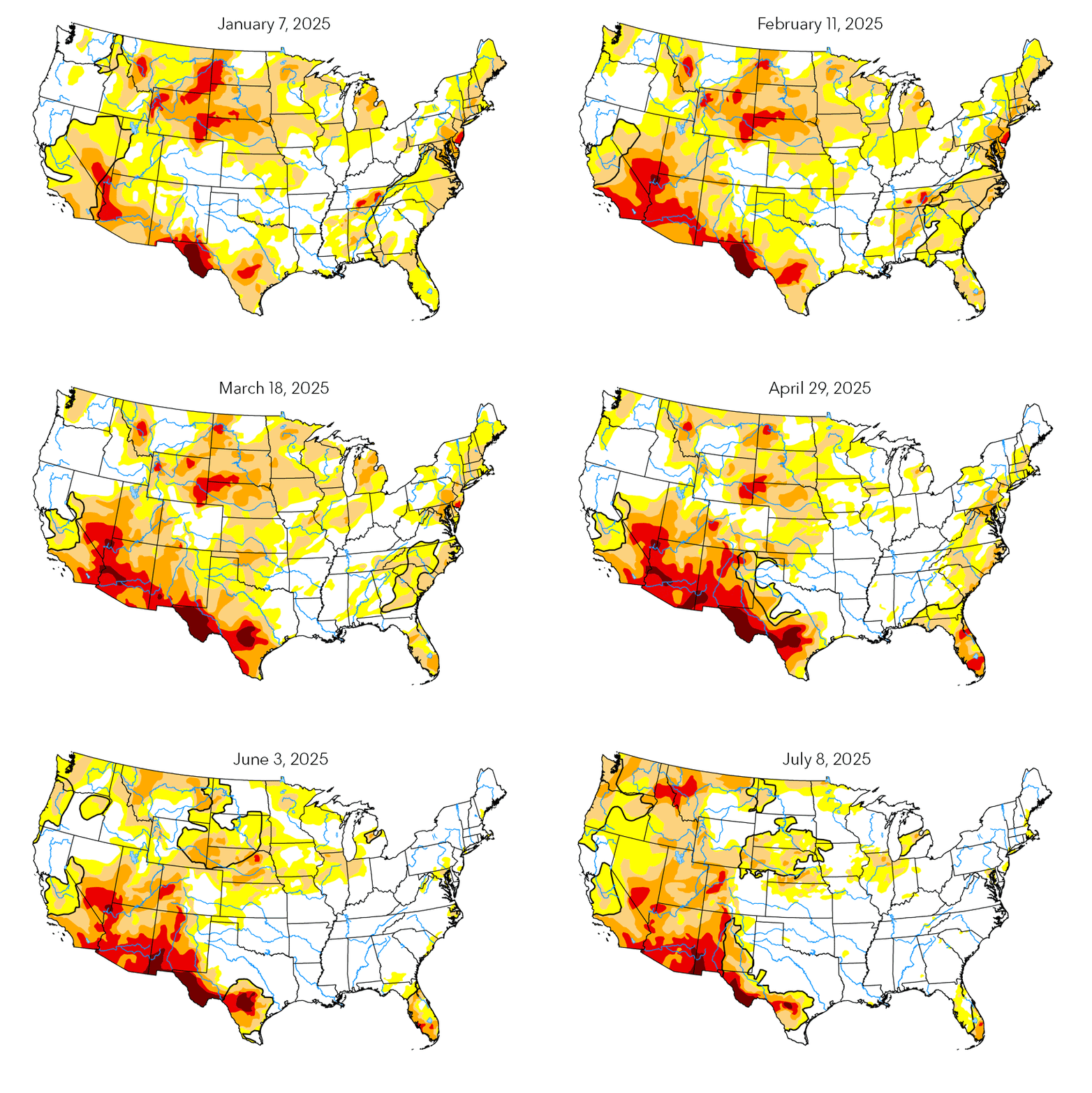
Scattered showers were reported in Indiana and Ohio as the week progressed, but generally favorable weather conditions allowed growers to move quickly on the corn and soybean harvest. Most of the heavier showers were tracking from central Indiana across northern Ohio at midweek, with highs topping out in the mid-70s.
The corn harvest as of Oct. 3 had progressed to 41 percent complete in Illinois, 26 percent in Indiana, and 11 percent in Ohio, with good or excellent ratings assigned to 70-77 percent of the regional crop. The soybean harvest was reported at 32 percent complete in Illinois, 28 percent in Indiana, and 22 percent in Ohio, with 68-72 percent of the acreage rated as good or excellent.
Growers were also busy planting winter wheat in early October, with progress as of Oct. 3 estimated at 24-25 percent complete in Indiana and Ohio, compared with 12 percent in Illinois.
Western Cornbelt:
While central Missouri experienced cloudy and cool conditions for the bulk of the week, Nebraska and Iowa enjoyed mostly clear, sunny weather, with temperatures climbing from the upper-70s to the mid-80s as the week progressed.
Those conditions benefited harvest activities in the region. Missouri growers had fully 52 percent of the corn in the bin by Oct. 3, compared with 19-21 percent in Iowa and Nebraska, while the soybean harvest had progressed by that date to 40 percent complete in Iowa, 34 percent in Nebraska, and 11 percent in Missouri. USDA rated 68-72 percent of Nebraska’s corn and soybeans as good or excellent, along with 60-65 percent of the acreage in Iowa and Missouri.
Missouri’s rice harvest was 54 percent complete by Oct. 3, while cotton growers in the state had 2 percent of the crop picked with 65 percent of the acreage rated as good or excellent. Nebraska’s sorghum harvest was 21 percent complete, with 48 percent of the crop rated as good or excellent.
Southern Plains:
Favorable weather helped growers move swiftly to harvest corn, soybeans, cotton, and sorghum in the Southern Plains in early October. Highs in the 70s were reported across Oklahoma and Kansas at midweek, with temperatures expected to reach the 80s and possibly 90s by the weekend.
Highs in the 90s were also reported in western and central Texas as the week progressed. Sources in central Texas said wet weather slowed the cotton harvest during the last days of September, but harvesters were rolling again this week. The cotton harvest as of Oct. 3 was 23 percent complete in Texas, with good or excellent ratings assigned to 57 percent of the acreage in Texas and Kansas, compared with 70 percent in Oklahoma.
The corn harvest was 86 percent complete in Texas, 51 percent in Kansas, and 22 percent in Colorado, with 50-61 percent of the regional crop rated as good or excellent. Kansas growers also had 10 percent of the sunflowers and 14 percent of the soybean crop harvested by Oct. 3, with 58 percent of the soybean crop rated as good or excellent.
The sorghum harvest had progressed to 84 percent complete in Texas, 19-21 percent in Kansas and Oklahoma, and 14 percent in Colorado, with good or excellent ratings assigned to 30 percent of the acreage in Oklahoma and 56-63 percent in the rest of the region.
Sources continued to report some preplant wheat applications taking place in the region. Wheat planting as of Oct. 3 was estimated at 77 percent complete in Colorado, 47 percent in Texas, 42 percent in Kansas, and 37 percent in Oklahoma.
South Central:
Temperatures and humidity were slowly building across the South Central region during the week. Conditions were described as “comfortable” at midweek, with highs in the low-80s across Louisiana, Mississippi, and Arkansas. By the weekend, however, temperatures in the 90s were likely, along with high humidity.
Forecasts warned of potentially strong thunderstorms in the Tennessee Valley at midweek, with reports of 40-60 mph winds, large hail, and up to 2-4 inches of rain in some locations.
The harvest of corn, soybeans, cotton, and rice continued across the region in early October. Growers in Tennessee and Kentucky had 50-57 percent of the corn in the bin by Oct. 3, with 80 percent of the acreage rated as good or excellent. The regional rice harvest had progressed to 96-99 percent complete in Louisiana and Texas, 77 percent in Mississippi, and 72 percent in Arkansas.
The cotton harvest was estimated at 13-14 percent complete in Louisiana and Mississippi, compared with 7 percent in Arkansas and 1 percent in Tennessee. USDA placed fully 86 percent of the Arkansas cotton crop in the good or excellent categories, along with 64-67 percent of the acreage in Tennessee and Mississippi, and 56 percent in Louisiana.
The soybean harvest was also well underway, with progress as of Oct. 3 estimated at 59 percent complete in Louisiana, 46 percent in Mississippi, 33 percent in Arkansas, 25 percent in Kentucky, and 15 percent in Tennessee. Good or excellent ratings were assigned to 87 percent of the acreage in Louisiana, 63 percent in Arkansas, and 75-78 percent in the rest of the region.
Southeast:
Sources reported rounds of heavy showers in parts of Alabama, Georgia, and the Florida Panhandle during the week, with flooding reported in some locations. A flash flood watch was posted at midweek in areas of Alabama and Georgia, with reports of gusty winds and an elevated risk of tornadoes.
Warm, humid weather was reported across Virginia and Carolinas at midweek, while highs in southern Florida pushed up into the high-80s and low-90s.
The wet weather slowed harvest activities across the region, but progress was advancing on corn, soybeans, cotton, and peanuts in early October. North Carolina growers had 86 percent of the corn and 10 percent of the soybeans in the bin by Oct. 3, with good or excellent ratings assigned to fully 81 percent of the corn and 62 percent of the soybeans.
The regional cotton harvest was 3-5 percent complete by Oct. 3, with 78-80 percent of the acreage in Alabama, South Carolina, and Virginia rated as good or excellent, compared with 58-60 percent in Georgia and North Carolina.
The peanut harvest had progressed to 35-36 percent complete in Virginia and Florida, 20 percent in Alabama and South Carolina, and 14-17 percent in North Carolina and Georgia, with good or excellent ratings assigned to 62 percent of the acreage in Florida, 68 percent in Georgia, 72 percent in North Carolina, 80 percent in Alabama, 88 percent in Virginia, and fully 96 percent in South Carolina.
U.S. Gulf and Atlantic:
Sources noted an ongoing navigational shutdown in the West Canal between New Orleans and Morgan City due to shoaling and the presence of heavy debris left from Hurricane Ida. Vessels were heard detouring through the Port Allen Canal, adding an estimated 1-2 days’ travel time in each direction.
The Coast Guard directory for Houma showed an end to travel restrictions at Port Fourchon and the Houma Canal during the week. Both areas were previously open to daylight travel only due to Hurricane Ida.
Overnight passage through Bayou Chene was unavailable due to ongoing floodgate construction, a Coast Guard posting indicated, leaving navigation unavailable nightly from 7:00 p.m. to 7:00 a.m. Towing lengths were restricted to 600 feet, forcing longer tows to break up and make multiple passes through the area, while tows measuring wider than 54 feet were obligated to travel with an assist tug. Ongoing dive operations were expected to trigger intermittent shutdowns of the entire waterway.
Extensive shoaling at Miles 113-116 on the Atchafalaya River triggered travel restrictions through the Morgan City area. Drafts were limited to 10 feet, while towing lengths and widths were reportedly capped at 600 feet and 70 feet, respectively. Strings longer than 400 feet were strongly advised to make use of an assist vessel.
Lengthy delays persisted through Port Allen Lock for the week. Increased vessel traffic due to the West Canal closure, combined with efforts by lock operators to balance traffic vessel inflows and outflows between the river and canal, conspired to slow movements through the structure. Delays were reported in a wide 33-65 hour range for the week, rising from 44 hours reported one week earlier. Thirty-five tows were counted in line to lock on Oct. 6.
Algiers Lock travel restrictions continued for the week, limiting unassisted lockages to four standard barges or two 30,000 mt tankers. Larger tows were reportedly possible with the use of an assist tug, however.
Intermittent 12-hour delay warnings were heard at the Belle Chasse Bridge, located at Mile 3 in the West Canal, due to a construction project anticipated to run through late 2022. Delays could extend to Algiers Lock when underway.
Coast Guard data showed weekday Bayou Boeuf Lock transit available during overnight hours, passing tows between 7:00 p.m. and 7:00 a.m. only. Twenty-four-hour lockages were available on Saturday and Sunday.
Most Bayou Sorrel Lock travel was noted under seven hours for the week, although intermittent delay spikes were seen approaching 24 hours. Industrial Lock wait times typically topped out at 12-13 hours, while intermittent delays were quoted in the 24-73 hour range. Sporadic Calcasieu Lock waits were reported at 5-10 hours, and waits were clocked up to 11 hours through the Colorado Floodgates on Oct. 6.
A tropical disturbance tracked by the National Hurricane Center off the coast of South Carolina on Oct. 7 was not expected to strengthen into a tropical cyclone prior to Oct. 9.
Mississippi River:
Falling water levels were heard reducing maximum drafts on the lower Mississippi River, increasing travel times on a per-ton basis. In addition, northbound tows were reduced by 5-10 barges on the lower river.
The Dredge Hurley continued to work at Mile 742 on the lower river, with no delays expected at that location as a result.
The Lock 15 secondary chamber is due to shut for repairs and maintenance on Oct. 11, prompting a shift to main chamber-only movements through Dec. 1. Following that project’s conclusion, the lock’s primary chamber will close for seasonal repairs and maintenance from Jan. 1 through March 3, 2022. Locks 5A, 8, and 10 are tentatively scheduled to shut for the winter navigation season from Dec. 6 through March 24, 2022.
Illinois River:
Persistent low water levels necessitated raised wickets for another week at LaGrange Lock and Peoria Lock, forcing continued lockages through both locations. Corps data showed Marseilles Lock wait times pushing above seven hours for the week.
Ohio River:
Main chamber repairs at Cannelton Lock are anticipated to continue through Nov. 19, prompting tows to pass through the site’s auxiliary chamber. Repairs to the secondary chamber are expected to cause intermittent transit outages on Nov. 1-19. Operations at the site kicked off on June 21.
Montgomery Lock is scheduled to close for main chamber maintenance from Oct. 18 through Dec. 17, forcing traffic through the secondary chamber. The primary chamber at Hannibal Lock is offline through Oct. 29 for planned repairs and maintenance. Tows were locking through the secondary chamber, with minimal delays reported.
Operation of the Dashields Lock secondary chamber remained hindered for the week due to an underwater obstruction blocking the miter gate. No timeline for a return to normal operation was available on Oct. 6.
The Willow Island Lock primary chamber was shut to navigation on Oct. 1 for planned maintenance, prompting detours through the auxiliary chamber. Work is scheduled to conclude on Oct. 31.
Ongoing miter gate repairs were projected to keep the Markland Lock auxiliary chamber offline through an estimate Oct. 29, forcing all traffic to run through the main chamber. The affected chamber has reportedly been offline since early 2020.
Waits were noted up to seven hours at Pike Island Lock on Oct. 6, while vessels experienced eight-hour passages through Meldahl Lock. Smithland Lock delays were noted up to 13 hours for the week. Following the successful raising of wickets at Olmsted Lock on Sept. 29, delays were quoted up to seven hours through the site on Oct. 6.
A mechanical breakdown was noted blocking movement through the primary chamber of the Tennessee River’s Pickwick Landing Lock during the week, forcing tows to detour through the site’s 600-foot auxiliary chamber. Main chamber repairs were tentatively scheduled for Oct. 12-23, sources said.
Wilson Lock continued to operate on a staggered one-way navigation system due to reported damage of the structure. Vessels traveling southbound were heard locking during daytime hours, while northbound boats were permitted to pass during overnight hours.
Kentucky Lock is scheduled to completely shut to navigation on Nov. 1-24 and again from Nov. 29 through Dec. 10 for miter gate repairs. Vessels are expected to detour through the Barkley Canal while work is underway. Kentucky Lock waits were noted in a general 3-7 hour range for the week, falling from 20 hours in the prior report.
Maintenance to the Cumberland River’s bio-acoustic fish fence (BAFF) system concluded on Oct. 5, ending an extended spate of overnight-only navigation.
The Monongahela River’s Lock 2 was scheduled to return to normal operation on Oct. 15, ending a period of repairs and maintenance that began on Sept. 13. Passage was available through the secondary chamber only while work was underway. Delays were quoted up to 15.5 hours for the week, falling from 26 hour reported previously.
The Allegheny River’s Lock 6 is closed until further notice due to a damaged miter gate anchorage.
Arkansas River:
Intermittent shutdowns are scheduled at Joe Hardin Lock between 7:00 a.m. and 6:00 p.m. on Oct. 19-21. Emmett Sanders Lock will see daytime closures on Oct. 26-28.
BASF and Ukraine’s Odessa Port Plant (OPP) have become the latest European producers to cut ammonia production due to the soaring cost of natural gas. Germany-based BASF on Sept. 27 reported that it was curtailing ammonia production at its production sites in Antwerp, Belgium, and Ludwigshafen, Germany.
“Due to the recent rise in natural gas prices in Europe, the economics for operating an ammonia plant in the region have become extremely challenging,” BASF said in a statement. The company said it will continuously monitor the gas price development and adjust its ammonia production accordingly.
OPP suspended ammonia production on Sept. 30, a day after halting urea production due to the high price of natural gas. According to the Russian news agency Tass, OPP said its gas supplier, Agro Gas Trading, was currently unwilling to supply gas “given its unprofitability, with the price exceeding $1,000 including mark-ups.”
OPP said the increased price of its finished products due to the higher gas prices means they have become “uncompetitive,” adding that all of its storage facilities “are completely packed with urea,” Tass reported. Ukraine’s Odesky Pryportovyi Zavod decided to halt ammonia production on Sept. 22, according to Bloomberg (GM Sept. 24, p. 1).
The recent shutdowns follow reports last week that Vienna-based Borealis AG was curtailing production of ammonia in Europe amid soaring natural gas prices. A company spokesperson told Green Markets on Sept. 23 that Borealis had reduced its production of ammonia and will “further analyze the situation” regarding its plants in Austria, France, and the Netherlands. Borealis AG had no further comment on the potential impact on the company’s downstream production.
Oslo-based Yara International announced on Sept. 17 that it planned to curtail around 40 percent of its European ammonia production capacity within the next week (GM Sept. 17, p. 1). The company told Green Markets on Sept. 20 that it was sourcing ammonia from its plants in Australia, the U.S., and Trinidad to help cover the production curtailments in Europe so it could maintain stable fertilizer production.
Some of the other European producers who have curtailed their ammonia production are believed to be buying ammonia to cover some of their shortfalls. Industry sources estimated that the current price of natural gas means most producers are facing an ammonia production cost of $1,000-$1,100/mt, putting the final product far out of reach for any buyer.
Lithuanian nitrogen fertilizer manufacturer Achema was expected to keep one of its two ammonia units offline after the completion of the summer maintenance program, according to a NewsBase report last week. There have been reports of more European producers reducing ammonia output, but this could not be confirmed directly with the companies by press time.
CF Industries Holdings Inc. on Sept. 21 said it was restarting the ammonia plant at its Billingham, U.K., complex at Teeside after announcing on Sept. 15 that it was halting operations at Billingham and Ince, U.K., in response to high natural gas prices. The restart of the Billingham plant followed an interim agreement reached on Sept. 21 with the U.K. government to cover the costs to restart the ammonia plant and produce CO2 for the U.K. market.
Safely restarting the ammonia plant at the Billingham Complex was expected to take several days. The restart did not include the Ince plant in Cheshire, and the support offered by the U.K. government is only for three weeks.
Meanwhile, operations resumed at Ma’aden Phosphate Co.’s (MPC) ammonia plant at Ras Al-Khair Industrial City on Saudi Arabia’s East Coast on Sept. 29 following the completion of maintenance work at the facility, Riyadh-based Saudi Arabian Mining Co. (Ma’aden) announced in a filing to Saudi Arabia’s stock exchange.
The MPC ammonia plant was shut down on May 20 after encountering a technical problem, which led to a limited fire at the facility (GM May 28, p. 2).
Crystal Valley, a farm supply cooperative headquartered in Mankato, Minn., has become the second agricultural co-op to be hit with a ransomware attack this month. Crystal Valley on Sept. 21 posted an alert on its website confirming that it had been targeted in an attack that infected its computer systems and “severely interrupted the daily operations of the company.”
“Crystal Valley and cyber security experts are working diligently to re-establish safe and secure operating systems, which will be back online when we are confident the issue has been resolved,” the company said. “Because of this, we are unable to accept Visa, Mastercard, and Discover at our cardtrols until further notice. Local cards do work.”
The news follows earlier reports that New Cooperative Inc., Fort Dodge, Iowa, was struck by a ransomware attack on or around Sept. 17, forcing it to shut down its computer systems as it tried to mitigate the assault (GM Sept. 24, p. 1). The BlackMatter ransomware group took credit for the attack and demanded a $5.9 million ransom by Sept. 25 in exchange for a decryptor, saying the ransom would jump to $11.9 million if the deadline was not met.
BlackMatter is believed to be linked to the ransomware group DarkSide, which attacked Colonial Pipeline Inc. earlier this year, triggering fuel shortages along the East Coast.
The Messenger, a newspaper in Fort Dodge, reported that New Cooperative would not be paying the ransom, citing a farmer close to the co-op who said the federal government was treating the ransomware attack as a terrorist attack. New Cooperative representatives did not respond to requests for more information. As of Sept. 30, New Cooperative’s website was still down.
Crystal Valley reported that it was alerted of the ransomware attack on its operations on Sept. 19. On Sept. 24, the company reported that it was accepting grain at all elevator locations, though at a slower-than-normal pace due to the use of manual hand tickets. The company said a formal notification of data-breach was being sent to every customer and company on record at Crystal Valley. No further updates were provided as of Sept. 30. The company’s website was functioning throughout the week.
“No money was stolen from Crystal Valley in the cyber-attack,” the company said on Sept. 24. “As always, Crystal Valley is fully capable of meeting any and all financial obligations. At this time, we are not aware of any data being used inappropriately, or that it was actually obtained by anyone, but we have determined that confidential data could have been viewed by an unauthorized person. Therefore, customers and business partners alike should assume that their personal information was compromised and take precautionary measures to monitor their banking accounts and financial information, along with credit reports, etc.”
Crystal Valley operates 16 locations providing agronomy, grain, energy, and feed products and services to more than 2,700 agricultural producers in southern Minnesota and northern Iowa. The company is also part of the CommoditAg e-commerce crop inputs platform (GM Aug. 31, 2018).
Bloomberg on Sept. 29 reported that House Oversight Committee Chairwoman Carolyn Maloney and Republican Rep. James Comer are seeking an FBI briefing about the agency’s delay in aiding businesses targeted by a ransomware attack this summer. The lawmakers said the FBI reportedly obtained a digital decryptor key that could have unlocked affected systems, but withheld the tool for nearly three weeks.
“Ransomware hackers have shown their willingness and ability to inflict damage on various sectors of the U.S. economy,” Maloney and Comer wrote to FBI Director Christopher Wray. “Congress must be fully informed whether the FBI’s strategy and actions are adequately and appropriately addressing this damaging trend.”
Earlier this month, the FBI released a notice warning companies in the food and agriculture sector to watch out for ransomware attacks aiming to disrupt supply chains. “Food and agriculture businesses victimized by ransomware suffer significant financial loss resulting from ransom payments, loss of productivity, and remediation costs,” the FBI said. “Companies may also experience the loss of proprietary information and personally identifiable information and may suffer reputational damage resulting from a ransomware attack.”
The FBI said multiple attacks have taken place on the food and agriculture sector since last year, including a Sodinokibi/REvil ransomware attack on a U.S. bakery company; an attack on global meat processor JBS in May that ended with JBS paying an $11 million ransom; a March 2021 attack on a U.S. beverage company; a January 2021 attack on a U.S. farm that caused losses of approximately $9 million; and a November 2020 attack on a U.S.-based international food and agriculture business that was hit with a $40 million ransom demand from the OnePercent Group.
China’s Sinofert Holdings Ltd., CNAMPGC, and Qinghai Salt Lake Industry Co. Ltd. (QSL) have been fined by the country’s State Administration for Market Regulation (SAMR) for “price gouging” on sales of potash, according to a Bloomberg report, citing statements from SAMR.
SAMR fined Sinofert Holdings and CNAMPGC each 2.6 million yuan (approximately $402,000 at current exchange rates), and QSL was fined 1.6 million yuan “for their behaviors in potassium chloride transactions this year” that violated China’s Price Law.
Domestic prices of potash increased more than 60 percent in the first half of this year. Domestic prices of NPK fertilizers have also increased sharply in recent months.
State-owned QSL is China’s largest potash producer. It has a production capacity of about 5 million mt/y, accounting for just over 40 percent of China’s estimated 12 million mt/y potash production capacity, according to Green Markets data (GM Jan. 3, 2020).
Sinofert is the country’s largest fertilizer supplier and distributor, selling about 2.1 million mt of potassium chloride last year, according to the report. CNAMPGC is also a leading importer, exporter, and distributor of fertilizers in China.
Late last week, China’s state planner, the National Development and Reform Commission (NDRC), called for a full court press to guarantee fertilizer supplies, issuing detailed orders to regulators like SAMR, as well as government departments and producers, according to the report. NDRC warned against fertilizer hoarding and price manipulation (GM Sept. 24, p. 16).
The state planner said the government would take measures to keep fertilizer supplies and prices stable, and it called for potash reserves to be released into the market to ease prices.
China’s national potash reserves in recent years have typically been maintained at the 1.5 million mt level. The country’s potash inventory at the ports was recently estimated at 2.045 million mt, according to a China Fertilizer Week report (GM Sept. 17, p. 15).
Hocking International Labs, San Marcos, Calif., on Sept. 23 announced the addition of Brian Cigainero to its commercial team. Cigainero will focus on expanding Hockings’s footprint as Area Sales Manager covering the Southeast, and will report to Scott Messer, Director of Ag Sales.
Hocking said Cigainero has significant experience in bio-solutions, nutritionals, and specialty chemical manufacturing, most recently serving as a Regional Manager at AgXplore. He has also held business development roles at Compass Minerals, Timac Agro, and Arysta Life Sciences. Cigainero holds a B.S. in Business Management from the University of West Georgia and a Masters of Agribusiness from Kansas State University. He and his family reside on their farm in Northwest Georgia.
“We are very fortunate to have Brian joining the Hocking team,” said Mark Auchampach, Chief Commercial Officer. “His experience, coupled with his energy and passion for building partnerships providing agronomic solutions, will be well received across the Southeast.”
Jerry Southwell, formerly with Yara North America Inc. and a member of the Board of Directors of the Florida Fertilizer and Agrichemical Association (FFAA), passed away on Sept. 25 after battling pneumonia for several weeks since being hospitalized with COVID, according to an announcement from the FFAA.
Southwell spent almost a quarter century with Yara and its predecessor companies before retiring in 2014. Before joining Yara, he was a Hardee County Extension Directory and Vocational Agribusiness teacher at Desoto County High School in Arcadia, Fla. He was the recipient of FFAA’s Lifetime Achievement Award in 2014, having served on FFAA’s Fertilizer Advisory Committee, the FFAA Scholarship Board, and the Florida Certified Crop Advisers Program.
Southwell is survived by his wife Jill, their sons Steven and Josh, daughter Robin, and six grandchildren. A Celebration of Life is scheduled for Oct. 1 at the First United Methodist Church in Wauchula, Fla. In lieu of flowers, the family suggests contributions be made in his memory to the First United Methodist Children’s Home (https://www.fumch.org/making-a-difference/make-a-donation/) or the Florida Sheriffs Youth Ranches (https://www.youthranches.org/ways-to-give/online-donation).
Toronto-based Chemtrade Logistics Income Fund announced on Sept. 30 that it has entered into a definitive agreement to sell its Potassium Chloride (KCl) and Vaccine Adjuvants businesses to Vertellus, a manufacturer of specialty products for various consumer goods, food and agriculture, healthcare, and industrial markets.
The sale price was reported at approximately US$155 million. The transaction is expected to close during the fourth quarter of 2021 and is subject to customary closing conditions. BMO Capital Markets is acting as financial advisor to Chemtrade in connection with the transaction.
“These are both good businesses, which have benefited from our recent capital investment that expanded and upgraded both plants,” said Scott Rook, President and CEO of Chemtrade. “As a strategic buyer, Vertellus will be able to add further value and will benefit from the skilled teams at both locations. We are confident that Vertellus and PPC will take the strong platform that we have built and make the businesses even stronger.”
The businesses, which had been classified as Assets Held for Sale in Chemtrade’s financial statements, are part of Chemtrade’s Water Solutions and Specialty Chemicals segment and are located in Midlothian, Texas, and Berkeley Heights, N.J.
Vertellus is a Pritzker Private Capital company and is headquartered in Indianapolis, Ind. The businesses that the company is acquiring from Chemtrade produce specialty ingredients essential in the efficacy of medications for hypertension and diabetes, production of next-generation biologics, and improving the effectiveness of certain vaccines.
Chemtrade said it will use the net proceeds of the sale to reduce bank debt. Based upon the midpoint of guidance for 2021 provided by Chemtrade in August 2021, and after making a pro-forma adjustment for the loss of a full year’s EBITDA of the disposed businesses, this repayment will reduce Chemtrade’s senior Debt:EBITDA ratio by approximately 0.7 times.
Due to the anticipated timing of the closing of the transaction, Chemtrade said the sale will not have a material impact on its 2021 reported distributable cash after maintenance capital expenditures. The businesses generated approximately US$14.3 million of EBITDA during the twelve months ended June 30, 2021.
Vancouver-based Semios, an agtech provider of real-time crop data, announced on Sept. 29 that it has raised $100 million in funding led by Morningside Group, a Boston-based private equity and venture capital firm.
Semios said the funding will be used to accelerate R&D and expand internationally to help growers reduce chemical inputs, better manage water, organize farming data, and improve crop outcomes. UBS Investment Bank acted as the exclusive placement agent for Semios.
“Semios is on a mission to simplify the grower’s experience, leveraging big data analytics and machine learning to help them mitigate crop risk so they can focus on growing more food, more sustainably,” said Dr. Michael Gilbert, CEO of Semios. “We have seen firsthand the challenges our customers are facing in the field – from severe drought and devastating fires, to frost, reduced profitability, and an increasing regulatory burden. But, in the face of these challenges, farmers are adapting to meet the nutritional needs of our growing population with new technologies.”
Semios, which was founded in 2010, utilizes a network of sensors that provide more than 500 million data points measuring climate, soil moisture, and insect and disease activity daily to help growers minimize crop risks. The company has more than 120 million acres of row and permanent crops under management, serving growers, agronomists, and ag retailers across the U.S., Canada, Australia, New Zealand, Europe, and South Africa.
“Morningside invests in companies committed to tackling pressing global challenges head on,” said Mick Sawka, Investment Manager at Morningside Group. “The ability to not only maintain but also enhance the sustainability of our food systems amid the complex dynamics of a changing climate is one of the world’s most pressing needs of our time. Semios is a leader in helping farmers respond to this challenge, and we’re proud to stand beside them.”
Semios has raised more than $225 million in external capital to date. Last year, the company announced $100 million in funding, also led by Morningside Group, that helped it acquire Altrac, Centricity, and Agworld in 2021 (GM Sept. 3, p. 29).
“Our recent acquisitions are aimed at bringing the tools farmers need to manage their crops under one roof,” Gilbert said. “This latest round of funding will help us continue to support the agricultural industry as it faces some of its toughest challenges yet.”