

Eastern Canada:
SOP Magnesia prices had reportedly firmed to a broad C$730-$815/mt FOB in Eastern Canada, depending on grade and location, with the upper end of the range reflecting an increase of C$95/mt since August.
Eastern Canada:
SOP Magnesia prices had reportedly firmed to a broad C$730-$815/mt FOB in Eastern Canada, depending on grade and location, with the upper end of the range reflecting an increase of C$95/mt since August.
Eastern Cornbelt:
Potassium thiosulfate pricing was unchanged at the $650/st level FOB Terre Haute, Ind., for the last confirmed business, but sources said the market is firming to $700/st FOB for new offers.
Eastern Cornbelt:
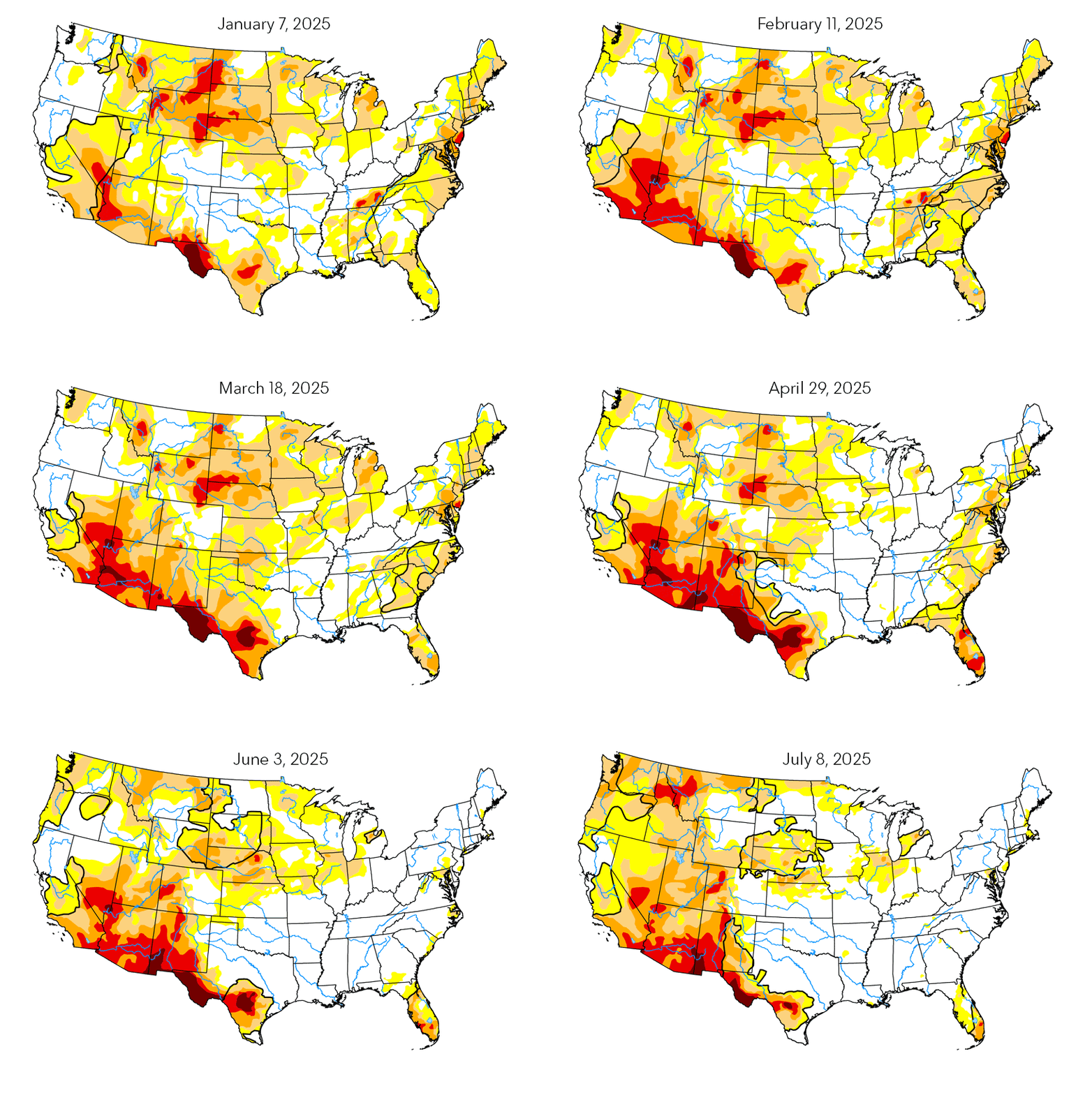
Unseasonably warm, dry weather persisted through much of the Eastern Cornbelt during the last week of September. Those conditions were ideal for the corn and soybean harvests, which were tracking near the average pace for this time of year.
Highs across Illinois and Indiana pushed into the mid-80s during the week, with lows in the 50s and 60s. Northern Ohio enjoyed highs in the upper-60s and 70s, with lows dropping to the mid-40s. Much of the region was expecting a gradual cooldown over the weekend, with a higher chance of rain in many locations.
The corn harvest as of Sept. 26 had progressed to 21 percent complete in Illinois, 15 percent in Indiana, and 6 percent in Ohio, with good or excellent ratings assigned to fully 70-75 percent of the regional crop. The soybean harvest was 13 percent complete in Indiana, 10 percent in Illinois, and 5 percent in Ohio, with 66-72 percent of the crop rated as good or excellent.
Sources reported some fertilizer application taking place ahead of winter wheat planting in late September. USDA reported that 11 percent of the Indiana wheat crop was planted by Sept. 26, compared with 5 percent in Ohio and 2 percent in Illinois.
Western Cornbelt:
Summer-like weather was reported in Iowa during the week, with highs reaching the upper-80s across much of the state. The heat sparked a number of thunderstorms as the week progressed, however.
Nebraska was also bracing for spotty showers later in the week, with highs topping out in the 60s and 70s across the state. Temperatures in central Missouri soared to the low-90s early in the week, creating ideal harvest conditions in late September.
The corn harvest as of Sept. 26 was reported at 34 percent complete in Missouri, 13 percent in Nebraska, and 9 percent in Iowa, with the soybean harvest estimated at 18 percent complete in Iowa, 17 percent in Nebraska, and 5 percent in Missouri. USDA placed 70-71 percent of Nebraska’s corn and soybeans in the good or excellent categories in late September, compared with 64-67 percent in Missouri and 59-62 percent in Iowa.
Missouri growers also had 38 percent of the rice harvested by Sept. 26, with the Nebraska sorghum harvest estimated at 11 percent complete by that date. Some 47 percent of Nebraska’s sorghum was rated as good or excellent, along with 69 percent of Missouri’s cotton crop.
Northern Plains:
Unseasonably hot, dry weather continued across the Dakotas in late September, with Hazen, N.D., posting a record 100 degrees on Sept. 28. Highs in the 70s and 80s were reported in Minnesota during the week, although showers and slightly cooler weather was on tap for some areas later in the week.
Most of North Dakota and northern Minnesota continued to experience severe-to-extreme drought in late September. Drought conditions had improved in eastern South Dakota, but the western half of the state remained in moderate-to-extreme drought.
Growers had 11-13 percent of the sugar beets and 2 percent of the sunflowers harvested in the Northern Plains by Sept. 26, with South Dakota’s sorghum harvest rated at 18 percent complete.
The corn harvest had progressed to 9-10 percent complete in the Northern Plains by Sept. 26, with the soybean harvest estimated at 30 percent in Minnesota, 26 percent in North Dakota, and 17 percent in South Dakota. All three states were tracking ahead of their five-year averages for both crops, with good or excellent ratings assigned to 35-38 percent of the corn and beans in Minnesota, 23-24 percent in South Dakota, and just 16-17 percent in North Dakota.
More telling was the percentage of corn and soybeans rated as poor or very poor, which totaled 26 percent of the acreage in Minnesota and 36-43 percent in the Dakotas. Fully 52 percent of South Dakota’s sorghum crop fell in the poor or very poor categories in late September.
Northeast:
Much cooler weather moved into the Northeast during the last week of September, with lows dropping to the 30s and highs topping out in the 50s and 60s in New England. The previous weekend brought strong thunderstorms to parts of New England, with reports of up to two inches of rain falling in western Massachusetts, Connecticut, and Vermont.
A cold front also moved through Pennsylvania and Maryland during the week, sparking thunderstorms in both states. Local reports talked of potentially damaging winds and hail in some locations on Sept. 28.
Pennsylvania growers had 2 percent of the corn in the bin by Sept. 26, trailing the five-year average of 11 percent. Crop conditions continued to be described as exceptional, however, with fully 86 percent of the acreage rated as good or excellent in the state.
Eastern Canada:
A number of slow-moving systems brought periods of rain and much cooler weather to the Maritimes during the week, while Ontario was struggling to dry out after some of the heaviest precipitation of the year on Sept. 21-23.
A pair of weather systems pounded southern Ontario with 50-100 mm of rain and strong winds during the previous week, causing localized flooding and contributing to widespread power outages. Heavy rain and colder weather was also reported in the Maritimes on Sept. 28-30, with parts of Nova Scotia collecting 30-50 mm and northern New Brunswick registering below-freezing temperatures at midweek.
The heavy moisture stalled some early harvest activity on southern Ontario. “Harvest is underway, but came to a big halt in a lot of places last week due to over six inches of rain in one day,” said one contact. “Checking in with our guys in the southern part of the province, beans are estimated to be 20 percent complete with a fairly good yield of 50-70 bushels/acre. They have also started scratching at the corn, with moisture around 20 percent.”
U.S. Gulf and Atlantic:
Massive amounts of debris clogging the West Canal following Hurricane Ida have forced a navigational shutdown between NOLA and Morgan City, La., while cleanup is underway.
The project, requiring specialized dredging equipment due to the nature of the material, was projected to run into late October. Prior to the shutdown, the West Canal was reported closed at Miles 18-20, with navigation warnings in place at Miles 23-33 and Miles 53-54.
Coast Guard data continued to show a partial shutdown of the Houma Navigational Canal, while Port Fourchon travel was noted available during daylight hours only.
Corps data showed significant ongoing backups through Port Allen Lock as operators work to balance vessel inflows and outflows between the Canals and the lower Mississippi River. Delays were noted up to 44 hours for the week, with 34 tows counted in line to lock on Sept. 28.
Algiers Lock continued to see length and width restrictions on unassisted lockages moving through the structure. Tows measuring wider than 60 feet were capped at 600 feet of length, while those narrower than 60 feet were not permitted lengths in excess of 700 feet. The caps limited movements to four standard barges or two 30,000 mt tankers, although larger crossings were reportedly available with industry assistance.
Belle Chasse Bridge replacement efforts are expected to trigger intermittent delays up to 12 hours through late 2022. Located at Mile 3 in the West Canal, delays in the area could affect Algiers Lock as well, sources warned.
Weekday movements through Bayou Boeuf Lock were available from 7:00 p.m. to 7:00 a.m., while 24-hour access was available on Saturday and Sunday. Corps data revealed intermittent delays through the lock stretching to 24 hours during the week.
Wait times at Industrial Lock ran to 26 hours, while movements were noted up to 12 hours through the Colorado Floodgates. Colorado Lock is scheduled to shut weekdays for guidewall rehab between Oct. 4 and Nov. 1. The shutdowns are expected to block transit through both the eastern and western locks.
The National Hurricane Center was tracking Hurricane Sam in the western Atlantic during the week. Located north of the Lesser Antilles and pegged as a powerful Category 4 storm on Sept. 30, Sam was expected to swing to the northeast in the days ahead, potentially bypassing the North American land mass in the process.
Tropical Storm Victor was forming in the eastern Atlantic on Sept. 30. Although the storm was expected to strengthen into a hurricane in the days ahead, Victor was not expected to pose a threat to North America.
Mississippi River:
A mix of falling water levels and unpredictable currents triggered a continuation of barge restrictions on lower Mississippi River travel. Northbound vessels were especially limited, with tows reduced by 5-10 barges and determined on a case-by-case basis.
Sources said Dredge Hurley was continuing to operate at Mile 742 on the lower river. No navigation delays were expected from the operation.
The Lock 15 auxiliary chamber was scheduled to shut from Oct. 11 through Dec. 1 for seasonal repairs. The site’s main chamber is tentatively slated to close from Jan. 1 to March 3, 2022. Lock 5A, Lock 8, and Lock 10 are tentatively due to go offline for winter servicing from Dec. 6 through March 24, 2022.
Illinois River:
Falling water levels kept wickets raised at LaGrange Lock and Peoria Lock during the week. Dresden Island Lock delays were noted up to five hours, while intermittent seven-hour waits were reported at Marseilles Lock and Dam.
Ohio River:
Pike Island Lock construction activities were noted shutting the main chamber to daytime navigation on Sept. 28-30, forcing travel through the auxiliary section. The closures were scheduled to run from 8:00 a.m. to 4:00 p.m. daily.
The Cannelton Lock primary chamber was slated to remain offline through Nov. 19 due to repair activities in progress since June 21, leaving passage available solely through the secondary chamber. Intermittent shutdowns are expected at the site’s auxiliary chamber on Nov. 1-19 due to planned repairs.
Montgomery Lock’s main chamber is scheduled to shut from Oct. 18 through Dec. 17, forcing movements through the secondary chamber. Lengthy delays are expected. The primary lock chamber at Hannibal Lock is reportedly offline through Oct. 29 for planned repairs, prompting detours through the site’s 600-foot secondary chamber.
Sources reported an ongoing shutdown of the Dashields Lock secondary chamber due to an underwater obstruction blocking use of that chamber’s miter gate.
Willow Island Lock is scheduled to kick off a main chamber shutdown on Oct. 1, prompting passage through the auxiliary chamber through Oct. 31. The site’s secondary chamber was scheduled to return from repairs on Sept. 30.
Structural miter gate damage will block use of the Markland Lock auxiliary chamber through an estimated Oct. 29. Originally reported in first-half 2020, the damage has forced all traffic to pass through the main chamber.
Falling water levels allowed Olmstead Lock to raise wickets on Sept. 28-29. Once completed, the move was expected to mark a return to lockages through the site.
On the Tennessee River, emergency miter gate repairs forced traffic through the Pickwick Landing Lock 600-foot auxiliary chamber, producing delays up to 5.5 hours during the week.
Staggered one-way lockages remained in effect at Wilson Lock for the week. Southbound travel was reportedly available during daytime hours, while tows moving to the north were greenlit overnight. Wait times were quoted up to nine hours as a result.
Kentucky Lock travel was delayed up to 20 hours for the week. The site is scheduled to fully shut to navigation from Nov. 1 through Dec. 10, with a four-day reopening tentatively slated for Nov. 25-28 to pass waiting vessels.
Bio-acoustic fish fence (BAFF) maintenance was in effect at the Cumberland River’s Barkley Lock, blocking daily movements between 6:00 a.m. and 6:00 p.m. through Oct. 5.
Main chamber access at Lock 2 on the Monongahela River is unavailable through Oct. 15 due to planned maintenance. Traffic was reported running through the secondary chamber, pushing delays to 26 hours for the week.
Arkansas River:
The Arkansas River reportedly returned to full navigation on Sept. 25 after an emergency dredging project closed the river at Miles 9-10 for much of the prior week.
Joe Hardin Lock will undergo intermittent travel
shutdowns on Oct. 19-21, a Corps posting indicated. Similar closures were
indicated at Emmett Sanders Lock on Oct. 26-28.
The Board of Directors of Farrell Growth Group (FGG), Kansas City, Mo., announced that Brad Oelmann has been named President of the company, effective Sept. 1, 2021. Oelmann replaces Jim Farrell, who served as President of FGG since January 2020.
Oelmann joined FGG in September 2020. Prior experience includes serving as CEO of Midwestern BioAg, Chief Operating Officer for Land O’Lakes, President and CEO of Aligned Ag Distributors, and President and CEO of United Suppliers. Oelmann is an Iowa native, and started his career with American Cyanamid following his graduation from Iowa State University with a degree in Agricultural Business.
“Brad is very well known and brings an impressive set of credentials to his new leadership role,” said Kelly Farrell, Principal Partner with FGG. “His strong background in agriculture and significant leadership experience in the crop input business makes him a great fit for us and our customers.”
Compass Minerals, Overland Park, Kan., said on Sept. 20 that lithium from its Ogden, Utah solar evaporation site could hit the market as early as 2025. Compass is a long-time producer of sulfate of potash (SOP), salt, and magnesium at the site. It announced in July that it was pursuing options at the site for lithium (GM July 16, p. 31).
The company is targeting an annual production capacity of approximately 20,000-25,000 mt/y LCE of battery-grade lithium, with up to 65 percent of the future production derived from brine that has already been extracted from the Great Salt Lake and in varying stages of concentration within the company’s existing ponds. Compass estimates that it already has some 127,000 mt of lithium concentrated in its ponds.
The company said its four-year timeline to market greatly surpasses the industry average of ten years.
The University of Michigan, Ann Arbor, said on Sept. 15 it has been awarded a $2 million grant from the National Science Foundation to study the effectiveness of a new solar-based, small-scale ammonia production process aimed at reducing greenhouse gas emissions.
Because the process lends itself to decentralized fertilizer production, the researchers hope to bring the technology to local farming communities, further cutting environmental costs by reducing transportation requirements. As part of the four-year project, the team hopes to also develop a training program to allow local farms to produce their own ammonia and fertilizers.
Highfield Resources, Navarre, Spain, on Sept. 21 announced the signing of a purchase contract for important components of the process plant in order to finalize the pre-construction activities at the flagship Muga Potash Mine in Spain. Following the recent A$18.1 million capital raise, the company said it is well funded to finalize the purchase contracts of the remaining long-lead items.
With the signing of the new contract it said 85 percent of the planned equipment needed for the plant has now been contracted, with the remaining 15 percent to be concluded over the next few weeks. The rest of the equipment, mainly for mining, will be acquired prior to start of operations.
“The signing of this supply contract with Weir Minerals is key to ensure that we are ready for construction,” said Highfield CEO Ignacio Salazar. “This is another important milestone for Highfield and continues to highlight the progress and commitment of the company to the efficient construction of Muga.”
Ostara Nutrient Recovery Technologies Inc., Vancouver, B.C., and Evoqua Water Technologies, Pittsburgh, announced on Sept. 16 the signing of an exclusive agreement in which Evoqua, a water treatment technology provider, will lead the sales and implementation of Ostara’s nutrient recovery solutions into the North America and Western Europe municipal markets.
“This partnership leverages the resources of each party, allowing more rapid adoption of our nutrient recovery solutions into new market geographies as well as new market segments,” said Dan Parmar, Ostara President and CEO. “Further, by combining Ostara’s and Evoqua’s proven complementary technologies, we can deliver complete resource recovery solutions through an integrated offering. It’s a true win-win partnership that also expands the production and distribution reach of our sustainable phosphorus-based Crystal Green® fertilizer.”
Egyptian Natural Gas Holding Co. (EGAS), Egyptian Petrochemicals Holding Co. (ECHEM), and Japan’s Toyota Tsusho Corp. earlier this month signed a Memorandum of Understanding (MOU) to study the best opportunities in the oil and gas sector to implement projects for extracting and storing carbon dioxide to produce blue ammonia utilizing Japanese technologies. The studies are to be completed over the next 6 months.