

Southeast:
SOP pricing in the Florida market remained at a solid $675/st FOB for all grades, with tight supply reported.
Southeast:
SOP pricing in the Florida market remained at a solid $675/st FOB for all grades, with tight supply reported.
Southern Plains:
Intrepid’s latest reference prices for Trio included $370/st for standard, $405/st for granular, $420/st for premium, $445/st for OMRI standard and fine standard, and $480/st for OMRI granular.
Southeast:
SOP Magnesia pricing was reported at $495-$525/st FOB in the Southeast, depending on grade and availability.
Eastern Cornbelt:
Potassium thiosulfate pricing was unchanged at the $650/st level FOB Terre Haute, Ind.
Eastern Cornbelt:
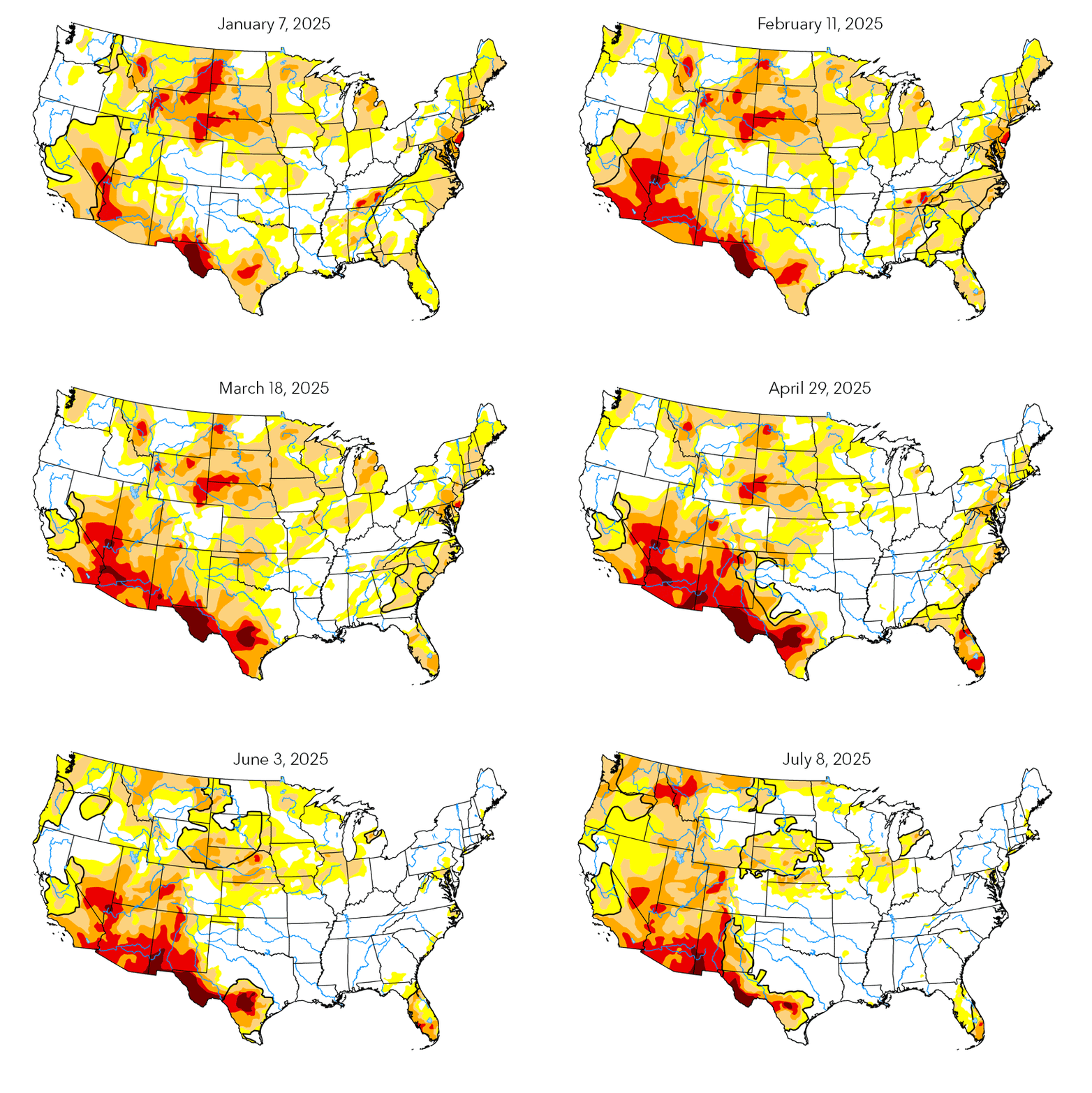
Ideal harvest weather was reported in the Eastern Cornbelt in mid-September, with highs reported in the mid-70s to low-80s. Although spotty thunderstorms moved through parts of northern Illinois and northern Indiana on Sept. 14, conditions were generally dry and favorable for fieldwork.
Growers had 1-2 percent of the regional corn crop in the bin by Sept. 12, USDA reported, with good or excellent ratings assigned to 62 percent of the acreage in Illinois, 69 percent in Indiana, and 70 percent in Ohio. Similar ratings were reported for soybeans, with 61 percent of the crop in Illinois, 67 percent in Indiana, and 70 percent in Ohio rated as good or excellent.
Western Cornbelt:
Highs in the upper-80s to mid-90s were reported in central and eastern Nebraska during the week, accelerating crop maturation as the harvest starts to get underway. Slightly cooler weather was expected in Nebraska and Iowa as the week progressed, with potentially heavy showers in parts of eastern Nebraska by the weekend.
Highs in the 80s were reported across Missouri for much of the week, with strong thunderstorms developing in a few areas on Sept. 14. Sources said cooler weather was on tap for the coming week in many areas of the state.
Missouri growers had 7 percent of the corn crop harvested by Sept. 12, compared with just 1 percent in Nebraska. USDA placed 66-69 percent of Nebraska’s corn and soybeans in the good or excellent categories on that date, along with 61-64 percent of the acreage in Missouri and 59-62 percent in Iowa.
Missouri’s cotton crop was fully 75 percent good or excellent on Sept. 12, while the state’s rice crop was 66 percent good or excellent and 17 percent harvested on that date. The sorghum harvest was just starting in Nebraska, with 2 percent of the crop in the bin and 48 percent of the acreage rated as good or excellent at mid-month.
Southern Plains:
Summer weather lingered in Kansas and Oklahoma in mid-September, with temperatures climbing to the mid- to upper-80s in many locations.
Hot weather was also reported in northern Texas, while parts of southern Texas were lashed with high winds and heavy rain on Sept. 14 as Hurricane Nicholas made landfall as a Category 1 storm. The storm reportedly put a temporary stop to barge and truck loading in Houston on that date, but sources said they expected a rapid return to operations during the week.
The harvest of corn, cotton, and sorghum was on in the region. The corn harvest as of Sept. 12 was 63 percent complete in Texas, 11 percent in Kansas, and 1 percent in Colorado, with 53-61 percent of the regional crop rated as good or excellent. The Kansas soybean crop was 59 percent good or excellent on that date.
Just 11 percent of the Texas cotton crop was picked by Sept. 12, with good or excellent ratings assigned to 58 percent of the acreage in Texas, 47 percent in Kansas, and 78 percent in Oklahoma. The regional sorghum harvest ranged from 69 percent complete in Texas to just 1 percent in Kansas, with 56-69 percent of the regional crop rated as good or excellent.
South Central:
Parts of Louisiana and Mississippi were hit with heavy rain from Hurricane Nicholas at midweek, which initially made landfall as a Category 1 storm in southern Texas early on Sept. 14. Rainfall totals of 4-8 inches were expected across much of southeastern Louisiana as the storm slowly plodded to the east.
Several flash flood warnings were also issued for parts of western Kentucky at midweek, with reports of up to six inches of rainfall over 12 hours in some locations. Weekend precipitation was on tap for parts of Arkansas and Middle Tennessee as well.
The harvest of corn, rice, and cotton was well underway in the South Central region in mid-September, with excellent crop conditions reported. Growers in Tennessee and Kentucky had 15 percent of the corn in the bin by Sept. 12, with fully 79-81 percent of the acreage rated as good or excellent.
The rice harvest had progressed to 33 percent complete in Arkansas, 50 percent in Mississippi, and 89 percent in Louisiana and Texas by Sept. 12, with good or excellent ratings assigned to 66 percent of the acreage in Arkansas, 74 percent in Texas, 78 percent in Mississippi, and 85 percent in Louisiana. Cotton rated as good or excellent totaled 64 percent of the acreage in Tennessee, 68 percent in Louisiana, 70 percent in Mississippi, and 89 percent in Arkansas.
Soybean conditions were also described in favorable terms in the region, with good or excellent ratings assigned to 65 percent of the crop in Arkansas, 85 percent in Louisiana, and 75-79 percent of the acreage in Tennessee, Mississippi, and Kentucky.
Southeast:
Tropical Storm Nicholas brought heavy showers to parts of Georgia, Alabama, and the Florida Panhandle as the week progressed. Five or more inches of rain in coastal areas of Alabama prompted flash flood watches in Mobile, Baldwin, Washington, and Escambia counties at midweek.
Forecasters were watching another tropical disturbance that was expected to bring strong winds and heavy rainfall to coastal areas of North Carolina late in the week. Parts of the Mid-Atlantic were also under flash flood warnings at midweek after severe thunderstorms pounded Frederick County, Maryland, on Sept. 14.
The harvest of corn and peanuts was underway in the Southeast, with favorable crops conditions reported. North Carolina growers had 49 percent of the corn harvested by Sept. 12, with good or excellent ratings assigned to fully 81 percent of the corn and 64 percent of North Carolina’s soybean crop. “We’ll probably be at an all-time high on corn yields,” said one Carolina contact at midweek.
The peanut harvest was 13 percent complete in Florida and just starting in Alabama, Georgia, Virginia, and the Carolinas as of Sept. 12. Peanut conditions were exceptional, with good or excellent ratings assigned to 74 percent of the acreage in Florida, 76 percent in North Carolina, 79 percent in Georgia, 88 percent in Virginia, 89 percent in Alabama, and fully 98 percent in South Carolina.
The regional cotton crop was also in good shape, with 86 percent of Virginia’s crop rated as good or excellent, compared with 83 percent in Alabama and South Carolina, 69 percent in Georgia, and 63 percent in North Carolina.
U.S. Gulf and Atlantic:
Hurricane Nicholas made landfall as a Category 1 storm at the Matagorda Peninsula in Texas early on Sept. 14. Galveston recorded nearly 14 inches of rain from the storm, while six inches was reported in Houston. Brazos Lock was shut to navigation on Sept. 14, and the Colorado Lock eastern gate was unavailable for service. Delays were posted up to 48 hours at the Colorado Lock western gate.
Sources continued to report transit restrictions leftover from Hurricane Ida throughout the Gulf. Delays and restrictions were expected to continue into mid- to late-September.
Bayou Chene and Port Fourchon travel remained restricted to daytime hours only, USGS data indicated, while restricted movements were noted through much of the West Canal. The Houma Navigational Canal remained shut to traffic on Sept. 14, and shoaling at Mile 19.5 in the West Canal contributed to a shutdown at Miles 18-20 that was projected to run through Sept. 21. Additional shoaling areas at Miles 23-33 required careful travel through the area, although navigation remained available.
Algiers Lock navigation caps effectively limited unassisted tows to four standard barges or two 30,000 mt tankers. Full-length tows remained possible with the use of an assist vessel.
Construction operations that kicked off in early August at the Belle Chasse Bridge reportedly triggered intermittent navigational outages at the West Canal’s Mile 3, with delays up to 12 hours reported.
Port Allen Lock delays were reported at 2-3 days as lock operators continue balancing vessel inflows and outflows between the canal and river. Forty-five tows were reported in line to lock on Sept. 14.
Ten-hour delays were noted at Bayou Sorrel Lock, while Industrial Lock passages required up to 80 hours to complete, Corps data indicated.
The National Hurricane Center on Sept. 16 reported tracking a tropical disturbance southeast of North Carolina. The system was assigned a greater than 60 percent chance of strengthening into a tropical depression prior to Sept. 18. A second system located in the Central Atlantic on Sept. 16 was also expected to strengthen into a tropical cyclone before Sept. 18.
Mississippi River:
Ongoing salvage operations resulting from Hurricane Ida extended navigation restrictions at Miles 108-168 on the lower Mississippi River. Northbound tows were limited to 42 barges, while vessels traveling downriver were limited to 36 cargoes. Towing widths were capped at six barges in both directions through the area.
Low water levels and speedy currents led to ongoing restrictions for the length of the lower river, with towing cuts reported at 5-10 barges. The Dredge Hurley was reportedly moved to the lower river’s Mile 742 for the week, with no transit closures predicted.
Lock 18 at Mile 410 on the upper river was closed to navigation from 8:00 a.m. to 6:00 p.m. on Sept 15 for planned repairs. Mel Price Lock delays were reported up to 5.5 hours for the week.
A pair of Merchants Memorial Rail Bridge navigation closures are scheduled for Sept. 14 and Sept. 17, with travel through the site unavailable for 24 hours on each date. The shutdowns were described as part of an ongoing bridge replacement effort set to continue through 2022.
Illinois River:
Sources noted raised wickets at Peoria Lock and LaGrange Lock, necessitating ongoing lockages through both sites.
Ohio River:
The Pike Island Lock main chamber was reportedly shut to navigation for repairs between 8:00 a.m. and 4:00 p.m. on Sept 14-16. Boats were heard navigating through the auxiliary chamber while work was underway.
The Cannelton Lock main chamber is shut through Nov. 19 for repairs and maintenance, pushing detours through the secondary chamber. The secondary chamber is scheduled for maintenance on Nov. 1-19.
The primary chamber at Montgomery Lock is scheduled to close from Oct. 18 through Dec. 17 for maintenance and repairs, with significant delays expected.
The Willow Island Lock secondary chamber is closed through Sept. 30 for planned maintenance. Following the conclusion of auxiliary chamber work, the primary chamber is scheduled to shut on Oct. 1-31, prompting detours through the secondary lock chamber.
Hannibal Lock was reported shutting its main chamber on Sept. 13 through Oct. 29 for repairs and maintenance, forcing tows to pass through the site’s smaller backup chamber.
The Markland Lock secondary lock chamber remains shut to vessel traffic through an estimated Oct. 29 due to cracks in the miter gate. All navigation has been detoured through the main chamber since the damage was discovered in early 2020. Intermittent 18-hour delays were reported at McAlpine Lock.
Travel through the Tennessee River’s Wilson Lock remained available via staggered one-way navigation for the week. Southbound tows were noted locking through the site during daylight hours, followed by overnight movements in the northbound direction. Delays were reported at 4-12 hours for the period. Corps data noted Kentucky Lock wait times up to 12 hours.
Bio-acoustic fish fence (BAFF) maintenance at Cumberland River’s Barkley Lock was set to begin on Sept. 16, blocking navigation daily from 6:00 a.m. to 6:00 p.m. through Oct. 5.
The Monongahela River’s Braddock Lock main chamber was noted shutting on Sept. 13 for repairs. Vessels were heard locking one barge at a time through the secondary chamber, producing delays of roughly five hours. Work at the site was scheduled through Oct. 15.
Arkansas River:
Work slated for Oct. 19-21 at Joe Hardin Lock will produce intermittent stoppages between 7:00 a.m. and 6:00 p.m. daily. Similar delays were anticipated at Emmett Sanders Lock on Oct. 26-28.
Nitrogen and methanol producer OCI NV, Amsterdam, and Abu Dhabi National Oil Co. (ADNOC) are planning to list their Middle Eastern fertilizer venture, Fertiglobe, as soon as October, people with knowledge of the matter told Bloomberg.
Advisers to the company have been holding early meetings with potential investors and aim to announce plans for the initial public offering in the coming weeks, according to sources. Investors could be offered around a 10-15 percent stake in Fertiglobe through the IPO, sources said, asking not to be identified because the information is private.
The IPO could benefit from the rebound in fertilizer prices, which have jumped in the past year as a crop rally helped farmers boost purchases of the nutrient. They have been further supported after Hurricane Ida struck the heart of the U.S. fertilizer industry and Storm Nicholas threatened more damage in the Gulf of Mexico.
At the same time, soaring energy prices in Europe have spread to the fertilizer industry, forcing companies, including Yara International ASA and CF Industries Holdings Inc., to curtail some output. Fertiglobe has locked in gas supplies from producers in markets including Abu Dhabi and Egypt, giving it a potential advantage over some rivals in Europe, people familiar with the matter said.
OCI, which is backed by Egyptian billionaire Nassef Sawiris, has a 58 percent stake in Fertiglobe, while ADNOC holds 42 percent.
Deliberations are ongoing, and details of the potential share sale could still change, sources said. Representatives for ADNOC and OCI declined to comment.
India’s RCF last week secured in-principle approval from its board to set up a Nano Urea Liquid production unit at its Trombay production site in Maharashtra state.
The company’s board on Sept. 8 gave the in-principle approval for a plant to produce 75 kiloliters per day, or some 150,000 bottles of 500 millilitres capacity, according to a report by India’s Business Standard.
The Nano urea liquid product is based on Indian Farmers Fertiliser Cooperative Ltd.’s (IFFCO) proprietary technology, and was a new product developed by the fertilizer cooperative, launched on May 31 (GM June 4, p. 32).
IFFCO and RCF signed a Memorandum of Understanding (MOU) in late July for the “transfer of technology” of Nano Urea Liquid (GM July 30, p. 33).
The Indian fertilizer cooperative also signed a “transfer of technology” MOU for Nano Urea Liquid with India’s National Fertilizers Ltd. (NFL) in late July.
IFFCO began production of the new product in June at its facility in Kalol in Gujarat state, and last month was seeking permission from India’s government to export the new product, according to Indian media reports (GM Aug. 13, p. 36). It is unclear which export markets IFFCO is targeting for the new product.
The fertilizer cooperative has also inked MOUs with Brazilian and Argentine cooperatives to set up Nano Urea Liquid production units with mutual collaboration in the two countries (GM June 18, p. 31; June 25, p. 32).
IFFCO has said the new product could cut conventional urea use by at least 50 percent.
LSB Industries Inc., Oklahoma City, reported that Fred Buonocore joined the company as Vice President of Investor Relations, effective Sept. 7, 2021. The company said he has nearly 20 years of experience in investor relations, along with five years in equity research.
Buonocore was most recently Senior Vice President with The Equity Group, an investor relations consulting firm, which he joined in 2012. Previously, he was an Equity Research Analyst with CJS Securities; Director of Investor Relations & Corporate Communications for K&F Industries; Investor Relations Manager at Nike; Investor Relations Manager at J.D. Edwards & Co.; Director of Investor Relations at Syntroleumm, Corp.; and Associate Director/Market Intelligence Group Leader-Specialty Chemical Sector at Thomson Financial Corporation.
He received an MBA with honors from Fairleigh Dickinson University and a B.S. in Business Administration from Villanova University. He holds the Chartered Financial Analyst designation.
Dry bulk, chemical, and asphalt trucking operator Dillon Logistics Inc. (Burr Ridge, Ill.) permanently shut down on Aug. 31 after 41 years of service, FreightWaves.com reported. The company, doing business as Dillon Transport, operated nine terminals in eight states, including locations in Tampa and Mulberry, Fla.
Dillon was noted by industry sources as a hauler of both dry and molten sulfur from the Port of Tampa to inland locations. The company’s shutdown was described as unexpected, with minimal advance notice reportedly offered to customers or employees. The company’s trucking capacity from the Port of Tampa had not been fully replaced as of Sept. 9, sources believed.
Former employee Cory Siegesmund on Sept. 1 filed a class-action lawsuit with the United States District Court for the Middle District of Florida, Tampa Division, claiming that Dillon provided notice of the company’s Aug. 31 shutdown on Sept. 1, an alleged violation of the Worker Adjustment and Retraining Notification (WARN) Act.
The WARN Act requires employers to provide advance notice of at least 60 days prior to “the permanent or temporary shutdown of a single site of employment, or one or more facilities or operating units within a single site of employment,” according to the suit.
The shutdown came after a planned sale of the company failed to transpire, the plaintiff claimed, describing a Sept. 1 email from Dillon informing the employees of their termination, effective one day earlier on Aug. 31.
A former Dillon executive, speaking to FreightWaves on condition of anonymity, said the decision to shut down was made by the company’s private equity owners.
Texas-based private equity firm Cotton Creek Capital recapitalized Dillon Transport in 2017 to help expand the company, according to a post on Cotton Creek’s website. Dillon Transport founder Jeff Dillon remained a “significant shareholder” following the recapitalization, the post indicated.
In addition to its nine terminals, Dillon operated 400 tractors and 700 trailers, employing 342 drivers in the process, according to the lawsuit. The Federal Motor Carrier Safety Administration’s SAFER website put Dillon’s total number of power units at 323 as of Sept. 7, however.
Dillon was founded in 1980.
Incitec Pivot Ltd. (IPL), Southbank, Melbourne, on Sept. 6 announced the resignation of CFO Nick Stratford, who has decided to leave to pursue other opportunities after 13 years with the company. He will remain in the post until Dec. 31, 2021, while an external search for a new CFO is undertaken.