

California:
Calamco reportedly raised its reference price to $327/st DEL for AN-20 on Sept. 1, up $24/st from the previous list price.
Pacific Northwest:
The AN-20 market was reported at the $300/st level FOB Kennewick in early September.
California:
Calamco reportedly raised its reference price to $327/st DEL for AN-20 on Sept. 1, up $24/st from the previous list price.
Pacific Northwest:
The AN-20 market was reported at the $300/st level FOB Kennewick in early September.
Cornbelt:
The NPSZ market remained at $675-$720/st FOB in the Cornbelt, depending on location.
Pacific Northwest:
40-Rock prices strengthened $15/st on Sept. 1, firming to $745-$760/st FOB and $755-$765/st DEL in the Pacific Northwest, with the low in Idaho and the high in Washington and Oregon.
California:
SOP pricing was steady at $650-$675/st FOB Stockton in early September.
Pacific Northwest:
The SOP market was quoted at $635-$650/st FOB in the Pacific Northwest.
California:
The SOP Magnesia market was pegged at $495-$525/st FOB for allocated tons in California, up another $20-$25/st from last report, depending on grade.
Pacific Northwest:
SOP Magnesia pricing continued to be reported at $480-$500/st FOB in the Pacific Northwest for limited tons, depending on grade and location.
California:
The crystalline potassium nitrate market was pegged at $910/st FOB Stockton for bulk tons, $980/st FOB for bulk bags, and $1,000/st FOB for 50-pound bags.
Eastern Cornbelt:
Potassium thiosulfate pricing was steady at the $650/st level FOB Terre Haute in early September.
Eastern Cornbelt:
Most of the Eastern Cornbelt enjoyed cooler weather during the week. After some spotty showers earlier in the week, temperatures across central Indiana rose to the upper-70s and low-80s, with similar seasonal highs reported in Illinois.
Much of Ohio experienced dry, cool weather during the week, with rain expected by the weekend. An increased chance of rain was also expected in parts of Illinois and Indiana over the Labor Day weekend.
USDA reported that 8 percent of Indiana’s corn crop was mature by Aug. 29, compared with 3-4 percent in the rest of the region. Good or excellent ratings were assigned to 70-71 percent of the corn and soybeans in Illinois, compared with 68-77 percent in Ohio and 66-69 percent in Indiana.
Western Cornbelt:
Frequent thunderstorms were reported in Iowa during the week, with daytime highs climbing to the low- to mid-80s. Strong winds and heavy rain also hammered parts of Nebraska early in the week, with reports of 4-7 inches of rain and 60-70 mph wind gusts in some eastern areas of the state.
Missouri was also bracing for potentially heavy precipitation late in the week. A slow moving cold front was expected to bring several rounds of thunderstorms to the Kansas City and St. Joseph areas on Sept. 3, with two inches or more of rain possible into the Labor Day weekend.
The regional corn crop was 11 percent mature in Missouri by Aug. 29, compared with 8 percent in Nebraska and 6 percent in Iowa. USDA rated 58-60 percent of the corn and soybeans in Iowa as good or excellent, compared with 59-63 percent in Missouri and 67-69 percent in Nebraska.
Missouri’s rice crop was 5 percent harvested by Aug. 29, with 65 percent of the acreage rated as good or excellent. Good or excellent ratings were also assigned to fully 71 percent of Missouri’s cotton crop in late August, while Nebraska’s sorghum crop slipped to 48 percent good or excellent, with 2 percent of the crop rated as mature.
California:
Cooler and calmer weather conditions earlier in the week helped firefighters keep the Caldor Fire from destroying communities on the south end of Lake Tahoe. Forecasts warned of strong winds as the week advanced, however, which could threaten more communities in the California-Nevada alpine region.
More than 15,000 firefighters were battling to contain the Caldor, Monument, and Dixie Fires in early September, as well as numerous other smaller wildfires in the state. Wildfires have already burned nearly 1.8 million acres in California this year, according to Cal Fire. Those blazes have destroyed nearly 3,000 structures.
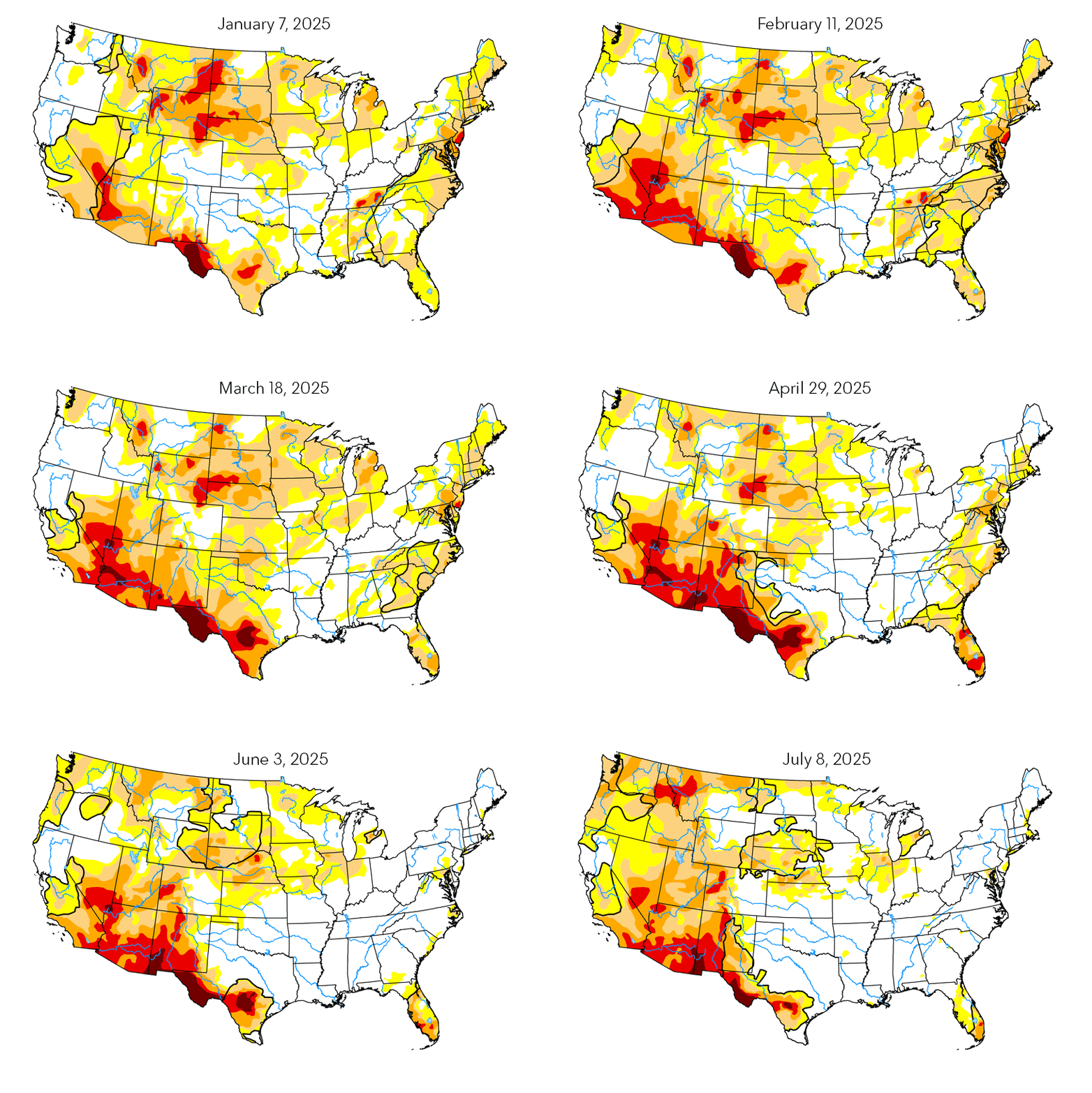
The historic fire season has been fueled by worsening drought conditions in the state. Nearly all of California is now experiencing extreme-to-exceptional drought, the most severe drought categories, according to the Sept. 2 U.S. Drought Monitor.
Fertilizer industry sources reported minimal interest in pricing and buying in early September. “There is still a lot of smoke,” commented one source. “Most are occupied on harvest. It has really been quiet on fertilizer here.”
Pacific Northwest:
Warm, smoky weather was reported across much of the Pacific Northwest during the first days of September. Highs in the 80s were common in coastal areas of Oregon and Washington at midweek, with temperatures expected to reach into the 90s in the Willamette Valley by the Labor Day weekend.
Boise, Idaho, posted its hottest June 1-Aug. 31 period on record, with an average temperature of 78 degrees, up from the previous record of 76.6 degrees set in 2015. The hot, dry weather accelerated the harvest of small grains in the region.
The spring wheat and barley harvest as of Aug. 29 was 95 percent complete in Washington, some 24-25 points ahead of the average pace. Harvest progress was rated at 86-88 percent complete in Idaho and 79-85 percent in Montana, with both states tracking well ahead of their five-year averages.
Western Canada:
Strong storms churned through the Prairies at midweek, bringing torrential rainfall, intense winds, hail, and localized flooding to parts of southern Alberta and Saskatchewan on Aug. 31. The rain also hit parts of British Columbia, helping firefighters who are battling a total of 224 wildfires across the province.
The storm threat expanded on Sept. 1 to areas stretching from northeastern Alberta into southwestern Manitoba, with reports of spotty crop damage in southeastern Saskatchewan and southwestern Manitoba.
Cereal harvest was wrapping up in the region, with reports of highly variable yields. Roughly 17 percent of Alberta’s crops were in the bin as of Aug. 27, well ahead of the average pace, with peas leading the charge at 72 percent harvested, followed by barley at 23 percent and spring wheat at 15 percent.
Saskatchewan growers had 36 percent of the crop in the bin as of Sept. 2, well ahead of the 22 percent five-year average. Saskatchewan’s harvest had progressed to 99 percent complete for winter wheat, 83 percent for fall rye, 85 percent for lentils, 84 percent for field peas, 57 percent for mustard, 40 percent for durum, 11 percent for chickpeas, 36 percent for spring wheat, and 11 percent for canola. Yields are reported to be far lower than average in many parts of the province.
In Manitoba as of Aug. 30, the harvest schedule had progressed to 100 percent complete on winter wheat and fall rye, 98 percent on field peas, 78 percent on barley, 70 percent on oats, 69 percent on spring wheat, 7 percent on canola, and 3 percent on flax.
U.S. Gulf and Atlantic:
Hurricane Ida made landfall in Louisiana on Aug. 29 as a strong Category 4 storm, triggering widespread flooding, wind damage, and outages of electricity and other essential services, including marine logistics.
Prior to Ida’s arrival, the Coast Guard ordered a complete barge evacuation of the Mississippi River south of Mile 73, while an Aug. 28 Port Condition Zulu order halted navigation on the lower river below Mile 305, in the East Canal, and much of the West Canal. No firm estimates on a return to navigation were immediately available, although some speculated movements could require weeks to normalize.
Algiers Lock travel was unavailable on Aug. 31 due to restrictions in place due to Hurricane Ida. Once reopened, unassisted tows locking through the site will remain subject to ongoing length and width restrictions in effect until further notice. Tows measuring more than 60 feet wide are capped at 600 feet of total length, while those below 60 feet in width will be permitted lengths up to 700 feet. The size caps have effectively limited movements to four standard barges or two 30,000 mt tankers. Boats locking with assistance are allowed lengthier tows, however.
Belle Chasse Bridge replacement efforts underway through late 2022 were also expected to trigger intermittent transit stoppages of up to 12 hours when river movements resume. The bridge is located at Mile 3 in the West Canal, near Algiers Lock.
Port Allen Lock, Bayou Sorrel Lock, Industrial Lock, Algiers Lock, Harvey Lock, and Bayou Boeuf Lock were shut to navigation on Aug. 31 due to Hurricane Ida. Delays were noted in a wide 3-13 hour range through the Brazos Locks system. Leland Bowman Lock waits ran up to five hours for the week.
The National Hurricane Center was tracking the movements of Tropical Depression Kate on Aug. 31. The “poorly organized” storm was not expected to impact the U.S., with current forecasts calling for the storm to fizzle over Atlantic shipping lanes later in the week.
A tropical disturbance located on the coast of the African country of Guinea on Aug. 31 evolved into Hurricane Larry on Sept. 2. Larry was projected to strengthen into a Category 4 storm in the days ahead, although forecasts disagreed on whether the storm might pose a threat to North America.
Mississippi River:
Dredging at Mile 607 reportedly concluded on Aug. 26. Dredging had been reported at the site, as well as nearby Victoria Bend, since early August. Movements remained slow, and were anticipated to persist into mid-September.
Reduced water levels on the lower river continued to necessitate 5-10 barge towing reductions on northbound travel.
A pair of navigational shutdowns are in the works at the Merchants Memorial Rail Bridge, located in the St. Louis area, as part of a new phase of the structure’s $222 million replacement project that kicked off in 2019. The closures, set to total 24 hours each, are scheduled to begin on Sept. 10 and Sept. 13, river conditions permitting. The replacement project is scheduled to run through 2022.
Lower bullnose repairs at Lock 27 concluded on Aug. 27. The work began on Aug. 2 after being delayed from July. The main chamber project, slated to repair the site’s upper bullnose, is expected to be rescheduled imminently.
Illinois River:
Wickets were reported in the raised position at LaGrange Lock and Peoria Lock during the week. Minimal wait times were recorded.
Ohio River:
The main chamber at Pike Island Lock was shut for maintenance between 8:00 a.m. and 4:00 p.m. on Aug. 31 through Sept. 2, prompting detours through the auxiliary chamber. Minimal delays were heard during the closure.
The Montgomery Lock primary chamber returned to normal operation on Aug. 27, ending a period of repairs and maintenance that kicked off on July 26. Wait times were quoted up to 6.5 hours for the week. The chamber is scheduled to close once more between Oct. 18 and Dec. 17, forcing vessels to pass through the secondary chamber.
The main chamber at Cannelton Lock was projected to remain offline through Nov. 19 due to repairs and maintenance underway since June 21. Passage is available through the auxiliary chamber. The site’s auxiliary chamber was expected to see intermittent closures on Nov. 1-19 due to planned repairs.
The Markland Lock auxiliary chamber is shut to vessel traffic through an estimated Oct. 29 due to structural damage to the miter gate, first reported in 2020. Navigation continued through the main chamber.
Braddock Lock’s main chamber is scheduled to shut from Sept. 13 through Oct. 15 for maintenance, with tows anticipated to detour through the secondary chamber.
Willow Lock is scheduled to see a main chamber outage on Oct. 1-31, necessitating detours through the auxiliary chamber. The Willow Lock secondary chamber was noted closing for repairs ahead of the primary chamber shutdown, from Aug. 16 to Sept. 30.
The Hannibal Lock main chamber is set to close from Sept. 13 through Oct. 29 for repairs, prompting tows to pass exclusively through the 600-foot secondary chamber. Falling water levels prompted lock operators to raise wickets at Olmsted Lock, forcing a return to locking at the site.
Damage reported at the Tennessee River’s Wilson Lock prompted a complete halt to navigation during the week. No timeline to resume lockages was immediately available.
Kentucky Lock closures were announced for Nov. 1 through Dec. 10. Navigation was likely to be completely unavailable during the period, save for a reopening window slated for Nov. 25-28. Kentucky Lock delays were quoted up to 36 hours for the week, increasing from 16 hours in the prior report.
Bio-acoustic fish fence (BAFF) maintenance is scheduled to begin on Sept. 16 at the Cumberland River’s Barkley Lock. Work at the site is projected to limit movements daily between 6:00 a.m. and 6:00 p.m., through Oct. 5.
On the Monongahela River, Lock 2 primary chamber access is scheduled to be unavailable from Sept. 13 through Oct. 15 due to planned maintenance. Traffic will run through the secondary chamber, with delays expected.
Navigation remained blocked at Lock 6 on the Allegheny River during the week due to ongoing emergency repairs.
Arkansas River:
Dewatering and repair operations that began on Aug. 27 at David D. Terry Lock were noted shutting navigation through Sept. 9, effectively closing the Arkansas River at the site.
Joe Hardin Lock is scheduled to see intermittent travel shutdowns on Oct 19-21. Closures were expected at Emmett Sanders Lock on Oct. 26-28.
Phosphate producer Itafos Inc., Houston, reported second-quarter net income of $9.6 million, up from a year-ago loss of $20.8 million. Revenues were $103.3 million, up from $62.1 million, while adjusted EBITDA rose to $33.7 million from $11.3 million.
While second-quarter production was off 20 percent at the Conda, Idaho, plant due to a full scope turnaround in June, the company noted that NOLA DAP prices were up 111 percent during the quarter, averaging $570/st compared to the year-ago $270/st. Total capital expenditures during the quarter were $18.2 million due to the turnaround, versus the year-ago $3 million.
Itafos said factors driving the year-over-year improvement included: no significant phosphate fertilizer supply capacity additions, which resulted in continued drawdown of global phosphate fertilizer inventory levels; strong phosphate fertilizer demand underpinned by global coarse grains and oilseeds at multi-year low stocks-to-use ratios and the highest prices in nearly a decade, supporting demand and fertilizer relative affordability; and countervailing duty orders on phosphate fertilizer imports to the U.S. from Morocco and Russia.
“We continued to deliver strong operational and financial performance during Q2 2021, resulting in H1 2021 adjusted EBITDA at Conda of $61.9 million and $54.3 million on a consolidated basis,” said G. David Delaney, Itafos CEO. “Our H1 2021 consolidated results exceeded our previously issued H1 2021 guidance range of $45-$50 million, reflecting the continued strength of the agriculture and fertilizer market fundamentals along with our solid operational performance. We expect these positive trends to continue and are raising our full year guidance for 2021 accordingly.”
The company revised its full-year adjusted EBITDA guidance to $110-$120 million from the previous guidance of $95-$105 million. The company expects the current global agriculture and phosphate fertilizer fundamentals to remain strong throughout the remainder of 2021.
“We are also pleased to announce that we have closed a refinancing of our existing secured term loan debt and amendments to our primary remaining debt facilities,” Delaney added. “This refinancing extends the maturity of our debt at a lower interest rate while providing flexibility to deleverage our balance sheet with the cash flows of the business.”
Itafos closed a three-year $205 million secured term loan. The proceeds were used to repay an existing secured term credit facility and to pay related transaction costs and fees. In connection with the closing, the company also completed an amendment to its existing secured working capital facility at Conda to increase the commitment amount from $20 million to $40 million and extend the term, among other modifications.
Six-month net income was $11.5 million on revenues of $193.5 million, up from the year-ago loss of $39.1 million and $137.5 million, respectively. Adjusted EBITDA was $54.3 million, up from $10.5 million.
| Conda | 2Q-21 | 2Q-20 | YTD-21 | YTD-20 |
| Tons Produced (mt) | 107,517 | 134,391 | 252,708 | 273,287 |
| Net Income ($M) | $24.4 | $3.4 | $39.1 | $4.4 |
| Revenues ($M) | $103.3 | $61.9 | $193.5 | $132.9 |
| Adjusted EBITDA ($M) | $37.7 | $14.5 | $61.9 | $22.8 |
CVR Partners LP, Sugar Land, Texas, announced on Aug. 25 that it currently intends to defer the scheduled turnaround at its Coffeyville, Kan., nitrogen fertilizer facility from October 2021 (GM Aug. 6, p. 28) to third-quarter 2022.
“The health and safety of our employees, contractors, and communities remains our critical priority,” said Mark Pytosh, President and CEO of CVR Partners’ general partner. “Between the recent spike in COVID-19 cases and the addition of Louisiana to Kansas’ travel quarantine list, we thought it prudent to reconsider the timing of this turnaround.
“Our proactive performance of maintenance activities during recent downtime events, together with a planned short, opportunistic outage later in the year, should enable us to safely defer this turnaround and complete the installation of the urea expansion project,” he added. “This turnaround deferral should also position us to capitalize on the strong margin environment we are currently seeing for both ammonia and UAN.”
The company said it will continue to monitor its marketing and operating conditions and make adjustments, if needed, to its turnaround and maintenance planning.
CVR now expects its total forecasted turnaround spending for 2021 of approximately $8-$10 million of expense for the Coffeyville facility to be spent in 2022, which will be in addition to the planned 2022 turnaround for its East Dubuque nitrogen fertilizer facility.
The Kansas Department of Health and Environment (KDHE) amended its travel quarantine list to include those arriving from the state of Louisiana, effective Aug. 13. The travel quarantine period for the non-vaccinated is seven days with a negative test result or 10 days without testing.
KDHE has also amended its list to state that anyone who attends an in-state or out-of-state mass gathering of 500 or more where individuals do not socially distance and wear a mask should follow the quarantine guidelines. Previously, the list included out-of-state mass gatherings only.
“The virus does not know the boundaries of our state, and we must all take steps to protect those close to us by staying home after attending any large events,” said KDHE Secretary Dr. Lee Norman.