All posts by mickeybarb@charter.net

Ammonium Polyphosphate

Eastern Cornbelt:

10-34-0 remained at $580-$600/st FOB in the Eastern Cornbelt for the last reported offers, with the low at Cincinnati.

Western Cornbelt:

The 10-34-0 market was unchanged at $575-$595/st FOB for the last reported business in the Western Cornbelt, depending on location.

Southern Plains:

The regional 10-34-0 market remained at $530-$540/st FOB in the Southern Plains, with the last offers for 11-37-0 in Texas reported in the $600-$620/st FOB range.

Muriate of Potash

U.S. Gulf:

NOLA potash barge prices continued to climb. The market was quoted at $365-$380/st FOB, up from the week-ago $345-$362/st FOB.

Eastern Cornbelt:

Potash pricing surged higher in the Eastern Cornbelt, with regional sources describing supply as “very snug out there.” The market was pegged at $395-$420/st FOB in early June, up $20/st from the prior week, with the lower end of the range confirmed at Cincinnati and the high at Ottawa.

Western Cornbelt:

Sources quoted potash pricing at $395-$415/st FOB in the Western Cornbelt, up $15-$20/st from the previous week, with the St. Louis market pegged at $395-$405/st FOB in early June. The market FOB Camanche firmed $20/st from the previous week, to $400/st FOB for June tons

Southern Plains:

Potash pricing was reported at $390-$415/st FOB in the Southern Plains, up $35-$40/st from last report, with the low at Houston and the high at Catoosa/Inola. Postings FOB Carlsbad, N.M., remained at $450/st for 60 percent white granular and $457/st for 62 percent white standard.

South Central:

Potash prices firmed to a broad range of $390-$420/st FOB warehouses in the South Central region, with the low reported at Memphis and the high at Shreveport. Most Arkansas terminals were pegged firmly at the $415/st FOB level at midweek.

Southeast:

Potash pricing had reportedly firmed to $425/st FOB Wilmington, up a full $55/st from mid-May levels. The last posted price at Fairless Hills was $415/st FOB as of May 27, but no tons were on offer there in early June.

Bangladesh:

Sources said the Ministry of Agriculture awarded the full tonnage under its annual tender for the supply of 200,000 mt of standard potash to Belarusian Potash Co. (BPC), via local trading companies. The award price was reported to be $345/mt CFR with the tons required to be shipped by Oct. 15. The tender closed on June. 3.

Brazil:

The Paranagua MOP market showed a slight uptick as the market tightened. Sources put the price at $395-$400/mt CFR, moving up the lower end of the range from last week.

Sources said the tightness in the market is mostly because suppliers are said to be slowing down deliveries from overseas to create temporary shortages at a time when other suppliers are unable to cover the difference between supply and demand. One observer said this is a standard – and expected – move that is generally considered when discussing prices and quantities.

The lack of material in Rondonopolis moved up prices about $12/mt, to $480-$520/mt FOB ex-warehouse. Demand for the next quarter applications is expected to start soon, leading to even higher prices.

Sulfur

Tampa:

Genscape reported an alkylation unit shutdown at the HollyFrontier Tulsa East refinery on May 28. The shutdown was followed by “significant” cooling. A coking unit located at the Tulsa site’s West plant has been noted offline since Jan. 14.

Tampa molten sulfur contracts were quoted at $192/lt CFR for second-quarter loading, up $96/lt from the previous $96/lt CFR deal.

Refinery utilization moved up for the week ending May 28, the Energy Information Administration (EIA) reported. Nationwide capacity stood at 88.7 percent for the period, a 1.7-point rise from the prior week’s 87.0 percent rate, and also topping both the year-ago 71.8 percent and the 88.2 percent five-year average.

Crude oil inputs were reported at an average 15.597 million barrels/d for the period, a 358,000 barrel/d increase from 15.239 million barrels/d posted previously.

U.S. Gulf:

Citgo on May 28 successfully restarted a 174,000 barrel/d crude distillation unit (CDU) and 85,000 barrel/d vacuum distillation unit (VDU) at the company’s Corpus Christi, Texas, refinery, Genscape reported.

Shut down on May 24, the units were noted ramping up activity starting on May 27. Decreased activity was observed from a 45,000 barrel/d hydrotreater, while the plant’s 30,000 barrel/d Platformer 5 catalytic reformer has remained shut since May 14. A 30,000 barrel/d naphtha hydrotreater, also halted on May 14, was noted restarting on June 3.

Phillips 66 shut a 34,000 barrel/d catalytic reforming unit at its Lake Charles, La., plant on May 29. The unit restarted on June 3.

Decreased production activity continued to be noted from the 250,000 barrel/d crude section at Shell’s Norco facility on June 2. The section began showing signs of a slowdown on May 13.

Chevron took a 56,000 barrel/d fluidic catalytic cracking unit (FCC) offline at its Pasadena, Texas, plant on June 2. Declining activity was also observed from a 41,000 barrel/d VDU, although that unit remained operational on June 3.

Valero briefly shut a 30,000 barrel/d hydrocracker at its McKee, Texas, refinery on June 1. The unit was restarted early on the morning of June 2, Genscape observed.

Gulf export sulfur price ideas continued to be noted in the $185-$190/mt FOB range, steady from the prior report.

Brazil:

Sources noted price ideas on Brazil spot at $215-$220/mt CFR, unchanged from last report. Contracts were quoted in the $213-$214/mt CFR range for delivery in the second quarter.

Vancouver:

The most recent price ideas for tons exported from Vancouver were quoted firming to $178-$180/mt FOB, up from $170-$180/mt FOB at last report.

Alberta:

A 128,000 barrel/d CDU and 64,000 barrel/d FCC at the Imperial Strathcona refinery were restarted in late May after being shut in mid-April for a planned turnaround, according to Genscape. Decreased activity was noted from the FCC on May 28, while a 21,000 barrel/d catalytic reformer remained offline on May 30. Increasing activity from a 47,000 barrel/d VDU taken offline as part of the turnaround was observed on May 31.

An 82,000 barrel/d CDU taken offline on April 20 during a multiunit turnaround at the Suncor refinery in Edmonton showed increased activity on June 2, although the activity failed to reach fully operable levels. Several additional units remained offline on June 2, including a 17,000 barrel/d coker, a 12,000 barrel/d catalytic reformer, a 94,000 barrel/d naphtha hydrotreater, a 38,000 barrel/d hydrotreater, and a 14,000 barrel/d EDD distillate hydrotreater.

Alberta netbacks were steady at $65-$110/mt FOB, sources said, including both molten tons contracted into the U.S. and prilled material selling internationally through the Vancouver export market.

West Coast:

Genscape noted the conclusion of planned maintenance at BP’s Cherry Point, Wash., plant on May 30. The turnaround, kicked off on March 31, included service to the facility’s 50,000 barrel/d Reformer 1 catalytic reformer and a 55,000 barrel/d hydrocracker.

Activity levels on an 82,000 barrel/d VDU were reported returning to normal at the Phillips refinery in Carson, Calif, on May 29. Decreased activity had been observed since May 25.

Price ideas for solid sulfur loading from the West Coast were on par with Vancouver at $178-$180/mt FOB, rising from $170-$180/mt FOB in the prior report. Second-quarter molten contracts were valued at $140-$155/lt FOB, essentially doubling from $70-$77/lt FOB in the first quarter.

China:

China’s largest refiner, Sinopec, announced an $811 million upgrade to its subsidiary Yangtze Petrochemical Corp. refinery, located in Jiangsu province, Reuters reported. Included in the upgrade plans were the plant’s 60,000 barrel/d residual hydrocracker and 65,000 barrel/d fluidic catalytic cracking unit. The project is scheduled to conclude in 2023.

Sources called the recent China import sulfur market in the $210-$215/mt CFR range, lifting from $210-$212/mt CFR noted previously.

Qatar:

Qatar solid sulfur offers for June rolled over from May at $183/mt FOB Ras Laffan, sources indicated.

Sulfuric Acid

U.S. Gulf:

Market players reported Gulf import sulfuric acid values in the $150-$155/mt CFR range, increasing from $135-$140/mt CFR in the prior report. Talks for the next round of business were rumored up to $190/mt CFR, although most players expected concluded pricing to land closer to the mid-$170s/mt CFR.

Gulf Coast:

Sources noted Gulf Coast sulacid contracts in the $85-$110/st DEL range for 2021 agreements.

Midwest:

Pricing stood at $85-$110/st DEL for Midwest delivery, sources said, steady from the prior report.

West Coast:

West Coast contracts were noted in the $100-$130/st DEL range.

Brazil:

Recent Brazil import pricing was noted firming to $180-$185/mt CFR, increasing from the prior $165-$170/mt CFR level.

China:

New power consumption restrictions will force a number of tin, aluminum, and zinc smelter shutdowns in China’s Yunnan province in June, Reuters reported. May drought conditions were blamed for thinning the region’s famously prodigious hydroelectric power supply.

The restrictions were reported to affect only privately owned smelters, and would not apply to state-run facilities. As a result, tin production was projected to be reduced by an estimated 1,000-2,000 mt. China’s total tin output was noted at approximately 15,300 mt in April. Heavy rains in the June forecast were anticipated to remove the power restrictions.

Operating rates for primary lead smelters located in Henan, Hunan, and Yunnan provinces softened 1.3 percentage points for the week ending May 28, Shanghai Metals Market reported, to 60 percent from the week-ago 61.3 percent.

The declining output was primarily attributed to capacity reductions at Yunnan Zhenxing and Tongfu, both reportedly limited by local Yunnan power restrictions. A fresh maintenance turnaround begun by Yunnan Lead Oxide was expected to conclude in mid-June.

Secondary smelter operating rates for facilities located in Jiangsu, Anhui, Henan, and Guizhou provinces moved 2.89 percentage points higher, however, to 60.41 percent. Environmental restrictions noted curbing outputs in Jiangxi were projected to end in the week ahead, likely further lifting outputs in the short term.

Ammonium Thiosulfate

Eastern Cornbelt:

The last offers for ammonium thiosulfate were unchanged in the $450-$500/st FOB range on a spot basis in the Eastern Cornbelt, but sources continued to describe inventories as extremely tight or unavailable in early June.

Western Cornbelt:

Sources continued to describe extremely tight ammonium thiosulfate inventories in the region, with the last business quoted in the $450-$475/st FOB range.

Southern Plains:

IOC’s ammonium thiosulfate postings on May 26 included $325/st FOB Houston and $335/st FOB Lubbock, Texas.

South Central:

No pricing was reported for ammonium thiosulfate in the South Central region, with product described as unavailable in early June.

Calcium Ammonium Nitrate

Germany:

CAN demand in Germany remains strong. OCI is reported to have posted new season pricing at €260/mt bulk CIF in Germany, some €25/mt lower than the price asked by the supplier earlier last month (GM May 14, p. 20).

Rival supplier Yara posted new season terms for June deliveries of its CAN-27 (YaraBelaNitromag) for Germany at €255/mt bulk CIF on May 21 (GM May 21, p. 19), which was a €15/mt reduction on its previous posting in mid-March.

SOP Magnesia

Southern Plains:

Intrepid’s May 17 Trio postings FOB Carlsbad included $285/st for standard, $320/st for granular, $330/st for premium, $360/st for OMRI standard, and $395/st for OMRI granular. Those levels were up $20/st from the previous postings.

Southeast:

SOP Magnesia pricing in Florida was up $20/st, to $380/st FOB for standard and $415/st FOB for premium grade, with sources continuing to report tight supply. In North Carolina, sources reported limited offers at $405-$410/st FOB and $435-$440/st DEL.

Crops/Weather

Eastern Cornbelt:

Temperatures in the mid- to upper-80s were reported across central and southern Illinois during the week. Central Indiana was hit with 1-3 inches of rain on June 2-3, with highs in the 80s expected by the end of the week. The rain was needed in some areas, where May monthly rainfall totals were down as much as three inches from average.

Scattered storms also worked their way through northern Ohio during the week, with temperatures topping out in the upper-60s. Much warmer weather was on tap for the weekend, however.

Corn planting surged to 92-95 percent complete in the Eastern Cornbelt by the end of May, with progress tracking ahead of the average pace in all three states. Soybean planting was a full 20 percentage points or more ahead of the five-year average, with progress as of May 30 estimated at 84-89 percent complete in the region.

Western Cornbelt:

Iowa was bracing for a return of heat and high humidity in early June, with temperatures expected to reach the upper-80s and low-90s across the state late in the week and over the coming weekend. Hot weather was also expected in Nebraska after the previous week brought strong thunderstorms and several tornadoes to parts of the state.

Temperatures in the 80s were reported across much of Missouri during the week, along with drier weather after the previous week’s storm activity. Growers were able to move quickly on the remaining planting activities in early June.

Planting progress was wrapping up and tracking ahead of the average pace for most crops. The regional corn crop was 92-99 percent planted by May 30, while soybean planting had progressed to 93-94 percent complete in Iowa and Nebraska. Nebraska growers also had 45 percent of the sorghum planted by that date, trailing the state’s five-year average.

Missouri growers had only 44 percent of the soybeans planted by May 30, but cotton planting in the state was tracking 20 percentage points ahead of normal at 98 percent complete.

Southern Plains:

After some strong thunderstorms and tornado activity in central and western Kansas during the final days of May, dry, hot weather returned to much of the state in early June, with highs climbing to the mid- to upper-80s.

Central Oklahoma was also under a tornado watch on May 27-28 as strong thunderstorms pushed through the state, bringing heavy rain, hail, and strong winds. Scattered thunderstorms were reported in parts of western Texas during the first days of June, and strong thunderstorms brought 3-5 inches of rain and flash flooding to parts of New Mexico on May 29-30.

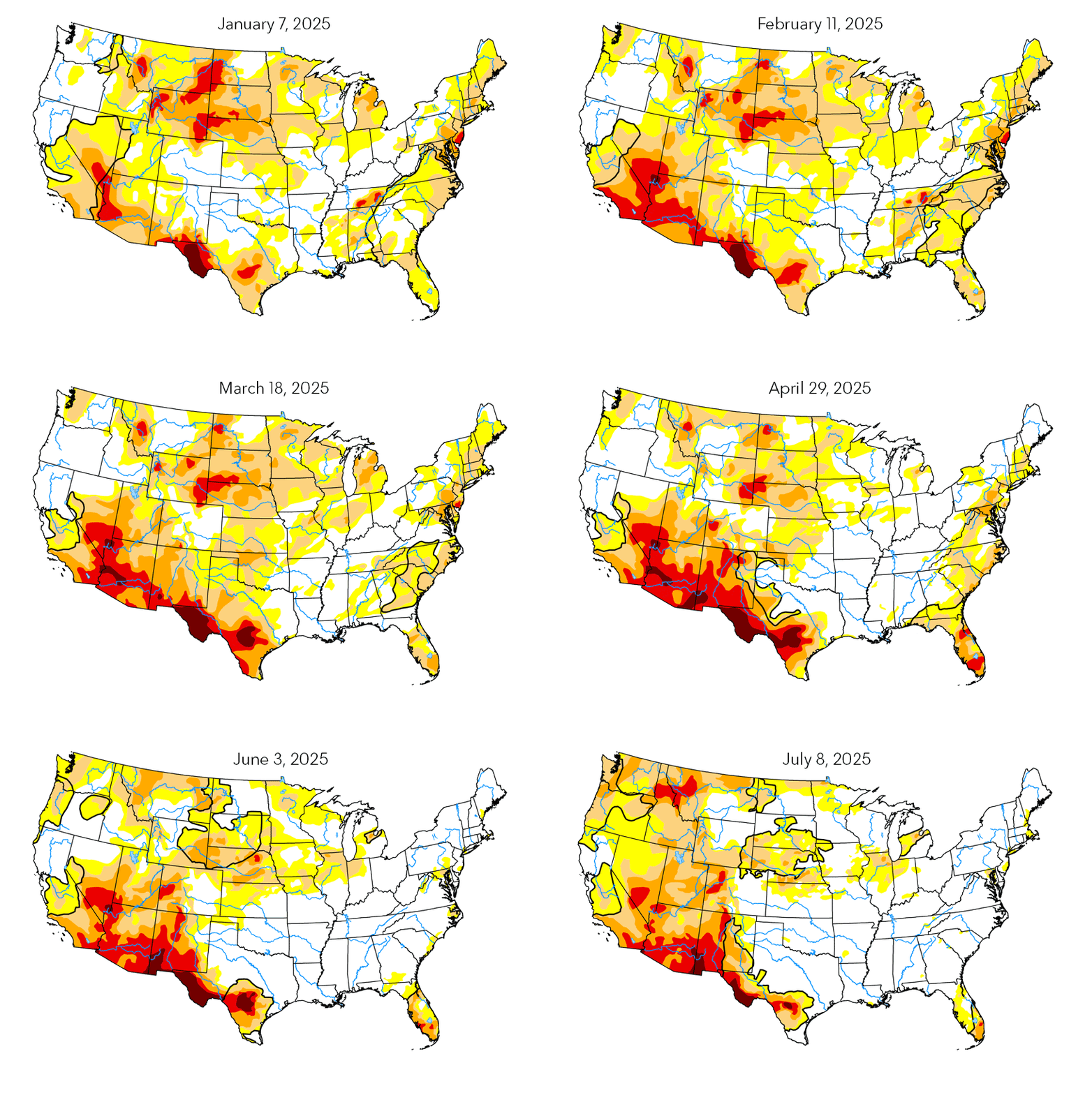
The June 3 U.S. Drought Monitor continued to show extreme-to-exceptional drought across much of New Mexico, western Colorado, and the western edge of Texas, but Kansas and Oklahoma were essentially drought-free.

“I guess the main story here in Central Texas is we had a drought busting rain since May 12,” said one contact. “This has put a stop or at least a big slowdown to fieldwork and pasture work.”

Corn planting as of May 30 had progressed to 95 percent complete in Texas and 83 percent in Kansas, with some 58 percent of the Kansas soybean crop planted. Cotton planting was estimated at 66 percent complete in Kansas, 54 percent in Texas, and 39 percent in Oklahoma, while sorghum planting lagged at just 17 percent complete in Kansas, 26 percent in Colorado, 30 percent in Oklahoma, and 82 percent in Texas.

South Central:

Flood warnings were in effect at several locations in Arkansas along the Black, Cache, and White Rivers at midweek due to recent heavy rain and cool temperatures. Severe weather alerts were also in effect for parts of Kentucky and Middle Tennessee at midweek, with forecasts warning of heavy rain, large hail, and damaging winds.

Heavy rain was also causing problems in parts of eastern Texas and Louisiana, with forecasts warning of flash flooding and gusty winds after one of the wettest Mays on record. Many areas were expecting an inch or more of additional moisture as bands of heavy rain track through both states in early June.

Planting was generally equal to or slightly ahead of the average pace for all crops in the region, although progress was lagging in Louisiana because of the wet conditions. USDA reported that 92-98 percent of the corn was planted in Kentucky and Tennessee by the end of May, with soybean planting estimated at 89 percent complete in Mississippi, 81 percent in Arkansas, 798 percent in Louisiana, and 66 percent in Kentucky and Tennessee.

Cotton planting was reported at only 63 percent complete in Louisiana by May 30, compared with 83 percent in Mississippi and 92 percent in Arkansas and Tennessee. Some 89-91 percent of the regional rice crop was emerged by the end of May.

Southeast:

Sources reported a brisk planting and application pace in much of the Southeast in early June, although some areas were expecting heavy rain as the week progressed.

Forecasts warned of torrential rains and flooding in parts of North Carolina on June 2-4, with the entire region under a level one threat for severe weather. Some areas had collected 2-6 inches of rain by June 3, with another 1-3 inches likely on June 4, along with 45 mph winds.

North Carolina needs the precipitation. “Lack of moisture has slowed us down,” said one industry contact. “If we get more moisture, we should finish soybean planting soon. We’ll sell a little soybean fertilizer and topdress some late corn, but most of our tons are already out.”

Rain was also expected across central Georgia late in the week, and sources reported some thunderstorm activity in northern Alabama on June 3. Conditions were wet across southern Florida during the first days of June as well, with weekend highs in the 90s expected.

Planting of most crops in the Southeast was well-advanced and tracking slightly ahead of the average pace. Cotton planting progress as of May 30 was estimated at 78-89 percent complete in the region, with 73-89 percent of the peanuts planted. North Carolina growers also had 60 percent of the soybeans and 100 percent of the corn planted by that date.