All posts by mickeybarb@charter.net

SOP Magnesia

Southern Plains:

Intrepid raised its Trio prices $20/st on May 17. New postings FOB Carlsbad, N.M., include $285/st for standard, $320/st for granular, $330/st for premium, $360/st for OMRI standard, and $395/st for OMRI granular. The company said the increase is in response to continued strong demand that is expected to continue into summer.

California:

SOP Magnesia pricing remained at $350-$370/st FOB in California, depending on grade.

Pacific Northwest:

SOP Magnesia pricing remained at $360-$380/st FOB in the Pacific Northwest for the last reported offers, depending on grade and location, but sources reported minimal availability for the remainder of the spring season.

Crops/Weather

Eastern Cornbelt:

Highs in the low- to mid-80s were reported in central and southern Illinois as the week progressed, with 80-degree weather also reported across much of Indiana after a period of heavy rain on May 17 that dropped 1-2 inches in many areas of the state. The heat wave extended into Ohio as well, with highs in the mid-80s expected through the weekend.

Corn planting as of May 16 had progressed to 86 percent complete in Illinois, 62 percent in Indiana, and 39 percent in Ohio, with Illinois and Indiana tracking well ahead of their five-year averages and Ohio lagging slightly.

Soybean planting was 71 percent complete in Illinois by that date, significantly ahead of the state’s 40 percent five-year average. Soybean planting progress was estimated at 50 percent complete in Indiana and 29 percent in Ohio, with both tracking ahead of average.

Western Cornbelt:

Iowa sources reported temperatures in the 70s and scattered thunderstorms at midweek, with growers moving quickly on spring planting. Forecasts warned of severe storms possible in the Nebraska panhandle late on May 20.

Wet conditions in Missouri continued to delay fieldwork in many locations at mid-month, with reports of strong thunderstorms tracking through western Missouri on May 20. Temperatures across the state reached the low- to mid-80s during the week, with a drier weekend on tap for many locations.

Brisk sidedress demand was reported in the region during the week, with planting progress and emergence tracking well ahead of the five-year averages for nearly all crops.

Iowa growers had fully 94 percent of the corn and 83 percent of the soybeans planted by May 16, with Nebraska trailing slightly at 86 percent on corn and 71 percent on soybeans. Missouri’s planting progress was rated at 84 percent on corn, 36 percent on soybeans, 65 percent on cotton, and 88 percent on rice.

California:

Cool weather moved into California as the week advanced, bringing rain and snow to higher elevations in the Sierra. Wind gusts of 50 mph or more were expected in Southern California over the weekend, prompting fire concerns due to extremely dry conditions.

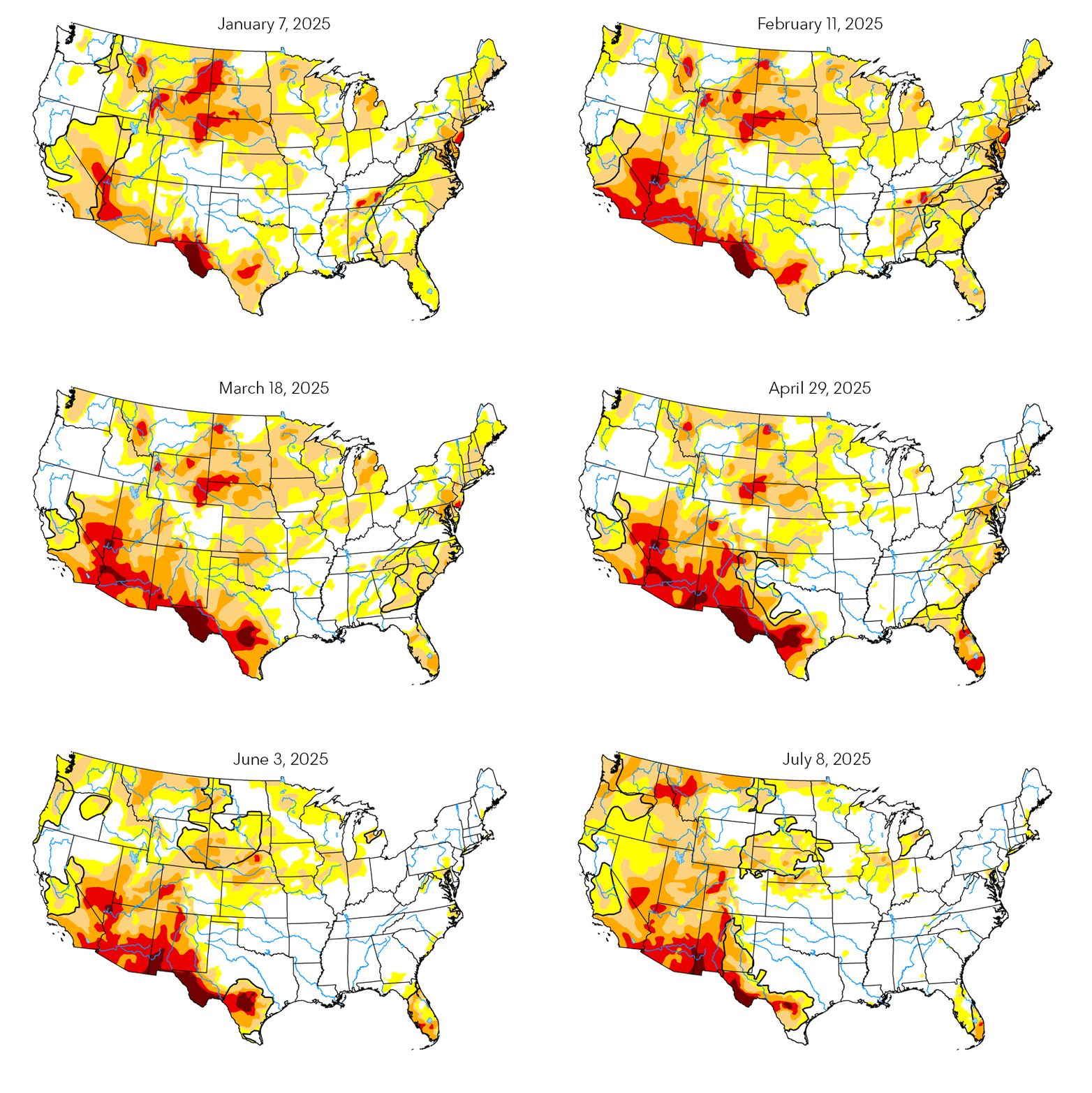
The May 20 Drought Monitor showed severe-to-extreme drought conditions covering most of the state, with sizable areas of exceptional drought emerging along coastal areas of Central California and inland locations in Southern California. Earlier this month, Gov. Gavin Newsom extended emergency drought orders to 41 counties across the state.

USDA reported that 85 percent of California cotton was planted by May 16, even with the five-year averages, but lagging slightly behind Arizona’s 87 percent progress. Rice planting had progressed to 80 percent complete by that date, well ahead of the 56 percent five-year average.

Sources continued to report reductions in fertilizer application volumes on almond and walnut crops due to low crop prices. “No surprise that we are seeing more restraint in fertilizer spending for almonds,” said one source. “Walnuts have been running with unsustainable pricing for a few years now. On both crops, the best producers are sticking to their overall plans but definitely trimming wherever they can.”

Pacific Northwest:

The week began with temperatures reaching the 80s from coastal areas of Oregon and Washington to eastern Montana. By the end of the week, however, a cold front brought rain and much cooler weather to much of the region, with highs in the 50s and snow flurries reported across western Montana.

Forecasts warned of potentially heavy snow in parts of northwestern Montana by May 21, with up to a foot of accumulation expected in some locations over the weekend. The moisture is needed, with vast areas of the region experiencing severe drought conditions in mid-May. The May 20 Drought Monitor also showed areas of extreme drought across eastern Montana and central Oregon.

Growers in Idaho and Washington had 98-99 percent of the spring wheat and barley planted by May 16, with both tracking ahead of their five-year averages. Planting progress in Montana was lagging at 71 percent complete, however.

Western Canada:

Weather extremes were reported across Western Canada during the week, with record high temperatures posted in parts of southern Manitoba on March 17 followed by snow and freezing rain from southern Alberta to northern Manitoba on March 19.

Highs in the low-30s C were reported in several southern Manitoba locations as the week began, prompting a special weather statement from Environment Canada warning of excessive heat. By midweek, however, winter storm warnings were in place for much of northern Manitoba, with temperatures falling to -6 C in Churchill.

Winter weather conditions were also reported in southern Saskatchewan on March 19, with 15-20 cm of snow expected in some southwestern areas of the province late in the week. The cold blast followed a round of high heat warnings for southern Saskatchewan on March 17.

Alberta and British Columbia were also experiencing wild weather. Strong thunderstorms churned through eastern British Columbia early in the week, bringing hail, high winds, and lightning. Parts of southwestern Alberta were bracing for 15-30 cm of snow later in the week.

Planting progress was tracking ahead of normal in Alberta, with 31.5 percent of the province’s major crops already seeded by May 11. Spring planting across Manitoba was 76 percent complete by May 18, while Saskatchewan growers had 74 percent of the spring crops planted by May 20, well ahead of the 48 percent five-year average.

“We’re still in the heat of the battle, but I’d say that by the weekend we will by 70-90 percent done with planting across the Western Canada region,” said one contact. Another source said he expects more summer fill programs to be announced over the next several weeks.

Transportation

U.S. Gulf:

High water was reported shutting the Port Allen Route’s Bayou Sorrel Lock through the early week, forcing detours through Algiers Lock. Transit was noted resuming on May 17. Residual delays from the shutdown were quoted up to 44 hours on May 17-19.

Port Allen Lock was scheduled to end a round of guidewall repairs on May 17. The damaged guidewall was noted limiting unassisted westbound travel to a single barge, while vessels with two or more barges in tow were required to utilize an assist vessel. Eastbound tows longer than 650 feet were required to use an assist boat. Intermittent four-hour shutdowns were reported from 6:30 a.m. to 7:00 p.m. daily while work was underway.

Restrictions persisted on Gulf operations above New Orleans thanks to elevated water levels, sources said, reducing maximum tow lengths by 5-10 barges.

Overnight movements through bridges in the Baton Rouge area were considered on a case-by-case basis only, sources said. Water levels at Baton Rouge were reported above the 30-foot action stage at 32.9 feet on May 18. The gauge was forecast to fall below action stage on May 23. A May 18 Flood Warning for the Mississippi River at Baton Rouge, West Feliciana, and Pointe Coupee was slated to expire on May 21.

Harvey Lock was slated to return to normal operation on May 22, as repairs to the nearby 4th Street Bridge were projected to wrap up on May 21. Tows have been routed through Algiers Lock while the project is underway, triggering delays in a 3-4 day range. A total of 78 vessels were reported in the locking queue on May 18.

The delays at Algiers were compounded by restrictions on unassisted lockages through the site, limited to four standard barges or two 30,000 mt tankers. Larger tows were reportedly possible when accompanied by an assist vessel.

Movements through Bayou Chene were unavailable between 7:00 p.m. and 7:00 a.m. daily, due to nighttime shutdowns for construction and dive activities. In addition, sources reported an assist vessel requirement on transits through the waterway.

Colorado River Lock delays were counted up to 16 hours for the week. Sources put Brazos Lock waits at 4-7 hours.

Mississippi River:

Transit through the I-40 Bridge, located at Miles 736-737 on the lower Mississippi River, resumed on May 14 after a failed May 12 structural inspection forced a complete navigation shutdown. A large crack discovered in a support beam will require at least 6-8 weeks to repair, although engineers were reported to green-light river traffic beneath the bridge while repairs are underway.

Sources reported an early-week closure through the upper river’s Smith’s Bay, located at Mile 530. Severe shoaling reported in the area prompted a round of dredging beginning on May 12, precipitating the stoppage.

Repairs underway at the Burlington Railroad Bridge, located near the upper river’s Mile 410, were noted to require advance notice of at least one hour on travel through the lock. The restrictions, in place daily between 7:30 a.m. and 4:30 p.m., were expected to continue into second-half June.

Elevated water levels continued to slow travel below Cairo, reducing maximum cargoes by 5-10 barges from their typical 25-barge slates. Sources noted ongoing restrictions on overnight travel through bridges in the Vicksburg area, although navigation requests were considered on a case-by-case basis.

The river gauge at Vicksburg returned an action-stage 35.7-foot reading on May 19. Levels were projected to move below the 35-foot action stage on May 21-22, an important step toward lifting restrictions on the lower river.

Rock-laying operations at Randolph Bluff, located at the lower river’s Mile 770, inhibited travel daily between 6:00 a.m. and 6:00 p.m. Requests for both northbound and southbound transits during daytime hours were considered on a case-by-case basis, sources indicated, although delays remained in a 6-12 hour range. The project was set to wrap up on May 31.

The Corps remains on track for a July shutdown of Lock 2 for miter gate repairs, sources noted. The project is expected to shut daylight-hour travel for 4-12 hour blocks. Guidewall repairs are projected to halt Lock 25 to daytime travel in July and August.

Lock 10 waits were reported up to five hours, while six-hour delays were noted through Lock 21. Waits were posted up to 11 hours through Lock 25, while 3-6 hour crossings were heard through Lock 27.

Illinois River:

Sources reported lowered wickets at Peoria Lock and LaGrange Lock due to elevated river levels, prompting lockless navigation through the area.

Ohio River: Main chamber repairs were noted kicking off May 17 at Meldahl Lock. Previously set to begin April 12, transit through the main chamber is expected to be completely unavailable, prompting detours through the site’s 600-foot auxiliary chamber through June 29. Delays for the week were quoted in a general 5-18 hour range. Sources warned of potential total-lock shutdowns interspersed throughout the project.

Structural cracks in the Markland Lock auxiliary chamber miter gate have reportedly kept that unit closed to navigation since early 2020. The chamber is scheduled to remain shut through Oct. 29, although the main chamber is expected to stay open to traffic for the duration of the closure.

The New Cumberland Lock secondary chamber was reported closed through June 10 for repairs and maintenance.

Primary chamber repairs and maintenance are set to begin June 21 at Cannelton Lock, likely prompting substantial delays through Nov. 19, sources indicated. Traffic is set to run through the site’s smaller auxiliary chamber while work is underway.

The Tennessee River’s Wilson Lock returned from main chamber repairs on May 14, sources noted. Vessels had been consigned to navigation through the secondary chamber since May 4, causing extensive, multiday delays.

Chickamauga Lock was noted shut to navigation on May 3-24 due to an electrical system overhaul. Kentucky Lock wait times were reported in a 12-18 hour range, with intermittent delays spiking as high as 36 hours.

Repairs to the bio-acoustic fish fence (BAFF) at the Cumberland River’s Cheatham Lock were set to fully halt traffic on May 17-27; June 1-10; June 14-24, June 28-July 1; and July 12-22.

Arkansas River:

David D. Terry Lock is scheduled to shut for a dewatering and repair operation Aug. 27 through Sept. 9, effecting a total river shutdown at the site. Intermittent delays were anticipated on Aug. 16-26, ahead of the full shutdown.

CHS Expands Louisiana Grain Export Terminal

CHS Inc., St. Paul, Minn., reported on May 12 that it plans a significant renovation and expansion project at its Myrtle Grove, La., grain export terminal. The $73 million investment focuses on storage and handling upgrades, which will grow market access for farmer-owners and help move 30 percent more bushels of grain annually through the terminal to global customers.

The CHS Myrtle Grove terminal handles wheat, soybeans, corn, rice, DDGS (distillers dried grains with solubles), and specialty grains for export to customers in Asia Pacific and Latin American countries. Located 25 miles south of New Orleans, it is the first terminal on the Mississippi River.

The terminal expansion project will add six shipping bins providing 580,000 bushels of storage, bringing total Myrtle Grove shipping bin storage capacity to 850,000 bushels. Other upgrades include a new bulk weighing and grading system, a new dock and barge unloading system, and independent conveyance for vessel loading that will allow two commodities to be loaded at the same time.

“Construction is expected to begin in August, during low river conditions,” said Kevin Hall, CHS Vice President, Supply Chain and Continuous Improvement. “Given the terminal’s unique location, significant environmental, engineering, and construction elements were built into every part of our plan.” Completion is expected by summer 2023.

CSX to Acquire Quality Carriers

CSX Corp., Jacksonville, said on May 12 that it has signed a definitive agreement to acquire Quality Carriers Inc., the largest provider of bulk liquid chemicals truck transportation in North America, from privately-held global logistics and transportation company Quality Distribution Inc., Tampa. Terms of the transaction were not disclosed.

CSX said Quality Carriers has been a leader in in bulk chemicals transportation since 1913 and operates the most extensive bulk tank trucking fleet in North America, with around 2,500 drivers. Through a network of over 100 company-owned and affiliate terminals and facilities in key locations throughout the U.S., Canada, and Mexico, Quality Carriers provides transportation services to many of the leading chemical producers and shippers in North America. CSX said the transaction will create a unique multimodal chemicals transportation solution that will expand the reach of both CSX and Quality Carriers.

Quality Carriers’ management team, led by President Randy Strutz, will continue to lead the business as part of CSX.

The transaction is expected to close in the third quarter of 2021, subject to regulatory review and certain customary closing conditions.

Agrilead Patents Pizazz®

Agrilead Inc., Russell, Kan., said on May 6 it has been awarded U.S. Patent No. 10,986,769 relating to its Pizazz® Dry Seed Finisher, which was first commercialized for soybean seed treatment application in 2018. It said the product, when applied as a powder following liquid seed treatments, improves seed handling with less bridging, better seed flow through planting systems, and enhanced seed appearance.

The company said the patent is for discovery of a product with less fugitive dust during treatment application, along with better seed coverage and treated seed performance, compared to first-generation dry products.

Pizazz® and the patented technology are owned by Agrilead and exclusively marketed by Kalo Inc., Overland Park, Kan., as a result of an industry alliance formed between the companies in 2015.

“Pizazz® has been successfully used upon millions of soybean and cotton acres; with increasing demand for more product applied to the same small seeds, we see dry seed finishers as important tools for achieving higher levels of seed care performance,” said Kalo President Chuck Champion.

The parties said the technology represents the cornerstone upon which a broad portfolio of innovative dry seed finisher products will be built and introduced; the next innovation is expected in fourth-quarter 2021.

Bion Applies for OMRI Listing for Solid Ammonium Bicarbonate Product

Bion Environmental Technologies Inc., New York City, a developer of advanced livestock waste treatment and resource recovery technology, announced on May 7 that it has submitted a new application to the Organic Materials Review Institute (OMRI) for the listing of its crystallized ammonium bicarbonate/ammonium carbonate recovered in its third-generation (3G) waste treatment platform.

Bion’s initial OMRI application, a liquid ammonium bicarbonate solution, was approved for OMRI listing in May 2020 (GM May 15, 2020).

Craig Scott, Bion’s Director of Communications, noted, “Bion was notified by OMRI last week that several application restrictions placed on the initial product listing have been removed following a review and clarification of our original application. This will provide end users with more opportunity and flexibility for field applications. Bion anticipates future products listed with OMRI will no longer include manure-related application restrictions.”

AD Nitrogen, Bion’s new solid crystalline product that is the subject of the current OMRI application, is a concentrated and dewatered form of the previously approved liquid product. The company said it has several advantages over a liquid nitrogen product: less weight and volume than a liquid product; easier storage and handling; water soluble and can be easily diluted to its ultimate application rate; and more versatility to both liquid and solid blenders.

Citing OMRI’s website, Bion said OMRI is busier this year than last year, and as a result the new listing may take longer than the original listing.

IFFCO Warns About Fertilizer Frenchie

Indian Farmers Fertiliser Cooperative Ltd. (IFFCO) has issued a statement about a fake firm named Fertilizer Frenchie that it said is offering dealerships and franchises in IFFCO’s name, according to the Press Trust of India (PTI).

IFFCO advised the public not to fall prey to misleading advertisements appearing on the internet and social media platforms. IFFCO said it is taking legal action against the entities.

Gensource Solidifies Offtake Agreement with Helm, Updates on Tugaske Project

Junior producer Gensource Potash Corp., Saskatoon, said on May 12 that on May 6 it executed a definitive offtake agreement with Helm Ag, Hamburg, Germany. The company had previously announced that Helm – through its U.S. subsidiary, Helm Fertilizer Co., Tampa – had inked a ten-year renewable offtake deal for 100 percent, or 250,000 mt/y, of the Tugaske Project’s production (GM Jan. 31, 2020).

Helm will market that product to its customers in the U.S. in an open-book manner, providing the direct link Gensource seeks between a potash producing facility in Saskatchewan and a clearly identified market.

The project is planned to be executed through a special purpose vehicle (SPV) that will construct, own, and operate the project. Gensource has previously disclosed that Helm plans to make an equity investment in that SPV alongside Gensource at financial close.

The capital structure of the SPV is being determined currently. The company said the terms of the shareholder agreement between Helm and Gensource with regards to their ownership of the SPV has largely been agreed upon, but the final agreement has not yet been executed.

As previously reported, KfW IPEX-Bank and Societe Generale SA have been appointed as joint lead arrangers for the proposed debt facility. The process toward debt commitment involves using the German export credit agency to provide credit insurance to the banks.

The final debt package will not be binding until the project reaches financial close, at which time the company anticipates that the definitive debt facility agreement will be executed with the banks.

In the meantime, Gensource reported that the project has progressed past the feasibility study level, having completed a FEED (Front End Engineering and Design) study. The updated NI 43-101 Technical Report – disclosed on March 22, 2021, and filed on SEDAR – is based on the FEED study, which includes significant detailed procurement work with the company’s selected process and equipment vendors.

The project is permitted under the Saskatchewan Environmental Assessment process and does not require an Environmental Impact Study. It has also been issued a Development Permit through the Rural Municipality of Huron, where the project is located.

Further licensing is required as detailed engineering proceeds and construction starts, under the Saskatchewan Environmental Protection standards, as well as building code requirements. Surface land for the process plant is under Gensource control, and all well pad leases and pipeline rights of way have been obtained. No further land purchases or agreements are required for the project.