

Southeast:
SOP remained at $770/st FOB in the Southeast for ag grade granular tons, with turf grade reported at the $820/st FOB level in Florida.
Southeast:
SOP remained at $770/st FOB in the Southeast for ag grade granular tons, with turf grade reported at the $820/st FOB level in Florida.
Southern Plains:
Following the company’s winter fill pricing offers, Intrepid’s postings for Trio FOB Carlsbad, N.M., included $380/st for standard, $415/st for granular, $425/st for premium, $430/st for OMRI standard and fine standard, and $465/st for OMRI granular.
Southeast:
The SOP Magnesia market was pegged at the $460/st FOB level in the Carolinas for granular tons in late April, with availability described as low.
Fertilizantes Heringer SA, Viana, Brazil, announced that it has it has received the resignation of Bruno Pessoa Serapiao, as both Vice Chairman of the Board as well as CEO. Elena Kholmanskikh has also resigned from the Board.
The Board has decided to appoint Julio Enrique Varela Gubitosi as acting CEO. He is the current Commercial, Financial, and Investor Relations Director of the company and would take on the added CEO responsibility.
Lieven Cooreman has resigned from the Board of Directors and his position as Chairman. He resigned as CEO and Vice Chairman earlier this year. As his replacement on the Board and as Chairman, the Board proposed Donal Lambert. He currently serves as CEO of North and South America for the EuroChem Group. He joined EuroChem in 2017 as CEO of the North America Commercial Business. He earlier worked for Koch Industries.
The Board is proposing Dmitry Boldyrev and Gustavo Bastide Horbach as new Board members, with Boldyrev as Vice Chair. Boldyrev studied Industrial Engineering at the Economic University of St. Petersburg and worked at EuroChem’s Kingisepp fertilizer plant. He has since accumulated over 20 years of Commercial Operations experience with EuroChem, currently holding the position of Global Head of Sales and Trading for EuroChem Group.
Horbach is a civil engineer and graduated from the PUC-RS School of Engineering with an MBA and Academic MBA from the Federal University of Rio Grande do Sul. He also has postgraduate degrees in negotiation, mergers and acquisitions, and management. The company said that in his 25-year career in the areas of large projects and capital-intensive industrial operations, he has worked for national and multinational companies such as CBi, SCGas, Copesul, Braskem, Yara International, and Mubadala/Trafigura.
Eastern Cornbelt:
Cool, wet weather slowed the fieldwork pace in the Eastern Cornbelt in late April, with frost warnings issued for parts of central and northern Illinois at midweek.
Similar conditions were reported in Indiana and Ohio during the week, with highs struggling to reach the 60s and lows dipping to freezing at some locations. An increased chance of rain was in the weekend forecast for much of Indiana and northern Ohio, with cooler-than-normal weather expected to persist into early May.
A hectic planting pace in mid-April pushed progress ahead of the five-year average for both corn and soybeans in the region. Corn planting as of April 23 was 18% complete in Illinois, 9% in Indiana, and 6% in Ohio, with soybean planting estimated at 15% complete in Illinois, 8% in Indiana, and 6% in Ohio. Ohio growers also had 61% of the oats planted by April 23, well ahead of the 37% five-year average.
Western Cornbelt:
While frost advisories and warnings were in effect for parts of central and northern Iowa at midweek, warmer temperatures and an increased chance of rain were in the forecast for the balance of the week and into the weekend.
Those factors were contributing to major flooding along portions of the Mississippi River in late April. River levels at Davenport, Iowa, rose to 19 feet on April 27, one foot above major flood stage, with levels predicted to reach 21 feet by April 30, nearing the record high of 22.7 feet recorded in 2019.
Highs reached the upper-60s across Nebraska at midweek, but a cold front was expected to bring increased showers and a chance of frost to some parts of the state later in the week. Spotty rains were also reported across Missouri during the week.

Corn planting as of April 24 had progressed to 10% complete in Iowa and Nebraska and 58% in Missouri, with Missouri tracking well ahead of its 18% five-year average. Soybean planting was also ahead of schedule at 16% complete in Missouri and 4-5% in Nebraska and Iowa, while Missouri’s rice and cotton planting had progressed to 63% and 1%, respectively.
Southern Plains:
Widespread rain and cooler temperatures settled over much of Kansas and Oklahoma during the week, slowing fieldwork but raising hopes for some drought relief across the region. Stronger storms were taking aim at Oklahoma by the weekend, with forecasts warning of potentially severe weather.
Severe weather was also tracking through parts of north-central Texas late in the week, with reports on April 26-27 of large hail, damaging winds, and tornadoes. Similar conditions were reported in New Mexico, where midweek storms brought strong winds and rain to parts of the state, along with snow at higher elevations.
In most cases, planting progress was tracking ahead of the average pace in the region. Corn planting as of April 23 was 72% complete in Texas, 24% in Kansas, and 2% in Colorado, with soybean planting estimated at 4% complete in Kansas. The Texas cotton crop was 18% planted by that date, while sorghum planting had progressed to 63% in Texas and 15% in Oklahoma.
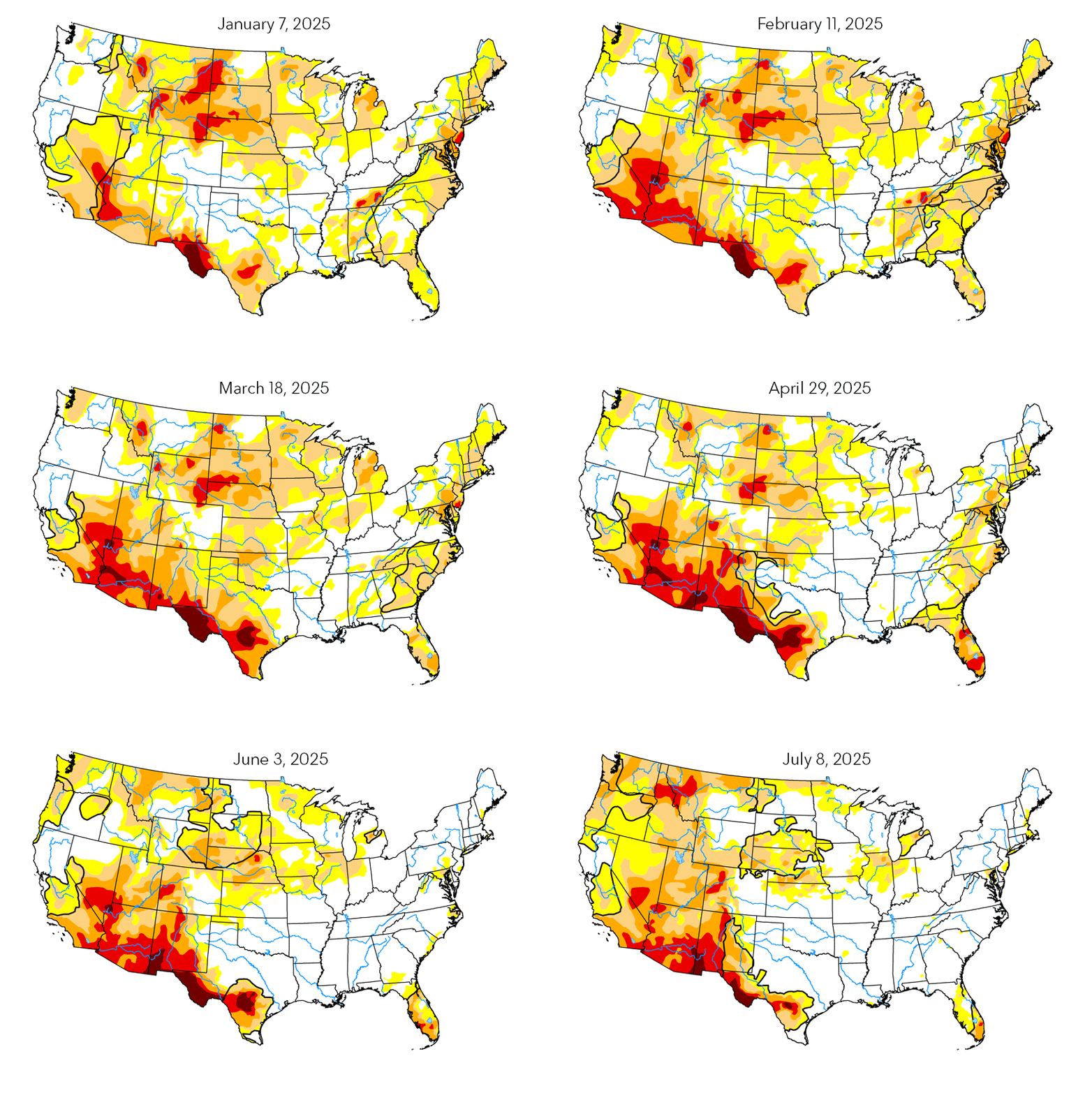
With severe-to-exceptional drought continuing to cover a wide swath of the Southern Plains, winter wheat conditions were showing the effects. Wheat in the good or excellent categories totaled just 23% of the acreage in Colorado, 14% in Kansas and Texas, and 6% in Oklahoma, with poor or very poor ratings assigned to 39% of the crop in Colorado, 55% in Texas, and 62-63% in Kansas and Oklahoma.
“Wheat is headed in Oklahoma and southern Kansas,” commented one source. “This is early and indicates the wheat is under a lot of stress. Lots of acres out west have been zeroed out.”
South Central:
Potentially strong thunderstorms were in the forecast for Arkansas and Tennessee as the week progressed, with widespread rain reported in those two states and Kentucky at midweek. Forecasts warned of damaging winds and hail in the Memphis, Tenn., area on April 27.
Severe weather was also expected to track through southern Louisiana late in the week, with hail and an inch or more of rain possible. Strong storms brought hail and damaging winds to parts of Mississippi on April 27 as well.
Planting progress was ahead of average for most crops in the region, thanks to generally favorable weather and soil conditions in April. Corn planting was 36% complete in Kentucky and 49% in Tennessee by April 23, with soybean planting estimated at 16% complete in Tennessee, 19% in Kentucky, 34% in Arkansas and Mississippi, and 41% in Louisiana.
Cotton planting was 5% complete in Arkansas and Louisiana by April 23, compared with 1-3% in Mississippi and Tennessee. Rice planting was well advanced in the region, with progress estimated at 39% in Mississippi, 51% in Arkansas, 74% in Texas, and 86% in Louisiana.
Southeast:
Rainy weather was reported in the Carolinas at midweek, with forecasts warning of severe thunderstorms, hail, and damaging winds later in the week. Forecasts also warned of back-to-back storms in Virginia on April 27-28 and into the weekend, with flooding possible in some areas.
Wet weather was also in the Alabama and Georgia forecasts as the week progressed, with southern portions of both states bracing for potentially severe storms on April 27. A deluge of rain and hail was reported across east-central Florida at midweek, with reports of quarter-sized hail in some locations.
North Carolina growers had 52% of the corn and 4% of the soybeans planted by April 23, while cotton planting had progressed to 1% in the Carolinas, 4% in Georgia, 6% in Alabama, and 20% in Virginia. Peanut planting as of April 24 was 19% complete in Florida, 4% in Alabama, and 2% in Georgia and the Carolinas.
“Some corn is planted, and some tobacco, but most is held up waiting on some dry days,” reported one North Carolina source at midweek.
US Gulf:
Falling water levels on the Lower Mississippi River were expected to allow for easing restrictions on travel above New Orleans. Towing lengths were previously cut by up to 25% from typical levels, triggering delivery delays as high as 48 hours.
Port Allen Lock was slated to shut to daytime navigation on April 27-28 for maintenance. Travel at Algiers Lock was unavailable Monday through Saturday, between 6:30 a.m. and 6:30 p.m., through May 4. Waits were reported up to 53 hours for the week, rising from 30 hours in the previous report.
Work at Colorado Lock was scheduled to conclude on April 28, ending a period of daytime shutdowns begun on Dec. 5, 2022. With travel reportedly unavailable daily from 7:00 a.m. to 7:00 p.m., most wait times tracked below the 40-hour mark. Intermittent travel outages noted at the Morgan City Railroad Bridge were expected continue through the end of June. The bridge is located at the Mile 121 in the West Canal.
Repairs to the Bayou Boeuf north chamber guidewall, kicked off on April 18, were expected to close the lock from 7:00 a.m. to 4:00 p.m., Monday through Friday, through May 19. Bayou Chene was suggested as an alternate route.
Port Allen Lock delays were reported up to 17 hours during the week, and wait times topped out at six hours at Bayou Sorrel Lock. Corps data put Industrial Lock waits up to 37 hours on April 24-25. Intermittent 5-19 hour delays were posted for vessels transiting Brazos Lock.
Mississippi River:
A bridge collision and sunken barge near Natchez was reported shutting Miles 350-363 of the lower river to navigation on April 24. Northbound movements resumed on April 25, sources said, while vessels pointed downriver were expected to restart navigation on April 26.
Falling water levels were likely to allow for reduced navigation restrictions below Cairo during the week. Tow lengths were previously slashed by 15-25%, adding an estimated 48 hours to delivery times. The river gauge at Vicksburg fell out of action stage on April 19, while the Baton Rouge gauge followed suit on April 23.
Floodwaters approached historic levels on the upper river, however, shutting numerous locks to navigation through at least early May. Locks 1-14 and Locks 16-17 were closed during the week, while Locks 15, 18, and 20-22 were expected to shut between April 27 and May 5. No outages were anticipated at Lock 19.
The river’s northernmost locks could start returning to service as early as May 4-5, forecasts indicated, while Lock 17 was unlikely to reopen before May 18. Tows were not expected to resume northbound departures from St. Louis until mid-May at the earliest.
The river gauge at St. Paul, reported at a major-flood 18.24 feet and rising on April 26, was projected to crest at 18.3 feet on April 26-28, while the Dubuque gauge, posted at a major-flood 22.3 feet on April 26, was forecast to top out at 23.2 feet on April 28-29.
A 23.2-foot crest at Dubuque, if achieved, would mark that gauge’s third-highest depth reading on record, following 25.69 feet recorded on April 26, 1965, and 23.91 feet notched on April 21, 2001.
Illinois River:
Intermittent transit shutdowns at Dresden Island Lock were scheduled to wrap up on April 28. Delays were noted up to seven hours during the week. A larger closure is expected at the site starting on June 1, sources said.
Wait times at both Marseilles Lock and Starved Rock Lock were posted up to 11 hours during the week. High water levels kept wickets in the lowered position at Peoria Lock and LaGrange Lock through the early week, facilitating lockless navigation through both sites. Peoria Lock delays were noted lifting to a 3-9 hour range on April 24-26, however.
The Illinois River is scheduled to shut to commercial navigation for approximately 120 days starting on June 1. Normal movements are projected to resume in late September or early October.
Ohio River:
Floating mooring system repairs underway at JT Meyers Lock are scheduled to run through Aug. 20, with intermittent main chamber shutdowns expected. The secondary chamber will go offline Aug. 21 through Sept. 10 for planned miter gate repairs, after which the main chamber will close once more from Sept. 11 to Nov. 17.
The primary chamber at Dashields Lock shut for maintenance on April 24, complicating travel between the Ohio River and the Allegheny and Monongahela Rivers. The project was extended through May 27, one week beyond the previously-reported May 20 end date.
The north chamber at McAlpine Lock will be closed to navigation May 15 through June 15 due to miter gate machinery repairs. Passage will be available through the south chamber. The land chamber at Smithland Lock is due to close Sept. 22 through Oct. 21 for miter gate machinery replacement.
On the Tennessee River, Wilson Lock delays were reported in a wide 4-24 hour range during the week.
Yara International ASA on April 28 reported a 64% fall in adjusted EBITDA to $487 million for the first quarter ended March 31, down from the previous year’s $1.35 billion, and missed the average analyst estimate of $838.4 million (Bloomberg Consensus).
Revenue was down 30% year-over-year, to $4.16 billion versus the year-ago 5.91 billion, also missing the average analyst estimate of $4.6 billion.
Net income attributable to shareholders of the parent company for the quarter was down 89% year-over-year, to $104 million ($0.41 per share) versus the year-earlier $944 million ($3.71 per share), once again missing the average analyst estimate of $449.3 million.
Adjusted net income was $101 million against the average analyst estimate of $455.5 million, with adjusted earnings per share of $0.40 versus the prior year’s $3.20 per share.
Yara said declining market prices led to lower deliveries and margins in the first quarter, which more than offset lower production costs, triggering inventory write-downs, impacting the results compared to a strong first quarter last year.
The company noted that earnings were impacted by an approximate $370 million negative volume effect and $190 million of inventory write-downs, more than offsetting lower natural gas costs.
Total deliveries fell by 21.5% to 6.57 million mt in the first quarter, down from the year-ago 8.37 million mt, while fertilizer deliveries fell 24% to 4.65 million mt, down from 6.12 million mt.
Total deliveries of fertilizers in Europe were 26% lower year-over-year to 1.67 million mt, down from the previous year’s 2.25 million mt, as customers postponed purchasing in a declining price environment and imports partly replaced curtailed capacity.
“A declining price environment towards the end of 2022 and through the first quarter made farmers and distributors delay purchases, leaving season-to-date European nitrogen industry deliveries an estimated 7% behind a year earlier,” Yara President and CEO Svein Tore Holsether said.
Americas deliveries fell 28%, to 2.0 million mt versus the prior year 2.8 million mt, driven by supply overhangs and customers delaying purchases in a declining price environment.
Deliveries in the Africa and Asia segment (which includes Oceania) were 9% lower year-over-year, down to 976,000 mt versus 1.08 million mt the previous year. Yara cited a planned maintenance stop in the Babrala plant in India, partially offset by higher premium product deliveries in China and Asia.
“However, we see a tighter nitrogen market into the second quarter, with strong European demand at new season nitrate prices and strong farmer affordability metrics indicating higher nitrogen application rates,” said Holsether.
Yara said its production curtailments in the first quarter amounted to 0.6 million mt of ammonia (about 44% of its European capacity) and 1.3 million mt of finished fertilizers (around 30% of its European capacity). As of the end of April 2023, it had curtailed an annual capacity of 2.8 million mt of ammonia (58% of its European capacity) and 3.9 million mt of finished products (23% of its European capacity).
It sees gas cost for the second quarter of the year an estimated $650 million lower than a year earlier, based on current forward markets for natural gas (April 19) and assuming stable gas purchase volumes.
Shares in Yara dropped as much as 6.8% to four-month lows of $418 following the release of the first-quarter results. As of 13.50 CET (GMT + 2 hours), the share price was up at $428.50.
Bloomberg cited Norne analyst Tomas Skeivys, commenting “the results are a clear realization that the ‘super-profit’ era witnessed over the last 12 months are at an end.”
DNB Markets analyst Niclas Gehin, as also cited by Bloomberg, noted the first-quarter EBITDA impact of low volumes and write-down.
“The miss of around $400 million includes negative volume effect, which was around $200 million more than what I had expected, along with a $190 million write-down,” said Gehin. He expects the consensus estimate for 2024-2025 EPS to be cut by 5% after the miss.
Yara Production and Deliveries
| ‘000 mt | 1Q-2023 | 1Q-2022 |
| Production1 | ||
| Ammonia | 1,380 | 1,723 |
| Finished fertilizer and industrial products (excluding bulk blends)1 | 4,043 | 4,863 |
| Yara Deliveries | ||
| Ammonia trade | 417 | 443 |
| Fertilizer | 4,653 | 6,123 |
| Industrial product | 1,499 | 1,801 |
| Total deliveries | 6,568 | 8,367 |
1 Including Yara share of production in equity-accounted investees, excluding Yara-produced blends
Yara Deliveries
| ‘000 mt | 1Q-2023 | 1Q-2022 |
| Crop Nutrition Deliveries | ||
| Urea | 1,049 | 1,379 |
| Nitrate | 966 | 1,361 |
| NPK | 1,754 | 2,081 |
| CN | 325 | 422 |
| UAN | 186 | 303 |
| DAP/MAP/SSP | 66 | 102 |
| MOP/SOP | 71 | 212 |
| Other products | 235 | 263 |
| Total Crop Nutrition Deliveries | 4,653 | 6,123 |
| Europe Deliveries | 1,670 | 2,249 |
| Americas Deliveries | 2,007 | 2,796 |
| North America | 731 | 905 |
| Brazil | 921 | 1,488 |
| Latin America excluding Brazil | 356 | 403 |
| Africa & Asia Deliveries1 | 976 | 1,078 |
| Asia | 718 | 870 |
| Africa | 258 | 208 |
| Industrial Solutions Deliveries | 1,499 | 1,801 |
1 The Africa and Asia business also includes Oceania
Uralchem-Uralkali on April 22 reported that a humanitarian shipment of 34,000 mt of fertilizers has been fully loaded onto a vessel in Riga, Latvia, and has started its journey to the Kenyan port of Mombasa, where it is due to arrive in late May.
The shipment is the second Uralchem-Uralkali fertilizer cargo to be released from a European Union (EU) port under the auspices of the UN World Food Programme (WFP), and donated free of charge to an African nation.
For this latest shipment – a cargo of potash, urea, and NPK fertilizers – Uralchem-Uralkali and the WFP reached an agreement with state-owned Kenya National Trading Corp. WFP is acting as service provider, chartering the vessel and providing other logistics support, according to a Tass report, citing a WFP spokesperson.
The first consignment consisted of 20,000 mt of NPK fertilizers, loaded in the Belgian port of Antwerp and officially handed over to Malawi in early March, having been shipped via Mozambique’s port of Beira for final onward transit by land (GM Feb. 3, p. 29; Nov. 11, 2022).
In its April 22 statement, Uralchem-Uralkali reiterated that it is committed to donating approximately 300,000 mt of mineral fertilizers stranded in EU ports to developing nations “to alleviate the unprecedented global food crisis and prevent significant crop loss in countries that face such risks.”
AdvanSix reported that Michael L. Marberry, the Chair of the Board of Directors, notified the company of his intention to retire from the Board, effective at the company’s annual meeting of stockholders to be held on June 15, 2023. AdvanSix said he indicated that his departure was not the result of any disagreement with management or the Board.
Effective at the annual meeting, Todd Karran will succeed Marberry as the new Board Chair, and the size of the Board will be reduced from nine to eight directors.
Gensource Potash Corp. on April 14 announced that Mike Mueller has resigned his position as a Director of the company, effective April 14. He joined the company as a Director in July 2018, and most recently served as Chair of the Audit Committee.
“It has been an honor to serve on the Gensource Board of Directors,” said Mueller. “While I am stepping down from this role, I look forward to following the company’s future progress, especially as it secures the financing necessary to put into construction the Tugaske Project, the company’s first production module of what could become several on its Vanguard Area. Gensource’s modular technology represents a modern and more sustainable way to produce and sell this critical mineral, and I unreservedly wish the company full success.”
Gensource said this change comes as the company prepares for the next phase of development, which includes the drilling of its first production cavern, followed by construction, ramp-up, and operation of the first module at the Tugaske. Associated with the financing of the project, the company expects that further Board changes will occur as the company moves towards development of the project. Gensource said it is engaged in undertaking additional steps to strengthen its overall team and value proposition in anticipation of numerous potential catalysts.