

California:
SOP Magnesia pricing was steady at $350-$370/st FOB in California.
Pacific Northwest:
TheSOP Magnesia market remained at $360-$380/st FOB in the Pacific Northwest, depending on grade and location.
California:
SOP Magnesia pricing was steady at $350-$370/st FOB in California.
Pacific Northwest:
TheSOP Magnesia market remained at $360-$380/st FOB in the Pacific Northwest, depending on grade and location.
California:
The crystalline potassium nitrate market in California was unchanged at $830/st FOB Stockton for bulk tons and $920/st FOB for 50-pound bags.
Eastern Cornbelt:
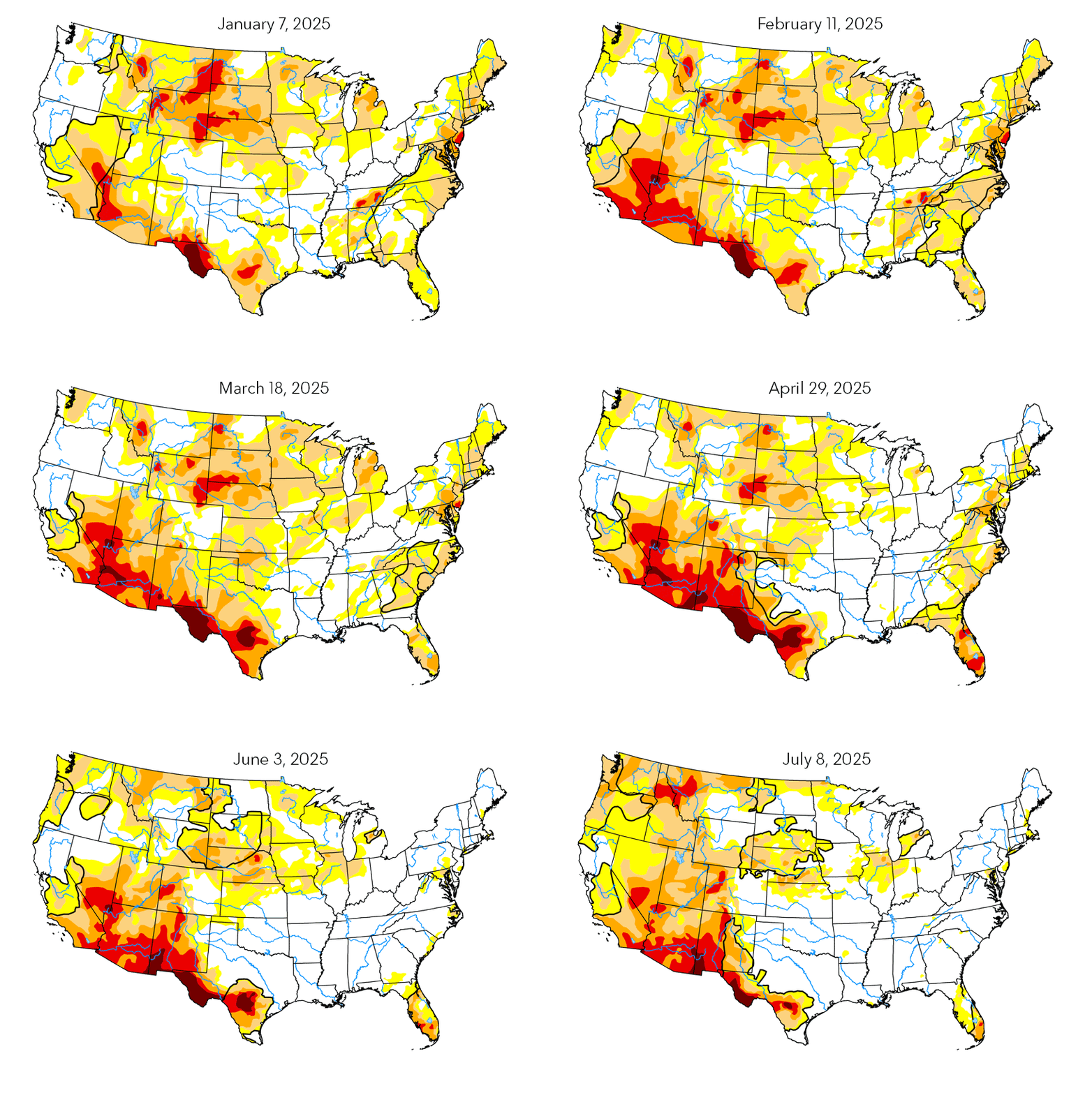
The week began with a mix of rain and snow across northern Ohio, with highs climbing into the 30s, a welcome change from the previous week’s bitter cold. Wind chills on Feb. 15-16 fell to the negative double-digits in the region, with heavy snow reported across central Indiana and south-central Ohio.
Conditions improved as the week progressed. By Feb. 24-25, highs in the 50s were common across southern Indiana and Illinois, with northern areas of both states enjoying 40-degree temperatures. Sources were once again talking about a potentially early start to spring fieldwork.
Western Cornbelt:
Temperatures across Iowa and Nebraska ranged from lows in the 20s to highs in the upper-30s at midweek, a vast improvement from the previous week’s subzero chills. There were growing concerns about potentially severe spring flooding on the Missouri River due to thawing ice and the formation of ice jams, however.

California:
Gusty winds and unseasonably warm temperatures were reported across Northern California during the week. The weather marked a shift from a series of systems earlier in February that dropped heavy precipitation across the region.
Strong Santa Ana winds also hit Southern California during the week, with 60-80 mph gusts causing power outages in some locations. Minimal precipitation was expected for the coming weekend, highlighting concerns about wildfires. Areas of severe-to-extreme drought persisted across Northern California in late February, with patches of extreme-to-exceptional drought showing up in inland areas of Southern California.
Pacific Northwest:
Heavy snowfall at mid-month caused widespread power outages in Oregon and Washington and blanketed parts of western Washington in up to 10 inches of accumulation. The same powerful system also sent temperatures in Montana plunging to the negative double digits, but more seasonal weather was reported across the region during the last full week of February.
Another Pacific storm system brought rain and gusty winds to coastal areas of Oregon and Washington late in the week, with forecasts warning of up to three feet of snow in the Oregon Cascades over the coming weekend. Steady rainfall was reported in Portland on Feb. 25, with a high wind advisory warning of 45-55 mph gusts across central, north-central, and northeastern Oregon.
Western Canada:
A Pacific system brought wind, rain, and snow to much of British Columbia early in the week. Scattered snow flurries were also reported across Saskatchewan at midweek, with temperatures hovering right at freezing. Another system battered parts of Alberta with strong winds on Feb. 25, with gusts up to 60 km/h reported.
Lower-than-normal snowfall so far this winter has pushed parts of southwestern Manitoba and southeastern Saskatchewan into moderate-to-severe drought conditions.
Although precipitation has been in short supply, cold temperatures certainly have not. Mid-February wind chills plunged to a negative 40-50 C in northern Manitoba. Extreme cold at mid-month resulted in 17 records being set across Saskatchewan on Feb. 13, with Alberta posting 26 cold temperature records over the Valentine’s weekend and another 15 records on Feb. 15.
U.S. Gulf:

Sources described Gulf travel as much improved for the week following the system-wide shutdowns noted in the prior report. Late-night and early-morning fog delays were reported slowing movements by 4-8 hours at a stretch throughout the week, while storms on Feb. 25 brought the potential for wind delays through the weekend, sources said.
Towing restrictions continued to be reported at Port Allen due to guidewall damage sustained in a January barge collision. Vessels traveling to the west were permitted to lock unassisted on lockages of one barge or fewer, while westbound tows with more than one barge required an assist vessel. Eastbound tows longer than 650 feet were required to use industry assistance. Delays at the site were reported in a wide 7-32 hour range for the week, softening from 61 hours previously.
Algiers Lock was closed from 7:00 a.m. to 6:00 p.m. on Feb. 22 for dolphin repair. Towing restrictions persisted at the site on all lockages, limiting unassisted 60-foot-wide tows to 600 feet of length. Tows below 60 feet in width were allowed to pass without assistance on lengths up to 700 feet, sources said.
The limits at Algiers Lock effectively set maximum capacity at four standard barges or two 30,000 mt tankers, although longer tows were reportedly possible with an assist boat. Wait times were clocked below six hours for most of the week, but peaked above 25 hours on Feb. 22-23 due to the repair project.
Rigolets Bridge, located in the East Canal, is shut for repairs through March 12. A trio of daily openings were scheduled for 5:30 a.m., 1:30 p.m., and 9:30 p.m. to allow passage to and from the Pearl River. Sources reported steady delays at the site.
Industrial Lock delays were generally reported in the 4-13 hour range, although intermittent waits were noted up to 15.5 hours. Sporadic 6-8 hour wait times were noted through the Colorado Floodgates, while boats passing Brazos Lock noted passages peaking above seven hours on Feb. 22.
Mississippi River:
Ice continued to trigger restrictions on tows between St. Louis and Cairo, Ill., cutting northbound strings from a combined 15 loaded barges and nine empty barges to 15 loaded barges and three empties. All-empty tows were slashed by 20 percent, to 24 empty barges from 30. Tows traveling southbound were limited to 60 percent of normal capacity, reduced from the typical 25 loaded barges to 15, sources said.
Forecasts predicted rising water levels at St. Louis. Travel had been slowed in recent weeks due to levels threatening to dip below the 0.0-foot mark. The St. Louis river gauge was expected to rise to 7.7 feet on Feb. 27 after dropping to nearly (-)1.0 feet on Feb. 21-23. Levels registered at 0.03 feet on Feb. 24.
Dike work at the lower river’s Mile 770 is slated to begin in late February. Work at the site is projected to block southbound travel daily from 7:00 a.m. to 6:00 p.m. once underway, and continue for roughly one month.
Repairs and annual maintenance to the Lock 27 main chamber, underway since Feb. 1, concluded during the week. Lingering delays continued to be heard up to 19 hours on Feb. 24, declining from the 50-hour wait times reported previously. Persistent ice accumulation was noted interfering with miter gate operation at the site, necessitating 105-foot width restrictions on all lockages.
Lock 21 was shuttered for repairs on Feb. 22-26. An additional repair shutdown is scheduled for March 8 through March 12. Lock 22 was closed on Feb. 16-26 for repairs, sources said. Mel Price Lock delays were quoted up to seven hours for the week.
Upper Mississippi River locks are shut for the winter navigation season. Reopening for spring is tentatively set to commence on March 15 with Locks 13-19, followed by Lock 25 as early as March 31.
Illinois River:
Navigation on the Illinois Waterway remained mostly halted for the week due to ongoing ice conditions. Traffic has been largely paused since Feb. 8, while the river’s remaining navigation has been limited to 89-foot widths since Feb. 11 through Marseilles Lock, Peoria Lock, Starved Rock Lock, and LaGrange Lock. Sources previously expected a tentative resumption of activity on the river starting around Feb. 24.
Utica Bridge demolition previously set for Feb. 17 remained on hold for the week due to ongoing cold weather. Travel will be unavailable through the area for at least 24 hours during the event.
Wickets were reported raised at Peoria Lock and LaGrange Lock for the week, slowing travel through both sites. Most vessels passed Peoria Lock in under five hours, while movements through LaGrange were delayed up to 13 hours.
Ohio River:
The Meldahl Lock main chamber is scheduled to shut from April 12 to June 11 for miter gate machinery repair, forcing traffic through the 600-foot secondary chamber. Delays are anticipated while the project is underway.
The auxiliary chamber at Markland Lock is scheduled to remain shut through Oct. 29 due to cracks in the miter gate. Transit has continued unabated through the primary chamber, with minimal delays reported.
A Smithland Lock secondary chamber project underway since Feb. 1 has one of the lock’s two auxiliary units offline through approximately March 1. The second auxiliary chamber at Smithland is slated to shut for 30 days starting around March 1, with work tentatively set to conclude on April 1.
The New Cumberland Lock auxiliary chamber is projected to shut from March 8 through June 10. Navigation will remain available through the main chamber while the project is underway.
The Greenup Lock primary chamber closed for repairs on Feb. 19 and is set to remain offline through March 5, forcing traffic through the secondary chamber. Following the main chamber project, repairs to the auxiliary chamber are scheduled to run from March 11 through April 11.
Navigation through the Cannelton Lock primary chamber will be unavailable starting on June 21. Sources are expecting significant backups through the duration of the project, scheduled through Nov. 21.
Rising water levels at Olmsted Lock prompted lowered wickets during the week, allowing vessels to transit without locking via the navigational pass. Sources reported delays at Tennessee River’s Kentucky Lock in a 6-20 hour range.
The Cumberland River’s Cheatham Lock will close to navigation from April 12 through June 21, sources noted. A total of four three-day openings are scheduled during the shutdown to pass any assembled traffic, sources said. Barkley Lock is scheduled to close to daylight-hour movements from March 22 through April 2 for repairs to the carp-deterring bio-acoustic fish fence (BAFF) system.
CVR Partners LP, Sugar Land, Texas, reported an improved fourth-quarter, including an 84 percent uptick in ammonia sales volumes. However, prices were lower for both ammonia and UAN. The company still remained in the loss column, though the loss was smaller at $16.9 million ($1.53 per diluted share) on net sales of $90.3 million, compared to the year-ago $24.9 million ($2.20 per share) and $86.1 million, respectively. EBITDA moved up to $18.1 million from the year-ago $10.8 million. The company does not plan a cash distribution for the quarter.
“CVR Partners achieved solid fourth quarter and full-year 2020 results, led by record ammonia production for the year (852,000 st), with the Coffeyville and East Dubuque fertilizer plants posting a combined ammonia utilization rate of 95 percent,” said Mark Pytosh, CEO of CVR Partners’ general partner. “The record-breaking operating performance of our fertilizer facilities coupled with higher product sales volumes helped offset the lower product pricing that we saw throughout 2020.
“Farmer economics have continued to improve during the past several months, with corn and soybean prices increasing by approximately 75 percent since July 2020,” he added. “In addition, weather conditions were favorable for both the harvest and fall ammonia applications, resulting in strong demand. Looking to the spring, we currently are seeing strong customer demand for fertilizer application at prices that are significantly higher than last year.”
The company told analysts that it benefited from lower petroleum coke prices in the fourth quarter due in part to the product it buys from its sister company, Coffeyville Resources, being tied to UAN prices, which were lower.
CVR posted a full-year loss of $98.2 million ($8.77 per share) on sales of $350 million, up from 2019’s loss of $35 million ($3.09 per share) and $404.2 million, respectively. EBITDA was down at $41.4 million from 2019’s $107.5 million.
Full-year results were impacted by a $41 million impairment of assessment of goodwill regarding the Coffeyville, Kan., facility, which was taken in June. The company also had no turnarounds in 2020, but did have a 32-day turnaround at East Dubuque, Ill., in 2019 expensed at $9.8 million. Also in 2020, the company repurchased 623,177 shares of common units at a value of $7 million.
On Feb. 22, 2021, the Board of Directors authorized the company to repurchase an additional $10 million in common units.
| Sales (000 st) | 4Q-20 | 4Q-19 | 2020 | 2019 |
| Ammonia | 114 | 62 | 332 | 241 |
| UAN | 325 | 293 | 1,312 | 1,261 |
| Plant Gate Pricing ($/st) | 4Q-20 | 4Q-19 | 2020 | 2019 |
| Ammonia | 267 | 324 | 284 | 392 |
| UAN | 139 | 176 | 152 | 199 |
| Production (000 st) | 4Q-20 | 4Q-19 | 2020 | 2019 |
| Ammonia – gross | 220 | 180 | 852 | 766 |
| Ammonia – net | 75 | 55 | 303 | 223 |
| UAN | 335 | 286 | 1,303 | 1,255 |
| Feedstock | 4Q-20 | 4Q-19 | 2020 | 2019 |
| Petroleum Coke ($/st) | 30.65 | 39.90 | 35.25 | 37.47 |
| Natural Gas ($/mmBtu) | 2.77 | 2.87 | 2.31 | 2.88 |
Incitec Pivot Ltd. (IPL), Southbank, Victoria, said on Feb. 15 it would take a total incremental adverse impact of approximately US$26 million (A$35 million) on its FY2021 earnings before interest and tax as a result of the updated status of its major plant maintenance projects and business performance, compared to previous expectations.
The Australian group reported that for the Waggaman, La., ammonia plant alone the earnings impact of the turnaround extension and an additional plant outage that occurred prior to the turnaround are expected to be an incremental US$15 million, up from previous expectations (for a total earnings impact of US$40 million). The assessment is based on a plant nameplate capacity of 800,000 mt/y of ammonia, as well as year-to-date realized ammonia and gas prices. The capital cost of the turnaround has increased by US$10 million, the company said.
IPL said the discovery phase of the Waggaman plant turnaround has been completed, during which emerging works were identified. The emerging work has increased the length of the turnaround by approximately two weeks, with the company now expecting the plant to be back online by mid-March 2021.
The Waggaman plant produced 729,000 mt of ammonia in FY2020, 15 percent more than the year-earlier 634,400 mt (GM Nov. 13, 2020), with the group reporting that the plant operated at 91 percent of nameplate capacity in FY2020, compared with 79 percent in the prior year.
Regarding its other major plant maintenance turnarounds, IPL confirmed that the six-week turnaround of the St. Helens plant was successfully completed in November 2020, and as previously announced, the planned maintenance shutdowns of the Mt. Isa and Phosphate Hill, Queensland, plants were successfully completed in October 2020.
IPL said planning and preparation for the earlier announced major turnaround to start in May of the Moranbah, Queensland, ammonium nitrate plant remains on track. The group expects lower second-half FY2021 production at the plant due to the turnaround.
Providing an update on its business performance, IPL said the total earnings impact of recent outages at Dyno Nobel Americas Explosives’ ammonium nitrate (AN) plants in Louisiana, Mo., and Cheyenne, Wyo., is estimated to be approximately US$11 million, which will be included in IPL’s first-half FY2021 results. The Australian group said the two plants experienced the unplanned downtime as a result of rotating equipment failure and repair works at the Louisiana, Mo., plant, which are currently underway.
Excluding the impact of these outages, Dyno Nobel Americas Explosives business earnings for first-half FY2021 are expected to be in line with the prior corresponding period.
Meanwhile, for Dyno Nobel Asia Pacific Explosives, IPL said the business performance of the division is tracking to expectation, with lower metallurgical coal exports not materially impacting earnings to date. It confirmed that Indonesian demand recovery is slow as expected, with COVID-19 related mine closures ongoing. The division’s business earnings for first-half FY2021 are expected to be in line with the prior corresponding period.
At Fertilisers Asia Pacific, the company said favorable weather conditions and recently firming fertilizer prices are expected to drive higher earnings in FY2021, and that the typical second-half earnings skew is expected to be accentuated in FY2021 as the business realizes the benefits from higher fertilizer prices.
IPL reported the company’s ongoing response plan is on track to deliver expected cost savings of at least A$30 million in FY2021, as previously announced. The response plan was initiated in FY2020 to respond to the impacts of COVID-19 and low commodity prices, and designed to deliver A$60 million cost savings over the years. The plan delivered A$20 million of cost savings in FY2020. The group will release its first-half FY2021 results on May 17.
K+S Group, Kassel, said its financial statements as of Dec. 31, 2019, together with the related interim group management report and the abbreviated financial statements as of June 30, 2020, are to be examined at the occasion-related request of the German Federal Financial Supervisory Authority (BaFin)
BaFin informed the German Audit Office for Accounting (DPR) about the reason for the examination, saying that assets reported in K+S’ consolidated financial statements as of December 31, 2019, and the abbreviated financial statements as of June 30, 2020 – in particular non-current assets – may be overstated.
The probe relates to a K+S statement on Nov. 4, 2020, that it had adjusted its long-term assumptions for the potash business (GM Nov. 6 & Nov. 13, 2020).
Essentially, this related to assumptions regarding that long-term potash price development are now lower. Furthermore, an upward adjustment of the weighted average cost of capital (WACC) became mandatory, K+S reminded in its Feb. 17 statement.
“Overall, this resulted in a non-cash, one-off impairment loss of around €2 billion on assets in the Europe+ operating unit,” the company reminded. The Europe+ operating unit comprises Potash and Magnesium Products (including Bethune) and Salt Europe.
The impairment loss was recognized in the financial statements for the third quarter of 2020 and had a correspondingly negative impact on adjusted consolidated earnings after tax and ROCE, but did not result in a cash outflow, said K+S.
At the occasion-related request of BaFin, the DPR has announced that it will examine the accuracy of the impairment losses recognized.
For this purpose, DPR has requested the company’s cooperation and the submission of documents, and K+S said it is “comprehensively” complying with this request and has already provided the documents requested by DPR.
K+S’s Board of Executive Directors is convinced that the impairment loss has been recognized appropriately and in compliance with all relevant accounting standards, the company said, adding that its Supervisory Board also does not anticipate any indications to the contrary at present.
The company’s stock dropped as much as 14 percent in early trading in Frankfurt on Feb 18, the lowest since March 2020, and as of 17.35 CET was 14 percent down on the day.
Bloomberg cited Baader analyst Markus Meyer as saying he could only speculate on the potential “worst-case” consequences – if there are any. The analyst said these could include delayed fiscal-year reporting, additional impairments, or equity measures to strengthen balance sheets. While a further impairment “would strain K+S’ relatively weak balance sheet further, it could result in equity measures to strengthen it in the medium term,” said Meyer.
Commerzbank downgraded the stock to hold from buy in a note to investors, Bloomberg reported. Commerzbank analysts, including Michael Schaefer, said they await further clarification from K+S’ 2020 annual report, due on March 11. Separately, Independent Research also cut K+S to sell from a hold rating.
BHP Ltd., Melbourne, this week said its Jansen Stage 1 potash project in Saskatchewan remains on track to be presented to the BHP Board for a final Investment decision in the middle of the 2021 calendar year.
“Potash is an opportunity in a commodity we like,” CEO Mike Henry reiterated to analysts at a group earnings call on Feb.16, reminding everyone that the nutrient is “well-placed” to benefit from the world’s population growth and changing diets.
BHP’s view of the trend demand growth for potash remains unchanged. In its latest Commodities Outlook, reported as part of its fiscal first-half financial results statement this week, the group anticipates trend demand growth in potash of 1.5 to 2.0 million mt/y (between two and three percent per annum) through the 2020s. This rate of growth, it believes, would “progressively absorb the excess capacity currently present in the industry, with opportunity for new supply expected by the late 2020s or early 2030s.”
The mining group estimates producer sales of potash hit a record 79 million mt annualized in the June quarter of 2020, noting this halted “the downtrend in price of the prior twelve months that was exacerbated by the pandemic,” with robust demand carried over into subsequent quarters.
BHP’s aspiration to diversify into what it what it calls “future-facing” commodities might suggest it will green light the Jansen potash project when it is presented to the board in mid-2021, according to a Dow Jones Newswire report this week, citing UBS. Potash prices remain at soft levels “that could challenge the economics of the project,” UBS believes, but predicts BHP might pursue Jansen “as an avenue for growth.”
BHP’s current investment program to complete the shafts at Jansen was reported as 89 percent complete in January (GM Jan. 22, p. 31). Under current plans, Jansen Stage 1 will provide between 4.3-4.5 million mt/y of potassium chloride production capacity on completion. As previously indicated, the group puts the required capex for Stage 1 at between US$5.3-$5.7 billion, anticipates a five-year construction timeframe, and sees around two years from first production to full capacity ramp-up.
BHP Ltd., Melbourne, on Feb. 16 reported a 16 percent rise in its fiscal first-half profit, with underlying attributable profit of US$6 billion in the six months to Dec. 31, 2020, up from $5.2 billion in the prior corresponding period. The result compared with a median analyst estimate of US$6.4 billion, according to Bloomberg
The mining group cited higher prices, particularly for iron ore and for copper, and strong operational performance for the profits’ boost. It said it would pay a record interim dividend of US$1.01, up from last year’s US$0.65.
Yara International ASA, Oslo, has signed a Letter of Intent with state-owned hydropower company Statkraft AS and Norwegian renewable energy investment firm Aker Horizons, aimed at establishing Europe’s first large-scale green ammonia project in Norway.
Yara in December revealed its plans for 500,000 mt/y of green ammonia production in Norway through fully electrifying its Porsgrunn ammonia plant, and said it was seeking partners as well as government support for the project (GM Dec. 11, 2020).
The Norwegian group said the Porsgrunn plant is well set up for large-scale production and export, allowing Norway to quickly play a role in the hydrogen economy. Yara has an ongoing 5 MW green ammonia pilot plant at the Porsgrunn site operating in cooperation Norwegian hydrogen company NEL.
“Constructing a new ammonia plant and associated infrastructure is typically a capital-intensive process, but by utilizing Yara’s existing ammonia plant and associated infrastructure in Porsgrunn, valued at $450 million, the total capital requirement for the project is significantly reduced compared with alternative greenfield locations,” said Yara.
The project will likely require more than €1 billion ($1.2 billion), according to Bloomberg calculations based on current cost estimates for the technology and amount of hydrogen required. Electrolyzers are expected to get cheaper in the coming years as demand rises for clean hydrogen, which could help lower costs.
Yara said provided that power is available at the site and the required public co-funding is in place, the project could be realized within five-to-seven years.
The three partners plan to seek support from the Norwegian government and the European Union to kick start a marketplace that will drive demand, said Yara International President and CEO Svein Tore Holsether.
In addition to the Porsgrunn project, the three companies plan to explore the potential for green ammonia production in Northern Norway as a future opportunity.
Yara announced earlier this month that it is establishing a global Clean Ammonia division to capture growth opportunities “within carbon-free food solutions, shipping fuel, and other clean ammonia applications” (GM Feb. 12, p. 1).