

Eastern Canada:
SOP Magnesia pricing slipped to C$760-$785/mt FOB in Eastern Canada, down C$15/mt at the high end of the range.
Eastern Canada:
SOP Magnesia pricing slipped to C$760-$785/mt FOB in Eastern Canada, down C$15/mt at the high end of the range.
Eastern Cornbelt:
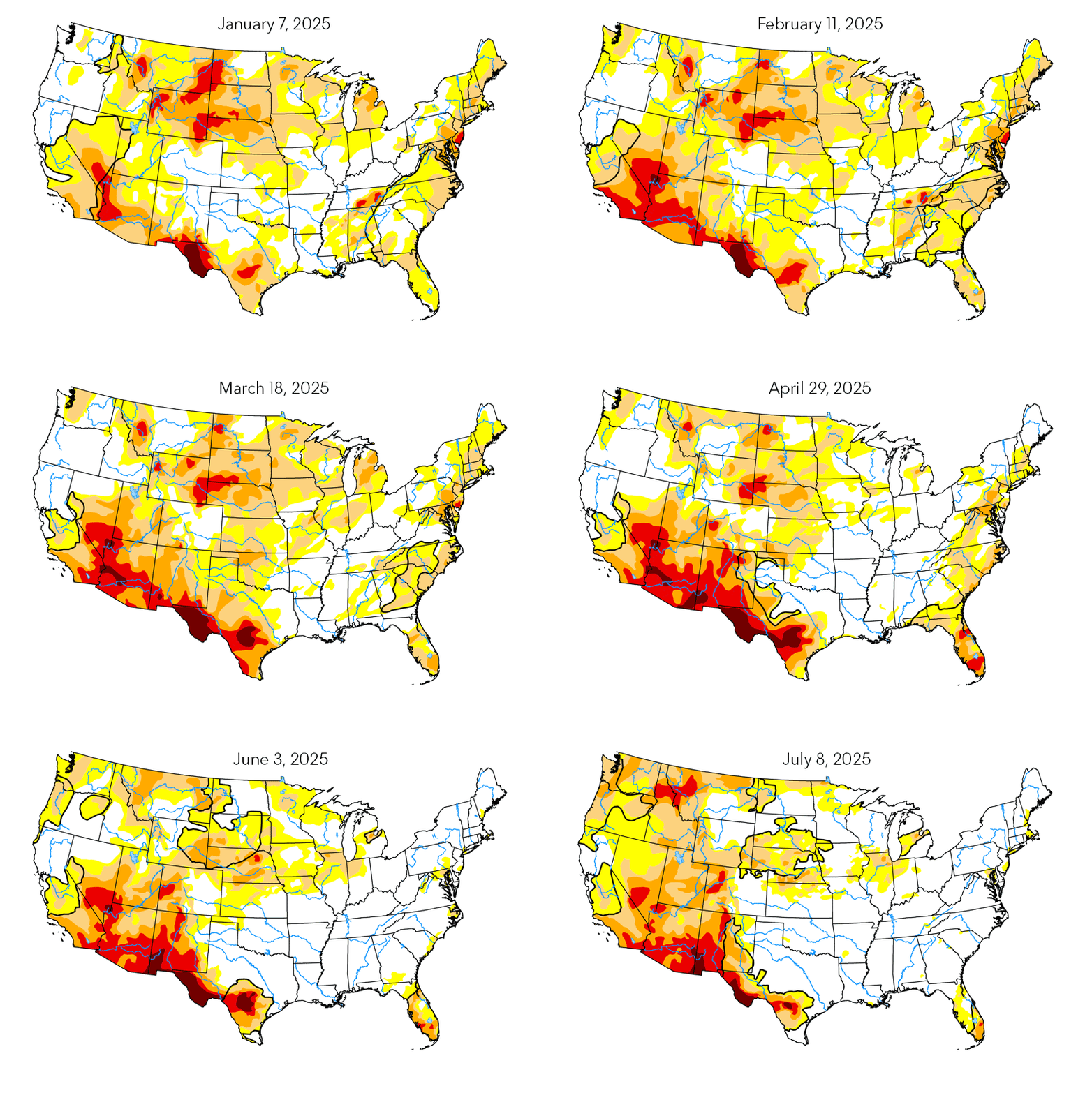
A stretch of summer-like days pushed temperatures into the 80s in the Eastern Cornbelt during the week, and ushered in some severe weather as the week progressed.
Highs in Illinois on April 20 reached 81 degrees in Chicago and 75 degrees in Joliet, with a severe thunderstorm warning posted for several northern Illinois counties on April 19 and a hazardous weather outlook in effect for most of northern Illinois on April 20.
Highs in Indianapolis, Ind., climbed to the low- to mid-80s on April 20, but gusty winds prompted a red flag fire warning for parts of the state on that date. A cold front dropped highs to the 50s and 60s by April 21, with weekend showers expected to produce a half-inch to 1.5 inches of rain across the state.
Similar conditions were reported in Ohio, with summer-like temperatures earlier in the week followed by cooler weather and an increased chance of rain on April 20-21. Highs in the low-80s were reported across the state at midweek, with several locations tying or breaking their daily record highs.
A flurry of spring fieldwork pushed the corn planting pace to 10% complete in Illinois and 3% in Indiana by April 16, with soybean planting estimated at 4% complete in Illinois and 2% in Indiana. Oats planting was 41% complete in Ohio by that date, well ahead of the 25% five-year average.
Western Cornbelt:

A cold front pushed through eastern Nebraska and western and central Iowa on April 19-20, producing strong thunderstorms that included damaging winds, hail, and heavy rain.
Local news reports confirmed golf ball- to tennis ball-sized hail in Auburn, Neb., at midweek, and tornado watches were posted for multiple Iowa locations on April 19-20. Midweek rainfall totals in Iowa were confirmed at 2.82 inches in Corning, 2.04 inches in Ames, 1.25 inches in Des Moines, 1.05 inches in Iowa Falls, and 0.82 inches in Fort Dodge.
Much cooler weather was on tap after the storms, with temperatures in Iowa and Nebraska dropping to the 40s and 50s on April 20-22. Lows in the upper-20s and low-30s were in the weekend forecast for both states.
The warm, dry weather at mid-month pushed planting progress to well ahead of the five-year average in the region. Corn planting as of April 16 was 30% complete in Missouri, 7% in Iowa, and 2% in Nebraska, with soybean planting estimated at 3-5% complete in Missouri and Iowa. Missouri growers also had fully 30% of the rice crop planted by that date, with oats planting estimated at 51-52% complete in Iowa and Nebraska.
Northern Plains:
Winter continued its hold on the Northern Plains during the week, with a winter storm watch posted for portions of northeastern North Dakota and northwestern Minnesota.
After scattered showers of rain and sleet earlier in the week, forecasts called for a mix of rain and snow on April 20-21, with heavy snow accumulation of six inches or more possible in northern Minnesota. Gusty winds of up to 45 mph were expected to accompany the precipitation.
The spring thaw pushed the Red River to minor flooding stage at 30.3 feet in Grand Forks, N.D., on April 18, with current forecasts calling for levels to reach moderate flood stage at 40 feet by the weekend. Moderate-to-major flooding is expected along most of the mainstem Red River in the coming weeks.
Northeast:
New England posted highs in the 60s and 70s as the week progressed, but rain was in the weekend forecast for much of the region. The same was true for New York and New Jersey, while highs in the upper-80s were expected across central Pennsylvania by the end of the week, prompting warnings of elevated fire risks due to gusty winds in tandem with the heat.
Red flag fire warnings were also in effect for portions of the Mid-Atlantic region during the week, particularly in Maryland due to dry and windy conditions. Weekend forecasts called for scattered showers and slightly cooler weather, however.
Corn planting was underway in parts of Pennsylvania, and growers in the state had 42% of the oats crop seeded by April 16, well ahead of the 27% five-year average. “The ground was in really good shape and the soil temperature was warm, so even if the calendar showed it was plenty early, the corn planters were seen in the fields,” said one regional contact.
Eastern Canada:
After unseasonably mild temperatures in the 20s C across much of Eastern Canada in mid-April, the region saw cooler weather and an increased chance of showers as the week progressed, with snow likely in northern Ontario.
Wet weather blanketed much of the Maritimes early in the week, with scattered showers reported in New Brunswick, Prince Edward Island, and Nova Scotia on April 17-19. A cold front was expected to bring rain to southern areas of Ontario and Quebec later in the week, with up to 10-23 cm of snow in northwestern Ontario.
Spring fieldwork was underway in the region as weather conditions allowed. “We had a good little run end of last week into the weekend, with a lot of wheat ground finished up,” reported one Ontario source at midweek. “Then a big drop on Monday, below freezing at night and snow, so a little slow down. We should get going again by tomorrow.”
US Gulf:
High water levels on the Lower Mississippi River continued to prompt travel restrictions on movements above New Orleans. Sources noted towing reductions of 15-25% below typical barge counts.
The NWS gauge at Baton Rouge was reported at an action-stage 33.1 feet and falling on April 19, after cresting shy of the 35-foot minor-flood stage at 34.52 feet on April 15. The gauge was forecast to fall out of action stage on April 22. A flood warning in effect for the area on April 19 was scheduled to expire late in the day on April 21.
Miter gate machinery replacement was reported closing the West Canal’s Leland Bowman Lock to daytime travel on April 18-19. The Black Bayou Bridge, located at Mile 237.5 in the West Canal, was shut 7:00 a.m. to 12:00 p.m. on April 18 for repairs to the fender system.
Emergency repairs at Bayou Sorrel Lock were concluded on April 13, ending a requirement for tows to lock with an assist boat, although locking with assistance remained “strongly” recommended on April 19. Repairs were noted at 6-11 hours on April 18.
Algiers Lock repair operations were said to block navigation between 6:30 a.m. and 6:30 p.m., Monday through Saturday, through an estimated May 4. Wait times for the week were quoted up to 30 hours, with 12 boats reported waiting to lock on April 19.
Colorado Lock maintenance and repairs are scheduled through April 28, limiting travel daily between 7:00 a.m. and 7:00 p.m. Waits topped out at 18 hours through midweek. Intermittent transit shutdowns were expected at the Morgan City Railroad Bridge, located at the West Canal’s Mile 121, until late June.
Repairs to the Bayou Boeuf Lock north chamber guidewall were scheduled to begin on April 17, closing the site to weekday travel between 7:00 a.m. and 4:00 p.m. Bayou Chene was available as an alternate route. The project is anticipated to run through May 19.
Intermittent Port Allen Lock waits were counted up to 25 hours, while Corps data showed Industrial Lock delays as high as 56 hours. Boats needed up to 11 hours to pass Calcasieu Lock, while Brazos Lock wait times were posted up to 17.5 hours. Weather delays continued to slow travel in the West Canal by up to 24 hours.
Mississippi River:
High water levels persisted on the lower river, restricting tow lengths by a reported 15-25%. Deliveries were delayed up to 48 hours as a result, sources said. The Vicksburg gauge was posted at an action-stage 36.44 feet and falling on April 19, with forecasts calling for levels to recede below the 35.0-foot action stage on April 19-20.
A mix of heavy rain and melting snow in the forecast for the Upper Mississippi River area was likely to trigger flooding between Oquawka, Ill., and St. Paul, Minn., in the week ahead. The conditions were expected to shut Locks 3-11 at a minimum, and potentially as far as Lock 17, for up to 15 days starting on April 23. Fresh snowfall was also possible following the rain, sources observed. Some freight operators were reported stopping travel at the upper river’s Mile 418 in advance of the expected shutdowns.
Lock 19 closed to daylight travel on April 18-19, leading to delays up nine hours. Daytime navigation was unavailable through the Ft. Madison Railroad Bridge on April 18-19, sources said.
Tows passing Lock 22 were delayed up to 5.5 hours. Locks 1-6, Lock 8, Lock 5A, and St. Anthony Falls Upper Lock and were offline on April 19, according to Corps lock data.
Illinois River:
Mechanical dredging at Dresden Island Lock begun on March 20 triggered intermittent delays in a wide 9-25 hour range through the week.
Marseilles Lock wait times were posted up to six hours, while 10.5 hour delays were noted at Starved Rock Lock on April 19. High water levels on the lower river kept wickets down at Peoria Lock and LaGrange Lock, allowing vessels to pass both sites without locking.
On June 1, Brandon Road Lock, Dresden Island Lock, and Marseilles Lock are scheduled to close to navigation for approximately 120 days, effectively shutting the Illinois River to commercial navigation. Normal movements were tentatively scheduled to resume in October.
Ohio River:
Repairs to the JT Meyers Lock floating mooring system are set to continue through Aug. 20, with intermittent main chamber shutdowns expected. The lock’s auxiliary chamber will go offline Aug. 21 through Sept. 10 for miter gate repairs, followed by another primary chamber outage between Sept. 11 and Nov. 17.
The Dashields Lock main chamber is projected to go offline April 24 through May 20 for gate replacement, while the McAlpine Lock north chamber is due to close May 15 through June 15 for miter gate machinery repairs, forcing all traffic to lock through the south chamber.
The Tennessee River’s Kentucky Lock saw waits in a wide 11-26 hour range through the week.
The US House of Representatives on April 18 failed to overturn President Biden’s April 6 veto of H.J. Res. 27, a congressional resolution that would have overturned his administration’snew“Waters of the United States” (WOTUS) rule.
Tuesday’s override vote was 227-196, far short of the two-thirds majority needed to overturn a presidential veto. The vote was similar to the House vote in February to approve the resolution (GM March 3, p. 26), with 10 Democrats and all but one Republican voting in favor of the override.
As a result, the new WOTUS rule remains in effect in 24 states after taking effect on March 20. The rule is barred from enforcement in the other 26 states following a federal court order in March blocking the rule in Texas and Idaho, and a temporary injunction issued on April 12 (GM April 14, p. 1) by a federal judge in North Dakota to block enforcement in an additional 24 states.
On the House floor Tuesday, Republicans once again criticized the Biden administration for supporting a rule that many industry trade groups and farm associations strongly oppose. In January a coalition of 17 trade groups filed a lawsuit against the US EPA and the Army Corps of Engineers challenging the rule (GM Jan. 27, p. 1), followed in February by a similar lawsuit lodged by the attorneys general from 23 states (GM Feb. 24, p. 1).
Responding to Biden’s veto message that the rule would provide more certainty to advance infrastructure projects and farming, House Transportation and Infrastructure Chairman Sam Graves (R-Mo.) said this is not the case.
“Instead, this costly, overreaching rule favors radical environmentalists at the expense of infrastructure, agriculture, and economic growth and those who depend on these activities,” Graves said.
A two-thirds majority supporting the veto override would also have been required in the US Senate, which approved a similar resolution to overturn the WOTUS rule on March 29 by a vote of 53-43 (GM March 31, p. 1). Following the House’s failed attempt to override the veto, however, the Senate will not take up the measure.
A federal judge in North Dakota on April 12 issued a temporary injunction blocking the US Environmental Protection Agency (EPA) and Army Corps of Engineers from implementing or enforcing the new “Waters of the United States” (WOTUS) rule in 24 states.
The ruling comes less than a week after President Joe Biden vetoed a US Congressional resolution that would have overturned the WOTUS rule (GM April 7, p. 1), which came into effect on March 20 after being announced in late 2022 (GM Jan. 6, p. 1).
The states include West Virginia, North Dakota, Georgia, Iowa, Alabama, Alaska, Arkansas, Florida, Indiana, Kansas, Louisiana, Mississippi, Missouri, Montana, Nebraska, New Hampshire, Ohio, Oklahoma, South Carolina, South Dakota, Tennessee, Utah, Virginia, and Wyoming. The injunction follows a federal court order in March blocking the rule in Texas and Idaho.
The 24 states, led by West Virginia, have “persuasively shown that the new 2023 rule poses a threat to their sovereign rights and amounts to irreparable harm,” Judge Daniel L. Hovland of the US District Court for the District of North Dakota ruled on April 12. “The states involved in this litigation will expend unrecoverable resources complying with a rule unlikely to withstand judicial scrutiny,” he said.
With the new WOTUS rule now barred in more than half the country, EPA issued a statement saying it and the Corps are reviewing the federal judge’s decision and their options. EPA noted, however, that the rule still stands in the states not included in the injunction, and it said it continues to believe the rule is “the best” interpretation of the Clean Water Act.
“The agencies continue to believe the rule, which is informed by the text of the relevant provisions of the Clean Water Act and the statute as a whole, as well as the scientific record, relevant Supreme Court case law, input from public comment, and the agencies’ experience and technical expertise after more than 45 years of implementing the longstanding pre-2015 regulations defining waters of the United States, is the best interpretation of the Clean Water Act,” EPA said in the statement.
“The agencies remain committed to establishing and implementing a durable definition of ‘waters of the United States’ informed by diverse perspectives,” the EPA statement continued. “Our goal is to protect public health, the environment, and downstream communities while supporting economic opportunity, agriculture, and industries that depend on clean water.”
The new WOTUS rule has been criticized by numerous industry trade groups, including The Fertilizer Institute (TFI), as being confusing and overreaching. In January a coalition of 17 trade groups filed a lawsuit against EPA and the Corps challenging the rule (GM Jan. 27, p. 1), followed in February by a similar lawsuit lodged by the attorneys general from 23 states (GM Feb. 24, p. 1).
“Once again, the courts have affirmed that the Biden administration’s WOTUS rule is overreaching and harmful to America’s beef farmers and ranchers,” said Todd Wilkinson, President of the National Cattlemen’s Beef Association in an April 12 statement. “Cattle producers in 26 states now have some additional certainty while this rule is being litigated, and we are optimistic that the Supreme Court will provide nationwide clarity on the federal government’s proper jurisdiction over water.”
A coalition of environmental groups sued the US Environmental Protection Agency (EPA) on April 11 for failing to set limits on chemicals like cyanide, benzene, mercury, and chlorides in wastewater emitted by oil refineries and plants that produce chemicals, fertilizer, plastics, pesticides, and nonferrous metals.
The lawsuit alleges that EPA has violated the Clean Water Act (CWA) by failing to set limits on the amount of pollution that these industries can discharge into waterways. The lawsuit also claims that EPA has failed to update effluent limitation guidelines (ELGs) that were set in the mid-1980s for oil refineries, plastics manufacturers, and fertilizer plants.
According to a statement from the Environmental Integrity Project (EIP), which is coordinating the legal action on behalf of 13 environmental groups, a total of 59 fertilizer manufacturing plants discharged nearly 90 million pounds of pollution into waterways in 2019, including 21 nitrogen plants that discharged 7.7 million pounds of total nitrogen.
“The EPA has set no limits on several fertilizer plant pollutants, including selenium, total chromium, zinc, iron, nickel, cadmium, cyanide, and lead,” the statement claims. “The current effluent guidelines for fertilizer factories have not been updated since 1986.”
The lawsuit was filed in the U.S. Court of Appeals for the 9th Circuit in San Francisco by the EIP, the Center for Biological Diversity, Clean Water Action, Waterkeeper Alliance, Food & Water Watch, Environment America, Bayou City Waterkeeper, Black Warrior Riverkeeper, Healthy Gulf, San Antonio Bay Estuarine Waterkeeper, San Francisco Baykeeper, the Surfrider Foundation, and Tennessee Riverkeeper.
“No one should get a free pass to pollute. It’s completely unacceptable that EPA has, for decades, ignored the law and failed to require modern wastewater pollution controls for oil refineries and petrochemical and plastics plants,” said Jen Duggan, EIP Deputy Director. “We expect EPA to do its job and protect America’s waterways and public health as required by the Clean Water Act.”
Peak Minerals, Salt Lake City, Utah, announced on March 27 that it has entered into a convertible loan agreement with a global strategic investor to invest $30 million in the continued development of the company’s Sevier Playa Sulfate of Potash (SOP) Project in west-central Utah.
The proceeds of the financing will be used to fund front-end engineering and design (FEED) for the project, complete final permitting activities, prepare the site in advance of construction, refinance the company’s existing senior debt obligations, and for general corporate purposes.
As part of the loan agreement, Peak Minerals and the investor have also entered into a binding term sheet for the long-term supply of 65,000 st/y of SOP from Phase 1 of the Project, which is targeting total SOP production of 215,000 st/y.
“We are pleased to announce the completion of this financing, and to have attracted a high caliber investor to the company,” said Jason Chang, CEO of EMR Capital, which operates Peak Minerals as a wholly owned subsidiary.
“As we move the Sevier Playa Project towards construction and operation, this investment marks an important milestone for the company,” Chang continued. “These funds will provide us with the necessary capital and financial flexibility to grow our internal technical team, complete FEED, initial site works, and contract negotiation, and arrangement of project finance as we advance towards a construction decision.”
The loan matures 30 months from the date of issuance, and the principal amount of the loan is convertible into common shares of the company at the option of the holder, upon completion of certain conditions. The interest payable can be capitalized to the loan at the option of Peak Minerals.
“Peak is a truly unique and exciting opportunity to invest in the potash sector and to support long-term domestic fertilizer availability and food security in North America in a product in which farmers in the US are partially import dependent,” Chang said.
CHS Inc. and Mid-Kansas Cooperative (MKC) announced on April 10 that they will expand their grain marketing joint venture to increase market access for growers in the Southern Plains. The expansion includes a new grain terminal with rail access near Sterling, Kan., which will be operational in 2024.
The joint venture was launched in 2013 (GM March 11, 2013) and includes a high-speed shuttle loading facility in Canton, Kan. The expansion follows CHS’s announcement earlier this year (GM Jan. 13, p. 27) that the company’s joint venture with Cargill, TEMCO LLC, will increase its grain export capabilities through Cargill’s 6 million-bushel terminal in Houston, Texas.
“CHS has been successfully partnering with MKC through joint ventures for more than 10 years,” said John Griffith, executive vice president, ag business, CHS. “This initiative expands our collaborative presence and maximizes our complementary asset base in the region to create an efficient, integrated supply chain to connect cooperative- and farmer-owners in the Southern Plains with customers around the world while leveraging the TEMCO terminal in Houston, Texas.”
CHS and MKC said both companies will continue to independently own and operate assets throughout the Southern Plains while expanding their grain marketing joint venture to move grain more efficiently through the distribution channel. The companies expect to begin to operate the expanded 50/50 joint venture this summer.
“Expanding our relationship with CHS will open up market access and create new opportunities for our farmers,” said MKC President and CEO Brad Stedman. “Our track record of successful partnership and shared vision to create value for cooperative-owners and customers makes MKC and CHS the right partners to link farmers with a more defined southern supply chain.”
Chicago-based Archer Daniels Midland (ADM) and BiOWiSH Technologies Inc., Cincinnati, Ohio, announced that ADM will now offer a BiOWiSH® Fertilizer Enhancement as a dry fertilizer treatment option for urea, MAP, DAP, and NPK blends. The new product will be available from ADM Farm Direct Fertilizer, as well as the company’s wholesale business.
“We’re extremely excited to partner with ADM,” said BiOWiSH CEO Graham Beesley. “Together we will ensure that more farmers in the US will be able to experience the benefits of high-quality biologically enhanced fertilizers, which are designed to increase crop production economically, safely, and sustainably.”
The BiOWiSH® Fertilizer Enhancement is a blend of proprietary microbial cultures, including BiOWiSH’s proprietary HoloGene 3™ technology and BiOWiSH® endophytic Bacillus, which is coated onto dry fertilizer or mixed with liquid fertilizers to create an enhanced efficiency fertilizer. ADM said it plans to offer it as an option to be coated onto dry fertilizers sold through several of its terminals for the 2023 season.
“ADM is committed to delivering solutions that will enhance farmer profitability and help them sustainably meet growing demand for agricultural products. BiOWiSH is one of those solutions,” said Graig Whitehead, ADM Director of Biologicals and New Technology. “It is an easy addition to a fertility program for farmers looking to benefit from improved nutrient use efficiency and increased yield potential.”
ADM said The BiOWiSH® Fertilizer Enhancement is available at its US fertilizer terminals in Blytheville, Ark., Camanche, Iowa, Madison, Ill., Ottawa, Ill., Owensboro, Ky., St. Paul, Minn., and Winona, Minn. Additional locations in the US and Canada are expected to offer the enhancement soon.
Last summer, BiOWiSH partnered with Riyadh-based SABIC Agri-Nutrients Co. to launch a new bio-enhanced urea product, which was offered for a limited time in select areas through ADM and American Plant Food (APF) facilities (GM July 29, 2022).