

Cornbelt:
The NPSZ market firmed to $675-$735/st FOB in the Cornbelt, depending on location.
Pacific Northwest:
40-Rock pricing remained at $780/st FOB or DEL in the Pacific Northwest.
Cornbelt:
The NPSZ market firmed to $675-$735/st FOB in the Cornbelt, depending on location.
Pacific Northwest:
40-Rock pricing remained at $780/st FOB or DEL in the Pacific Northwest.
US Imports:
July-February SOP imports softened 38.6% year-over-year, to 69,698 st from 113,472 st. February imports were up 69.9%, however, to 14,495 st from the year-ago 8,530 st.
US Exports:
SOP exports for February firmed 369.5% year-over-year, to 6,531 st from 1,391 st. July-February shipments moved 14.0% lower, however, to 36,551 st from 42,482 st in the year-ago period.
California:
The SOP market in California remained at $750-$760/st FOB, with the low confirmed at Stockton.
Pacific Northwest:
SOP pricing in the Pacific Northwest remained at $800-$810/st FOB in early April.
California:
Granular SOP Magnesia pricing was steady at $565-$575/st FOB in California for the last confirmed business.
Pacific Northwest:
The granular SOP Magnesia market was quoted at $525-$535/st FOB in the Pacific Northwest.
California:
Potassium nitrate prices in California were quoted at $1,385/st FOB Stockton for bulk tons, $1,490/st FOB for bulk bags, and $1,510/st FOB for 50-pound bags.
Eastern Cornbelt:
Highs reached the 70s and low-80s in the Eastern Cornbelt during the week, sparking a flurry of spring fieldwork and preplant fertilizer applications. The combination of warm temperatures, low humidity, and gusty winds prompted a red flag fire warning for multiple counties in northern Illinois and Indiana at midweek.
Ohio also posted highs in the 70s during the week, but rain and much cooler weather was in the weekend forecast. Northern Illinois was expecting a mix of rain and snow on April 16, with temperatures dropping to the low-30s.
Corn planting was just 1% complete in Illinois by April 9, with progress estimated at 5% in Kentucky. Ammonia was rolling hard in the region during the week, with truck availability becoming a major issue as the week progressed. “There’s plenty of product, but we can’t get enough trucks,” reported one source on April 13.
Western Cornbelt:
Summer-like temperatures blanketed much of the Western Cornbelt during the week, sending highs into the low- to mid-80s across Iowa, and even the upper-80s in southern Nebraska.
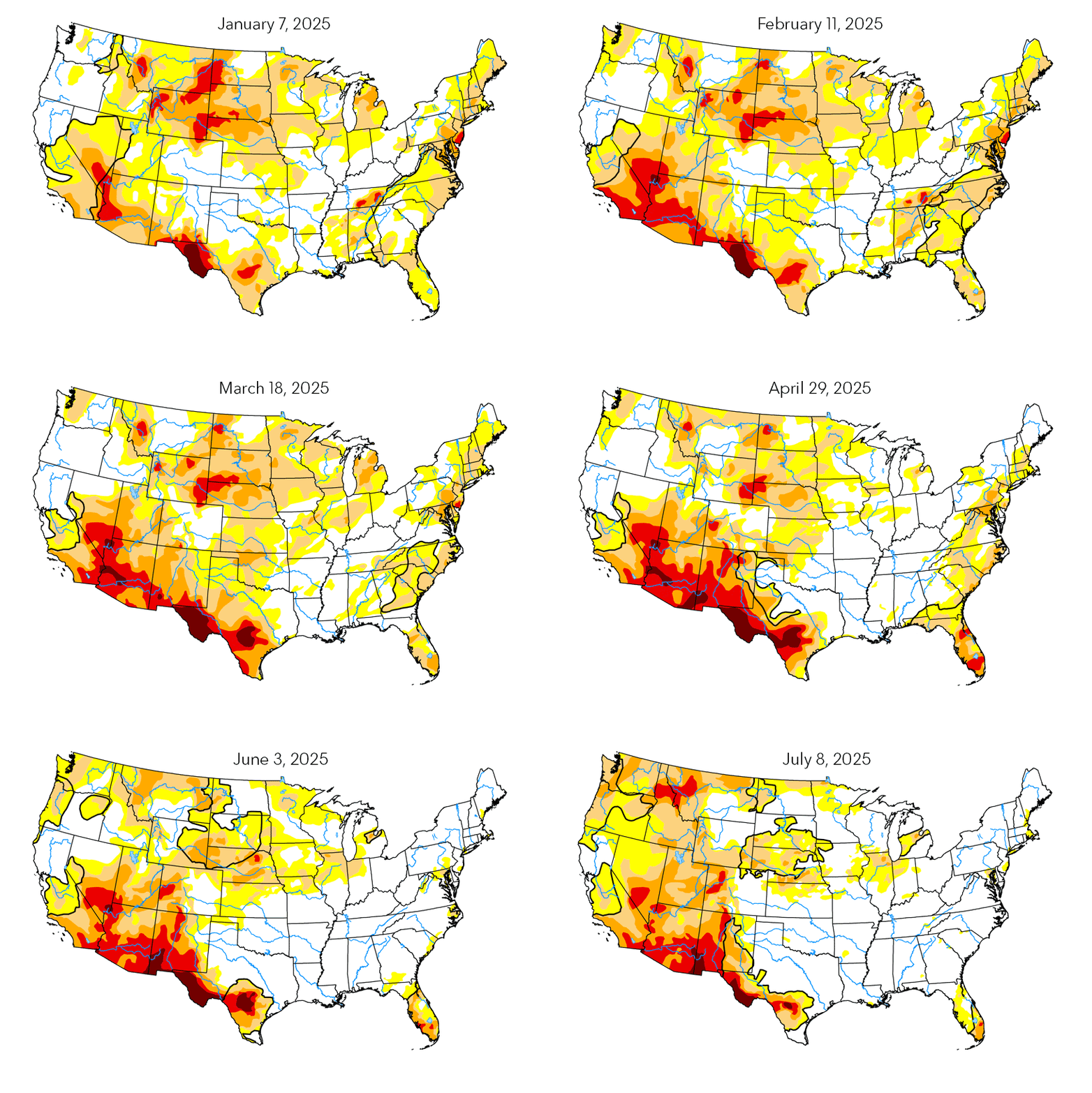
The warm weather sparked brisk spring fieldwork across the region, but also triggered a fire weather watch for much of southeastern Nebraska and southwestern Iowa due to low humidity and gusty winds. With nearly all of Nebraska experiencing drought conditions ranging from moderate to exceptional, firefighters have been battling numerous grass fires across the state since late March.

Forecasts warned of an increased chance of showers and thunderstorms in Iowa by April 14. The incoming cold front was expected to drop temperatures down to the high-50s and low-60s across Iowa and Nebraska by the weekend.
Corn planting had yet to register any progress in the Western Cornbelt as of April 9, but USDA said 6% of the Kansas crop was seeded by that date. Missouri growers had just 1% of the rice crop planted by that date, with oats planting estimated at 13% complete in Iowa and 20% in Nebraska.
California:
Fieldwork and spring planting were finally underway in California after one of the coldest and wettest winters on record. “It’s great to finally have weather conducive to movement,” said one source.
Parts of Northern California posted their coldest March on record, and the state as a whole experienced its coldest December-March period in 44 years. Central California also endured its wettest winter on record, stretching from the Central Valley into the southern and central Sierra Nevada.
With snowpack also at record levels, the state is bracing for a record-breaking amount of snow water in the coming weeks and months. According to the latest forecasts, widespread flooding is inevitable in the Tulare Basin and is also likely in the San Joaquin watershed and in the Owens Valley.
Pacific Northwest:
Winter weather conditions continued over much of the Pacific Northwest during the week. Snow was once again in the midweek forecast for Portland, Ore., Vancouver, Wash., and the western Columbia River Gorge, with up to a half-inch of accumulation at elevations above 1,000 feet and a mix of rain and snow at lower elevations.
Snow was also reported across parts of Idaho and western Montana on April 12-13, with the heaviest accumulation limited to mountain passes. Spring fieldwork was delayed as a result. The planting of spring wheat was estimated at 11% complete in Washington and 2% in Idaho as of April 9, with barley planting reported at 5% in Washington, 2% in Idaho, and 1% in Montana.
Western Canada:
Cool temperatures settled over Saskatchewan and Manitoba during the week, with a mix of freezing rain and snow reported early in the week in parts of central and northern Saskatchewan. Warmer weather was in the weekend forecast, however, with highs expected in the low teens.
Higher elevations in Alberta were bracing for heavy snow on April 11-12, with 100 km/h wind gusts reported in multiple areas of the province on April 11. Parts of southern British Columbia were under rainfall warnings during the week, with flood advisories issued for the Okanagan, Similkameen, South Coast, and East and West Kootenay regions.
Manitoba also released an updated spring flood forecast on April 12, which detailed major flood risks for the Red River between Emerson and the Red River Floodway inlet, and low-to-moderate risks in the Interlake region along the Fischer, Icelandic, and Assiniboine rivers.
“It’s still too early for fieldwork but I think we’ll see the snow melt off quickly, so maybe a late April start in some areas,” said one regional contact.
US Gulf:
An ongoing high-water event on the Lower Mississippi River extended towing restrictions on movements above New Orleans, sources said. Barge counts were reduced by up to 25%, resulting in delivery delays as high as 48 hours.
The Baton Rouge river gauge returned an action-stage 34.37-foot reading on April 11, with a peak of 34.5 feet predicted on April 12-14. The gauge was forecast to fall out of action stage on April 23, while an NWS flood warning for the Baton Rouge area was slated to remain in effect through April 20.
Emergency repairs reportedly shut Bayou Sorrel Lock to daytime navigation on April 11-14, blocking travel daily from 7:00 a.m. to 5:30 p.m. In addition, tows measuring wider than 54 feet were required to transit with an assist vessel while repairs were underway. Nine-hour delays were reported on April 11.
Algiers Lock is shut for repairs from 6:30 a.m. to 6:30 p.m., Monday through Saturday, through May 4, with wait times posted up to 29 hours during the week, below 57 hours reported previously. Work underway since Jan. 30 at Calcasieu Lock concluded on April 6, sources said. Lingering delays were counted up to 12 hours on April 10-11.
Maintenance and repairs at Colorado Lock shut the site to daylight-hour navigation through April 28. Wait times stretched to a wide 8-40 hour range through the week, shifting from 13.5 hours at last check.
Bayou Boeuf Lock north chamber guidewall repairs, previously scheduled to begin on April 10, were pushed back to April 17, sources said. The project will close the site to weekday navigation between 7:00 a.m. and 4:00 p.m., with Bayou Chene available as an alternate route. The project is scheduled to run through May 19.
Miter gate machinery repairs are expected to close Leland Bowman Lock to navigation on April 18-19. Intermittent shutdowns were anticipated at the Morgan City Railroad Bridge, located Mile 121 of the West Canal, between mid-April and the end of June.
Port Allen Lock wait times ran up to 18.5 hours through during the week, while most Industrial Lock delays fell in a wide 31-45 hour range. Boats waited up to 10.5 hours to pass Brazos Lock. Weather delays caused delays up to 24 hours throughout the West Canal.
Mississippi River:
High water levels continued on the lower Mississippi, resulting in tow-size restrictions and delivery delays. Tow lengths were reduced by 15-25%, sources said, stretching deliveries by 24-48 hours as a result.
The NWS river gauge at Vicksburg was posted at an action-stage 40.85 feet and falling slowly on April 12, while forecasts called for the area to recede below the 35.0-foot action stage on April 19.
On the upper river, damage to the Lock 12 upriver mule necessitated the use of an assist tug on northbound lockages, sources said. Lock 19 was due to shut for 6-12 hours daily on both April 12-13 and April 18-19. Daytime travel closures were scheduled at the Ft. Madison Railroad Bridge on April 12, 18, and 19.
Five-hour waits were reported at Lock 19. Lock 1 and St. Anthony Falls Upper Lock remained shut to navigation during the week.
Illinois River:
Brandon Road Lock was closed to daytime traffic on April 11-12 for repairs, leaving transit unavailable from 6:00 a.m. to 6:00 p.m. Sources reported intermittent closures at Marseilles Lock, triggering waits up to 28.5 hours through the week. Elevated water levels kept wickets down at Peoria Lock and LaGrange Lock, allowing boats to transit both sites without locking.
Brandon Road Lock, Dresden Island Lock, and Marseilles Lock are expected to shut on June 1, closing the river to commercial transport through the end of September.
Ohio River:
Floating mooring repairs underway at JT Meyers Lock are scheduled to run through Aug. 20, prompting intermittent main chamber shutdowns. The lock’s auxiliary chamber is reportedly on track to close for repairs Aug. 21 through Sept. 10, followed by another round of main chamber work between Sept. 11 and Nov. 17.
Primary chamber repairs at Hannibal Lock were scheduled to wrap up on April 10. Delays reported at 17 hours on April 10 softened to a 6-14 hour range on April 12, falling from 23 hours in the prior report.
The main chamber at Greenup Lock was scheduled to return from maintenance on April 12, while sources expected the Melville Lock auxiliary chamber to shut April 17 through Aug. 4 for repairs.
On the Tennessee River, intermittent Kentucky Lock delays were reported in a wide 6-26 hour range. Wilson Lock waits ran as high as eight hours.
Arkansas River:
Interlock system repairs were scheduled to completely close Maynard Lock to navigation on April 10-14.
Atlas Agro AG, the Swiss company that owns Pacific Green Fertilizer Corp., has signed a memorandum of understanding (MOU) with Houston-based KBR to license KBR’s K-GreeN® technology for Atlas’ planned investments in green nitrogen plants, including the Richland, Wash., ammonium nitrate (AN) plant (GM March 31, p. 1).
Pacific Green inked a $9.1 million real estate purchase and sale agreement with the Port of Benton, a municipal corporation in Washington, on March 8 for a 150-acre site. The company’s development plan is for a 1 million square foot fully renewable hydrogen production facility to form ammonia, nitric acid, and AN.
“We are proud to partner with KBR and use its K-GreeN process for our green fertilizer facilities,” said Atlas Agro CEO Petter Østbø in an April 13 statement. “Each of our green ammonia plants will produce fertilizer that will help feed nearly 16 million people and avoid global carbon emissions of more than one million tons per year.”
Under the terms of the MOU, KBR will provide technology licensing, basic engineering design, proprietary equipment, and catalyst for Atlas Agro’s green nitrogen plants. The capital expenditure for the Richland plant is projected at $1.2 billion and the company expects the facility to employ 160. The project’s timeline is for groundbreaking in 2024, with the plant to be operational in 2026-2027.
“We are excited to support Atlas Agro’s vision of zero-carbon fertilizer production through our market leading green ammonia technology, K-GreeN,” said Doug Kelly, KBR President, Technology. “We are also confident that we can drive schedule synergies across the series of plants to accelerate availability of clean ammonia globally.”
The Yakima Herald Republic reported this week that Atlas Agro has started an engineering study for the Richland plant and is pursuing an “all-of-the-above” strategy to consider existing and emerging renewable generation sources in the region, including solar, wind, nuclear power, hydroelectric power, and biofuels.
The planned facility was praised this week by Washington Gov. Jay Inslee and U.S. Sen. Patty Murray (D-Wash.), the Yakima Herald Republic reported, with Murray calling it “a game changer for farmers across Washington state and the entire Pacific Northwest.”
“Washington welcomes Atlas Agro and is excited to watch it develop the world’s first commercial-scale green fertilizer plant,” Inslee said in a statement released by Agro. “This is a meaningful example of what’s possible as we build a clean, green hydrogen sector in our state and seize the economic opportunities of a zero-carbon future.”
American Plant Food River Partners (APFRP), a subsidiary of American Plant Food Corp. (APF), confirmed that it is proceeding with plans to build a 420,000 st/y ammonium sulfate plant at Cornerstone Chemical Co.’s 800-acre Cornerstone Energy Park in Waggaman, La.
APFRP in March filed an initial minor source permit application with the Louisiana Department of Environmental Quality. If the permit is approved, the company would break ground on the $200 million facility in January 2024, with construction completed by mid-2025.
“This project represents a significant investment in Jefferson Parish and will make APFRP a reliable source of crop nutrients for Louisiana and America’s farmers,” said Jerry Bilicek, Chief Operating Officer for APF, in an April 4 statement to Green Markets.
“Reduced nitrogen fertilizer production in the US over the past 30 years, coupled with the growing need for sulfur, has led to an increased reliance on foreign-produced fertilizers,” Bilicek said. “APFRP’s proposed fertilizer production facility will ensure access to a dependable supply of vital crop nutrients made in the US, while improving supply diversity and enhancing domestic food security.”
APF, which is headquartered in Galena Park, Texas, first announced plans for the facility last October (GM Oct. 28, 2022). At the time, APF said the plant would cost $225 million and be able to produce 500,000 st/y of ammonium sulfate, but both the cost and capacity estimates have been lowered with value engineering completed.
The facility will source ammonia and sulfuric acid from Incitec Pivot Ltd.’s (IPL) Waggaman ammonia plant and Cornerstone, respectively, with the latter producing sulfuric acid along with other chemicals. Following last month’s announcement that CF Industries Holdings Inc. has agreed to purchase IPL’s 880,000 st/y (800,000 mt/y) ammonia production complex in Waggaman (GM March 24, p. 1), CF will reportedly inherit the deal to supply ammonia to the new APF facility.
APF also reported in October that it is exploring a technology that would allow it to extract ammonium sulfate from wastewater already produced at the site. The extracted product could represent as much as 13% of the facility’s production capacity, the company said.
According to the DEQ permit application, the facility will consist of three ammonium sulfate granulation plants and two ammonium sulfate and NPK fertilizer handling structures. All equipment and material transfer points in the facility will be equipped with vent take-offs to minimize dust, and enclosed belt conveyers will be used to transport the ammonium sulfate to a 60,000 st storage building.
The NPK fertilizers that will be received, stored, and distributed from the site include urea, MAP, DAP, and potash. The facility will include a dedicated barge dock for incoming shipments of these products, the permit states, and the proposed NPK storage building will have capacity for approximately 30,000 st.
According to the statement from Bilicek, the project represents approximately $200 million in local capital investment in Jefferson Parish and will provide roughly 200 construction jobs and 30 permanent jobs. The facility’s 420,000 st/y ammonium sulfate capacity will be distributed by barge, rail, and truck.
“Cornerstone is one of the largest employers in Jefferson Parish, with hundreds of employees who call South Louisiana home,” Bilicek said. “APF River Partners and Cornerstone are currently engaged with and investing in the community, and regularly communicating with city and parish stakeholders to keep them appraised and updated on the proposed facility’s schedule and progress.”
A proposed clean ammonia production facility is advancing in Mingo County, W.Va., with an anticipated initial production capacity of 2.1 million mt/y and construction slated to begin in 2024, the project’s partners announced on April 3.
The multi-billion-dollar Adams Fork Energy blue ammonia project is being developed by Adams Fork Energy LLC and the Flandreau Santee Sioux Tribe on the site of a reclaimed coal mine near Gilbert Creek, W.Va. The facility is expected to be online in late 2026 or early 2027.
The partners are touting the plant as the largest clean ammonia facility in the US and an anchor project in the Appalachian Regional Clean Hydrogen Hub (ARCH2), a proposed initiative to use natural gas as a feedstock to create hydrogen and capture and store carbon from various industries in the region.
“Adams Fork Energy is a transformational manufacturing investment for Southern West Virginia,” said Francis Sacr, Special Advisor to the President of Adams Fork Energy. “Thanks to leadership in Washington through the Bipartisan Infrastructure Law and the Inflation Reduction Act, we’re excited to advance our clean ammonia production facility that will create family-sustaining local jobs while boosting available supply of clean ammonia, a critical component to sustainable food production and achieving a lower-carbon energy future.”
The project developers said that they have entered into a strategic partnership with CNX Resources Corp., a natural gas company based in Pittsburgh, Pa., with operations in the Appalachian Basin, to provide fuel and carbon sequestration services. Technology provider Haldor Topsoe will furnish its SynCOR™ clean ammonia technology for the facility.
“This project is accelerating America’s lower carbon energy and manufacturing future in the heart of Appalachia,” said Nick Deiuliis, CNX President and CEO. “Similar to our other regional projects, CNX’s unique combination of assets, innovative technologies, and proven operational expertise make us the premier energy and tech company driving the Basin’s lower emission future.”
“This project will be an important part of the energy transition with a CO2 capture of more than 99%,” said Henrik Rasmussen, Managing Director, the Americas, for Haldor Topsoe. “The plant will produce 6,000 metric tons per day of decarbonized clean ammonia in the first phase.”
The project is expected to support 2,000 construction jobs, as well as generate significant tax revenues and capital investment for Mingo County in southern West Virginia. Adams Fork said it has received federal, state, and local bipartisan support, and is expected to displace more than 2.7 million mt/y of CO2 equivalent.
“I’m incredibly proud that the Adams Fork Energy plant will become the largest clean ammonia facility in the country,” said West Virginia Governor Jim Justice. “I’m confident they will be a champion in this emerging field and help our southern West Virginia communities flourish for decades to come.”
Adams Fork Energy was founded in 2010 to convert stranded American fossil fuels into useable chemicals. The company partnered with the Flandreau Santee Sioux Tribe in 2022 to develop these projects.
“The advancement of this project benefits the tribe economically, and the use of innovative technology presents a viable source of domestic energy independence for the US,” said Anthony Reider, President of the Flandreau Santee Sioux Tribe. “Our participation will present unique opportunities for federal funding for the project, and the Tribe will benefit from educational opportunities afforded by the project’s sponsors to our Tribal members.”
U.S. Senator Joe Manchin (D-W.Va.) also hailed the project, noting that it was made possible by programs created in the Infrastructure Law and the Inflation Reduction Act to support the production and use of hydrogen in the US.
“The Inflation Reduction Act and Bipartisan Infrastructure Law continue to deliver for West Virginia,” Manchin said. “Today’s announcement of plans for a clean ammonia production facility in Mingo County will help ensure the Mountain State continues to be a leader in American energy innovation and support good paying, West Virginia energy jobs.”