

Potassium thiosulfate was steady at $730/st FOB Terre Haute for the latest offers.
All posts by mickeybarb@charter.net
Crops/Weather
Eastern Cornbelt:
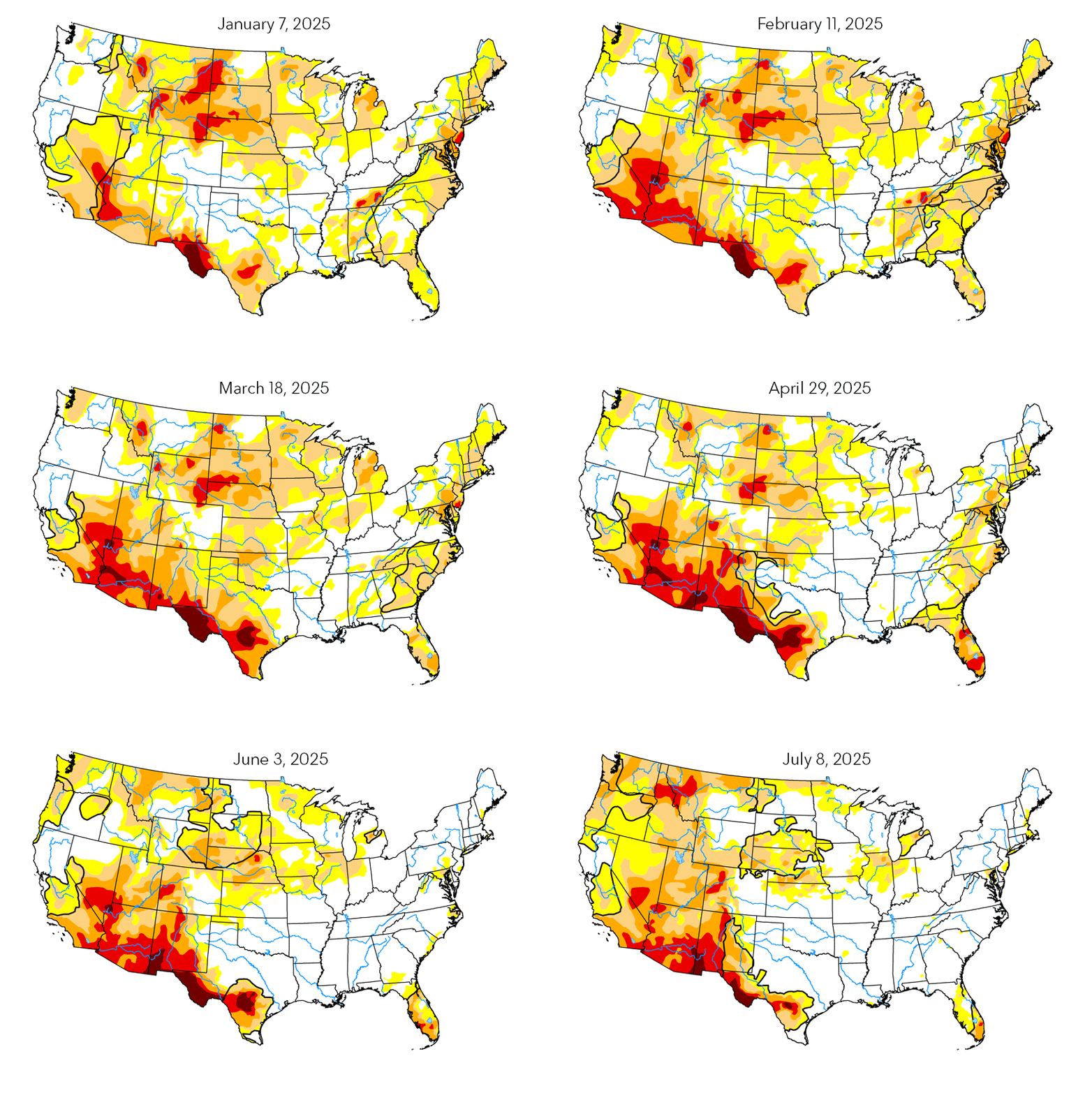
After steadily warming temperatures during the week, Illinois was bracing for potentially strong storms on March 31. Forecasts warned of 70 mph winds, large hail, and the potential for tornadoes, particularly in the northern areas of the state.
Thunderstorms also moved through the Peoria area on March 30, with highs there expected to reach the upper-60s and possibly the 70s by Friday. Highs in central Indiana reached the 60s late in the week, but an incoming cold front was expected to trigger thunderstorms late in the week, with hail and damaging winds possible.
A mix of rain and snow pushed through northern Ohio at midweek, followed by warmer temperatures on March 30. By Friday, however, another system was expected to produce widespread rains and strong winds in Ohio.
Western Cornbelt:
Temperatures warmed to the high 40s, 50s, and even low 60s in Iowa on March 30, with the highest readings in southern Iowa. Rainfall across Iowa was expected to pick up late on March 30, with severe storms possible on March 31. Forecasts warned of wind, hail, and possible tornado activity by Friday afternoon over a wide swath of the state.
Highs reached the mid-60s and low-70s across Nebraska on March 30, but a cold front on Friday was expected to usher in some thunderstorm activity, along with a 20-degree drop in temperatures. By late on March 31, spotty snow showers were in the forecast for parts of northern Nebraska.
A wind advisory was in effect for northern Missouri on March 30, with potentially strong thunderstorms in the March 31 forecast.
Northern Plains:

Winter storm warnings and watches were in effect for portions of South Dakota and Minnesota late in the week. Forecasts warned of 8-12 inches of snow in northern and central South Dakota as cold air pushed into the region after midweek highs in the 30s. Southern areas of the state were expecting rain and isolated thunderstorms on March 30.
Snowfall was also expected in North Dakota, with most of the accumulation reported south of Interstate-94. Minnesota was bracing for 1-4 inches of fresh snow in northern areas of the state, with freezing rain and ice across southern Minnesota. Highs in the mid-30s were expected in the Twin Cities area on April 1.
Northeast:
A Great Lakes system brought cold temperatures, gusty winds, and a mix of rain and snow to New England late in the week. While snow accumulation was limited to 2-3 inches in the Green Mountains, some areas saw a half-inch or more of rain, with temperatures dropping to the 20s and 30s across the region.
Midweek snow squalls were also reported in Pennsylvania and western New York, with more precipitation expected by the weekend. Temperatures in the Mid-Atlantic region fell from the upper-50s to the 20s and 30s by March 30.
Eastern Canada:
More winter storms swept through Eastern Canada during the final week of March, compounding fieldwork delays and diminishing hopes of any early start to spring planting in the region.
An Arctic cold front brought heavy snow, 70-80 km/h wind gusts, and -10 C wind chills to southern Ontario at midweek. While calmer conditions were expected on March 30, another system was threatening to drop 20-40 cm of rain and snow on southern and eastern areas of the province by the coming weekend.
The prior weekend brought up to 20 cm of snow to southern Quebec, with more expected as the week progressed. The Maritimes were also bracing for a cold front on March 30, with a mix of rain and snow and 40-60 km/h winds. While most areas were expecting five cm or less of snow accumulation, 10-15 cm was possible in northern New Brunswick by the weekend.
“We’ve had wind and rain the last week, and further north some snow,” commented one Ontario source at midweek. “No fieldwork here to speak of; too wet and too cold.”
Transportation
US Gulf:
High water levels on the Lower Mississippi River prompted ongoing towing restrictions on northbound travel above New Orleans, slashing maximum barge counts by up to 15%. Resulting delivery delays were reported in a 24-48 hour range.
The Baton Rouge river gauge was posted at an action-stage 30.84 feet on March 28. Levels were predicted to rise to a minor-flood 36.0 feet on April 9.
Maintenance underway at Bayou Sorrel Lock since March 1 was slated to conclude on May 31. The project was reported to limit daytime navigation, triggering intermittent waits up to 11 hours during the week.
Sources reported a Brazos Lock closure running 7:00 a.m. to 7:00 p.m., Monday through Friday, through March 31, with delays noted up to 10 hours. Calcasieu Lock maintenance, scheduled during daytime hours through April 6, resulted in 4-11 hour wait times, according to Corps data.
Starting on April 10, repairs to the Bayou Boeuf north chamber will halt weekday navigation through the site between 7:00 a.m. and 4:00 p.m. Bayou Chene was suggested as an alternate route. The project is scheduled to last until May 12.
Colorado Lock maintenance and repairs are projected to run through April 28, limiting travel between 7:00 a.m. and 7:00 p.m. daily. Wait times were reported up to 27 hours during the week. A planned project at the Morgan City Railroad Bridge, located at the Mile 121 in the West Canal, will trigger intermittent travel stoppages between mid-April and the end of June.
Algiers Lock repairs begun on March 20 necessitated Monday-through-Saturday closures between 6:30 a.m. and 6:30 p.m., anticipated to run through May 4. Waits were reported at 35 hours on March 28.
Port Allen Lock delays were heard up to 14 hours during the week. Waits were reported up to 38 hours at Industrial Lock, while Corps data showed intermittent Harvey Lock wait times up to seven hours on March 28. Boats transiting Brazos Lock were delayed up to 11 hours.
Mississippi River:
High water levels continued on the lower river, prompting delivery delays and a reported 15% reduction in northbound tow sizes.
The river gauge at Vicksburg, posted at an action-stage 35.4 feet and rising on March 29, was expected to crest at 42.5 feet on April 6-7, below the 43.0-foot minor-flood stage. The NWS forecast Memphis levels to peak at an action-stage 28.4 feet on April 2-3.
On the upper river, the Mel Price Lock main chamber was on track to open for spring navigation on March 31, sources said. St. Anthony Falls Lock and Lock 1, both located in the Twin Cities area, were closed to navigation during the week.
Mel Price delays were quoted in a wide 14-81 hour range. Starved Rock Lock, reported as fully returned from seasonal maintenance on March 17, saw wait times as high as 43 hours. Delays were noted up to 11 hours at Lock 14.
Illinois River:
Rising water levels limited barge counts on the Illinois Waterway, sources said. The high levels allowed wickets to remain in the lowered position at Peoria Lock and LaGrange Lock, however, facilitating lockless navigation through both locations.
Dredging work was noted kicking off at Dresden Island Lock on March 20. Minimal delays were reported on March 29.
The Illinois River is scheduled to close to commercial navigation for approximately 120 days, starting on June 1. Sources expect normal movements to resume in late September or early October.
Ohio River:
A number of loose barges were reported blocking McAlpine Lock travel on March 28. Nine of the 12 untethered barges were quickly corralled, while the remaining three were reportedly held against the McAlpine dam by the current. Corps data showed at least three industry vessels successfully transiting the lock on the morning of March 29.
High flows necessitated the use of an assist vessel on southbound travel through Smithland Lock during the week, sources said, leading to intermittent 5-14 hour delays. The Smithland land chamber is due to shut Sept. 22 through Oct. 21 for miter gate machinery replacement.
The primary chamber at Hannibal Lock is closed for maintenance through April 7. Waits were quoted up to 10 hours, down from 27 hours at last check. The Greenup Lock main chamber is shut through April 12, while the secondary chamber at Melville Lock is projected to close April 17 through Aug. 4 for maintenance.
Ten-hour waits were observed at the Tennessee River’s Kentucky Lock, while boats passing Pickwick Landing Lock waited up to seven hours to pass. Tows transiting Wilson Lock were delayed by 3-11 hours. Sources reported a shutdown at Chickamauga Lock on March 27-29.
Arkansas River:
Interlock system repairs at Maynard Lock were expected to run April 13-14, a change from April 10-14 reported previously.
USDA Projects 92 Million Corn Acres in 2023
US corn growers will plant 92 million acres of corn this spring, USDA said in its March 31 Prospective Plantings report. The acreage estimate is up 4%, or 3.42 million acres, from last year, and also up from the 91 million acres that the agency projected at its annual Outlook Forum in February (GM Feb. 24, p. 1).
Driven by lower inputs costs and high commodity prices, corn acreage is expected to be up or unchanged in 40 of the 48 estimating states, USDA said, with North Dakota’s crop increasing 800,000 acres from last year. Increases of 150,000 acres or more from last year are also expected in Illinois, Indiana, Iowa, Kentucky, Minnesota, and South Dakota.
Soybean planted area for 2023 is estimated at 87.5 million acres, up slightly from last year and unchanged from the February estimate. Compared with last year, planted soybean acreage is up or unchanged in 15 of the 29 estimating states, USDA said, with increases of 100,000 acres or more anticipated in Minnesota, North Dakota, South Dakota, and Wisconsin.
These soybean acreage increases are balanced by decreases of 100,000 acres or more in Arkansas, Indiana, Kansas, Michigan, and Missouri, USDA said. If realized, the planted soybean area in Illinois, Nebraska, New York, Ohio, and Wisconsin will be the largest on record.
All wheat planted area for 2023 is estimated at 49.9 million acres, up 9% from 2022 and slightly higher than USDA’s February projection of 49.5 million acres. The 2023 winter wheat planted area, at 37.5 million acres, is up 13% from last year and up 2% from the previous estimate. Area planted to spring wheat for 2023 is estimated at 10.6 million acres, down 2% from 2022, while durum planted area is expected to total 1.78 million acres, up 9% from last year.
All cotton planted area for 2023 is estimated at 11.3 million acres, down a full 18% from last year, but up from USDA’s February estimate of 10.9 million acres. Upland area is estimated at 11.1 million acres, down 18% from 2022, while American Pima area is estimated at 154,000 acres, down 16% from 2022.
Area planted to rice in 2023 is expected to total 2.58 million acres, up 16% from 2022, with Arkansas expected to increase long grain acres by 14% from last year and California boosting its medium grain rice acreage by 66%. Rice acreage in Texas, by contrast, is expected to be at a record low this year.
USDA also released its quarterly Grain Stocks report, which showed mostly lower inventories of grains as of March 1 versus the same time last year. Corn inventories were reported at 7.4 billion bushels, soybeans at 1.69 billion bushels, and wheat at 946 million bushels, with corn and soybean inventories coming in under analyst projections.
CF to Buy IPL’s Waggaman Ammonia Plant
CF Industries Holdings Inc. on March 20 announced that it
has signed a definitive agreement with Australia’s Incitec Pivot Ltd. (IPL) to
purchase IPL’s 880,000 st/y (800,000 mt/y) ammonia production complex located
in Waggaman, La., for $1.675 billion (A$2.5 billion). IPL reported last
November (GM Nov. 18, 2022) that it was taking a strategic review of
Waggaman after having received a number of unsolicited offers.
The companies will allocate approximately $425 million of the purchase price to a 25-year ammonia offtake agreement under which CF will supply up to 200,000 st/y of ammonia to IPL’s Dyno Nobel Americas (DNA) explosives subsidiary. IPL said the agreement secures the ammonia at producer cost, which is linked to natural gas-based pricing at a level commensurate with Waggaman’s cost of production.
CF expects to fund the remaining $1.25 billion of the purchase price with cash on hand.
“We are pleased to reach this agreement with Incitec Pivot Ltd. that benefits from our industry-leading ammonia production capabilities, deploys our capital efficiently, and provides long-term value for both companies’ shareholders,” said Tony Will, CF President and CEO. “We believe the Waggaman facility will fit seamlessly into our network, as well as our strategic focus on ammonia as a clean energy source, given its proximity and pipeline connection to our Donaldsonville, La., Complex, its distribution and logistics flexibility, and its favorable characteristics for the addition of carbon capture and sequestration (CCS) technologies to enable low-carbon ammonia production.”
“Our announcement today represents a pivotal step in the execution of our strategy to enhance the focus of our businesses on the high value technical and service needs of our explosives customers,” said IPL Managing Director and CEO Jeanne Johns. “We are also delighted to be partnering with CF Industries, a world-class producer of ammonia with an excellent manufacturing and safety track record. We are looking forward to this journey as we seek to deliver long-term sustainable value creation for our shareholders and stakeholders.”
Ammonia produced at the Waggaman facility today is distributed ratably to three customers – Trammo Inc., Cornerstone Chemical Co., and IPL’s DNA – with approximately 75% used in industrial applications. IPL told Green Markets that these medium- to long-term offtake agreements would remain in place.
Prior to the plant being built, IPL said the plant’s ammonia was sold out from day one with Trammo taking 300,000 mt/y, Cornerstone 200,000 mt/y, and DNA 300,000 mt/y (GM April 22, 2013). At that time, IPL said the new plant would have ammonia pipeline access to supply DNA’s Louisiana, Mo. (LOMO) plant, barge for Donora, Penn., and rail for Cheyenne, Wyo. In the meantime, the Donora plant was idled in May 2015 (GM April 6, 2015), lessening the company’s ammonia requirements.
In addition, CF will reportedly inherit a deal by IPL to supply ammonia to American Plant Food’s planned ammonium sulfate plant in the same 800-acre complex (GM Oct. 28, 2022).
IPL broke ground on the plant in August 2013 (GM Aug. 12, 2013), and it was completed in September 2016 (GM Sept. 30, 2016). At the time of completion, IPL said the plant was within the original budget of $850 million (A$1.3 billion) and that it sat in the bottom quartile of the global ammonia cost curve, benefiting from both low US natural gas prices as well as its brownfield site at Cornerstone’s existing complex on the west bank of the Mississippi River in Jefferson Parish, 15 miles from New Orleans. Cornerstone spent $175 million in upgrades and infrastructure at the facility, which took total investment at the site to $1.025 billion.
Based on the contracts in place, CF estimates that the plant will generate gross margin per ton commensurate with its existing ammonia segment prior to synergies, which the company expects to capture through greater capacity utilization and operational and logistics optimization. Over the last five years, CF said its operational capabilities have resulted in ammonia asset utilization that is approximately 10% higher than the average utilization rate of the company’s North American peers.
Despite CF’s optimism, the Waggaman plant has not had the smoothest run since its 2016 startup, with IPL having to deal with an original construction defect, which, along with other problems has caused significant downtime over the years (GM Feb. 25, 2022; Nov. 19, 2021; Sept. 17, 2021; May 21, 2021; Nov. 15, 2019; April 5, 2019). However, as of November 2022 (GM Nov. 18, 2022), Johns said the plant had been running flawlessly since a production restart in April 2022. In the most recent major event, the plant suffered a pipe rupture on Feb. 18, 2022, that resulted in a hydrogen release and did not restart until April 19, 2022 (GM Feb. 18, 2022; April 22, 2022).
CF anticipates implementing CCS at the site on an accelerated timeline, increasing its network’s low-carbon ammonia production capability, supporting Louisiana’s and the country’s climate goals, and earning 45Q tax credits for sequestered carbon dioxide. IPL had already been advancing the plant toward blue ammonia production with a front end engineering design (FEED) study for a carbon capture facility underway (GM Sept 9, 2022), which would process up to 950,000 mt of CO2 to transport via a pipeline to a permanent geological sequestration site. After the completion of the FEED, IPL said construction of the carbon capture unit would commence in 2023 and be completed by the end of 2025.
The transaction has been unanimously approved by the Boards of Directors of both companies and is subject to receipt of certain regulatory approvals and other customary closing conditions. Under the terms of the sales agreement, antitrust regulatory clearance and the completion of customary closing conditions must be satisfied within 24 months of the execution of the agreement. “While we’re very hopeful that this process will be completed within the next nine months to 12 months, I do want to emphasize that the process will run its due course,” said IPL CFO Paul Victor.
Should the deal not gain antitrust approval, CF would have to pay IPL a $75 million break-up fee. “Obviously, we wouldn’t have entered into this transaction if we didn’t see a pathway to success on the antitrust,” Johns told analysts. IPL said there is no possibility of a counter bid.
The Waggaman divestment is seen as a prelude to IPL’s plan to separate its explosives and fertilizer businesses into separate companies (GM Nov. 18, 2022; May 27, 2022; Sept. 6, 2019).
The net cash proceeds after tax are $837 million (A$1.249 billion). The sale will allow IPL plenty of cash to implement its planned $400 million share buyback plan, and also to pay down debt.
Johns told analysts that the 200,000 st/y offtake agreement for 25 years effectively equates to retaining about 25% of the economic benefit of Waggaman for that time period. The offtake is for 15 years, however, it can be extended for two five-year periods at IPL’s option.
“Of Waggaman’s ammonia production, only about 20% of today’s volume is utilized within our manufacturing footprint, which underpins the Dyno Nobel Americas explosives business,” Johns added. “With the decision to sell this world-class asset, we will reduce our excess exposure to commodity and operating risk, while maintaining Waggaman’s strategic value.”
IPL said that of the 200,000 st, 150,000 st/y would be available for DNA’s Louisiana, Mo. (LOMO) plant, with the additional 50,000 st/y for a probable LOMO debottleneck opportunity, top-off feedstock for other parts of the DNA business, or for sale. IPL’s Victor said the cost of the ammonia will be below the previous price used to allocate value to Waggaman from the tons supplied to LOMO. He noted the 200,000 st/y is for a continuous supply of ammonia, and not subject to outages at Waggaman. “I think if you really look at the economic benefits, it is much greater than what we have today,” he said.
Analysts noted that high natural gas costs in Australia caused IPL to close its Gibson Island urea plant (GM Nov. 12, 2021), though the site may have a new life as a green ammonia plant (GM Oct. 7, 2022). IPL also announced a joint venture to build a new Technical Ammonium Nitrate (TAN) plant in Saudi Arabia for a facility with deepwater access, advantaged ammonia based on its proximity to some of the cheapest gas reserves in the world, and the ability to provide a growth agenda in Europe (GM Nov. 4, 2022).
CHS Inc. – Management Brief
CHS Inc. has appointed Sarah Bovim as Vice President, Government Affairs. She brings over 17 years of experience leading government affairs and public policy for Whirlpool Corp. and Albertsons Companies.
Before working in the private sector, Bovim served as a Senior US Trade Negotiator at the Office of the US Trade Representative (USTR) during both Democratic and Republican administrations. She has also worked as an economist for the US Department of Commerce, International Trade Administration, and The World Bank.
Bovim succeeds Jim Zappa, who will retire on April 3, 2023, as Head of Government Affairs. Zappa joined CHS in 2015 as General Counsel and held various leadership roles within the organization.
5E Advanced Materials Inc. – Management Brief
5E Advanced Materials Inc., Houston, on March 21 reported the appointment of Susan Seilheimer Brennan as the company’s new CEO commencing April 24, 2023. The company’s Principal Executive Officer, Anthony Hall, will begin an immediate process, aided by Chairman David Salisbury, to transition the CEO function to Brennan.
5E is a boron and lithium company with US government Critical Infrastructure designation for its 5E Boron Americas (Fort Cady, Calif.) Complex. The company said Brennan has an extensive global leadership background, particularly in the battery technology and electric vehicle industries.
Most recently, as the CEO of NYSE-listed Romeo Power, she was responsible for leading an organization that developed a suite of battery technology products designed for commercial vehicles. She also led the successful sale of Romeo Power to Nikola Corp., a provider of zero-emissions transportation and energy infrastructure solutions.
Prior to her role at Romeo Power, she was the COO of Bloom Energy, a fuel cell technology company, that completed a successful IPO after the leadership team grew the business to almost $1 billion.
She has also served as Director of Manufacturing Operations for Ford Motor Co. and Vice President of Manufacturing for Nissan North America. She has worked in chemical process development at Hoechst Celanese.
Brennan holds a B.S. from the University of Illinois-Champaign-Urbana and an MBA from the University of Nebraska at Omaha. She is a Non-Executive Director of Senior PLC, Founder and Board member of the Southern Automotive Women’s Forum, and a former advisor of The Pathways Group at Stanford University. She is also an advisor to the Dean of Engineering at University of California at Long Beach, as well as Ambassador for the US Department of Energy’s flagship C3E program – Clean Energy, Education, and Empowerment.
Symborg – Management Brief
Following the closing of Symborg’s acquisition by Corteva Agriscience on March 2 (GM March 10, p. 1), Raphael Godinho will become Symborg’s new General Manager, replacing former CEO and Co-Founder Jesús Juárez. Godinho, an agricultural engineer, and previously Global Product Manager & Global Program Leader of Biologicals at Corteva, brings over 18 years of experience to the crop protection market worldwide.
Godinho began his relationship with Symborg by leading Corteva’s global negotiation of the distribution agreement between the two companies to expand and bring Utrisha™ N and BlueN™ nutrient efficiency optimization solutions to growers. Now, he has joined Symborg’s headquarters in Murcia, Spain, to lead Symborg’s move into Corteva’s biological market.
Symborg and Stoller are joining forces with Corteva to create Corteva’s biological unit, Corteva Biologicals Business, to provide farmers with differentiated and sustainable biological solutions.
“The future of biologicals is promising,” said Godinho. “With Symborg, Stoller, and Corteva’s knowledge and tools, we will be able to create a range of biological solutions with outstanding efficiency and market relevance.”
Millennial Potash Corp. – Management Brief
Millennial Potash Corp., Vancouver, announced that Mark D. Stauffer, Ph.D. and P.Ag., has been appointed to the company’s Board of Directors. He is the former President of the Potash and Phosphate Institute of Canada (PPIC), and former Senior Vice President of International Programs, at the Potash and Phosphate Institute (PPI), now the International Plant Nutrition Institute. He is also a past Director of Migao Corp., a China-based specialty potash producer, a past Chairman of Allana Potash Corp., and a past Director of Gensource Potash Corp.
Dr. Stauffer obtained his B.S. (Agriculture) and M.S. from the University of Guelph and obtained his Ph.D. in Agronomy from the Virginia Polytechnic Institute & State University
The company also announced the resignation of Luke Norman from the Board and wished him the best in his future endeavours and mining projects.
The company has entered into an agreement with Oak Hill Financial Inc., Toronto, to provide business and capital markets advisory services, including investor relations.
UN Secretary-General Calls for Action on Belarus K Sanctions
UN Secretary-General António Guterres is seeking support for action to ensure Russian and Belarusian fertilizers reach developing countries despite sanctions against the two countries in a bid “to stop world hunger,” according to a Politico report, citing European diplomats with knowledge of the discussions.
Guterres raised his concerns, along with highlighting the need for financial system reforms and urgent climate action, while attending a European Council summit in Brussels on March 23.
European Union (EU) Member States have been working on aligning existing sanctions against Belarus with those already imposed on Russia, but talks are stuck (GM March 17, p. 29).
Most EU countries want to counter the narrative, mainly heralded by Russia, that EU sanctions are preventing food and fertilizers from reaching food-insecure countries. A diplomat from one of the countries that back continued sanctions was cited as dismissing Guterres’ comments as “nothing to do with global food security” and “just a way to appease the UN.”
However, some EU diplomats are calling for a possible exemption for Belarusian potash, which before sanctions were imposed was the country’s number two export earner after oil.
According to the report, Lithuania’s government, backed by the other EU Baltic capitals, and Warsaw, believe that continuing to squeeze Russia and Belarus is crucial to ending the war in Ukraine.
An unnamed EU diplomat from one of the countries that back continued sanctions and cited by the report said there was no way the country will agree to deviate from sanctions on Belarusian potash, arguing that allowing Belarusian potash to flow through the EU would hand the Lukashenko regime a lifeline.
Portugal has put forward a compromise proposal that would ensure safeguards to avoid sanctions circumvention, according to the report, citing three other diplomats.
Belarus potash has been making its way to countries that are not food insecure, such as Brazil and China.
However, for some developing countries, Belarus was an important supplier. As pointed out in the report by Kenya-based Africa Fertilizer Initiative, West Africa, for example, used to get almost half of its potash from Belarus, but according to AFI is getting by.
But while potash may not have to be applied each year, it is important, Joseph Glauber, a Senior Research Fellow at the Washington, DC-based International Food Policy Research Institute told Politico, adding that if the Ukraine war drags on, “the situation could get worse, especially if supplies remain low and prices high.”
Despite Member State differences, the EU still hopes to agree to a new sanction regime on Belarus by the end of this month, according to reports.