All posts by mickeybarb@charter.net

Crops/Weather

Eastern Cornbelt:

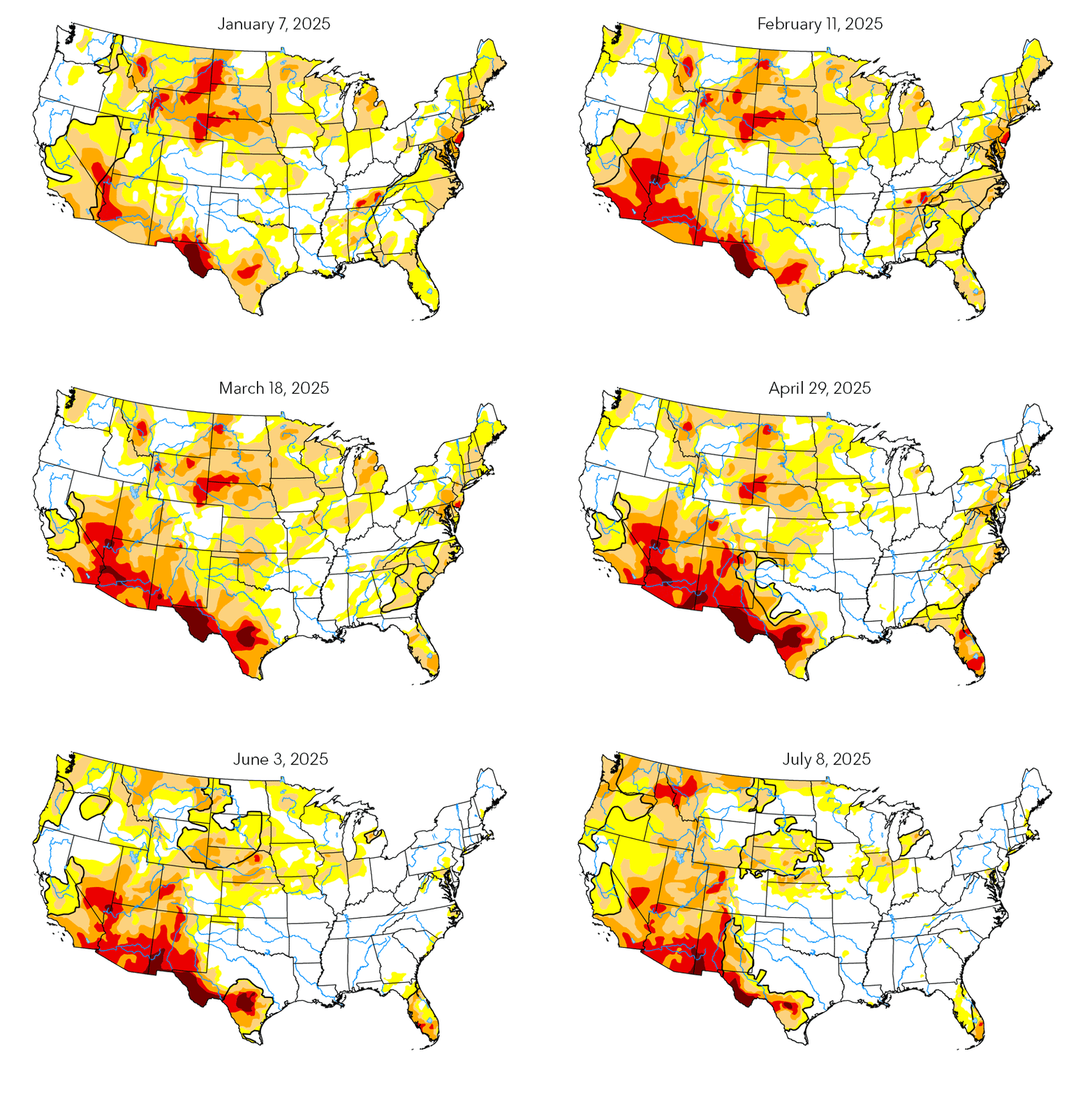
US Drought Monitor

Cold, wet weather continued to limit spring fieldwork in the Eastern Cornbelt. Up to three-quarters of an inch of rain was reported in central Illinois during the week, with forecasts warning of snow flurries on March 17-18 as weekend temperatures drop to the 20s and 30s.

Similar conditions were reported in central Indiana, with forecasts warning of steady rains on March 16 and a mix of rain and snow on March 17. Weekend highs in the state were expected to only reach the 30s, with more snow flurries likely on March 18.

A winter weather advisory was in effect for parts of northern Ohio at midweek, with 1-3 inches of lake effect snow expected. Central Ohio was expecting rainfall late in the week, with highs falling from the 50s to the 30s on March 17.

Western Cornbelt:

Highs climbed to the 40s and 50s in Iowa at midweek, but cooler and wetter weather was on tap for the end of the week. Much of the state was bracing for a cold and windy weekend, with highs struggling to climb out of the 30s in many locations, and wind chills remaining in the teens.

Winter kept its grip on Nebraska as well. After seeing temperatures at midweek reach the mid-60s in northern Nebraska and close to 70 in central areas of the state, winter weather warning and advisories went into effect on March 16, with forecasts warning of 2-7 inches of snow and 55 mph winds.

Central Missouri was hit with rainfall late in the week, with highs dropping from the 60s at midweek to the low-40s by March 17. By the weekend, high temperatures across central Missouri were expected to remain in the low-30s, with wind chills dropping to the 20s.

The weather continued to delay spring fieldwork in most areas, although Missouri contacts reported “minimal pasture fertilization taking place at this time.”

Corn Wheat Soybean Index

Southern Plains:

Although highs reached the 50s and low-60s across Kansas early in the week, conditions turned wet and cold as the week progressed, with highs dropping to the 40s and some western and northern areas of the state seeing a mix of rain and snow.

Oklahoma was bracing for potentially severe weather on March 16, with forecasts warning of large hail, high winds, and possible tornado activity. Strong storms were also expected to produce hail and high winds across central and northern Texas on March 16, with near-freezing temperatures moving into northern Texas on March 17.

A cold front was also taking aim at New Mexico late in the week, with rain and snow in the forecast for the western, central, and northern parts of the state on March 16-17. Freezing temperatures and snow returned to Colorado’s Front Range during the week after a brief period of springlike weather.

Dry conditions in parts of Kansas were taking a toll on winter wheat, with one source reporting a minimum 40% winter kill in north-central areas of the state. “Wheat conditions are going backward,” he said.

“Corn is pretty much done and emerging nicely for the most part,” reported one Texas source. “A little cold for the cotton guys with the front this week, but by this time next month it will be well underway.”

South Central:

Multiple storms were tracking through the South Central region late in the week, with severe weather reported in some areas.

Thunderstorms in southern Arkansas on March 16 produced strong winds and hail in some locations, with widespread rain across the state. Damaging winds, hail, and an elevated tornado risk were also reported in Louisiana and Mississippi on March 16-17, along with significant rainfall in some locations.

Kentucky was bracing for significantly cooler weather by the coming weekend, with highs dropping to the low-40s and upper-30s on March 17-18, well below the mid-60s reported at midweek.

“It’s been wet, so wheat applications are being done mostly by plane,” said one regional contact at midweek. He noted that the Louisiana market has been more active with the movement of corn fertilizer, “but that has also slowed off a bit this week with some rain.”

Southeast:

Cool temperatures and spotty showers were reported across the Southeast during the week. A freeze warning was in effect at midweek for portions of North Carolina, with temperatures dropping to the 20s in the mountains and north-central areas of the state.

Alabama was bracing for thunderstorms on March 16, with forecasts warning of potentially damaging wind gusts and a chance of tornado activity in northwestern areas of the state. Much cooler weather was on tap for the weekend, with lows expected to drop to the 20s and 30s in parts of Alabama.

Dry weather was reported across most of Florida after a wet weekend, with high temperatures reaching the 60s and 70s and lows dropping to the 40s and 50s. Rain was expected to return to central Florida over the coming weekend, however.

Transportation

US Gulf:

Weekday Bayou Sorrel Lock closures, restarted in March, were expected to limit daytime travel through May 31. Waits were noted up to five hours during the week.

Daylight-hour travel through Brazos Lock is blocked from 7:00 a.m. to 7:00 p.m., Monday through Friday, until March 31. Wait times were posted up to 38 hours. Work underway since Jan. 30 at Calcasieu Lock was scheduled to continue through March 3, with delays reported peaking at 23.5 hours on March 13.

Maintenance and repairs at Colorado Lock prompted daylight-hour shutdowns expected to run through April 28. The project was previously anticipated to wrap up on March 10. Waits topped out around the 41-hour mark.

Travel shutdowns were likely at the Belle Chasse Bridge in late March and early April due to ongoing bridge replacement work, sources said. The structure previously saw numerous single-day shutdowns between Feb. 20 and March 10. A planned closure at the Morgan City Railroad Bridge, located at Mile 121 in the West Canal, will force intermittent marine travel stoppages from mid-April through June.

Algiers Lock repairs, previously expected to start in late February and run for seven weeks, were delayed after inspections revealed the damage to be more extensive than previously believed. Once begun, dive work at the site is expected to close the lock to daytime travel for at least 30 days. About 20 days of shutdowns were previously anticipated. Most Algiers Lock waits tracked below 12 hours on March 14.

Port Allen Lock wait times were reported up to 17 hours during the week. Industrial Lock delays were counted in a wide 36-81 hour range.

Mississippi River:

High water levels persisted on the lower Mississippi River, triggering tow-size restrictions and slowed travel speeds. Maximum barge counts were reduced by up to 25% on both northbound and southbound travel, stretching delivery windows by 24-48 hours as a result.

Baton Rouge depths were reported at an action-stage 32.5 feet and rising on March 14. The gauge was forecast to crest at 33.5 feet on March 18-19 before falling below the 30.0-foot action stage on March 26.

Vicksburg tracked above the 35-foot action-stage at 40.48 feet on March 14. The gauge’s push above 40.0 feet prompted tows measuring wider than 105 feet to limit travel through the area to daylight hours, sources said. Some shippers expected conditions to begin improving as soon as the end of the week.

The Mel Price Lock and Chain of Rocks Lock main chambers were closed for repairs through March 31 and March 17, respectively. Transit continued through both sites’ auxiliary chambers, resulting in delays up to 40 hours at Mel Price. Chain of Rocks waits reportedly peaked at 26 hours on March 12-13.

The upper Mississippi River is expected to fully reopen from seasonal navigation shutdowns by April 1.

Illinois River:

High water levels continued to impact Illinois River navigation above Starved Rock Lock, sources said. Bridge clearance issues and reduced travel speeds were reported on both upriver and downriver travel.

Wickets remained lowered for the week at Peoria Lock and LaGrange Lock, allowing vessels to pass both sites without locking.

Brandon Road Lock, Dresden Island Lock, and Marseilles Lock are scheduled to shut to navigation for about 120 days starting on June 1, effectively closing the river to commercial transport through the end of September.

Ohio River:

The main chamber at Racine Lock was scheduled to return from repairs on March 12. Lingering delays were counted up to six hours on March 14. The primary chamber at Hannibal Lock was reported shut through April 7, with wait times noted up to 30 hours.

At JT Meyers Lock, floating mooring repairs slated to run through Aug. 20 were noted triggering intermittent main chamber shutdowns. The auxiliary chamber at JT Meyers is due to shut Aug. 21 through Sept. 10 for miter gate repairs, followed by an additional main chamber closure on Sept. 11-Nov. 17.

The Greenup Lock primary chamber is closed March 12 through April 12. At Melville Lock, the secondary chamber is due to shut April 17 through Aug. 4.

Kentucky Lock, on the Tennessee River, saw delays in a wide 5-19 hour range. Wilson Lock passages required up to 22.5 hours to complete, Corps data showed.

Arkansas River:

Interlock system repairs scheduled at Maynard Lock will shut the site to navigation on April 10-14, sources said.

Renewal of Black Sea Grain Initiative Under Discussion

The UN is expecting a Russian delegation in Geneva next week for discussions to renew the Black Sea Grain Initiative, Farhan Haq, a spokesperson for the UN’s secretary-general, said at a press briefing this week. The UN-brokered export pact is up for renewal on March 18.

The meeting will reportedly include discussions with Rebeca Grynspan, who has been working to clear obstructions for Russian exports, including fertilizer, according to Bloomberg. Grynspan is the Secretary-General of the UN Conference on Trade and Development.

Russia has shipped 40 million tons of grain abroad since July 1, Interfax reported on March 8, citing Roman Nekrasov, Director of the Crop Production Department at the country’s Agriculture Ministry. This means the country has already met at least two-thirds of the ministry’s 55-60 million ton grain-export forecast for the season, Bloomberg reported.

Russian Agriculture Minister Dmitry Partushev, in an interview with Kommersant, said Russia will have 30 million tons of grains from the current agricultural year, which runs from July 1, 2022, to June 30, 2023, to be sold in the next season thanks to the record crop and slow exports at the start of the season.

Cargill Inc., the world’s top agricultural commodities trader, said this week that rising grain exports from Ukraine are sparking optimism that the Black Sea Grain Initiative will be renewed.

The increase in Ukraine’s shipments of corn, wheat, and barley is helping push down world food costs after they jumped to a record in 2022. “There is political support from around the world to keep the corridor open,” Cargill CEO David MacLennan said in an interview with Bloomberg. “As long as that is the case, we will continue to help farmers and help product out of the country.”

Corteva Closes on Stoller, Symborg Acquisitions

Corteva Inc., Indianapolis, Ind., announced on March 2 that it has completed the acquisition of Houston-based Stoller Group Inc. and Symborg, a microbiological technologies company based in Murica, Spain. Corteva said the acquisitions position it as a global leader in the biologicals industry.

“These acquisitions illustrate Corteva’s commitment to providing farmers with sustainable solutions that bring value and productivity to the farm,” said Chuck Magro, CEO of Corteva Agriscience. “We are pleased to officially welcome Symborg and Stoller employees to Corteva. We believe their knowledge and expertise, combined with Corteva’s innovations capabilities, will come together to form a leading biologicals business ready to accelerate and grow with the rapidly expanding biologicals market.”

Corteva’s intent to purchase Stoller for $1.2 billion in cash was first announced on Nov. 30, 2022 (GM Dec. 2, 2022). At the time, Corteva pitched Stoller as one of the largest independent plant science and biologicals companies, with projected 2022 revenues of more than $400 million from operations in more than 60 countries.

Corteva announced its intent to acquire Symborg on Sept. 22, 2022 (GM Sept. 22, 2022). Financial terms and conditions of the agreement were not disclosed. Upon closing, Corteva said Symborg locations in Spain and subsidiaries in the US, Mexico, Peru, Chile, Brazil, France, Turkey, China, and Australia would become key elements of Corteva’s Biologicals Portfolio.

Corteva first collaborated with Symborg to scale up and market Utrisha™ N and BlueN™ nutrient efficiency optimizer as part of a distribution agreement between the two companies. The natural-origin biostimulant enables plants to fix nitrogen from the air and make it available to the plant, providing an alternative, supplemental nitrogen source and potentially reducing greenhouse gas emissions from fertilizer use.

The biologicals market is expected to be the fastest-growing crop protection segment in the industry, Corteva said, representing 25% of the overall market by 2035. Corteva said the acquisitions, which will be accretive to EBITDA in 2023, reinforce its commitment to providing farmers with environmentally friendly, sustainable tools that complement evolving farming practices with proven effectiveness.

Intrepid 4Q Sales Fall on Lower Volumes, Higher Pricing; Adjusted EBITDA Slips

Intrepid Potash Inc. reported fourth-quarter net income of $4.0 million on sales of $66.7 million, off from the year-ago $223.9 million and $71.9 million, respectively. The company’s 4Q 2021 net income was inflated by a $215.9 million valuation allowance for deferred tax assets, according to a company filing.

Adjusted EBITDA for the quarter was $23.1 million, down from the year-ago $24.8 million. Intrepid attributed the lower quarterly sales figures to deferred purchasing from buyers.

“During the fourth quarter, the trend of our agriculture customers showing preference for just-in-time purchases mostly continued until we saw a key fill program announced in early January,” said Intrepid Executive Chairman and CEO Bob Jornayvaz. “While some of the expected 2022 demand for our fertilizer products was deferred into 2023, during the fourth quarter the diversity of our sales mix into feed and industrial markets helped provide a stable floor for sales volumes.”

Potash sales totaled $43.8 million in the fourth quarter with an average net realized sales price of $693/st, up from the year-ago $38.8 million and $504/st, respectively. Intrepid produced more tonnage during the period, at 106,000 st versus 86,000 st in 4Q 2021, while selling 50,000 st compared to the year-ago 61,000 st, an 18% decline.

“Overall in 2022, high potash pricing drove very strong financial performance for Intrepid, which was among the best years in company history. Full-year adjusted EBITDA came in at $142 million, adjusted net income totaled $80 million, and our cash flow from operations totaled $89 million, which is net of the third-quarter $32.6 million customer refund,” Jornayvaz said.

“Using our strong cash flow generation, we were able to begin our investments in growth projects with the key goal of increasing our potash production and improving our per-unit economics,” he added. “Moreover, under our share repurchase program, we also returned approximately $22 million in capital in 2022, reducing our outstanding share count by roughly 5% compared to the second-quarter 2022 average.”

Fourth-quarter Trio® sales totaled $17.3 million with an average realized price of $461/st, compared to the year-ago $24.6 million and $388/st, respectively. The company produced 51,000 st in 4Q versus 53,000 st in the year-ago quarter, but sold just 28,000 st, down 42% year-over-year from 48,000 st.

Net income for full-year 2022 was $72.2 million on sales of $337.6 million, compared with the prior year’s $249.8 million and $270.3 million, respectively. Adjusted EBITDA was $141.8 million, up from $67.6 million in 2021.

Potash sales totaled $191.4 million in 2022 with an average realized price of $713/st, improving on the prior year’s $151.8 million and $353/st, respectively. The company sold 222,000 st of potash in 2022, off 33% from 2021’s 331,000 st, while producing 270,000 st for the 12-month period, down from 287,000 st in 2021.

Trio® sales for 2022 were $117.8 million with an average realized sales price of $479/st, rising from the prior year’s $96.1 million and $295/st, respectively. Sales volumes for 2022 fell 18%, however, to 197,000 st versus 239,000 st in 2021. Production was reported at 226,000 st for 2022, off from 228,000 st in 2021.

Intrepid expects the strong fertilizer market to continue into 2023, powered in part by ongoing potash supply uncertainty stemming from the war in Ukraine. The company’s key focus for the year ahead, according to Jornayvaz, will be the successful execution on its growth projects, with the goal of improving the cost side of Intrepid’s potash production unit economics.

“Looking at the broader macro environment for potash, there continues to be a structural potash supply gap owing to the Belarusian sanctions and concerns around Russian supply, which should continue to provide a relatively high floor for pricing in 2023 and beyond, even as incremental supply from other projects starts to enter the market,” Jornayvaz said.

“As for the outlook, we are pleased to share that this year is off to an encouraging start,” he added. “US farmers have wrapped up two consecutive years of very high profitability, are entering 2023 with strong balance sheets, and high prices for crop futures point to another year of robust farmer economics. For the first quarter, we have seen strong demand for our potash and Trio®, which we expect to continue throughout the year as farmers will likely be incentivized to maximize their yields.”

Potash 4Q-22 4Q-21 2022 2021
Sales (000 st) 43,756 38,807 191,378 151,751
Gross Margin ($000) 20,907 12,516 94,769 35,845
Sales Volume (000 st) 50 61 222 331
Production Vol. (000 st) 106 86 270 287
Avg Realized Price ($/st) 693 504 713 353
Trio® 4Q-22 4Q-21 2022 2021
Sales (000 st) 17,265 24,612 117,826 96,058
Gross Margin ($000) 3,429 7,913 39,123 16,442
Sales Volume (000 st) 28 48 197 239
Production Vol. (000 st) 51 53 226 228
Avg Realized Price ($/st) 461 388 479 295
Oilfield Solutions 4Q-22 4Q-21 2022 2021
Sales (000 st) 5,732 8,479 28,668 22,770
Gross Margin ($000) 1,315 1,420 7,516 3,477

Meristem Opens New Warehouse in Indiana

Crop inputs supplier Meristem Crop Performance Group LLC, Columbus, Ohio, announced on March 2 that it has built and opened a new 20,000-square-foot warehouse in Westfield, Ind., in the northern suburb of Indianapolis, Ind.

The company said the new site “provides an eastern capability for Meristem,” with logistics and fulfillment supported by another Meristem warehouse in Fremont, Neb. The Westfield warehouse is already accepting and staging inventory for the 2023 crop season.

“We’re very excited about this next step in our modified direct-to-farm distribution solution to help us cut waste and drive down costs for Meristem farmer-customers,” said Mitch Eviston, Meristem Founder and CEO. “This big, new, efficient warehouse is at the heart of our mission to assure that we can efficiently get farmers what they need when they need it.”

John Gertz, Meristem’s Chief Operating Officer, said customer pick-ups and outbound shipments at the Westfield warehouse began during the last week of January. “After coming through the ups and downs of logistics during the pandemic, we knew we needed to build excellence in order fulfillment, and with these warehouses east and west, we are well on the way,” he said.

Meristem has hired Nikki Decesare and Jim Clay to run the new warehouse. Decesare and Clay will join Meristem veteran Ashley McCann, Sales and Customer Care Manager, to spearhead the company’s new customer care initiative, which Meristem said is designed to “assure a first-class customer experience and product stewardship for every farmer-customer.”

“As we’ve grown to reach several million acres all across the country, we’ve gained a lot of insight to what’s needed to bring a positive experience to farmers, plus continue our drive to make it efficient,” McCann said. “Communication is key, and that’s why we’re also hiring another three customer care associates to assure that we stay connected to customers.”

Mosaic Fertilizantes to Expand Potash Production in Brazil

Mosaic Fertilizantes, the Sao Paulo, Brazil-based business unit of The Mosaic Co., announced on March 7 that it plans to invest more than R$800 million (US$154 million) to increase potash production in Sergipe, northeast Brazil, to 450,000 mt in 2024 from 370,000 mt last year.

The expansion at the Taquari-Vassouras Mineral Chemical Complex in Rosário do Catete will focus on the extraction of sylvinite used in the processing of potash. The investment in machinery and local infrastructure is expected to extend the life of the operation to at least 2030, the company said, with investments in labor, contracting services, and purchasing materials contributing to Sergipe’s economy.

“Aware of the importance and viability of this operation for the domestic market, we decided to make this investment to extend the useful life of this operation and increase its production capacity in a market that should continue to grow,” said Corrine Ricard, President of Mosaic Fertilizantes. “We know how relevant it is to have a competitive operation in one of the countries with the highest growth rate in potash demand.”

Since taking over the operation of the Taquari-Vassouras Mineral Chemical Complex following the purchase of Vale’s fertilizer assets (GM Jan. 12, 2018; Jan. 5, 2016), Mosaic Fertilizantes said it has invested resources and technical efforts to study economically viable and long-term solutions for continuing the exploration of potash in Sergipe.

“All of this points to the continuity of commitment and commitment to the local operation, essential for the national agribusiness,” Ricard said. “We maintain a constant dialogue with employees, the community, and authorities about the evolution of our operation and about opportunities and challenges for the growth of the fertilizer industry in the region.”

In February (GM Feb. 24, p. 23), Mosaic Fertilizantes announced plans to invest R$400 million (US$80 million) in the construction of a 1 million mt blending and distribution facility at Palmeirante, in Tocantins state, expanding the company’s presence in Brazil’s northern agricultural region.

The site will start operations in 2025, employing around 200 people. The unit will produce 500,000 mt in the first year, the company said, reaching its targeted annual production capacity of 1 million mt in 2028.

Mosaic Fertilizantes said it is now Brazil’s largest distributor of fertilizer. When combined with direct sales from the production business, the company said its total sales volumes account for 23% of all fertilizer sales in Brazil.

FY2022 Production, Sales Up for PhosAgro

Russian fertilizer group PhosAgro PJSC, Moscow, reported that its production of fertilizers and other chemicals reached 11.1 million mt in 2022, a 4.6% increase compared with 10.59 million mt the previous year (GM Feb. 3, p. 27).

Fertilizer sales volumes in 2022 grew 6% year-over-year, to 11.1 million mt from 10.43 million mt in 2021. FY2022 sales volumes were an all-time record, the group said in a March 3 statement.

Phosphate-based fertilizer and feed phosphate sales volumes increased by 8%, to 8.4 million mt from the prior year’s 7.76 million mt, while nitrogen fertilizer sales volumes were up 2%, to 2.55 million mt from 2.5 million mt the previous year.

PhosAgro attributed the sales volume growth to the increase in production volumes and strong demand for fertilizers in Russian and global markets.

The increased sales volumes of end products, combined with higher average sales prices in world markets and a focus on sales of high-margin fertilizers, helped boost PhosAgro’s FY2022 revenue by 35% compared with the previous year, the group reported.

At the same time, revenue grew faster than the cost of sales, which rose by about 23% during the 12 months. Revenue reached RUB569.5 billion ($8.3 billion), up from RUB420.5 billion the year before.

FY2022 adjusted EBITDA increased 39%, to RUB266.9 billion ($3.9 billion) from RUB192.1 billion. Adjusted net profit for the year rose 40%, reaching RUB182.3 billion, up from RUB130.5 billion.

PhosAgro’s results for the fourth quarter of 2022, however, were weaker than last year. Lower phosphate fertilizer prices and a stronger ruble led to a 14% drop in revenue, Interfax reported.

Adjusted EBITDA for the final quarter was down almost 28% at RUB44.5 billion, and below the Interfax Consensus estimates of RUB46.3 billion. Downward pressure came from rising commodity prices, higher inflation, and a higher Mineral Extraction Tax (MET) for apatite-nepheline ore production compared to the year before, according to the report.

Fourth-quarter adjusted profit fell 29% on the previous year, to RUB32.1 billion, slightly missing analysts’ expectations of RUB32.6 billion.

Looking ahead, PhosAgro said the market for nitrogen-based fertilizers in the first quarter of 2023 has been marked by excess supply due to high levels of carryover stocks in European countries, as well as in North and South America, which the company said continues to have a negative impact on prices.

The group said phosphate-based fertilizers have now stabilized. “Prices can expect support from an increase in seasonal activity in South America, and in Brazil in particular, as well as in the US domestic market following a significant reduction in imports in 2022,” PhosAgro said.

The group reported that its net debt as of Dec. 31, 2022, had increased to RUB180.3 billion ($2.6 billion), up from RUB153.7 billion as of Dec. 31, 2021. The group’s net debt/EBITDA ratio, however, decreased to 0.68x at the end of 2022 versus 0.80x at the end of 2021.

Based on the FY2022 results, PhosAgro’s Board of Directors has recommended paying dividends of RUB465 ($6.11) per share from retained earnings, and approved April 4 as the dividend record date. The dividend will be discussed at a general meeting on March 24.

PhosAgro Production and Sales Volumes

‘000 mt FY2022 FY2021 % change
Production      
Phosphate fertilizers and feed phosphates 8,224 7,894 +4
Nitrogen fertilizers 2,547 2,412 +6
Other products 302 280 +8
Total 11,073 10,585 +5
       
Sales Volumes      
Phosphate fertilizers and feed phosphates 8,403 7,762 +8
Nitrogen fertilizers 2,551 2,495 +2
Other products 144 177 (19)
Total 11,098 10,434 +6