

Cornbelt:
The NPSZ market was unchanged at $685-$725/st FOB in the Cornbelt, depending on location.
Pacific Northwest:
40-Rock pricing was steady at $780/st FOB or DEL in the Pacific Northwest, unchanged from last report.
Cornbelt:
The NPSZ market was unchanged at $685-$725/st FOB in the Cornbelt, depending on location.
Pacific Northwest:
40-Rock pricing was steady at $780/st FOB or DEL in the Pacific Northwest, unchanged from last report.
California:
SOP pricing in California slipped to $850-$860/st FOB, down from the previous $850-$900/st range, with the high at Chico and the low reported at Stockton, Woodland, and Turlock.
Pacific Northwest:
Granular SOP pricing was steady at $860-$870/st FOB in the Pacific Northwest.
California:
Granular SOP Magnesia in California remained at $565-$575/st FOB for the last confirmed business.
Pacific Northwest:
The granular SOP Magnesia market was steady at $560-$565/st FOB in Washington.
California:
Potassium nitrate prices in California included $1,385/st FOB Stockton for bulk tons, $1,490/st FOB for bulk bags, and $1,510/st FOB for 50-pound bags.
Eastern Cornbelt:
A winter storm was expected to bring snow to northern Illinois and rain to central areas of the state late in the week, with forecasts suggesting a strong possibility of 6-10 inches of snow in some locations.
Indiana was bracing for strong winds and heavy rainfall from the same system. All of central Indiana was under a wind advisory on March 3, with forecasts warning of 1-2 inches of rainfall and localized flooding, prompting a flood watch from some areas. Far northern areas of the state were bracing for snow as the system pushes through.
Strong thunderstorms earlier in the week produced widespread power outages across central Ohio, prompting multiple tornado and severe thunderstorm warnings. Some areas saw large hail and 45-60 mph winds gusts, followed by climbing temperatures as the week progressed, with highs reaching the 50s and 60s across the state. Another round of heavy rain and minor flooding was in the Ohio forecast again on March 3.

Western Cornbelt:
The week began with 1-2 inches of rainfall across a wide swath of central Iowa. Highs climbed to the 30s in northern Iowa and the low-50s in central and southern Iowa during the week.
Light snow flurries moved through Nebraska on the last day of February, with temperatures warming to the 40s and 50s at midweek. Another cold front was on tap for late in the week, however, with highs falling back to the 30s and low-40s.
Missouri was bracing for potentially heavy rain late in the week, with flash flood watches in effect for some southern areas of the state on March 2. Forecasts warned of 1-2 inches across central Missouri and close to three inches in parts of southeastern Missouri.
California:
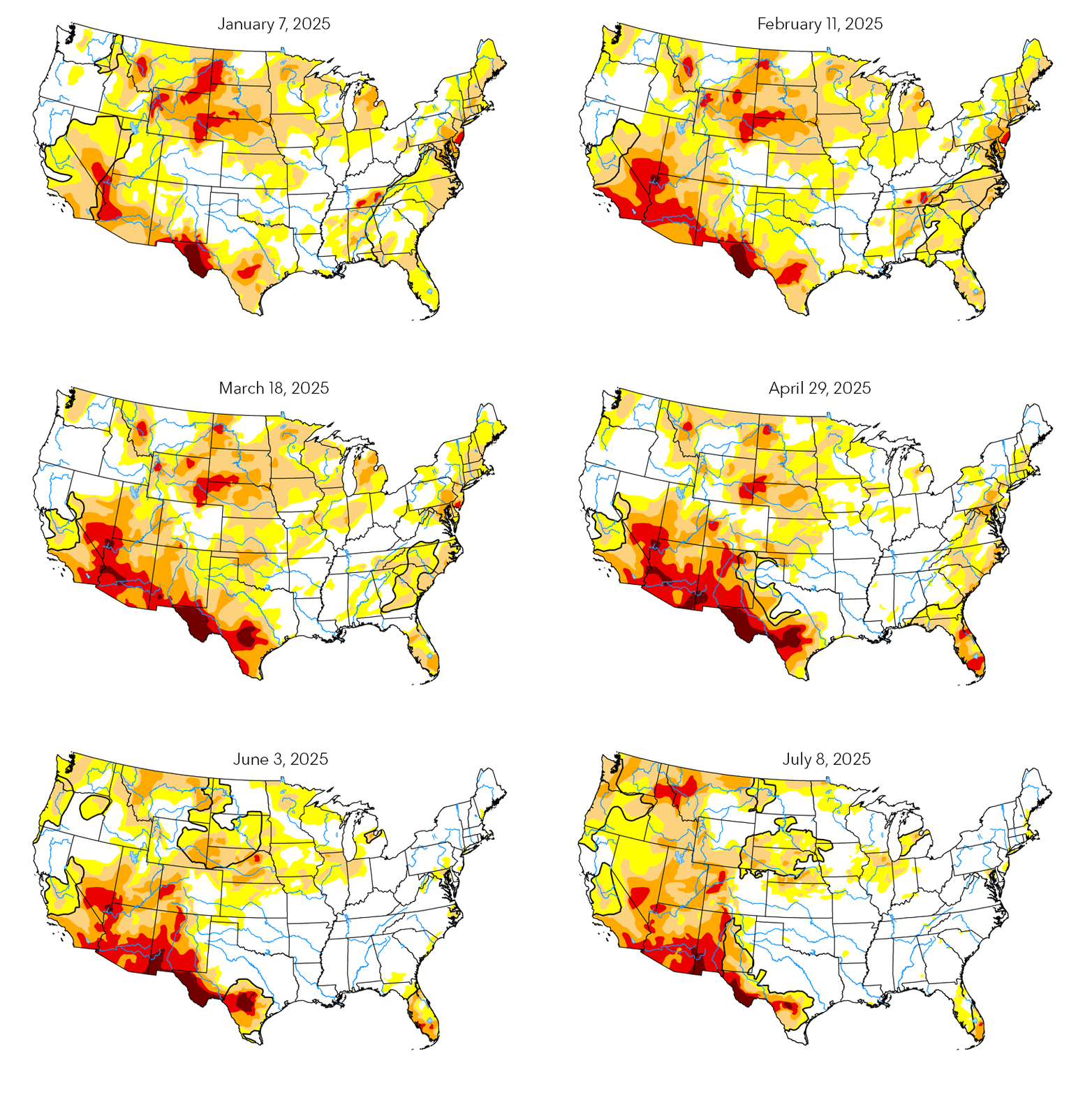
California’s historic winter continued as February came to a close, with more heavy snow causing widespread power outages and road closures.
In Northern California, blizzard conditions were expected to drop another 3-4 feet of snow in the Sierra Nevada from Feb. 28 through March 1, forcing authorities to close portions of Interstate 80 and Highway 50 during the week. More than 50,000 homes and business were without power on Feb. 28 across Northern California.
Sacramento experienced heavy rain, strong winds, and near freezing temperatures at midweek, while San Francisco posted a record low of 39 degrees on March 1. Snowfall totals in Yosemite National Park reached 15 feet as waves of storms pounded the region.
A third wave of storms also pushed more rain, snow, and high winds into Southern California early in the week, prompting winter storm warnings for Los Angeles, Riverside, and San Bernardino. Forecasts warned of 2-6 feet of snow accumulation at higher elevations and an inch or more of rain in coastal areas and valleys.
The recent storms continued to boost reservoir levels, contributing to California’s ongoing drought recovery. Shasta Lake was up to 84% of its historical average by the end of February, compared with 57% at the beginning of January. Lake Oroville is higher than its historical average at 116%, up from 71%.
California’s snow water equivalent in the Sierra Nevada was 181% of average as of Feb. 27 and 156% of a full season’s average, according to the California Department of Water Resources. The Northern Sierra/Trinity region’s snowpack is at 144% of the average, Central Sierra is 185%, and the Southern Sierra mountains are at 219% of the average.
Pacific Northwest:
After a near-record 10.8 inches of snow in Portland, Ore., in late February, forecasts warned of additional snow and slush during the first days of March across the Willamette Valley, along with freezing temperatures.
Eastern Oregon was bracing for 35 mph winds and 6-8 inches of snow above 3,000 feet during the week, with heavy snow and high winds also expected in southern Oregon.
A winter storm warning was in effect for parts of the Cascades in western Washington on March 2-3, with 4-6 inches of snow expected in the Cascade foothills in southern Washington and 12-24 inches in Snohomish, King, Whatcom, and Skagit counties. Temperatures in Seattle dropped to 28 degrees on March 1, the coldest in 58 years for that date.
The same powerful system also brought heavy snow and severe weather to Idaho, prompting closures earlier in the week for portions of Highways 20, 26, 87, 32, and 33. Snowfall also blanketed portions of western Montana during the week, with temperatures in the 20s and low-30s across much of the state.
Western Canada:
After a cold Arctic blast during the final week of February, temperatures warmed up considerably across Western Canada during the first days of March.
The warmer weather also ushered in some winter precipitation, along with strong winds in some locations. A wind warning was in effect for most of southern Alberta at midweek, with reports of 70-100 km/h gusts causing blowing and drifting snow across the region.
Environment Canada also issued a special weather statement for British Columbia’s South Coast at midweek, with rain expected at lower elevations and heavy snow in the mountains. The last days of February also brought heavy snow to Vancouver and other locations in the province.
US Gulf:
Most sources put NOLA urea trades in the $310-$335/st FOB range, up from the week-ago $302-$325/st FOB.
Eastern Cornbelt:
Urea prices in the Eastern Cornbelt rebounded slightly on firming NOLA barge business. Most terminals were reported at $390-$400/st FOB on the Illinois and Ohio Rivers during the week, but very little was trading. “Dealers are scared it’s not going to last,” commented one source about the bump in pricing. “Most have a layer of urea bought in the $500s.”
Western Cornbelt:
Urea prices firmed to $375-$400/st FOB in the Western Cornbelt, with the St. Louis, Mo., market quoted at the $375-$380/st FOB level at midweek.
Southern Plains:
New urea pricing at Catoosa/Inola, Okla., was quoted at $385-$410/st FOB during the week, up from $370-$390/st FOB last week. The Houston, Texas, urea market was reported at the $450/st FOB level for the latest offers.
South Central:
Urea was quoted at $385-$400/st FOB in the South Central region, with the low confirmed at Memphis, Tenn., and Convent, La., and the high at Little Rock, Ark. Kentucky sources quoted new offers out of Ohio River terminals at $390-$400/st FOB, with the low for prompt and the high for prepay.
Southeast:
Urea pricing out of port terminals in the Southeast was reportedly down to $410/st FOB, well below the previous week’s $425-$450/st FOB and the $460-$470/st FOB level confirmed earlier in February.
India:
The long-awaited urea tender call finally came from IPL. The closing date is March 3, with the buyer calling for 1 million mt and a shipping deadline of June 1.
Industry watchers had been expecting a shipping period longer than the usual six weeks, but most were surprised by the 12-week time frame. Sources said the longer shipping window will help prevent the urea market from overheating as trading houses scramble to gather tons to offer to India, and will allow for purchase deals to be spread out over the three-month period instead of being concentrated.
Sources also noted the longer shipping time could allow for more Chinese product to play a role in the tender. Buying from China requires clearances from customs officials that have taken 2-3 month to be issued. Even with word from Beijing that the clearance process will be streamlined, the process could still require multiple weeks before the urea is cleared for export. The longer shipping period offered by IPL could make it possible for tons to be approved for shipment in May.
Besides the possibility of more Chinese product than expected, sources said the Arab Gulf producers will most likely lead the way. Producers from Indonesia, North Africa, and possibly Nigeria could also become part of the supply chain.
Sources were generally hesitant to offer predictions on where the price will end up, although one trader speculated that the recent Indonesian selling tender was a possible floor. The price in Indonesia was $349/mt FOB, leaving this trader to suggest Indian prices ranging $360-$400/mt CFR.
No matter the price, sources said the final amount will be dramatically lower than the last tender price of $573-$579/mt CFR, which closed on Nov. 14, 2022 (GM Nov. 18, 2022).
Middle East:
Egyptian prices moved up smartly all week. Sales of small 5,000-6,000 mt lots to European buyers started the week at $387/mt FOB and ended at $395/mt. Most of the deals were done by MOPCO, but sources reported that Abu Qir also sold some small lots late in the week.
Traders said the sales all seemed to be covering shorts into Europe. Sources expect to see at least one cargo from Egypt offered in the Indian tender.
Algerian producer AOA followed Egypt’s lead with sales to European buyers at $380/mt FOB. Deals with more distant buyers, such as those in Latin America, were put in the $340s/mt FOB. AOA told those inquiring later in the week that they were sold out for March.
No new spot deals were reported in the Arab Gulf, leaving industry watchers to estimate where prices might be. Sources said that discussions widened target prices down to $330/mt FOB, and as high as $340/mt FOB. One source said the higher end was being offered by producers, with buyers pushing hard for the lower end.
Arab Gulf urea is expected to be the dominant product offered in the IPL urea tender, set to close on March 3. Sources said the tender’s long three-month shipping window could allow more participation from producers.
Sources said that weak demand from the United States, Brazil, and Australia could allow Arab Gulf producers to shift potential tonnage from those buyers to India, giving traders even more product for offers than expected.
Indonesia:
The mid-February selling tender surprised many in the industry. One trader noted that even one day before the tender call, Indonesian sources predicted that no sales would be made until March.
The change of heart, said one trader, might have occurred after reports of reduced domestic demand circulated in the country. Even if this was the main factor, sources said the government remains hesitant to push for more exports until the very end of the current season, as the government does not want the domestic market to appear short of product in an election year.
Even with concerns for the domestic market, sources said that 1-2 cargoes of Indonesian product will most likely be offered into the Indian tender.
Brazil:
Carnival celebrations cut into the work week, leaving just a few days for trading. Even with the short week, sources reported a large upward shift in the market. Deals rumored at $360/mt CFR came on the heels of sales at $350/mt CFR. By the end of the week, new offers were reported at $370/mt CFR, but without any confirmed business at that level
Rondonopolis was reported up a few dollars as well, with sources putting the price at $550-$565/mt FOB ex-warehouse. The inland market was not yet hit with the large increase seen at the ports. Many local buyers are only getting product as they need it rather than buying too far in advance.
South Korea:
Urea imports were counted at 102,000 mt for January, down 34% from 155,000 mt imported in January 2022, Trade Data Monitor reported. China supplied 47% of the imports with 48,000 mt, followed by 26,000 mt from Qatar.
Black Sea:
Prilled urea from the Black Sea is now reported at $285-$295/mt FOB, down from $320/mt FOB a week ago.
American farmers will plant more corn, soybeans, and wheat this spring, with Russia’s war in Ukraine keeping crop prices high and supplies tight, USDA Chief Economist Seth Meyer said at the agency’s annual Outlook Forum on Feb. 23.
Corn plantings are projected at 91 million acres, up 2.4 million acres from last year and the highest planted acreage since 2021. USDA said reduced corn exports from Ukraine and strong demand from China should boost corn exports by 275 million bushels this year, with feed and residual use up 6%.
Soybean planted acreage is estimated at 87.5 million acres, unchanged from last year, but a projected yield increase to 52 bushels/acre from last year’s 49.5 bushels/acre should boost soybean annual production in 2023.
Planted wheat acreage is projected at 49.5 million acres, up 3.8 million acres from last year due to high global prices and tight supplies, partially due to the ongoing war in Ukraine. US cotton plantings, by contrast, are expected to decline by almost 21%, dropping to 10.9 million acres in 2023.
Total planted acreage in the US in 2023 is expected to be up nearly 3% from 2022. Corn futures fell as much as 1% after the estimates were released, dropping to $6.675/bushel in Chicago. Soybean futures also fell, while wheat and cotton rose, with cotton futures moving up as much as 1.6%.
Crop prices, while still high, are projected to decline in 2023, USDA said. Corn prices are estimated to drop more than 16%, with the season-average price projected at $5.60/bushel. Soybean prices are expected to fall nearly 10%, to a season-average price of $12.90/bushel, while the season-average price for wheat is projected at $8.50/bushel, down almost 6%.
The lower crop prices will also drive farm income lower, USDA said, with 2023 net cash farm income falling nearly 23% from 2022’s record levels, and net farm income dropping approximately 18%. While down from last year, Meyer stressed that US farm income will still be strong, driven by thin global supply.
“The supplies that are available for purchase on the global market remain tight,” he said.
The estimates are USDA’s first acreage outlook for the spring season, with more definitive estimates based on thousands of farmer surveys due in the Prospective Plantings report on March 31.
US Gulf:
NOLA barges continued to be called $250-$275/st ($7.81-$8.59/unit) FOB, with players firmly entrenched at each end of the range.
Eastern Cornbelt:
UAN-32 pricing in the Eastern Cornbelt continued to drop, with new offers reported at $310-$315/st ($9.69-$9.85/unit) FOB Cincinnati, Ohio, $315-$335/st ($9.84-$10.47/unit) FOB Mount Vernon, Ind., and up to $360/st ($11.25/unit) FOB Seneca, Ill.
Western Cornbelt:
UAN-32 remained under pressure in the Western Cornbelt, with new offers reported at $295-$300/st ($9.22-$9.38/unit) FOB Port Neal, Iowa, and $320-$325/st ($10.00-$10.16/unit) FOB St. Louis. In the Northern Plains, the latest spring offers FOB Winona, Minn., were quoted at $365/st ($11.41/unit), down significantly from the previous $440/st FOB level.
Southern Plains:
UAN-32 at Oklahoma production points reportedly fell to $265-$300/st ($8.28-$9.38/unit) FOB, down from $310-$330/st ($9.69-$10.00/unit) FOB, with the low confirmed at Verdigris. New offers FOB Woodward were quoted at $270-$275/st ($8.44-$8.59/unit), while rail-DEL pricing in the Texas High Plains slipped to $300-$305/st ($9.38-$9.53/unit).
South Central:
February-March UAN-32 offers were confirmed at $310-$335/st ($9.69-$10.47/unit) FOB in the South Central region, down from the prior $325-$350/st ($10.16-$10.94/unit) FOB range, with the low for truck tons in Louisiana and the high reported by Kentucky sources out of Ohio River terminals.
Southeast:
The UAN-32 market in the Southeast was quoted at $370-$400/st ($11.56-$12.50/unit) FOB port terminals in late February, with the low confirmed at Savannah, Ga., and the high at Wilmington, N.C., and Norfolk, Va. Spot pricing out of inland terminals in Georgia remained significantly higher at the $450/st ($14.06/unit) FOB level.
Turkey’s Yıldırım Holding AS has taken over operations at the Croatian port of Šibenik, located on the country’s Adriatic coast, north of Split, according to a Bloomberg report, citing an emailed statement from the Turkish group.
The port used to operate as Croatia’s main fertilizer port prior to the production halt early last year at the country’s sole fertilizer producer, Petrokemija d.d.
The takeover of Šibenik port is part of Yildirim’s acquisition of control of Petrokemija. The Turkish group signed an agreement with the Croatian producer’s biggest shareholder, Croatian oil and gas group ING d.d., and Croatian gas company Prvo Plinarsko Društvo last November to acquire Terra Mineralna Gnojiva company, which holds a 54.517% stake in Petrokemija (GM Nov. 18, 2022).
Yildirim Holding has been targeting a first-quarter 2023 production restart of Kutina-based Petrokemija, and aims for the operation to achieve full capacity operations of 1 million mt/y of fertilizers (GM Dec. 9, 2022). Production was halted over 10 months ago amid rising natural gas costs,
The port of Šibenik is a general cargo port, handling ships of up to 50,000 dwt. Yildirim port operations subsidiary Yilport is targeting €50 million (approximately $53 million at current exchange rates) at the port, aimed at turning it into a multi-purpose terminal, according to the report.