

Eastern Cornbelt:
After spotty showers earlier in the week, dry weather and cooler temperatures settled in for most of the Eastern Cornbelt in mid-September. Highs in the mid-70s were reported at midweek in Illinois and Indiana, with lows dropping to the 40s in central and northern Ohio.
Illinois growers had 2% of the corn harvested by Sept. 10, with 42% of the crop rated as mature. Crop maturation was lagging in Indiana and Ohio, where just 11-12% of the corn was mature by that date. USDA rated fully 75-82% of Ohio’s corn and soybeans as good or excellent on Sept. 10, compared with 65% in Indiana and 58% in Illinois.
Western Cornbelt:
Cooler weather moved into much of the Western Cornbelt during the week, with parts of Iowa picking up needed rain showers as the week began.
Several Iowa locations received more than two inches of rain on Sept. 10, including Centerville, Eldon, Allerton, and Promise City. Des Moines received nearly an inch as the system worked through the state, with Iowa City posting just above a half-inch of rain. Temperatures hit the high-70s and low-80s across the state for the balance of the week.
With 38-51% of the regional corn crop mature by Sept. 10, USDA assigned good or excellent ratings to 51% of the acreage in Nebraska, 46% in Iowa, and 35% in Missouri. Iowa growers had 9% of the corn crop in the bin by Sept. 10, compared with 2% in Missouri and Nebraska.
Some 44-46% of the regional soybean crop fell in the good or excellent categories at mid-month, along with 80% of Missouri’s rice, 60% of Nebraska’s sorghum, and 67% of Missouri’s cotton crop. Missouri’s rice crop was 14% harvested by Sept. 10, while 16% of Nebraska’s sorghum was rated as mature.
Northern Plains:

After a sunny week with highs in the 80s, central Minnesota was bracing for spotty showers on Sept. 14-15. Similar conditions were reported in South Dakota, where western areas of the state were expecting a 60% chance of rainfall and lows dipping into the 50s late in the week.
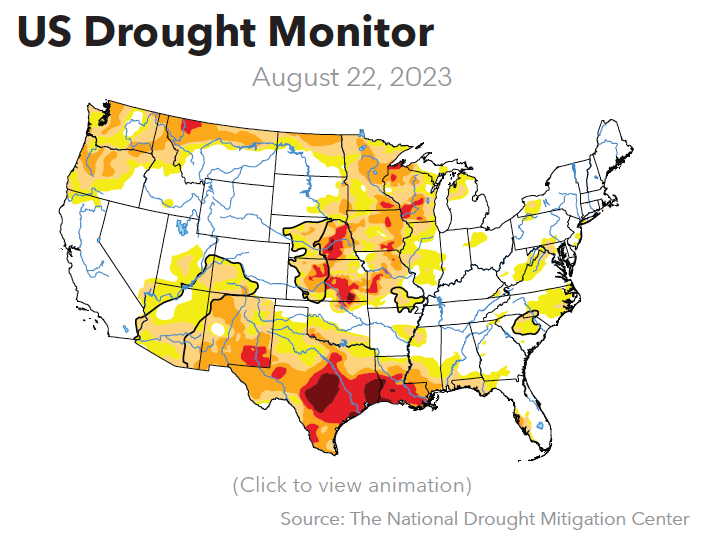
All of Minnesota remained locked in drought, with a broad swath of severe-to-extreme drought stretching across the midsection of the state from north to south. Drought conditions also covered the northern half of North Dakota at mid-month.
Just 1% of the corn in Minnesota and South Dakota was harvested by Sept. 10, with good or excellent ratings assigned to 39% of the acreage in Minnesota, 41% in South Dakota, and 66% in North Dakota. South Dakota’s sorghum crop was 55% good or excellent, while soybeans in those two categories totaled 43-51% of the regional crop.
The harvest of oats, spring wheat, and barley had progressed to 99-100% complete in South Dakota, 94-98% in Minnesota, and 82-93% in North Dakota as of Sept. 10.
Great Lakes:
Sunny weather was reported across Michigan and Wisconsin during the week, with highs in the 70s. Parts of Michigan reported scattered showers during the week, and the state was largely drought-free in mid-September. Drought was widespread in Wisconsin, however, with severe-to-extreme drought covering much of the state.
The regional corn crop was 10-16% mature as of Sept. 10, with good or excellent ratings assigned to 56% of the acreage in Michigan and 50% in Wisconsin. Soybean conditions were similar, with 53% of Michigan’s crop and 47% of Wisconsin’s rated as good or excellent.
Northeast:
Parts of New England were under a tropical storm warning late in the week as the remnants of Hurricane Lee were expected to bring damaging winds, heavy rain, flooding, and power outages to the region.
A flash flood warning was also in effect for parts of Maryland at midweek, but the major impact from Lee was expected north of the Mid-Atlantic region, from Rhode Island to Nova Scotia. A tornado was confirmed in Connecticut on Sept. 13.
Corn conditions continued to excel in Pennsylvania, thanks to plenty of moisture and heat units this summer. Fully 80% of the state’s acreage fell in the good or excellent categories on Sept. 10, with 4% of the acreage rated as mature. “A lot of the corn for silage is off as it dried down quickly with the hot dry weather,” said one contact.