DAP/MAP

Central Florida: 

With nothing new reported on the Central Florida truck phosphate market, prices continued to be quoted at the $910-$950/st FOB level for both DAP and MAP.

MAP trucks loading from North Florida were posted at $1,000/st FOB, unmoved from the prior report. Reference prices at Aurora, N.C., also remained at $1,000/st FOB for both DAP and MAP.

U.S. Gulf: 

Phosphate barges loading from NOLA continued their upward march during the week, with sources reporting DAP barges trading above the $1,000/st FOB mark for the first time since Sept. 15, 2008. The NOLA market’s all-time high of $1,095/st FOB was recorded on July 21, 2008.

After several weeks in the $900s/st FOB, market players reported DAP firming from a floor of $980/st FOB up to $1,000-$1,010/st FOB during the week, rising from the week-ago $980/st FOB top.

MAP barges remained a step behind DAP. Most players cited $995/st FOB as the top of the market, rising from the week-ago $975/st FOB high, but well shy of the all-time $1,115/st FOB MAP record set on June 30, 2008. Sources reported MAP values kicking off the March 18-24 trading period at $960/st FOB.

An uncertain global supply outlook, combined with expected price increases in a number of international ammonia and sulfur markets, were likely to sustain prices through the short-term, many players argued.

The DAP barge market was quoted in the $980-$1,010/st FOB range through the week, rising from $940-$980/st FOB at last report. MAP barges were pegged at $960-$995/st FOB, up from the week-ago $940-$975/st FOB range.

U.S. Export: 

Price ideas on the U.S. Gulf phosphate export markets were noted in the $1,000-$1,050/mt FOB range, with actual values likely to land higher should new business conclude today. The market was previously reported at $850-$858/mt FOB.

Eastern Cornbelt: 

DAP pricing firmed to $1,000-$1,030/st FOB regional terminals in the Eastern Cornbelt, up from the prior week’s $990-$1,020/st FOB range, with the Cincinnati market pegged at $1,000-$1,010/st FOB at midweek. MAP pricing was reported at $1,000-$1,025/st FOB in the region, with the low confirmed at Cincinnati.

Western Cornbelt: 

The DAP market was quoted at $1,000-$1,030/st FOB in the Western Cornbelt, up $10/st at the high end of the range, with the St. Louis market pegged at $1,000-$1,020/st FOB. MAP remained at $1,005-$1,025/st FOB in the region.

California: 

New MAP postings in California were quoted at the $1,070/st FOB or DEL level, up another $50/st from the prior week and a full $100-
$150/st higher than early March pricing levels.

Pacific Northwest: 

MAP pricing in the Pacific Northwest was up another $50/st or more from the previous week, to $1,060/st FOB Aurora, Ore., $1,060/st DEL in Idaho, Utah, and Montana, and $1,050/st DEL in Washington, Oregon, and Nevada.

Western Canada: 

MAP prices were pegged in the C$1,400-$1,500/mt FOB range in Western Canada in late March, up dramatically from the C$1,220-$1,280/mt offers reported earlier in the month. No current DEL prices were confirmed in late March.

Saudi Arabia: 

Recent Saudi Arabia phosphate pricing was heard firming to the $950-$1,120/mt FOB range, rising from $950-$1,030/mt FOB at last report.

China: 

Exports of DAP are still allowed, but only to buyers with long-term contracts. Sources said no new deals are being allowed to be covered at this time.

Exports of DAP in January and February were reported at 363,000 mt by Trade Data Monitor. This represents a 9 percent drop from the 399,000 mt exported during the same period in 2021. The main buyers in the first two months of this year were India with 106,000 mt, and Thailand with 41,000 mt.

February 2022 exports of DAP were down almost 60 percent, to 114,000 mt from February 2021 exports of 279,000 mt. Bangladesh was the top buyer in February with 36,000 mt, followed by 28,000 mt to Thailand and 21,000 mt each to Japan and Australia.

Exports of MAP in January and February were reported at 101,000 mt by Trade Data Monitor, down 74 percent from the 387,000 mt exported in the same period of 2021. February 2022 exports of 48,000 mt showed an even more precipitous drop compared to February 2021 exports of 227,000 mt. Australia dominated the February purchases with 39,000 mt.

India: 

DAP producers are holding off on making major production decisions, sources said, because the government is considering making changes to subsidy levels and the maximum retail price for their product. The new fiscal year begins on April 1, and new rules are expected to be in place at that time.

NFL will close a tender on March 28 for two lots of 50,000 mt each of DAP. The cargoes are to be evenly divided between East Coast and West Coast ports. The tender included calls for NPS and NPK orders as well.

In the past three months NFL has held similar tenders, but ultimately had to scrap them because of a lack of participation from the international community.

Indonesia: 

A tender closed on March 23 for 135,000 mt of DAP or 16-45-0 or 16-44-0.The tender called for dividing shipment to four different companies in Indonesia between April and July.

Receiving Company # Lots Quantity (mt) Receiving Period
Gresik 3 25,000 End April/Early May
Kaltim 2 10,000  Early July
Kujang 2 10,000 Mid-June
Pusri 5 5,000 Mid-June

Brazil:

Prices for MAP came up on limited trading. Sources put the landed price at $1,200-$1,300/mt CFR. While some deals were done at the upper end of the range, sources said the bulk of the limited business was concluded at the lower numbers.

Prices at Rondonopolis remained steady at $1,350-$1,500/mt FOB ex-warehouse. Sources said there are reports of some deals closing at lower prices, but in small volumes. A wide range of offers and counterbids indicates the price range could be higher, but the bulk of the deals seem to be in the indicated range.
Crops/Weather

Eastern Cornbelt:

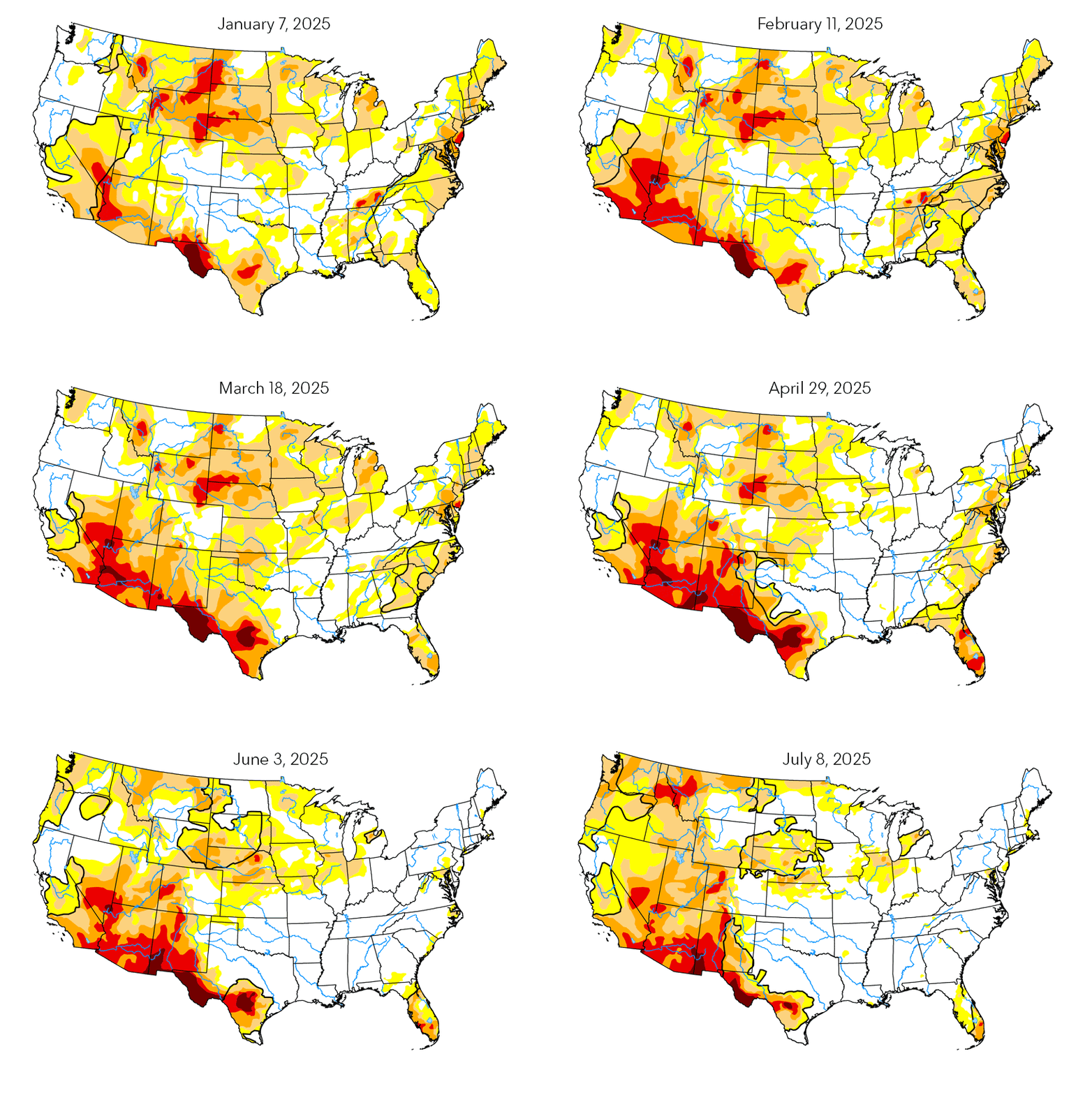
US Drought Monitor

Cool, windy, and wet conditions were reported across much of the Eastern Cornbelt during the week. Forecasts warned of a wintry mix of rain and snow in northern Illinois by the weekend, with temperatures topping out in the upper-30s and mid-40s.

Similar conditions were reported in Indiana, with much of the state enduring rain and 50-degree highs during the first half of the week. Cooler weather was on tap late in the week, with highs topping out in the 40s in northern Indiana and the low-50s in southern Indiana.

Central and northern Ohio also experienced light to moderate rains at midweek, along with gusty winds. Late in the week, however, highs in the mid-40s were expected, with lake-effect snow bands taking shape over the weekend. For some parts of northern Ohio, weekend highs were not expected to climb above the low-30s.

Western Cornbelt:

Widespread rain was reported across Iowa as the week progressed, including spotty snow showers on March 24 in some areas. A wind advisory was issued for much of Iowa on March 25, with 40-50 mph gusts expected across central and northern Iowa, and highs only expected to reach the mid- to upper-40s by the weekend.

Damp and dreary weather was also reported across central and northern Missouri during the week. Strong winds battered much of Nebraska, with temperatures reaching the 70s in western Nebraska as the week progressed. Eastern areas of Nebraska struggled to break out of the high-40s to mid-50s during the week, however.

California:

After a wet weekend with highs topping out in the 60s, much of Northern California saw temperatures soar well into the 70s during the first days of spring, with some locations notching highs in the mid-80s.

The heat wave also blanketed Southern California, with a number of daily record highs posted on March 22-24. In San Diego County, Ramona posted a high of 83 degrees on March 22, some 15-20 degrees above average.

Drought conditions continued to expand across California. As of mid-March, the entire state was experiencing mostly severe drought, with broad areas of extreme drought covering Central and Northern California, along with a narrow slice of the inland southern region.

Spring application was “starting to take off” in the state, according to one source, but early volumes were down for some areas.

“With a portion of our area’s almonds frosted, and weak tree nut pricing overall, we aren’t surprised to experience a year-to-date drop of +-10 percent in our tons sold,” commented one contact. “In normal years, this open weather would mean a solid uptick. That is not the case this year.”

Pacific Northwest:

Although parts of coastal Oregon experienced cool, wet weather earlier in the week, temperatures climbed to the upper-60s and low-70s across western Oregon at midweek, with parts of southwestern Oregon notching highs near the 80-degree mark on March 22.

Similar weather conditions were reported in southern Idaho, with highs expected to reach the mid-70s late in the week. Cooler temperatures and light rains were reported in northern Idaho at midweek.

Parts of western Montana collected several inches of wet, heavy snow as the work week started, but much warmer temperatures followed, with highs climbing to the 50s and low-60s by midweek.

Much of Montana, southern Idaho, and Oregon remained in some form of drought in late March, with a wide swath of extreme-to-exceptional drought covering central and western Oregon. A huge expanse of extreme drought was also reported across central Montana.

Spring application was ramping up quickly in the region. “It’s been held up with cool, wet weather, but that should be behind us after today,” said one Washington contact at midweek. “It looks like a warm, typical spring going forward. Our truck activity ramped up starting Friday last week, but will be full tilt tomorrow.”

Western Canada:

The week began with reports of heavy snow and strong winds across Alberta on March 20-21, followed by much warmer weather at midweek. Temperatures climbed to the upper teens in southern Alberta on March 23, with unseasonably warm weather also reported as far north as Fort McMurray.

Double-digit heat was reported in central and southern Saskatchewan as well, but a wintry mix of freezing rain and snow was in the March 24-25 forecast for the region, along with potentially strong winds.

Rain and snow were also reported in southern Manitoba on March 21-22, with reports of 15-25 mm of precipitation in the Red River Valley and up to 20 cm of snow in the Thunder Bay region. Winnipeg reportedly collected 5-10 mm of rain and 10-15 cm of snow as the system worked through the province.

Sources reported some floating application happening in southern Alberta in late March, but most of Western Canada was still a good three weeks from spring fertilizer activity. “People will really be getting antsy unless we get some snow here, or it starts raining,” said one contact. “We’re hoping for one those things to happen, as we need to get some moisture built up here.”

Itafos Reports Record Results for FY21

Phosphate producer Itafos Inc., Houston, reported record 2021 results and robust fourth-quarter earnings as it expects continued strength in 2022 – citing low global inventory levels, no significant additions of supply capacity, stable phosphate fertilizer demand, reduced supply from Russia, global disruption of supply chains of raw materials following Russia’s invasion of Ukraine, and China’s decision to severely restrict phosphate fertilizer exports through at least June 2022.

“We made great progress in reshaping the fundamentals of our company during 2021, which resulted in record operational and financial performance, including full-year revenues of $413.2 million, adjusted EBITDA of $143.4 million, and world class safety metrics,” Itafos CEO G. David Delaney said.

Full-year net income was $51.4 million on revenues of $413.2 million, up from 2020’s loss of $62.3 million and $260.2 million, respectively. Adjusted EBITDA was $143.4 million, up from $15 million. The company said Itafos Conda produced 536,603 mt during the year, up from 2020’s 516,480 mt.

DAP NOLA prices averaged $715/st in fourth quarter 2021 compared to the year-ago $368/st, up 94 percent year-over-year, driven by strong agriculture and phosphate fertilizer market supply and demand dynamics. Similarly, DAP NOLA prices averaged $602/st in FY21 compared to $312/st in FY20, up 93 percent year-over-year.

Itafos’ fourth-quarter highlights included revenues of $116.8 million compared to the year-ago $75.1 million; adjusted EBITDA of $47.9 million compared to $4.8 million; and net income of $24.3 million compared to a $9.4 million loss.

Delaney noted the company is looking to continue to build upon further improved financial and operational performance in 2022, aided by rising prices and solid volume demand in its markets. Its guidance for this fiscal year expects adjusted EBITDA of $190-$230 million, net income of $65-$95 million, basic earnings of C$0.44-$0.65/share, maintenance capex of $13-$23 million, growth capex of $12-$22 million, and free cash flow of $135-$165 million.

“Our full-year guidance for 2022 reflects the continued strength of the business and our expectations of increasingly strong fundamentals in the agriculture and phosphate fertilizer markets,” said Delaney.

In 2022, Itafos said it will continue to focus on deleveraging its balance sheet with cash flows from the business, extending Conda’s mine life through permitting and development of its H1/NDR mining operation, and evaluating strategic alternatives for its non-North American assets.

Senator Portman Says DOC Should Reclassify Russia as Nonmarket Economy

The Biden administration should take additional trade actions – including naming Russia a nonmarket economy (NME) – to put pressure on Russian President Vladimir Putin and his allies amid Russia’s invasion of Ukraine, Sen. Rob Portman (R-Ohio) said March 21 in a speech on the Senate floor, as reported by Bloomberg.

“The Commerce Department should reclassify Russia as a nonmarket economy, making it easier to bring unfair trade cases against them,” said Portman, who is also the former U.S. Trade Representative. “It is appropriate to reclassify them, because up to 70 percent of their economy is now run by the government.”

DOC last fall was asked to reclassify Russia as an NME, but relented after pressure from a Russian delegation, Portman contended.

DOC launched the market economy status investigation at the end of July 2021 as a result of antidumping and countervailing investigations into Russian imports of UAN. The U.S. International Trade Commission last August found a “reasonable indication” that such imports are materially injuring the domestic industry. But the agency decided last October to retain Russia’s market economy status.

In light of Russia’s invasion of Ukraine, DOC should “reconsider that decision and ensure that Russia is reclassified as a nonmarket economy,” Portman said, noting that several countries, including China and Belarus, are already classified as NME economies.

“This means these countries don’t have a free market,” Portman said. “Instead, they have policies that restrict the flow of capital, involve government in the running of the economy, and don’t allow wages to be set in free bargaining between labor and management. When a country is a nonmarket economy, it means our trading forces have an easier time being tougher on those countries when they sell products here that are unfairly priced. It’s time to do it.”

Russia gained market economy status from the U.S. in 2002 (GM June 10, 2002), much to the chagrin of some members of the U.S. fertilizer industry, who argued the revocation might make it harder to use antidumping laws to counteract import surges from Russia. The Ad Hoc Committee of Domestic Nitrogen Producers (CDNP), in particular, voiced strong objections to the revocation (GM March 25, 2002).

Additionally, the ITC should “bring the full might of U.S. trade remedy law to bear on Russian companies,” Portman said. He noted that he and Finance Committee colleague Sherrod Brown (D-Ohio) last week sent a letter to the agency on the matter.

“Given Russia’s behavior, including its manipulation of trade flows in pursuit of maligned strategic objectives and exceptional involvement of the state in the domestic economy, we asked the commission to take these into account in cases involving Russia when they violate our trade laws,” Portman said.

Access to U.S. markets is a “privilege, not a right,” Portman said. “The urgency of the moment means we have to find a way to stop preferred access to our market,” he said. “Let’s do it this week.”

Mosaic Reports Higher Revenues on Lower Volumes for January-February

The Mosaic Co., Tampa, on March 21 reported higher revenues on lower volumes for each major company segment – Potash, Phosphates, and Mosaic Fertilizantes. It said logistical constraints continue to impact shipments with rail delays in Canada and Central Florida through the first two months of the year, which are expected to continue through the end of the first quarter.

In addition, potash shipments were expected to be further impacted by the Canadian Pacific Railway work stoppage. As a result, sales volumes for the first quarter of 2022 are now expected to be at or near the low end of previous guidance ranges for both Potash and Phosphates.

Potash Jan/Feb 22 Jan/Feb 21
Sales Volumes (000 mt) 1,048 1,241
Sales Revenues ($M) 604 295
Phosphates Jan/Feb 22 Jan/Feb 21
Sales Volumes (000 mt) 999 1,355
Sales Revenues ($M) 873 634
Mosaic Fertilizantes Jan/Feb 22 Jan/Feb 21
Sales Volumes (000 mt) 1,118 1,429
Sales Revenues ($M) 870 523

AmmPower Small-Scale Ammonia Plant Prototype Near Completion

Technology company AmmPower Corp., Toronto, said on March 18 that its prototype for the IAMM™ agricultural unit, the Independent Ammonia Making Machine™ (GM Feb. 11, p. 1), is near completion.

The company said the prototype is completely scalable in its technology stack, and the sales cycle beginning next quarter will aim to sell IAMM™ units – capable of generating 4 mt/d of carbon-free green ammonia – at tradeshows and direct to consumers.

AmmPower said it intends to price the units competitively, having regard to maximizing prospective customers’ return on investment and eligibility for carbon credits and similar government incentives. The company earlier suggested a price tag of $3-$3.5 million.

“The farming space has always been subject to high volatility due to factors out of its control,” said AmmPower Director of Sales and Marketing, Agriculture Eric Kelley. “The IAMM™ unit allows farmers to take charge of their own ammonia supply. The fact that the ammonia is green, with no reliance on natural gas, is an added bonus for all stakeholders involved. I feel that the IAMM™ will be a critical disruptor in a quickly evolving agricultural market.”

New Dangote Urea Plant Inaugurated

Nigeria’s President Muhammadu Buhari was on hand at a ceremony in Lagos on March 22 to inaugurate the new 3 million mt/y Dangote urea plant, according to a Bloomberg report.

“This fertilizer plant is expected to further advance our administration’s drive toward achieving self-sufficiency in food production in the country,” he said. “The nation also stands to gain extensively in earnings of foreign-exchange from the excess production and exports from the plant.”

The $2.5 billion plant is owned by billionaire businessman Aliko Dangote, believed to be Africa’s richest person, who is investing $19 billion in projects on the continent, including the fertilizer plant and a 650,000 barrel-per-day oil refinery outside Lagos. The refinery, which is expected to be completed in September, will supply domestic consumers and markets elsewhere in sub-Saharan Africa.

JBS Starts Organic Fertilizer Production in Brazil

Giant meat company JBS SA started to produce organic fertilizer at its unit located in Guaiçara, in the state of Sao Paulo, and foresees 150,000 mt/y production, according to Bloomberg, citing a company statement. Greeley, Colo.-based JBS invested 134 million reais ($26.74 million) in the plant.

JBS will be the first Brazil food producer to use waste generated from its own operations to produce fertilizer, according to a Reuters report that also said the plant marks the company’s debut in the ag inputs market. JBS announced plans for such a facility in 2017 (GM Aug. 25, 2017).

Progressive Ag Approves Merger with MKC

Members of Progressive Ag Cooperative, a full-service co-op based in Wellington, Kan., have voted in favor of a merger with MKC, according to a March 11 announcement from both companies. The merger will become effective on May 16, 2022.

“Together we identified benefits we can gain by combining the two organizations, and we look forward to working together for the future of our cooperatives, the members, and our employees,” said Allan Wegner, MKC Board Chairman.

The merger was approved with an 85 percent majority at a special vote meeting on March 10 after a merger agreement was approved by the boards of both co-ops on Feb. 11. Progressive Ag said it conducted due diligence with several other potential partners, but MKC was chosen because of its focus on customer service, facility improvement, branding, innovation, and employee and customer education.

“The approved vote shows our members see the same vision the board did in partnering with MKC,” said Derek Totten, Progressive Ag Board Chairman. “We look forward to improved efficiencies in operations, and the opportunity to expand our technologies and other services to producers’ operations in our footprint.”

Progressive Ag offers grain, fertilizer, seed, fuels and lubricants, and agronomy services from six full-time Kansas locations at Wellington, Danville, Argonia, Bluff City, Mayfield, and New Haven. In addition, the company operates six seasonal grain locations and one seasonal fertilizer and grain facility in Newport, Kan.

Progressive Ag’s agronomy fertilizer line includes anhydrous ammonia, UAN-28, urea, ammonium thiosulfate, DAP, MAP, MESZ, 10-34-0, potash, and 08-20-05-05S-0.5Z Triple Nickel. The company also offers custom application for both dry and liquid fertilizers, grid and tissue sampling, and micronutrient sales and application.

Headquartered in Moundridge, Kan., MKC has nearly 10,000 members and offers grain, agronomy, energy, feed, risk management, and precision ag products and services. With the addition of Progressive Ag, MKC will now consist of 71 Kansas locations with nearly 600 employees. The company was founded in 1965.

Bipartisan Group of Congressmen asks ITC to Remove Fertilizer Duties from Morocco, Trinidad

A bipartisan group of 86 members of Congress sent a letter dated March 17 to Jason Kearns, the Chair of the U.S. International Trade Commission, asking that ITC remove phosphate tariffs from Morocco and suspend the current process and preliminary duties on UAN from Trinidad and Tobago.

The Congressmen said that the conditions surrounding on-farm expenses in the U.S. have dramatically changed since ITC initiated these investigations.

The Congressmen noted that USDA recently forecast that farm production expenses will increase by 6.6 percent from 2021, with several factors leading to increased expenses, including China’s curtailed fertilizer exports, a congested supply chain, increased demand, severe weather, COVID-19, and general inflationary pressures. They said farmers are seeing fertilizer prices four to five times higher than this time last year.

“Currently, only about 35 percent of the world’s traded supply of phosphate fertilizer is not subject to duties for import into the U.S,” said the group. “This has unnecessarily restricted supply and added costs. Historically, phosphate fertilizer accounts for 15 percent costs for producers. Since the U.S. Department of Commerce’s decision to impose duties on phosphate fertilizer imports from Morocco, phosphate fertilizer prices have increased 93 percent.”

The group said because there is a degree of substitution among nitrogen fertilizer, the impact of the tariffs on UAN is felt across all nitrogen products. It cited a recent predictive modeling study by Kansas State University’s Department of Agricultural Economics as indicating that ammonia prices should be around $1,000 per ton, with the actual price exceeding $1,500 per ton. It said that at the end of February, all fertilizer prices were near record high levels.

“Eliminating these duties on fertilizer imports provides the most immediate opportunity for a near term, partial remedy to the high costs of fertilizer facing U.S. farmers before the end of the 2022 planting season,” said the Congressmen. “Currently, in a time of tight global supply and demand for corn, soybeans, wheat, and other commodities, planting decisions are increasingly being made not on market fundamentals, but rather on the cost of production driven by the price and supply of fertilizer.”

“Removing duties levied on Moroccan phosphates would have the immediate impact of increased competition in the U.S. market and alleviate some supply concerns,” said Alexis Maxwell, Green Markets Director of Research.

As previously reported, the Emergency Relief from Duties Act has been filed in both the House and the Senate. It would create a pathway to create emergency waivers for duties placed on fertilizers by the ITC (GM March 18, p. 1). Another group of some 19 Republican members of Congress has sent a letter to President Biden urging him to take immediate action to lower the cost of fertilizer.

Disclaimer of Warranty
All information has been obtained by Green Markets from sources believed to be reliable. However, because of the possibility of human or mechanical error by our sources, Green Markets or others, Green Markets does not guarantee the accuracy, adequacy, or completeness of any information and is not responsible for any errors or omissions or for the results obtained from the use of such information.

For additional details visit our Terms of Use.