

US Gulf:
US Gulf spot sulfuric acid prices continued in the $95-$105/mt CFR range, players said.
Brazil:
Brazil sulfuric acid imports were steady at the week-ago $120-$125/mt CFR level.
US Gulf:
US Gulf spot sulfuric acid prices continued in the $95-$105/mt CFR range, players said.
Brazil:
Brazil sulfuric acid imports were steady at the week-ago $120-$125/mt CFR level.
Eastern Cornbelt:
The ammonium thiosulfate market remained at $275-$300/st FOB in the Eastern Cornbelt, with the low confirmed at Cincinnati and out of spot Illinois River locations.
Western Cornbelt:
Ammonium thiosulfate remained at $280-$300/st FOB in the Western Cornbelt, with the low reported at Waterloo, Iowa, and the high in Nebraska.
Eastern Canada:
The ammonium thiosulfate market remained in a broad range at C$455-$545/mt FOB for the last confirmed offers in Eastern Canada.
Germany:
CAN prices were stable this week against a backdrop of steady in-season demand. Cheaper material of Eastern European origin is reportedly available for as low as €250/mt CIF in some regions, so prices are likely to see more downward pressure in the near term.
Cornbelt:
NPSZ pricing in the Cornbelt was reported at $710-$750/st FOB, depending on location.
Eastern Canada:
SOP remained in a broad range at C$1,085-$1,200/mt FOB in Eastern Canada, depending on grade and location.
Eastern Canada:
SOP Magnesia strengthened to C$690-$700/mt FOB in Eastern Canada, up C$5/mt at the low end of the range.
Eastern Cornbelt:
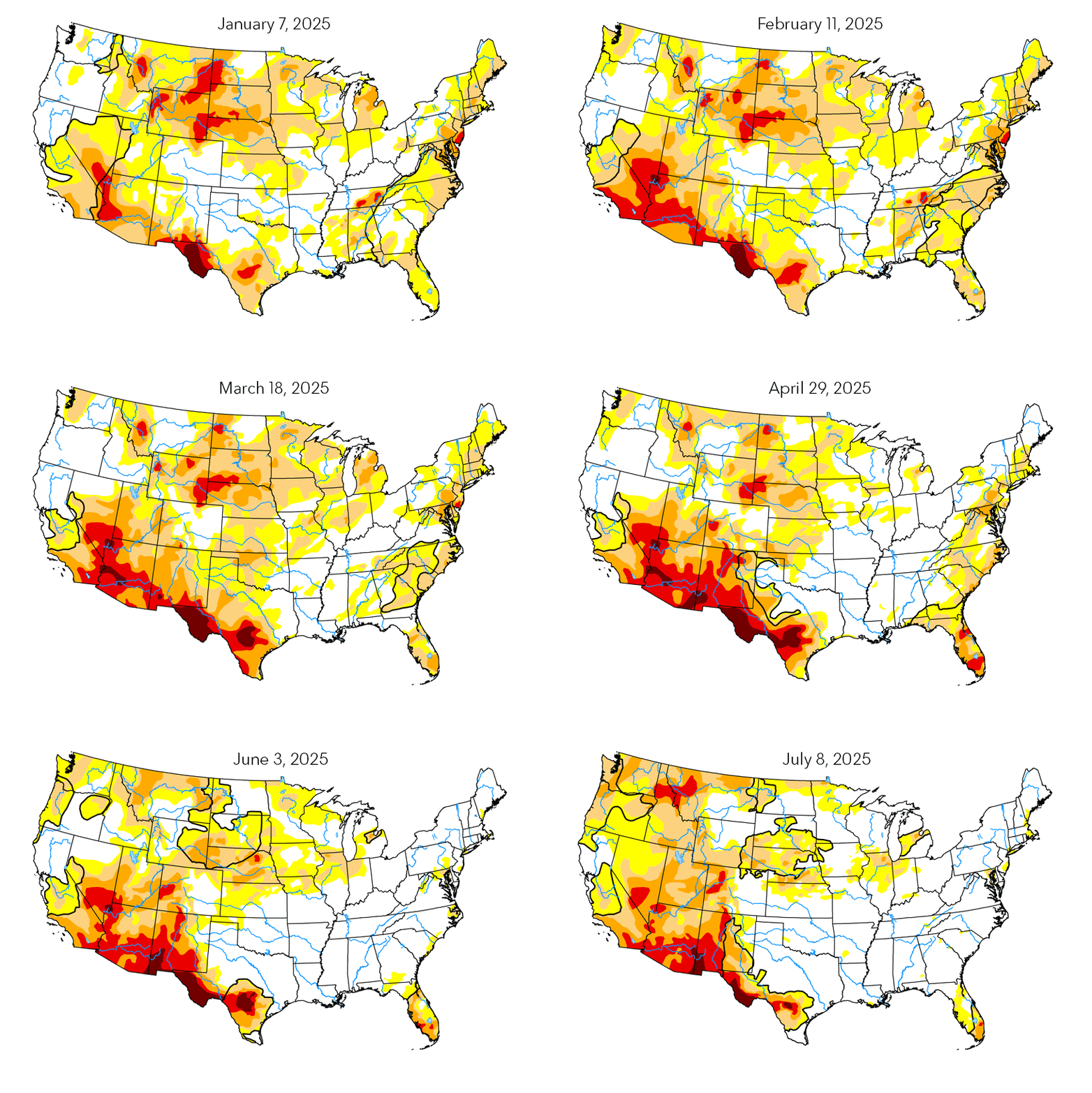
Strong thunderstorms pushed through northern Illinois early in the week, generating strong winds and heavy rain across multiple counties.
Calmer weather prevailed for the balance of the week, though forecasts once again warned of potentially strong thunderstorms and steady rain over the Easter weekend in Illinois and Indiana, with temperatures topping out in the 60s in both states. Widespread rains were also on tap for northern Ohio by the coming weekend.
High winds and spotty thunderstorms were reported in Michigan during the week, while parts of the Upper Peninsula were under a winter storm warning, with forecasts warning of up to a foot of snow in some locations at midweek.
Western Cornbelt:
Temperatures across Iowa rose from the 40s to the 60s as the week progressed, but another round of thunderstorms was expected by the weekend. Most areas weren’t expecting heavy rainfall from the weekend storms, however. High winds and rain were also in the forecast for northern Missouri, but not until early next week.
Central Nebraska was hit with snowfall and high winds at midweek, with 1-4 inches of accumulation reported across the region on March 26. A stronger system was taking aim at western Nebraska late in the week, with 5-8 inches of snow possible as a winter storm moves in from Wyoming.
Northern Plains:

Up to a foot of snow fell in northern Minnesota over the prior weekend, with steady rainfall reported in southern areas of the state. Much cold weather followed the precipitation, with lows falling to the teens and single digits across the state.
Another system was expected to bring several inches of snow to northern Minnesota and North Dakota again over the Easter weekend, along with a wintry mix of sleet and freezing rain in southern areas of both states. Highs in the 50s were expected by the first days of April in Minnesota and North Dakota, with South Dakota looking at temperatures in the 60s.
Northeast:
The previous weekend brought heavy rain and snow to New England, dimming hopes of an early start to spring fieldwork in the region.
Rainfall totals ranged from 2-3 inches as the powerful system worked its way through the region on March 23-25, with forecasts warning of a foot or more of snow in northern New England. Heavy rain and strong winds also battered parts of Pennsylvania and New York, while showers and cloudy conditions lingered in Maryland for most of the following week.
Providence, R.I., is set to post its second rainiest March on record. The city had notched 9.75 inches before the latest round of moisture, well above the monthly average of 4.9 inches and trailing only March 2010, when 16.34 inches fell and caused widespread flooding.
Eastern Canada:
The Maritimes and parts of Quebec were bracing for a wet Easter weekend, with forecasts warning of 60 mm of rain in Nova Scotia and 70 mm in parts of Newfoundland and Labrador. Rainfall totals across New Brunswick were expected to range from 30-90 mm, while eastern Quebec was preparing for 30-50 mm of rain and possible snow at higher elevations.
US Gulf:
Guidewall repairs scheduled through Oct. 30 at Bayou Sorrel Lock prompted intermittent travel outages from 7 a.m. to 4 p.m., with waits noted up to 26 hours during the week. Carpenters Bayou, located near the Houston Ship Channel, was closed to traffic from 12-4 p.m. on March 27, sources said.
Ellender Bridge repairs, in progress at Mile 243 of the West Canal since Feb. 5, will prevent weekday drawbridge openings from 7 a.m. to 5 p.m. through April 12. Bridge work at Mile 63 of the Port Allen Route will close the area to navigation between 7 a.m. and 7 p.m. on April 19, 21, and 23.
Planned Bayou Boeuf Lock repairs were expected to leave navigation unavailable from 7 a.m. to 6 p.m. on April 1-30. Additionally, the site will close entirely on April 2-5 and April 9-12, completely halting lock access for 83 hours at a time.
Brazos Lock repairs scheduled into late August limited movements from 7 a.m. to 7 p.m., resulting in intermittent 5-20 hour delays during the week. The project was previously set to conclude on Feb. 29.
Port Allen Lock waits were noted up to 18 hours. Boats transiting Industrial Lock saw delays up to 48 hours, according to Corps data, while Algiers Lock wait times topped out around 16 hours during the week. Colorado Lock passages required up to nine hours to complete.
Mississippi River:
A sunken barge reported at Mile 260 of the Lower Mississippi River will necessitate a river closure during salvage operations, sources said. No date for the retrieval was announced on March 27.
Loading drafts were cut by 10% on travel through the St. Louis area, sources said. Drafts were reduced by 5-10% between St. Louis and Cairo, Ill. Tows traveling upriver were limited to 9.5 feet of draft between Columbus, Ky., and St. Louis, while southbound travel was capped at 10.5-foot drafts.
The river gauge at St. Louis showed 4.97-foot depths on March 28. River levels at Memphis, Tenn., were reported at 7.03 feet and falling at midweek, with 2.90-foot readings predicted on April 11. A March 28 flood warning at Vicksburg, Miss., was scheduled to expire on April 1.
Dredging underway at Miles 0-22 of the lower river is expected to run 24/7 through April 1, through the project may continue intermittently through the end of August. Tows were required to pass at lowest safe speeds.
Illinois River:
Travel will be unavailable from 7 a.m. to 12 p.m. at Miles 296-296.7 on April 3-4 for fish barrier testing. Dresden Island Lock was closed to daytime travel on March 26-27 due to miter gate motor and brake assembly installation, resulting in delays up to 14 hours.
Mechanical dredging continued at Miles 244.2-244.5, according to a Coast Guard posting, running Monday through Thursday from 6:30 a.m. to 5 p.m. The work will continue until further notice.
Four wickets stuck in the raised position at LaGrange Lock prompted caution warnings for vessels transiting the site’s navigational pass. The wickets are located at the lock’s left descending side of the river and are submerged below the waterline.
Lowered wickets at Peoria Lock allowed tows to pass without locking. Waits were reported up to 11 hours at Marseilles Lock.
Ohio River:
Meldahl Lock travel was delayed due to an ongoing main chamber shutdown, resulting in waits as high as 48 hours, up from 22 hours at last report. Repairs were expected to run through the end of March.
Valve repairs at Greenup Lock are scheduled through April 12. Planned maintenance at Markland Lock and Cannelton Lock will limit movements through both locations between April 22 and June 7, while Markland Lock will close once more on June 10-28 for miter gate repairs.
Machinery work at Racine Lock is on the books for June 1 through July 11, while delays are projected at Hannibal Lock from June 15 to Nov. 7 for dewatering and miter gate repairs. Belleville Lock will see alternating 30-day main and auxiliary chamber shutdowns during the second half of the year.
Boats transiting Kentucky Lock, on the Tennessee River, were delayed up to nine hours during the week, while 3-6 hour waits were reported at Pickwick Landing Lock. Intermittent 10-40 hour delays were noted at Wilson Lock.
The Cumberland River’s Old Hickory Lock is closed to overnight travel through April 1. The site will shut completely between April 1 and May 9.
Arkansas River:
Miter gate inspections are scheduled for Aug. 16-Sept. 8 at the Van Buren Bridge, located at Mile 300.8 of the Arkansas River. Vessels will reportedly be allowed to pass the site following the ninth day of work.
CVR Energy Inc. is currently considering strategic transactions with its majority owner (66%) Icahn Enterprises LP (IEP) involving nitrogen producing unit CVR Partners LP, according to March 18 filings after markets closed.
CVR Energy, which owns approximately 36.8% of CVR Partners, may opt to buy some or all outstanding publicly held shares of the fertilizer company, or sell CVR Partners. CVR Energy and IEP are “indirectly controlled” by billionaire Carl Icahn, according to the filing.
CVR Partners’ common units are listed on the New York Stock Exchange under the symbol UAN. CVR Energy owns a 100% interest in CVR Partners’ general partner CVR GP LLC. CVR Partners operates nitrogen producing facilities in Coffeyville, Kan., and East Dubuque, Ill.
CVR Partners’ units closed at $74.25 on March 19, up 16.5% from the March 18 close, while CVR Energy’s moved up 1.9% to close at $36.24.
CVR Energy and IEP are also considering the acquisition of additional refining assets. CVR Energy currently operates refineries in Coffeyville and Wynnewood, Okla.
Mark Smith and James Strock, two CVR Energy Independent Directors, have been named to the Board’s Special Committee-Strategic, which was formed to consider, evaluate, and negotiate the potential strategic transactions noted above on behalf of the company.