All posts by hlancey@bloomberg.net

Ammonium Thiosulfate

Eastern Cornbelt:

The ammonium thiosulfate market was unchanged at $265-$275/st FOB in the Eastern Cornbelt, with the low reported in Illinois and the high at Cincinnati. The Terre Haute, Ind., market remained at the $270/st FOB level in early March.

Western Cornbelt:

Ammonium thiosulfate pricing in the Western Cornbelt was steady at $260/st FOB Waterloo, Iowa.

Eastern Canada:

The ammonium thiosulfate market remained in a broad range at C$465-$545/mt FOB for the last confirmed offers in Eastern Canada.

Crops/Weather

Eastern Cornbelt:

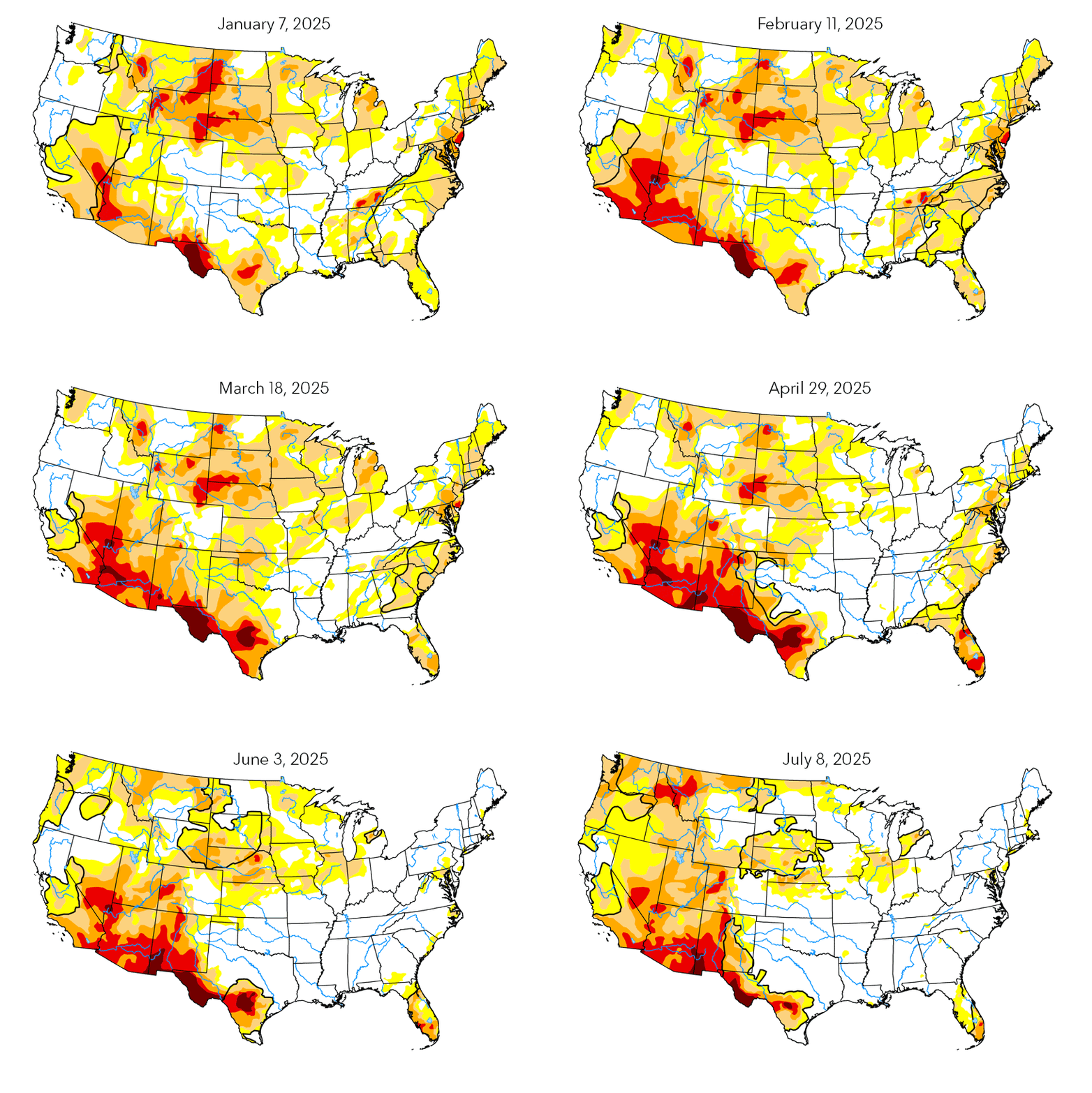
US Drought Monitor

Unseasonably mild temperatures sparked another round of thunderstorms in the Eastern Cornbelt during the first full week of March.

After near-record highs on March 4 that reached the mid-70s, some 20-30 degrees above normal, a cold front at midweek brought heavy rain, gusty winds, and lightning to parts of Illinois and Indiana, as well as an EF-0 tornado to northwestern Ohio. Cooler weather followed the storms, with highs topping out in the mid-40s in the region.

After notching one of its warmest Februarys on record, Michigan was bracing for multiple rounds of rain and snow as the week advanced. Forecasts called for 2-5 inches of snow in northern Michigan by the weekend, and an inch or less in southern and central areas of the state.

Western Cornbelt:

Temperatures generally ranged in the 50s and 60s across the Western Cornbelt during the first full week of March, though potentially strong storms were expected to move in as the week progressed.

Southeast Iowa was bracing for a half-inch to an inch of rain on March 7-8. Rain and snow were also in the forecast for western and central Nebraska as the week progressed, with reports of school closures in effect in parts of the panhandle on March 7. The precipitation moved through Missouri as well, with reports of heavy rainfall and potentially severe storms in the Ozarks.

Northern Plains:

Corn Wheat Soybean Index

The first weekend in March brought freezing rain and snow to northern North Dakota and northern Minnesota, but temperatures in the 40s and 50s were common across the Northern Plains in early March. Highs in the 60s were in the weekend forecast for parts of South Dakota.

Mild temperatures, a lack of snow, gusty winds, and drought conditions ranging from abnormally dry to severe prompted a red flag warning for several counties in southern Minnesota at midweek.Sources said those same weather conditions were hinting at an early start to spring fieldwork in the region.

Northeast:

Flood watches were in effect across the Northeast and southern New England as forecasts warned of 1-3 inches of rain on March 6-8. The heavy rainfall is expected to impact areas from New York to Massachusetts, with snowfall also likely in parts of New England.

Pennsylvania sources reported several days of fertilizer application on small grains in early March, but activity was limited as many areas were stalled by wet weather.

Eastern Canada:

Parts of Ontario posted record high temperatures early in the week, with Toronto notching 16 C on March 4, well above the previous record of 13.3 C set on March 4, 1974.

A powerful weather system was expected to move into Eastern Canada by the coming weekend, however. Most areas were expecting heavy rain, with 30-40 mm possible in southern Ontario and snowfall likely in eastern Ontario and Quebec.

Precipitation hit the Maritimes much earlier, with rain, freezing rain, gusty winds, and snow reported on March 6-8 in parts of New Brunswick, Nova Scotia, and Prince Edward Island, prompting winter weather warnings for the region.

Forecasts warned of a much colder weather pattern developing across Eastern Canada around the official first day of spring and continuing through the end of March and into early April.

“It could be an early spring, as all the snow has melted and there is very little frost in the ground,” said one Ontario contact. “We had record breaking temps early this week, in the high 60’s F. If the ground stays dry, we could be going by mid-April.”

Transportation

US Gulf:

Intermittent fog delays slowed movements throughout the Gulf for up to 12 hours at a stretch during the week. The conditions were forecast to begin improving on March 8. Emergency repairs at Calcasieu Lock forced daytime shutdowns on March 2-8, pushing delays to 13 hours.

Unplanned repairs continued at the Black Bayou Bridge, blocking weekday navigation from 5-8 a.m. and again from 4-7 p.m. Travel was unavailable on Saturday and Sunday from 6-8 a.m. and 5-7 p.m. No expected completion date was reported on March 6.

Dive operations that were reportedly limiting daytime travel through Colorado Lock were expected to wrap up on March 6. Intermittent delays were noted in a wide 1-4 day range for the week, rising from 5-23 hours at last report.

Bayou Sorrel Lock guidewall repairs restricted movements between 7 a.m. and 4 p.m., Monday through Friday, pushing waits as high as 34 hours. Drawbridge repairs underway at the Ellender Bridge, located at Mile 243 of the West Canal, will block weekday navigation from 7 a.m. to 5 p.m. through April 12.

Bayou Boeuf Lock repairs previously set for mid-March were rescheduled for April 1-30, sources said. The project will now entail weekday shutdowns from 7 a.m. to 6 p.m., in addition to a pair of total navigation outages scheduled for April 2-5 and April 9-12.

Despite a predicted Feb. 29 end to daytime shutdowns at Brazos Lock, wait times through the site were reported in the 1-3 day range during the week. Tows were restricted to a single loaded barge or two empty barges per pass, sources said.

Port Allen Lock waits ran up to five hours, Corps data indicated, while boats transiting Industrial Lock waited up to 67 hours to pass. Intermittent five-hour delays were noted at Algiers Lock.

Mississippi River:

Loading drafts were reduced by roughly 10% on travel through the St. Louis area, sources said, while maximum drafts were cut by 5-10% for boats moving between St. Louis and Cairo, Ill. Reported at 0.7 feet on March 6, the St. Louis river gauge was forecast to decline to (-)2.4 feet on March 27-29.

Upper Mississippi River Locks began opening for spring navigation on March 4, sources said. The final lock is slated to resume lockages on March 16, conditions permitting. Cargoes destined for upper-river docks began departing from New Orleans in the second week of February, while upriver tows were expected to begin releasing from St. Louis during the first two weeks of March.

Delays were quoted up to eight hours through both Mel Price Lock and Lock 27 during the week. On the lower river, dredging kicked off in the Southwest Pass on March 3. Slated to work between Mile 0 and Mile 22, the dredge will operate 24/7 through an estimated Aug. 31, according to a Coast Guard posting.

Illinois River:

Maximum loading drafts continued at 9-10 feet on the Illinois River, sources said, depending on location and direction of travel. Marseilles Lock travel was unavailable on March 5-6 due to miter gate repairs, prompting 27-hour waits.

Due to low water levels, wickets remained in the raised position at both Peoria Lock and LaGrange Lock, resulting in delays of seven hours and 19 hours, respectively. Boats waited up to seven hours to pass Starved Rock Lock.

Ohio River:

Meldahl Lock waits were posted up 27 hours due to an ongoing main chamber shutdown, rising from 21 hours at last report. Repair efforts could continue through the end of March, sources said.

Greenup Lock valve repairs are on the books for March 4 through April 12. Planned maintenance at Markland Lock and Cannelton Lock will run from April 22 through June 7 at both sites, while Markland Lock will see an additional shutdown on June 10-28 for miter gate repairs.

Machinery work at Racine Lock is scheduled for June 1 through July 11, and dewatering and miter gate work at Hannibal Lock is likely to delay travel between June 15 and Nov. 7. Belleville Lock will face nonconcurrent main and auxiliary chamber shutdowns lasting 30 days each during the second half of the year.

Wait times were noted up to 19 hours through the Tennessee River’s Kentucky Lock, while tows waited up to 13 hours to pass Wilson Lock. Old Hickory Lock, on the Cumberland River, will close to overnight travel on March 18-31, followed by a complete shutdown running from April 1 through May 9.

Arkansas River:

Repairs to the Van Buren Bridge are tentatively scheduled to begin on April 15 and continue for approximately 18 days. Waiting vessels will be allowed to transit the site on April 24 or 25, sources said. The bridge is located at Mile 300.8 of the Arkansas River.

LSB Reports 4Q Loss; Expects to Add UAN Capacity, Nitric Acid Storage in 2024 LSB Industries Inc. reported a

LSB Industries Inc. reported a fourth-quarter loss of $5.3 million on net sales of $132.6 million, down from the year-ago net income of $65.9 million and $233.7 million, respectively. Adjusted EBITDA was down at $25.1 million from the year-ago $105.5 million.

“Our fourth-quarter results were consistent with our expectations,” said Mark Behrman, LSB President and CEO. “While we continued to experience a weaker pricing environment relative to 2022, pricing rebounded off of third quarter lows enabling us to generate a significant sequential top and bottom improvement. Our fourth-quarter results benefited from increased production and sales volumes of downstream products, reflecting improved manufacturing operations.”

LSB posted full-year net income of $27.9 million on net sales of $593.7 million, down from 2022’s $230.3 million and $901.7 million, respectively. Adjusted EBITDA was $132.7 million, down from $414.7 million.

“We generated solid cash flow in 2023 in spite of the headwinds encountered throughout the year,” he said. “As a result, we were able to further strengthen our balance sheet, positioning us to continue to invest in the reliability and safety of our facilities and return value to shareholders.”

In addition to the turnarounds planned for LSB’s Pryor, Okla., and Cherokee, Ala, facilities during this year’s third quarter, Behrman said LSB also expects to complete “multiple projects that we believe will deliver incremental EBITDA beginning in the second half of the year.” LSB expects the two 30-day turnarounds to result in approximately 34,000 st of lower ammonia production and related downstream production.

“Despite the turnarounds, however, we expect sales volumes for our downstream products to be up year-over-year as a result of operational improvements and the completion of margin enhancement projects that we have underway at our Pryor and El Dorado facilities,” Behrman said in an earnings call.

LSB expects that a third-quarter Pryor urea expansion will increase UAN sales volumes by 75,000 st/y. It also highlighted a nitric acid project at El Dorado, which will add 5,000 st of nitric acid storage, which LSB said will better allow it to optimize its product mix, ultimately translating into incremental profits.

LSB is expecting lower natural gas prices in 2024 than in 2023 and anticipates increased sales volumes of higher margin downstream products. LSB said urea and UAN prices have been on the rise recently due to a favorable US import/export balance and expectations for strong demand. The company said the higher urea prices were due in part to China’s export limitations.

“We are now in a position where inventories are really tight for most fertilizers,” Behrman told analysts, citing a lack of imports and US production outages earlier this year due to winter storms. He shared that LSB lost some production at its El Dorado plant due to a power outage.

“We are starting to see UAN pricing move to be more in a traditional relationship with urea, and we are encouraged by the buying patterns,” he added.

LSB expects fertilizer prices to be at levels attractive to farmers for the spring planting season, with corn prices remaining resilient despite rising stock-to-use ratios. LSB said industrial demand in the US remains stable due to the strong domestic economy, with robust demand for mining products due to attractive market fundamentals. LSB said demand also remains stable for quarrying and aggregate production and US metals demand.

The company anticipates lower 2024 ammonia prices due to heavy fall application by US farmers. It said lower natural gas prices in Europe will likely result in greater nitrogen production and increased supply from European producers.

LSB CFO Cheryl Maguire told analysts that LSB expects first-quarter 2024 adjusted EBITDA to be lower than the year-ago $51 million, but up from fourth-quarter 2023’s $25.1 million, representing a solid start to the year highlighted by strong ammonia demand, improved downstream production, and lower natural gas costs.

Product (Gross Sales $)4Q-234Q-22% Change
AN & Nitric Acid 47,95981,576 (41) 
UAN36,62155,449(34)
Ammonia36,731 83,144(56)
Other 11,30213,485(16)
Total  132,613233,654(43)
Sales Volumes st 4Q-234Q-22% Change
AN & Nitric Acid  124,697157,104(21)
UAN 125,966102,912 22
Ammonia 95,44784,10013
Total 346,110344,116 1
Avg Selling Price $/st4Q-234Q-22% Change
AN & Nitric Acid 322 464 (31)
UAN 253522(52)
Ammonia 368978(62)
Other Factors4Q-234Q-22% Change
Avg Nat Gas ($/mmBtu)3.996.95(43) 
Tampa NH3 $/mt5991,116(46)
NOLA UAN 256533(52)
Recent Spot Prices 3/1/243/1/23
Tampa NH3 $/mt445590
NOLA UAN 243270
Natural Gas ($mmBtu) 
(NYMEX Spot)
1.84 2.81
Volume Outlook 2024E 2023A
Ammonia Production (st)780,000-800,000 816,000
Sales Volume (st)
AN & Nitric Acid 560,000-580,000  529,000
UAN 560,000-580,000 483,000
Ammonia280,000-300,000 375,000

SSP

Brazil:

SSP 19-21 prices increased $15/mt at the top of the range, to $190-$230/mt CFR from the week-ago $190-$215/mt CFR, with lower quality product priced at the bottom of the range.

Aggressive $295/mt FOB ex-warehouse offers were referenced for SSP-19 at Rondonópolis, dragging prices to $295-$335/mt FOB from last week’s $320-$345/mt FOB. While interest in SSP has been growing as a substitute for MAP, sources said buyers are considering TSP as well. SSP-23 prices strengthened slightly, to $360-$380/mt FOB from last week’s $360-$375/mt FOB.