All posts by hlancey@bloomberg.net

CAN

California:

CAN-17 in California remained at a flat $330/st FOB in late February.

Pacific Northwest:

The CAN-17 market was unchanged at $345/st FOB Kennewick, Wash.

Germany:

CAN prices in Germany retreated again this week, falling €5/mt due both to softer urea sentiment and rainy weather, which is delaying fieldwork across Germany. Still, those on the supply side are confident that as soon as the weather permits, application followed by restocking efforts will trigger liquidity.

SOP Magnesia

Southern Plains:

Intrepid’s Trio postings at Carlsbad firmed $15/st on Feb. 29, to $305/st for standard, $335/st for granular, $345/st for premium, $380/st for OMRI standard and fine standard, and $410/st for OMRI granular.

California:

Granular SOP Magnesia in California was unchanged at $450/st FOB Stockton for the latest offers.

Pacific Northwest:

The SOP Magnesia market was quoted at $440-$450/st FOB for granular tons in the Pacific Northwest, with rail-DEL offers pegged at the $450/st level in northwestern Washington.

Crops/Weather

Eastern Cornbelt:

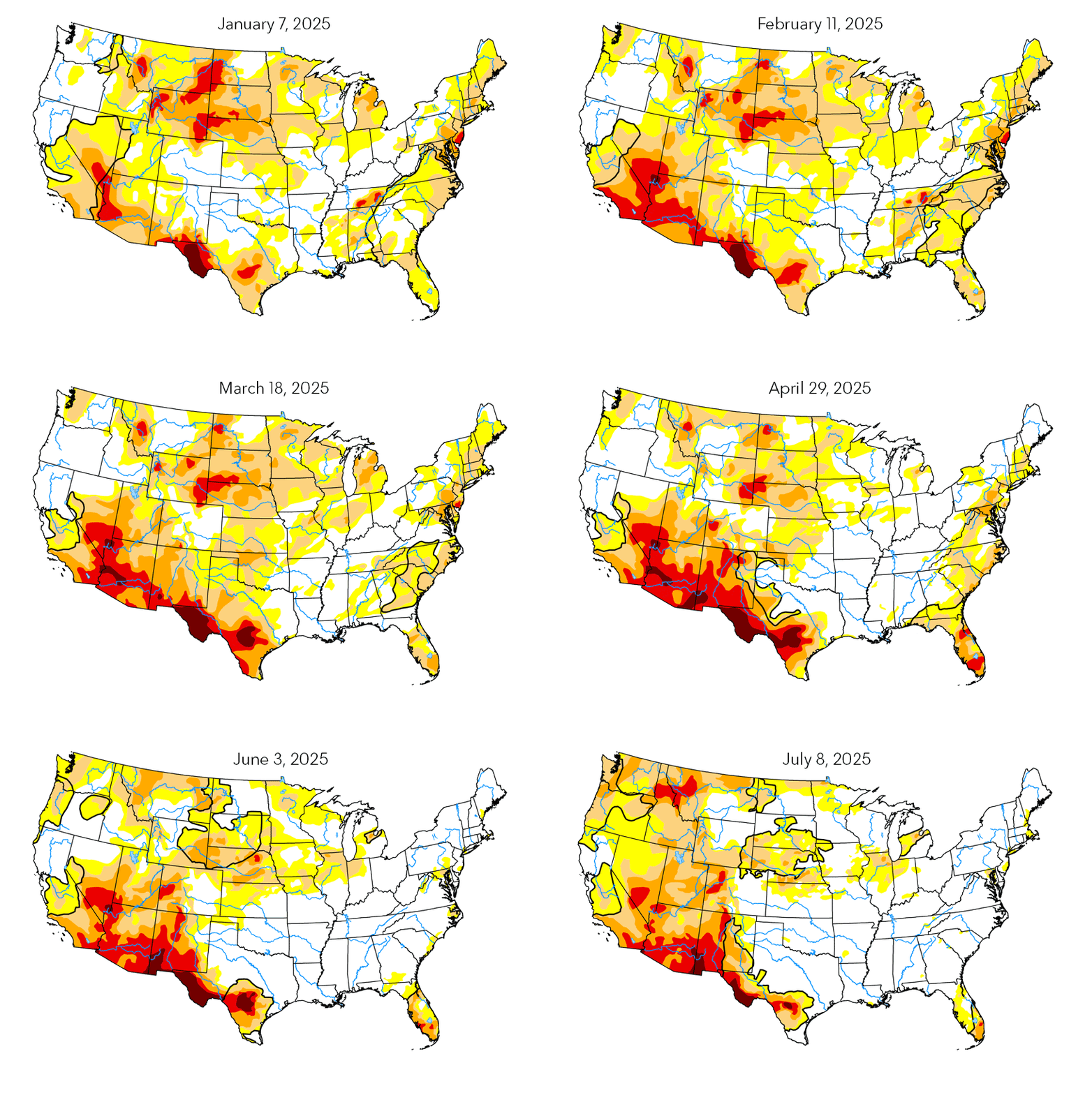
US Drought Monitor

A strong weather system spawned at least 11 tornadoes in Illinois and northwestern Indiana and five tornadoes in Ohio on Feb. 27-28. The cluster of storms also brought hail up to two inches in diameter, heavy downpours, lightning, and very strong winds to the region.

The tornadoes ranged in intensity from EF-0 to EF-2, causing significant structural damage and widespread power outages. Tornado damage was also reported in Grand Blanc, Mich., while northern areas of the state were hit with high winds and snow flurries at midweek.

Western Cornbelt:

After posting record highs near the 80s on Feb. 26, temperatures in central and northern Iowa plunged to the teens and single digits at midweek, with snow flurries reported in some areas.

High winds accompanied the winter precipitation, but unseasonably mild weather returned by the end of the week, with temperatures hitting the 60s and weekend highs once again expected near the 80s.

Dry, windy conditions prompted red flag fire warnings across Nebraska as the week progressed, with highs in the upper-50s and 60s. Scattered showers were in the weekend forecast for parts of the state.

Corn Wheat Soybean Index

California:

Winter Storm Orzelle was expected to drop up to 12 feet of snow in California’s Sierra Nevada from Feb. 29 to March 3, prompting blizzard warnings for the northern and central Sierra, including Lake Tahoe, and for eastern Nevada.

Winter storm warnings for snow and strong winds were also in effect for other parts of Northern California, the Cascades and western Nevada, including Reno. Strong winds were expected to accompany the snowfall, along with up to an inch of rainfall at lower elevations in Northern and Southern California.

The upper elevation snowfall is needed for the state’s water supply. Although powerful storms brought surplus rain to much of the state earlier this winter, the Sierra snowpack was only 80% of what it should be by Feb. 28.

Pacific Northwest:

The same powerful weather system that brought heavy snow to Northern California also prompted a round of weather warnings in western Oregon late in the week.

Forecasts warned of 1-2 feet of snow from Feb. 28 to March 1 at higher elevations in the Cascades, with 4-11 inches expected below 2,500 feet. The Coast Range was also under a winter storm advisory, with 2-14 inches of snow, 55 mph winds, and heavy rain at lower elevations.

The storm was expected to bring strong winds to southern Idaho and gusty winds and rain to western Washington late in the week, with forecasts warning of potential power outages in both regions.

The prior weekend brought 2-6 inches of snow to the valleys of western Montana, with a foot or more reported at higher elevations. The snowfall was accompanied by strong winds, with another round of wind and winter precipitation on tap for the first weekend in March.

Western Canada:

A fast-moving Alberta clipper prompted winter storm warnings in parts of Saskatchewan on Feb. 26, as 48 mph wind gusts and snow flurries pushed temperatures down to below zero and wind chills to the negative 20s.

A second system was expected to bring heavy snow to Alberta, Saskatchewan, and Manitoba over the coming weekend, with 10-30 cm of accumulation possible in central and southern Saskatchewan and up to 40 cm in parts of Manitoba. Forecasts warned of temperatures in Alberta plunging 15-20 degrees on Feb. 29 and lows dropping to -20 C.

Transportation

US Gulf:

Repair work stopped travel through the Florida Avenue Bridge, located between Miles 1 and 2 of the East Canal, from 6 a.m. to 10 p.m. on Feb. 24. Emergency repairs underway at the West Canal’s Lapalco Bridge were expected to limit navigation between 7 a.m. and 6 p.m. daily through an estimated March 1.

Unplanned repairs at the Black Bayou Bridge blocked weekday navigation from 5-8 a.m. and again from 4-7 p.m., and weekend travel was unavailable at 6-8 a.m. and 5-7 p.m. No expected completion date was reported on Feb. 28.

Guidewall repairs at Bayou Sorrel Lock scheduled into June prompted intermittent outages on weekdays between 7 a.m. and 4 p.m. Waits were recorded up to 34 hours during the week.

Dive operations at Colorado Lock that began on Feb. 26 were expected to limit daytime travel through roughly March 6. Intermittent delays were noted in the 5-23 hour range.

Repairs at the Ellender Bridge, at Mile 243 of the West Canal, will prevent the site’s drawbridge from opening from 7 a.m. to 5 p.m. on weekdays through April 12. St. Claude Avenue Bridge work concluded on Feb. 24.

Calcasieu Lock will shut from 7 a.m. to 7 p.m. on March 6-7 for hydraulic machinery repairs. Bayou Boeuf Lock repairs scheduled to kick off in mid-March will require up to three separate closures lasting four days apiece, sources said. Daytime shutdowns for timber replacement are also anticipated.

Brazos Lock was expected to return from maintenance on Feb. 29, ending a period of daily 7 a.m. to 7 p.m. closures. Tows were restricted to one loaded barge or two empty barges per pass during the week, forcing delays up to 15 hours.

Port Allen Lock waits were noted up to 41 hours. Boats transiting Industrial Lock waited up to 80 hours to pass, and Algiers Lock delays were reported in a wide 5-28 hour range.

Mississippi River:

Loading drafts were reduced by 10% on travel through the St. Louis area, sources said. Drafts were reduced by 5-10% between St. Louis and Cairo, Ill.

A Feb. 26 grounding forced a shutdown at Miles 408-418 of the lower river, sources said. Upriver travel resumed on Feb. 27, while southbound movements followed on Feb. 28. Channel maintenance in progress at Mile 349 was expected to wrap up on Feb. 29.

Barges loading from the New Orleans area began releasing in February for Upper Mississippi River destinations. Northbound barges will start releases from St. Louis during the first two weeks of March.

Upper river locks are scheduled to open for spring navigation on March 4-16, starting with Lock 17 and concluding with Locks 3-9. For now, Locks 11-16 and 18-20 were scheduled to remain open for weekday lockages between 8:00 a.m. and 4:00 p.m. through March 9, though Lock 19 was closed to daytime travel on Feb. 27-29. Locks 21 and 22 are open for locking 24/7.

Illinois River:

Maximum loading drafts were adjusted down to 9-10 feet on the Illinois Waterway, depending on location and direction of travel. Marseilles Lock will close for miter gate repairs on March 5-6.

Due to falling water levels, lock operators began raising wickets at Peoria Lock and LaGrange Lock on Feb. 26 and 27, respectively. Delays climbed to nine hours at LaGrange on Feb. 29, while intermittent 5-10 hour waits were posted at Peoria during the week.

Ohio River:

Meldahl Lock travel was delayed up to 21 hours due to a main chamber shutdown, falling from 16-31 hours at last report.

Valve repairs at Greenup Lock are scheduled to run from March 4 through April 12. Planned maintenance at Markland Lock and Cannelton Lock will limit movements through both sites between April 22 and June 7, while Markland Lock will shut again on June 10-28 for miter gate repairs.

Machinery work at Racine Lock will run from June 1 to July 11, and delays are expected at Hannibal Lock from June 15 to Nov. 7 for dewatering and miter gate repairs. Belleville Lock will see alternating 30-day main and auxiliary chamber shutdowns during the second half of the year.

Kentucky Lock, on the Tennessee River, saw delays up to 14 hours during the week, while similar waits were reported at Wilson Lock. The Cumberland River’s Old Hickory Lock will shut overnight on March 18-April 1, ahead of a complete closure scheduled for April 1 through May 9.

Arkansas River:

Van Buren Bridge repairs were pushed back once again, sources said. The 14-day project, previously set to begin on March 11, is now tentatively scheduled for April 15-29. The bridge is located at Mile 300.8 of the Arkansas River.

Ammonia

US Gulf/Tampa:

The Tampa ammonia price for March was settled at $445/mt CFR, unchanged from the February contract. While lower natural gas prices have continued to pressure some international markets, the January polar vortex in the US reportedly resulted in the loss of up to 300,000 st of domestic production. 

Eastern Cornbelt:

No actual ammonia movement was confirmed in the Eastern Cornbelt during the week, but sources said the mild weather was tempting some locations to consider an early start to preplant applications. The increase in interest, along with some lost production during the January cold spell and the resulting delays in positioning tons, contributed to higher prices during the week.

“The big fall ammonia application and early start now is tugging on the system, trucks are out of position and a few terminals in the Eastern Cornbelt are without inventory,” said one regional contact. “There have been heavy ammonia exports the last two months and the cold weather knocked a few production plants offline in January in the Southern Plains.”

Prompt ammonia prices jumped to $575-$590/st FOB terminals in Illinois and Indiana, up from a recent low of $550/st FOB, while 2Q offers reportedly firmed to $590-$625/st FOB in the region, depending on location. Michigan sources continued to quote Courtright, Ont., offers at $535/st FOB for prompt and $610/st FOB for prepay, however.

Western Cornbelt:

With ammonia movement ramping up in western Missouri and just starting in Iowa, prompt prices moved up during the week, to $575/st FOB Nebraska and Iowa terminals from the prior week’s low of $550/st FOB. Spring prices were quoted at $600-$615/st FOB in the region, depending on location.

Southern Plains:

Stronger ammonia prices were reported in the Southern Plains in late February as near-term availability remains limited. The early application season has contributed to the tight market, but sources said the greater impact came from production hiccups and lost capacity caused by the mid-January polar vortex.

Prompt ammonia offers firmed to $540-$560/st FOB terminals and production points in the Southern Plains, up from the prior $460-$520/st FOB range, with the low reported at Woodward, Okla. Several production sites were either sold out or not offering tons in late February, however. Sources said no tons are currently being offered at Pryor or Verdigris, Okla.

South Central:

While truck pricing for ammonia remained at a low of $400-$410/st FOB Gulf Coast production points, inland terminal prices were starting to firm based on limited offers and tight supply. Sources quoted a broad range at $450-$550/st FOB for any available offers, with the high reported at Cherokee, Ala.

Middle East: 

Talks are underway for spot cargoes shipping from the Middle East in March-April, sources said. The deals should be closed in the next couple of weeks, just in time for Ramadan, when many offices cut back on staff or close entirely. Traders noted price expectations for the cargoes at a ceiling of $300/mt FOB.

The softening comes as ammonia prices are easing internationally and product reserves are building in producer storage facilities.

North Africa:

EuroChem sold a cargo of Indonesian ammonia to OCP/Morocco at a reported price of $410/mt CFR. Once the load is discharged, sources said the vessel will continue to the Baltic Sea under a new lease with EuroChem.

Northwest Europe:  

Rumors of a possible rollover in the Tampa ammonia price for March, combined with the reported EuroChem sale to OCP/Morocco, indicate that imported ammonia prices should be softening in Northwest Europe, area sources said.

No new spot deals were reported during the week, leaving the market at $460-$480/mt CFR. Industry watchers expect to see prices at $450/mt CFR and below for end-March arrivals, however.

Downward pressure continues to build from the recent illiquidity and a further reduction in natural gas prices, with the TTF slipping lower at midweek to €23/MWh, or around $7/mmbtu. As downstream demand remains muted ahead of what some fear may be a delayed spring season in Europe, importers are not motivated to purchase deepwater ammonia until CFR offers fall closer to domestic production costs.

After the vessel carrying Indonesian ammonia drops off its load to OCP/Morocco, sources said the ship will travel to the Baltic Sea, where EuroChem will most likely put the ship to work moving ammonia out of Russia’s makeshift terminal near St. Petersburg.

Southeast Asia:         

Sources reported widely variable pricing in the Southeast Asian spot ammonia market during the week. While players put the current price at $330-$350/mt FOB, a small deal from Indonesia to a regional buyer was pegged at $380/mt FOB. At the same time, the netback from a EuroChem sale of Indonesian product to Morocco was significantly lower, at $300/mt FOB.

South Korea:

South Korea remains a bellwether for trends in the market. While never a price mover, the prices and imports in the Korean peninsula help market watchers assess the state of the regional market, sources said.

South Korea imported 126,000 mt of ammonia in January, according to Trade Data Monitor,a 22% increase from the year-ago 103,000 mt. Saudi Arabia accounted for 57% of the month’s imports with 72,000 mt, followed by 54,000 mt from Indonesia.