All posts by hlancey@bloomberg.net

Potassium Sulfate

California:

The SOP market was steady at $640-$650/st FOB in California, with the low reported at Stockton.

Pacific Northwest:

The SOP market remained at $640-$650/st FOB for the last offers in the Pacific Northwest.

Northwest Europe:

SOP remained in a wide range at €560-€600/mt in Northwest Europe, equivalent to $600-$645/mt FOB based on current exchange rates. New offers were rumored as high as €610-€615/mt, fueled by limited exports from Asia and supply uncertainty from North Africa, though no actual deals were confirmed at the higher numbers.

Potassium Thiosulfate

Eastern Cornbelt:

Potassium thiosulfate pricing dropped to $680/st FOB Terre Haute in early February, down $20/st from last report. Offers in the Great Lakes region were confirmed at $685/st FOB Michigan warehouses.

Western Cornbelt:

Potassium thiosulfate pricing slipped to $680/st FOB Waterloo, Iowa, in early February, down $20/st from last report.

California:

The potassium thiosulfate market in California was down $20/st, to $680/st FOB Sacramento.

Crops/Weather

Eastern Cornbelt:

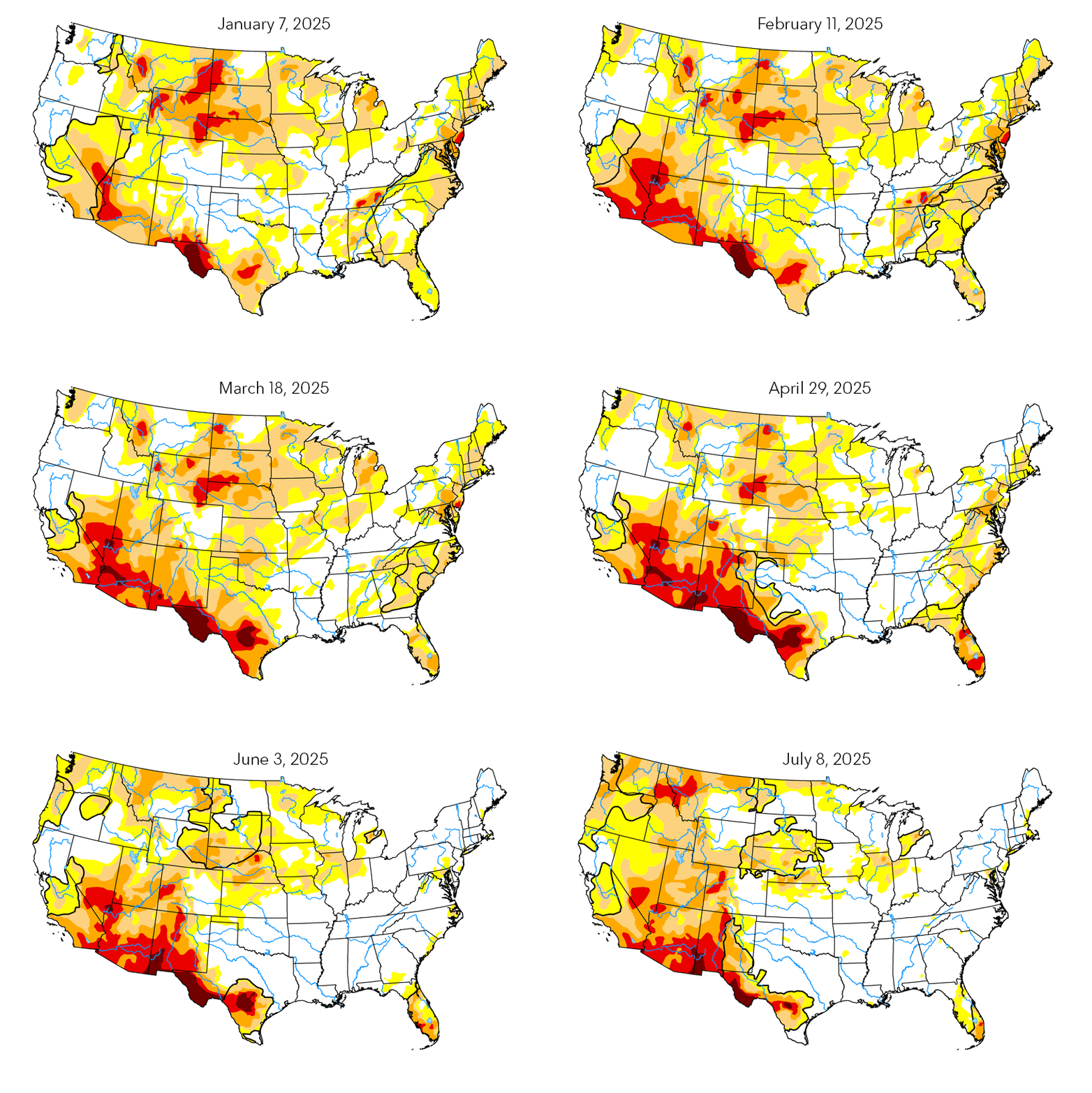
US Drought Monitor

Dense fog advisories were once again issued for several locations in the Eastern Cornbelt during the week, including northern Illinois, as temperatures warmed to the 50s and scattered showers moved through the region.

Temperatures across Indiana and Ohio were nearly 20 degrees above normal, with highs reaching the upper-50s and low-60s during the week. Record warmth was also reported in Michigan in early February. Rains chances increased for the coming weekend, however, with forecasts warning of potentially heavy downpours in some locations.

Western Cornbelt:

Record highs in the low-60s were notched in multiple Iowa locations at midweek, with low temperatures remaining in the 40s. Light showers were reported in northwestern Iowa late in the week, with gusty winds picking up across the state.

Unseasonably warm and windy weather was also reported across Nebraska during the week, prompting flood watches along portions of the Platte, Loup, and Elkhorn Rivers due to ice jams. Wind advisories and red flag warnings were in effect for parts of western Missouri as well.

California:

Corn Wheat Soybean Index

A powerful atmospheric river brought torrential rain and heavy snow to California in early February, causing widespread flooding, mud slides, and power outages and leaving at least nine people dead.

The system dropped more than eight inches of rain in Los Angeles over three days, ranking as the second wettest three-day period in the city’s history. The state’s highest rainfall total was recorded at Cogswell Dam, which posted 13.86 inches over four days. The storm also brought heavy snowfall to the Sierra Nevada, including up to three feet at Mammoth Mountain.

Pacific Northwest:

Rain and snow flurries were reported across central Oregon at midweek, with highs in the 30s and 40s. Similar temperatures were reported in the valleys of southern Idaho, with up to a foot of snow recorded at higher elevations. Highs in the 50s were expected in both states by mid-February, however, continuing a trend of above-normal temperatures for the region.

Similar conditions were reported in western Washington in early February, with rain at lower elevations and up to 4-8 inches of snow in the Cascades. More significant snowfall hit western and central Montana during the week, with highs topping out in the 20s and 30s across the state.

Western Canada:

Snowfall warnings were issued for western Manitoba and southeastern Saskatchewan at midweek, with 10-15 cm of accumulation expected in some locations, along with a mix of snow and freezing rain in others. In southern Alberta, fog advisories were in effect at midweek.

Much of the region has experienced above-normal temperatures and below-normal winter precipitation in recent weeks. While temperatures were expected to drop after the snowfall, most areas will still be above seasonal norms heading into mid-February. “It’s looking like we’ll need a lot of snow in March or rain in April,” said one regional contact.

Transportation

US Gulf:

Bayou Sorrel Lock guidewall repairs were reported between 7:00 a.m. and 4:30 p.m., Monday through Friday, driving waits to 32 hours during the week. Harvey Lock returned from miter gate repairs on Feb. 3, ending a period of delays noted up to 12 hours.

Navigation through the BNSF Railroad Bridge at Mile 121.3 of the West Canal was unavailable from 8 a.m. to 1 p.m. on Feb. 6 and 8, with a repeat scheduled for Feb. 13. Repairs began on Feb. 5 at the Ellender Bridge, located at the West Canal’s Mile 243, blocking weekday travel from 7 a.m. to 5 p.m. through April 12. The Claude Avenue Bridge, at Mile 6.5 in the West Canal, will shut from 6 a.m. to 10 p.m. on Feb. 24.

Following temporary repairs completed last week at Bayou Boeuf Lock, a more intensive project requiring three shutdowns of four days each is anticipated to begin in mid-March. Additional daytime closures may be required in the weeks leading up to the project, sources said.

Repair work at Brazos Lock will limit daytime lockages until Feb. 29. Travel through Brazos was restricted to a single loaded barge or two empty barges per pass, prompting intermittent delays in a wide 5-37 hour range.

Port Allen Lock waits peaked at 27 hours on Feb. 5-6, according to Corps data, while boats transiting Industrial Lock waited up to 56 hours to pass. While most Algiers Lock delays were noted in a 5-10 hour range, a handful of tows were delayed by 16-33 hours at the site. Sporadic 10-51 hour delays were posted at Colorado Lock.

Mississippi River:                     

Water levels continued to rise on much of the Lower Mississippi River. The river gauge at Vicksburg, Miss., pushed to an action-stage 35.2 feet on Feb. 8, en route to a predicted 36.2-foot crest on Feb. 9. The gauge at Baton Rouge, La., was expected to crest at an action-stage 30.9 feet on Feb. 11-13, while levels at Memphis, Tenn., peaked shy of the 28-foot action stage at 22.8 feet on Feb. 4-6.

Channel restoration was underway at the lower river’s Mile 249 through Feb. 29, potentially limiting northbound travel during daytime hours. Revetment operations at Mile 214, reported blocking navigation from 6 a.m. to 7 p.m. last week, concluded on Feb. 2.

Upper-river locks are slated to reopen for spring navigation on March 4-16. Cargoes loading from New Orleans for ports south of Dubuque, Iowa, were expected to begin releases in the second week of February. Barges pointed above Dubuque will start releasing in the second half of February.

Prior to the river’s full reopening, Locks 11-16 and 18-20 were available for locking on weekdays from 8 a.m. to 4 p.m., conditions permitting. Locks 21 and 22 are open for lockages 24/7.

Digging activities at Mile 49.5 of the upper river concluded on Feb. 3, sources said, ending a run of daytime shutdowns.

Illinois River:                   

High water levels were reported on the Illinois River due to melting ice. The conditions, along with heavy drift and lingering ice, complicated lock operations and forced slower travel speeds.

A mechanical malfunction delayed travel through Marseilles Lock during the week, forcing delays of 9-33 hours. Waits tracked in a 5-13 hour range at Brandon Road Lock, and midweek transits through Starved Rock Lock required up to 63 hours to conclude. Wickets were down at Peoria Lock and LaGrange Lock, allowing tows to pass without locking.

Ohio River:

Sources reported an unscheduled main chamber outage at New Cumberland Lock. With no auxiliary chamber available, lock operators were reportedly forced to push the site’s gates open and closed with a boat, stretching wait times above 20 hours.

The main chamber at Meldahl Lock remained unavailable due to an unscheduled primary chamber closure, prompting detours through the secondary chamber. Waits were recorded in a wide 36-62 hour range during the week.

Greenup Lock valve repairs are scheduled for March 4-April 12. Planned maintenance at Markland Lock and Cannelton Lock will restrict movements at both sites between April 22 and June 7.

Upper guidewall replacement at the Tennessee River’s Kentucky Lock is scheduled to end on Feb. 15. Waits ran up to 25 hours for the week, while intermittent 7-12 hour delays were noted at Wilson Lock. Old Hickory Lock, on the Cumberland River, will see occasional shutdowns for maintenance between March 18 and May 9.

Arkansas River:

Lock 2 was shut to daytime navigation on Feb. 5-9. The Van Buren Bridge, located at Mile 300, is scheduled to close to marine traffic on March 11-29. A single opening is expected on March 20 to clear waiting vessels.

Indiana Blue Ammonia Project Receives EPA Permits for Carbon Storage

The US EPA on Jan. 24 issued permits that allow Wabash Carbon Services LLC to construct two wells for the eventual injection and permanent storage of carbon dioxide underground, one at a site in Vermillion County and another in Vigo County, Ind.

These underground injection wells will be used to store carbon dioxide captured from Wabash Valley Resources LLC’s (WVR) planned $1.2 billion, 500,000 mt/y fertilizer plant near West Terre Haute, Ind.

“After a thorough technical review and engagement with the public, including consideration of over 1,000 public comments, EPA has determined that the two proposed wells meet public health and safety requirements to move forward,” said EPA Region 5 Administrator Debra Shore.

Wabash Carbon Services plans to inject up to 1.67 million mt/y of carbon dioxide into the wells over an injection period of 12 years. In 2021, WVR selected Honeywell, Des Plaines, Ill., to provide a range of its Honeywell UOP technologies to help capture and sequester the carbon.

Plans for the ammonia project date back to 2016 (GM May 20, 2016), when Phibro LLC, Stamford, Conn., announced that its affiliate, Philipp Brothers Fertilizer, together with a group of investors, had acquired SG Solutions’ Gasification Plant. Phibro planned to convert the clean coal gasification plant into ammonia production. Originally, the plant used coal and petroleum coke, and at last report the plan was to use petcoke and biomass for the new production. It will also generate electricity.

WVR said the project will displace half of the imported ammonia supply to Illinois, Indiana, and Ohio and would put downward pressure on prices. It said it will add more than 1,100 direct and indirect jobs, including the creation of up to 500 union construction jobs at peak employment, and add over 100 permanent jobs at the facility.

Iowa State Auditor Seeks to Block Koch-OCI Deal

Iowa State Auditor Rob Sand (D) on Jan. 30 sent a letter to the Federal Trade Commission and the US Department of Justice seeking to block OCI Global’s $3.6 billion sale of its Iowa Fertilizer Co. plant in Wever, Iowa, to Koch Industries Inc. (GM Dec. 22, 2023). A group of 18 agriculture and environmental groups sent a similar letter on Jan. 22 (GM Jan. 26, p. 1).

Sand said the project received more than $500 million in local, state, and federal funds and was pitched to Iowa taxpayers as a project that would encourage competition in a heavily consolidated industry.

“Less than a decade later, OCI Global is cashing out, with Koch Industries seeking to reap the benefits by buying the plant,” Sand said in the letter. “But the fact that it wouldn’t be owned by Koch was a justification for the massive commitment of tax dollars in the first place.”

“If this acquisition by Koch Industries is allowed to proceed, the cost of fertilizer to farmers will likely increase due to further industry consolidation,” he continued. “That hurts Iowa producers. It also negates the original intent of the deal that OCI Global reached with Iowa taxpayers to increase competition in the industry.”

To date, Sand is the only Iowa statewide official to speak out against the deal. He is also the only statewide official that is a Democrat and he is seen as a possible future candidate for governor.

“Reneging on a deal may not seem like a big deal to a big corporate entity like OCI or Koch Industries, but for most Iowans, our word is our bond,” he added. “In 2013, promoting the largest tax incentive package in Iowa history, Governor Branstad said, ‘the Koch Brothers don’t want the competition […] We want competition.’ I agree with the former governor. This deal should be rejected.”

India to Cut Fertilizer Subsidy

India will cut its fertilizer subsidy in the new fiscal year from April 1 as global prices weaken and the government looks to prune its budget deficit, according to a Bloomberg report. The country will slash the allocation to 1.64 trillion rupees ($19.8 billion) in 2024-25, down from 1.89 trillion rupees for the current fiscal year.

Finance Minister Nirmala Sitharaman made the announcement in her interim budget speech in Parliament on Feb. 1.

The reduced spend will help India trim its budget deficit but could pose challenges for the government trying to manage food inflation. India uses the subsidy to reimburse companies for selling fertilizer to farmers at below-market prices. If cultivators have to bear higher costs, they might trim the use of crop nutrients, putting the country’s food security at risk.

India’s budget deficit is projected to be 5.8% of gross domestic product in 2023/24. The government aims to curb the deficit to 5.1% in the next financial year.

Shares of Indian fertilizer producers fell on concerns that a reduction in subsidies will cut fertilizer consumption. National Fertilizers Ltd. slid as much as 5.1% in Mumbai, Rashtriya Chemicals & Fertilizers Ltd. declined as much as 4.7%, while Chambal Fertilisers and Chemicals Ltd. fell 1.4%.

Brazil, Bolivia Ink MOU to Develop Fertilizer Plants

Brazil and Bolivia have signed a Memorandum of Understanding (MOU) to undertake studies on potentially building new fertilizer plants in both countries, according to an Agência Brasil report on Jan. 30, citing Brazil’s Agriculture Ministry.

The two countries inked agreements to study new plants to produce nitrogen, phosphate, and potash fertilizers, the Brazilian ministry said in a statement. The deal should help reduce Brazil’s dependence on imported fertilizers, said Minister of Agriculture, Livestock and Food Supply Carlos Fávaro.

Alternatives need to be created, one of which is the supply of natural gas at more competitive prices, the report also cited the minister as stating. Bolivia is one of Brazil’s key suppliers of natural gas.

The MOU follows reports from last autumn citing Bolivia’s Hydrocarbons and Energy Minister Franklin Molina that Brazil’s government was seeking to invest in new fertilizer projects in Bolivia that would produce nitrogen fertilizers, including urea, as well as potash and phosphates (GM Sept. 8, 2023).

Brazil’s state-owned oil and gas group Petróleo Brasileiro’s SA (Petrobras) and Bolivia’s Yacimientos Petroliferos Fiscales Bolivianos (YPFB) in October were also reported to be in talks about a possible joint investment to build an ammonia and urea plant in Puerto Quijarro, on the Brazil-Bolivia border (GM Oct. 27, 2023). Petrobras cautioned at the time that no final investment decision had been made.

Brazil is already the main customer of Bolivia’s only urea plant, Marcelo Quiroga Santa Cruz (formerly known as Bulo Bulo), which has a nameplate capacity for 2,100 mt/d of granular urea.

According to the statement, Fávaro said Brazil also intends to compete its current fertilizer projects, including Petrobras’ nitrogen fertilizer Unit-III (UFN-III) project in Três Lagoas, in the state of Mato Grosso do Sul. The plant has a projected urea and ammonia production capacity of 3,600 m/d and 2,200 m/d, respectively.

Construction of the project was halted in December 2014 when work was about 81% complete. Petrobras then tried to sell the project, including two failed deals with Russia’s Acron Group (GM April 29, 2022).

Early last year, however, Fávaro indicated that Petrobras would resume construction of UFN-III as part of new President Luiz Inácio Lula da Silva’s push for Petrobras to play a broader role in the development of various public policies in Brazil, including fertilizer investments (GM Jan. 20, 2023).

The new agreements signed by Brazil and Bolivia will expire in five years but can be renewed, according to the statement, and are part of a proposed expansion of cooperation between the two countries. Ministers from the two governments on Jan. 30 also signed an MOU aimed at expanding cooperation in biofuels, biotechnology, and fertilizer trade.

The MOU is aimed at developing policies to determine prices for the fertilizer and biofuels industry in the two countries, according to a bnamericas report, citing a press release by Bolivia’s Ministry of Hydrocarbons and Energy. Technical visits, internships, training, symposiums, seminars, and other activities will also be undertaken related to fertilizers and biofuels.