

California:
The AN-20 market was unchanged at $320/st DEL in California.
Pacific Northwest:
AN-20 remained at the $345/st level FOB Kennewick in late December.
California:
The AN-20 market was unchanged at $320/st DEL in California.
Pacific Northwest:
AN-20 remained at the $345/st level FOB Kennewick in late December.
Cornbelt:
NPSZ pricing in the Cornbelt remained in a broad range at $645-$730/st FOB, depending on location.
Pacific Northwest:
40-Rock was quoted at the $740-$750/st FOB or DEL level in the Pacific Northwest in late December.
California:
The SOP market was steady at $640-$650/st FOB in California, with the low reported at Stockton.
Pacific Northwest:
SOP was steady at $670-$680/st FOB in the Pacific Northwest, depending on grade.
California:
Granular SOP Magnesia was unchanged at $505-$520/st FOB in California.
Pacific Northwest:
The SOP Magnesia market was unchanged at $430-$440/st FOB for granular tons in the Pacific Northwest.
California:
Potassium nitrate pricing in California remained at $1,235/st FOB Stockton for bulk, $1,340/st FOB for bulk bags, and $1,360/st FOB for 50-pound bags.
Eastern Cornbelt:
Potassium thiosulfate was steady at $700/st FOB Terre Haute for the last offers.
Western Cornbelt:
Potassium thiosulfate pricing was unchanged at $700/st FOB Waterloo.
California:
The last potassium thiosulfate offers were confirmed at the $700/st level FOB Sacramento.
Eastern Cornbelt:
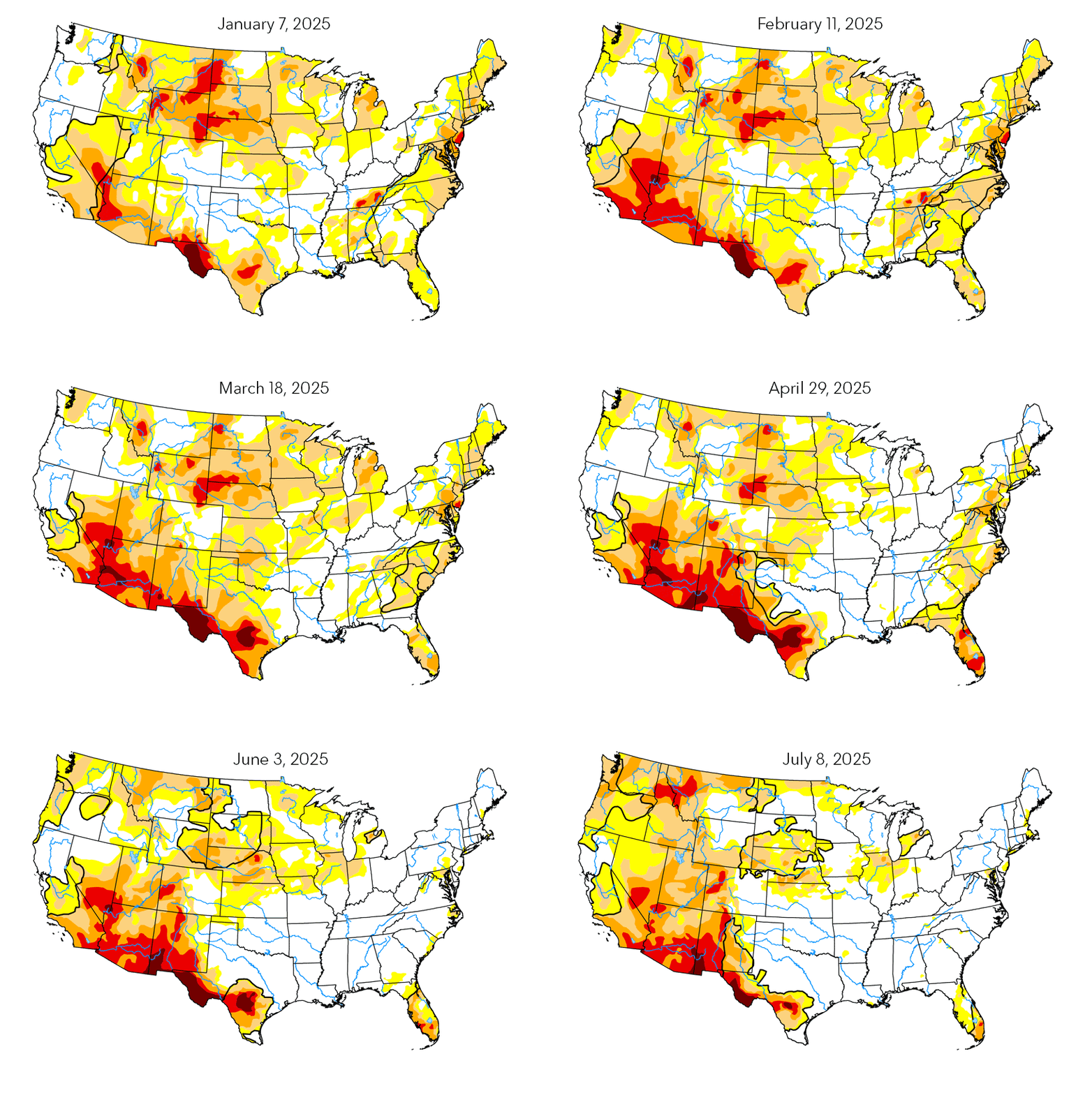
Dry weather was reported across Illinois and Indiana during the week, with temperatures reaching the 40s and 50s. Widespread showers were possible over the Christmas weekend, though temperatures were expected to remain well above normal.
A cold front pushed through the Great Lakes region early in the week, dropping significant lake-effect snow in parts of northern Ohio, along with 40-50 mph winds. The heaviest accumulation ranged from 8-11 inches, but temperatures were expected to warm to the 40s as the week advanced.
Parts of Michigan were also under winter storm warnings early in the week, with 4-6 inches reported in southwestern areas of the state and 1-2 inches inland.
Western Cornbelt:
Mild temperatures and spotty showers were reported across Iowa and northern Missouri during the week, with an increased chance of rain over the Christmas weekend.
Central and eastern Nebraska were also bracing for an increased chance of rain showers and thunderstorms over the weekend, with some snow accumulation possible in western areas of the state on Christmas Eve.
California:

A powerful Pacific storm brought torrential rain to much of California during the week, triggering flooding and debris flows in some areas.
After drenching Northern and Central California at midweek, the system was expected to push southward and inland over Southern California, delivering what several forecasters said would be a month’s worth of rain in just 24 hours.
Forecasts warned of 1-4 inches of rainfall in coastal areas from Los Angeles to San Diego, while 6-8 inches was expected in the mountains from Santa Barbara County to Ventura and Los Angeles counties, with some areas potentially getting much more.
Pacific Northwest:
Dry, mild weather conditions were reported across the inland Pacific Northwest during the week, while coastal areas of Washington were under a flood advisory at midweek after heavy rains hit the region.
The latest round of moisture follows a powerful atmospheric river that swept the Pacific Northwest in early December, resulting in Seattle and several other Washington cities posting daily record rainfall totals that pushed the Stillaguamish River to 21 feet above flood stage, flooding portions of Granite Falls, Wash.
Western Canada:
Western Canada continued to experience unseasonably mild temperatures and a lack of snowfall in December. Average highs across much of the region have been 5-10 degrees above normal for the month, while December snowfall in Winnipeg, Man., has totaled only 2.2 cm so far, well below the 23 cm average for the month.
The dry end to the year capped a heavy fall fertilizer season across much of the region, with the weather providing ideal conditions for fall fieldwork.
US Gulf:
Low water levels held draft restrictions at 9.5 feet for northbound tows moving above New Orleans, sources said, while towing widths were capped at six empty barges or four loaded barges. Draft limits stood at 9.5 feet in both the East and West Canals. Shoaling was reported in the Galveston harbor and Houston Ship Channel during the week.
Ongoing guidewall repairs forced a daytime shutdown at Bayou Sorrel Lock on Dec. 16, and the lock was reportedly shut for 18 hours on Dec. 20. Repair work is set to run daily from 7 a.m. to 4:30 p.m. through March 2024, with intermittent delays expected. Wait times were posted at 14.5 hours on Dec. 21 after peaking above 20 hours earlier in the week.
Emergency dredging blocked Harvey Canal travel at Mile 2.8 on Dec. 18 through at least Dec. 23. Work was scheduled for 7 a.m. to 5 p.m., with a daily opening planned for 11 a.m. to 1 p.m. Repairs to the Grand Lake Bridge, located at Mile 231.5 of the West Canal, concluded on Dec. 16, according to a Coast Guard posting.
Bayou Boeuf Lock, located at the West Canal’s Mile 93.3, will undergo a series of four-day navigation stoppages for gate repairs starting in mid-January.
Repairs to the Ellender Bridge, at Mile 243 of the West Canal, will block weekday vessel traffic from 7 a.m. to 5 p.m., from Feb. 5 through April 12, 2024. Bridge repairs in the Morgan City, La., area will halt navigation at the West Canal’s Mile 121.3 from 8 a.m. to 1 p.m. on Jan. 16, 18, 23, 25, and 30, as well as on Feb. 1 and 6.
Wait times at Industrial Lock were reported in a wide 13-39 hour range during the week. Algiers Lock delays were posted up to 14 hours, while intermittent Brazos Lock waits were noted in the 5-13 hour range.
Mississippi River:
Towing restrictions continued at week-ago levels despite falling water levels at Memphis, Tenn. Northbound loading drafts were reduced by 20-25% from typical levels, while tows moving downriver saw 10-15% draft restrictions. Towing widths remained at a maximum of six barges, below the usual 6-8 barge limits, depending on vessel horsepower. Draft limits were pegged in the 9-10.5 foot range, depending on location.
Following a move above the (-)5-foot low stage threshold on Dec. 14-19, the river gauge at Memphis fell to (-)6.7 feet on Dec. 21, with levels expected to decline to (-)10.1 feet on Jan. 4, 2024. Water levels at Vicksburg, Miss., were cresting above that area’s five-foot low stage at 5.3 feet at midweek, though a reversal to 1.9 feet was predicted for early January.
Drafts were noted at a maximum nine feet through the St. Louis area. St. Louis depths posted at (-)2.97 feet on Dec. 21 were expected to slide to (-)3.8 feet by Jan. 4. Lock 25 was scheduled to close to navigation from 6 a.m. to 6 p.m. on Dec. 18, 22, and 29.
Through-traffic has ended between St. Louis and St. Paul, Minn., for the 2023/24 winter navigation season, sources said. Locks 11-16 and 18-20 are scheduled to remain open on weekdays from 8 a.m. to 4 p.m. through the winter, while Locks 21 and 22 will be staffed to pass vessels 24/7. Upper-river locks will begin opening for spring travel in March.
Most dredging activities on the upper and lower rivers were reportedly paused for the holidays. Work was expected to resume around Jan. 2.
Illinois River:
Loading drafts continued at a maximum nine feet on the Illinois River due to low water levels. Wickets continued in the raised position at Peoria Lock and LaGrange Lock, forcing tows to lock through both sites. Wait times were noted up to eight hours at Peoria Lock.
Railroad bridge work blocked daytime travel at Mile 160.7 on Dec. 18-20. Construction at the McClugage Highway Bridge, located at Mile 165.8, shut navigation on Dec. 19-20, sources said. Delays ran in a 4-9 hour range at Dresden Island Lock.
Ohio River:
Draft levels continued at 9.5-11 feet on the Ohio River, depending on location. Maximum tow lengths were steady at 15 barges.
An unscheduled main chamber shutdown at Meldahl Lock pushed waits to 22 hours at the site, though delays had fallen below the 10-hour mark by Dec. 21. Southbound lockages through Smithland Lock were required to use an assist boat due to strong outflows, sources said.
The Montgomery Lock main chamber is due to return from repairs and maintenance on Dec. 22. Corps data pegged wait times in the 1-3 day range during the week.
Kentucky Lock, on the Tennessee River, will close for upper guidewall replacement from Jan. 22 through Feb. 15. Waits topped out at 16 hours at Kentucky Lock, while 10-17 hour delays were noted at Wilson Lock.
Sens. Chuck Grassley (R-Iowa), Joni Ernst (R-Iowa), and Tammy Baldwin (D-Wisc.) are leading a bipartisan push to shed light on market factors driving the cost of fertilizer, which they estimate accounted for more than 30% of farmer input costs for the last growing season.
The Fertilizer Research Act of 2023 would require the USDA to conduct a study on competition and trends in the fertilizer market to determine their subsequent impacts on price. The senators plan to push to include the legislation in next year’s five-year farm bill reauthorization, though they are open to other paths for passage if opportunities arise.
“Farmers’ bottom lines thin as the price of fertilizer rises,” said Grassley. “With fertilizer being one of the ag industry’s highest input costs, it’s problematic [that] farmers have such a limited window into market fluctuations. Our bill will provide farmers in Iowa and across the Heartland with needed transparency and certainty as they navigate production costs.”
“Wisconsin’s farmers work long hours year-round to provide food for our families, but in recent years, they have faced tough economic headwinds, including the high cost of fertilizer,” added Baldwin. “This hurts their bottom lines, our rural communities, and American consumers, and we need to do more to address rising input costs for our agricultural industry.”
The bill, which was filed Dec. 12, is endorsed by the Iowa Corn Growers Association (ICGA) and Iowa Soybean Association.
“We appreciate that Senator Grassley has honored our request for a study to review the competition and transparency of the fertilizer industry,” said Jolene Riessen, ICGA President. “In recent years, the continued increase in input costs, especially fertilizer, has put pressure on Iowa’s corn farmers and our wallets. That’s why an assessment will provide clarity to better understand if there is adequate information on the pricing practices, tariffs, and exertion of market power by companies within the industry.”
Within one year of the bill’s passage, the Secretary of Agriculture, in consultation with the Economic Research Service, would be required to issue a report on USDA’s website regarding the US fertilizer industry. Specifically, the report would include:
The Fertilizer Institute (TFI) said it supports transparency through improved data collection and analysis. The group also seeks the reestablishment of the position of Fertilizer Economist at the USDA to serve as a liaison between the agency and Congress on crop nutrient matters and also to develop reports on global supply, demand, and prices.
TFI noted that the
US has one of the most competitive fertilizer industries in the
world and is one of only three nations that has at least 20 unique companies
producing fertilizer products. It noted that many countries have only a single
producer or no domestic production at all.
TFI added that in 2022, the US held a 7.6% share of global fertilizer
production and 90% of
global fertilizer usage happens outside of the US. “The fertilizer market is
truly global and is impacted by geopolitical events, trade disruptions, supply
chain issues, weather, energy prices, and the natural ebb and flow of supply
and demand,” said the organization.
A spokesperson for top fertilizer maker Nutrien Ltd. said the company would review the legislation and declined further comment. Crop nutrient producers CF Industries Holdings Inc. and The Mosaic Co. didn’t immediately respond to requests for comment.
The push for a sweeping study of the fertilizer market follows
intense scrutiny of US meatpackers, as well as the Biden
administration stepping up its oversight of competition within the
seed industry.
A bipartisan group of House and Senate members, led by Sen. Roger Marshall (R-Kan.), on Dec. 12 sent a letter to the US International Trade Commission urging it to consider the input of farmers and agricultural retailers as it weighs a final decision on tariffs on phosphate imports from Morocco (GM Nov. 3, p. 1; Sept. 22, p. 1).
“The Commission has only narrowly opened the record after its previous determination to put tariffs on phosphate was remanded back to the Commission by the US Court of International Trade,” said the group. “The Court gave the Commission wide latitude to reopen the record, yet the Commission is not allowing commodity organizations and agriculture retailers to provide information about the US fertilizer market.”
“Since this process began in 2020, growers, retailers, and suppliers have provided information to the Commission and the US Department of Commerce about the US fertilizer market and the worsening challenges we face obtaining adequate domestic supply,” the group continued. “We believe that the Commission is arbitrarily limiting both the information allowed to be submitted and the parties permitted to respond.”
They noted that the questionnaire was sent only to US producers and US importers of phosphate. “We believe additional parties, namely the farmers who need phosphate fertilizer to grow crops, the retailers who sell phosphate fertilizers, and the organizations who represent them, should be given the opportunity to respond,” they said.
Some 58 agricultural groups, led by the National Corn Growers Association, sent a letter to the ITC on Dec. 7 on the same topic. “We urge the ITC to consider impacts on family farms as it works to reconsider its determination of material injury to domestic industries,” the earlier letter stated.
Congressional members joining Marshall included Sens. Bill Hagerty (R-Tenn.), Cindy Hyde-Smith (R-Miss.), Pete Ricketts (R-Neb.), Deb Fischer (R-Neb.), and John Boozman (R-Ark.), as well as Reps. Tracey Mann (R-Kan.), Jake LaTurner (R-Kan.), John Rose (R-Tenn.), Greg Pence (R-Ind.), Julia Letlow (R-La.), James Baird (R-Ind.), and Jim Costa (D-Calif.).