All posts by hlancey@bloomberg.net

Ammonium Thiosulfate

Eastern Cornbelt:

The ammonium thiosulfate market was steady at $245-$270/st FOB in the Eastern Cornbelt, with the low confirmed at Terre Haute, Ind., and the high at inland terminals. The Cincinnati market remained at $255/st FOB.

Western Cornbelt:

Ammonium thiosulfate was unchanged at $225-$260/st FOB in the Western Cornbelt, with the low reported at Waterloo, Iowa.

Eastern Canada:

The ammonium thiosulfate market remained in a broad range at C$465-$545/mt FOB for the last confirmed offers in Eastern Canada.

Potassium Sulfate

US Imports:

September SOP imports were 3,195 st, down 77.7% from the 14,299 st posted in September 2022. July-September volumes softened 50.8%, to 10,123 st from last year’s 20,569 st. Imports from Canada totaled 8,679 st in July-September, ahead of 603 st from Taiwan. Belgium sent 194 st. 

US Exports:

SOP exports softened 42.4% in July-September, to 7,445 st from the year-ago 12,930 st. September exports punched in at 3,535 st, off 9.2% from 3,892 st recorded one year earlier. Mexico purchased 4,500 st of US product in July-September, while Canada took 2,142 st and Costa Rica received 528 st. 

Eastern Canada:

SOP pricing remained in a broad C$1,100-$1,200/mt FOB range in Eastern Canada.

Crops/Weather

Eastern Cornbelt:

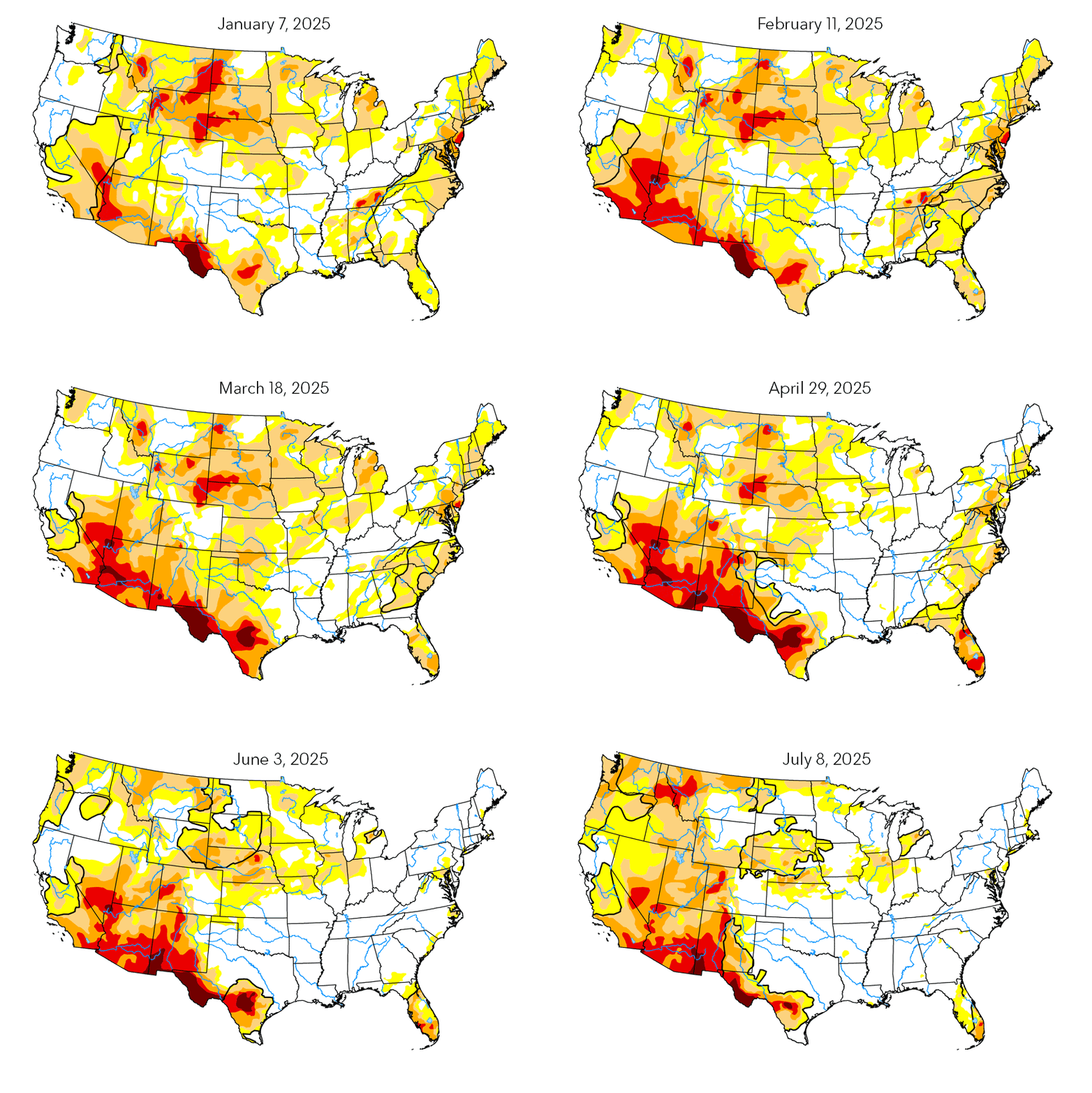
US Drought Monitor

Highs in the 60s were common across the Eastern Cornbelt during the week, along with dry conditions that allowed growers to wrap up the fall harvest in many locations. The mild weather also prompted a flurry of fall fieldwork and fertilizer application in mid-November.

Temperatures were expected to drop late in the week, with rain chances picking up. Up to a half-inch of rain was possible in parts of southern Indiana on Nov. 17, with temperatures peaking in the mid-50s.

Northern Ohio and southern Michigan also posted highs in the mid- to upper-60s during the week, but cooler temperatures and rain were in the forecast for Nov. 17 and into the weekend.

The corn harvest as of Nov. 12 was 95% complete in Illinois, 82% in Indiana, 68% in Ohio, and 52% in Michigan, while the soybean harvest had progressed to 94-97% complete in the Eastern Cornbelt and 83% in Michigan.

Western Cornbelt:

Highs reached the upper-60s in Iowa and Nebraska and the low-70s in parts of Missouri at midweek, but a cold front was expected to move into the region late on Nov. 16, with highs topping out in the 50s on Nov. 17 and through the weekend.

The fall harvest continued to track ahead of the average pace for all crops in the region, with the corn harvest as of Nov. 12 rated at 91-94% complete in the region, and soybeans at 91% complete in Missouri and 99% in Iowa and Nebraska. Growers also had 93% of Missouri’s cotton and 90% of Nebraska’s sorghum in the bin by that date.

Northern Plains:

Corn Wheat Soybean Index

Warm, windy conditions were reported across the Northern Plains during most of the week, with highs reaching the upper-60s in Minneapolis, Minn., and the mid- to upper-40s in the Dakotas. Temperatures were expected to fall below freezing in the region late in the week, however, before rebounding again over the weekend.

The regional corn harvest had progressed to 93% complete in Minnesota, 87% in South Dakota, and 76% in North Dakota by Nov. 12, with all three states tracking ahead of their five-year averages.

The soybean harvest was 97-100% complete in the region, while fully 86% of South Dakota’s sorghum crop was in the bin by Nov. 12. The sunflower harvest was rated at 59% complete in North Dakota and 72% in South Dakota by that date.

Northeast:

Warm, breezy weather was reported over much of the Northeast and Mid-Atlantic regions during the week, with highs reaching the low-70s in Maryland.

A potentially strong weather system was expected to hit the Northeast starting on Nov. 17, however. Forecasts warned of rain and gusty winds for New England’s coastal communities, with snow possible at higher elevations in New York, New Hampshire, Vermont, and Maine. Another system was expected to bring more rain during the Thanksgiving week.

Just over half of Pennsylvania’s corn crop was in the bin by Nov. 12, well behind the 71% five-year average. Pennsylvania’s soybean harvest was actually tracking ahead of the average pace, however, at 76% complete by that date.

Eastern Canada:

After rain, freezing rain, and snow across central Ontario earlier in November, much of the province enjoyed mild temperatures and ideal harvest conditions at mid-month. Weather alerts were in effect for northeastern Ontario on Nov. 16, however, with forecasts warning of strong wind gusts up to 80 km/h and possible power outages in the region.

The same system that brought winter weather to Ontario in early November also hit southern Quebec and parts of the Maritimes. Southern Quebec collected 2-6 inches of snow on Nov. 7-9, along with strong winds and blizzard conditions. Heavy rain also prompted flash flood warnings in some areas.

The pleasant mid-month weather in Ontario was “certainly helping with the corn harvest,” according to one regional contact. Another source reported good yields and quality as the harvest continues, though he added that “drying costs will be high.”

Transportation

US Gulf:

Algiers Lock is shut through Dec. 1 for gate repairs, leaving tows to detour through the Port Allen Route. Travel times were increased by 24-48 hours as a result.

Guidewall repairs at Bayou Sorrel Lock shut the site daily from 7:00 a.m. to 4:30 p.m., triggering delays up to 20 hours. Tows arriving before 4:30 p.m. were able to lock before the site closes the following morning, and the closures were suspended whenever waits rose above 24 hours. As of Nov. 9, lock operators will prioritize southbound lockages during daylight hours while giving preference to northbound vessels overnight.

Long wait times continued at Harvey Lock due to low head conditions, sources said, pushing delays as high as 85 hours on Nov. 11-15. Tows are limited to 300-foot lengths and 70-foot widths when head conditions fall below 1.5 feet. Reverse head conditions shut the site entirely between June 15 and Oct. 16.

Brazos Lock travel was delayed from 7:00 a.m. to 7:00 p.m. daily for repairs and maintenance, pushing wait times to 24 hours during the week. The work is scheduled through Nov. 29. Slow-travel warnings are in place at Bayou Chene through Nov. 30.

The Ellender Bridge, located at Mile 243 of the West Canal, was closed to navigation from 8:00 a.m. to 8:00 p.m. on Nov. 11-12. The shutdowns are scheduled to repeat on Nov. 18-19.

Port Allen Lock waits were noted up to 37 hours due to excess traffic from the Algiers Lock shutdown. Intermittent 7-28 hours delays were reported at Calcasieu Lock.

Mississippi River:    

Low water conditions intensified on the Lower Mississippi River, pressuring southbound loading drafts to 75-80% of typical capacity, down from 80-85% reported last week. Loading limits for northbound tows continued at 75-80% of normal. Last week’s increase to six-barge towing widths remained in effect on Nov. 15, though widths were reportedly limited to five barges at Mile 921.

The river gauge at Memphis, Tenn., stood at a low-stage (-)8.19 feet on Nov. 16, falling from (-)5.4 feet one week earlier, with levels forecast to settle near (-)10.80 feet on Nov. 28. Sources previously expected towing widths to return to five barges when the Memphis gauge falls below (-)8.0 feet, though no new restrictions were reported on Nov. 16.

The Vicksburg, Miss., gauge returned a low-stage 4.53-foot reading at midweek. Forecasters expected Vicksburg depths to hit 1.90 feet on Nov. 30. Dredging was reported at Miles 737-738 and 486 of the lower river. Intermittent 24-hour delays were noted at both locations.

Barge drafts continued to see 10-15% reductions through St. Louis, sources said, while loading weights were cut by 5-10% between St. Louis and Cairo, Ill. Barge drafts were limited to 9.0 feet between St. Louis and St. Paul, with maximum tow sizes capped at 12-15 barges, depending on location. Dredging was reported at Miles 481 and 45.

The St. Louis river gauge was posted at (-)1.3 on Nov. 16. Levels were predicted to recede to (-)2.0 feet on Nov. 30.

The start of the upper Mississippi River’s winter closeout was revised to Dec. 4, sources said, one day earlier than previously scheduled, while locks are projected to reopen for spring navigation on March 5-15, 2024. Locks 11-16 and 18-20 will be open to navigation from 8:00 a.m. to 4:00 p.m., Monday through Friday, between Dec. 17 and March 9. Locks 21 and 22 will remain open 24/7.

Illinois River:

Illinois River loading drafts were reduced by 5-10% due to low water levels. Sources noted barge drafts at 9.00 feet on Nov. 10, falling from 9.25-9.50 feet at last report, while maximum tow sizes continued at 15 barges for both north- and southbound travel.

Wickets were raised at Peoria Lock and LaGrange Lock due to low water, necessitating lockages through both locations. Sources reported dredging at Miles 226-228.

Ohio River:

Maximum loading drafts were noted at 9-10 feet on the Ohio River, depending on location, a 10-15% cut from normal levels, while tow sizes were limited to 15 barges regardless of direction. Drafts remained at 8.5 feet on the Monongahela River, sources said.

The John T. Myers Lock main chamber returned to operation on Nov. 10. Lingering congestion left delays as high as 24 hours on Nov. 13, though wait times softened later in the week. The site’s auxiliary chamber is closed on Nov. 13-22 for miter gate repairs.

The primary chamber at Montgomery Lock is shut until Nov. 22, prompting detours through the secondary chamber. The secondary chamber will close on Nov. 22-26, followed by another primary chamber shutdown on Nov. 26-Dec. 22.

Passage through the Smithland Lock river chamber is unavailable through Nov. 22, although the land chamber remains open. Downriver lockages were required to travel with an assist boat. The river chamber at Olmsted Lock was scheduled to go offline Nov. 13-23 for maintenance, leaving the land chamber open to navigation.

The Tennessee River’s Kentucky Lock is scheduled to shut from Jan. 22 through Feb. 15, 2024, for upper guidewall replacement. Waits at Kentucky Lock were noted up to 21 hours during the week. Sources reported 13-hour delays at Wilson Lock.

ICL’s 3Q EBITDA, Sales Decline

ICL Group Ltd. reported a 78% drop in third-quarter net income attributable to shareholders, to $137 million from $633 million in last year’s third quarter. Diluted earnings per share for the quarter were $0.11 versus $0.49 the previous year.

Adjusted EBITDA was down 67% year-over-year, to $346 million from last year’s $1.05 billion. ICL cited lower pricing across all its businesses, which more than offset increases in volumes and lower raw material prices and transportation rates.

Sales in the third quarter declined 26%, to $1.86 billion from last year’s $2.52 billion, but ICL noted they sales were up versus 2021 on both a quarter and year-to-date basis.

“ICL delivered solid results, while continuing to target long-term growth and consistently strong cash generation, enhanced by efficiency initiatives,” said ICL President and CEO Raviv Zoller. “While some competitive pressures remain in certain end-markets, demand recovery is on the horizon for our specialty businesses, and we are expecting a return to a more stabilized growth trajectory during 2024.”

In the company earnings call, Zoller referenced the Oct. 7 attack on Israel by Hamas, noting that “while there are some challenges, ICL’s operations there continue to function without significant disruption.”

ICL lost several members of “its ICL family” in the attacks and in the aftermath (GM Oct. 20, p.1). Approximately 600 of its more than 4,500 Israeli employees have been called to reserve duty, “a situation that has required some adjustments,” Zoller said.

Transportation of goods also has become “a unique challenge” for the company, he said. Despite these headwinds, Zoller said ICL remains committed to its customers, to its focused long-term growth strategy, and to its employees, their families, and the communities where the company does business.

ICL reaffirmed its guidance for full-year adjusted EBITDA, which it now expects at the middle of the previously announced range $1.6-$1.8 billion, with the company’s specialties focused businesses expected at approximately $0.7 billion.

ICL’s Potash segment reported a 38% year-over-year decline in third-quarter sales, to $526 million from $854 million, and a 69% decline in segment EBITDA, to $164 million from $537 million.

ICL said its production in Spain continued to face “geological constraints” in the third quarter as the company continues to transition away from a lower-grade mineral zone at the Cabanasses mine. This shift is in concert with other efficiency efforts as the company strives to increase output and decrease costs in Spain.

Third-quarter potash sales volumes, including sales to internal customers, increased to roughly 1.28 million mt, with higher volumes to Europe, Brazil, and China. ICL said its potash supply is now sold out for 2023.

The average potash price in the third quarter was $342/mt CIF, down significantly from $679/mt CIF last year but slightly above the third-quarter 2021 average price of $335/mt CIF. ICL said potash prices are stabilizing and expects its fourth-quarter average price to be almost level with the third quarter price.

ICL projects global potash demand next year at 68-69 million mt, following an expected 64-65 million mt in 2023 and some 60-61 million mt last year. ICL expects to produce 4.7-4.8 million mt of potash in 2024.

“In general, inventories are low in most regions, and there is a need for replenishment of inventory,” Zoller said. “China’s inventory is not low, but at the same time, there’s a lot of demand coming out of the country, so there’s a healthy environment for next year as well.”

ICL’s Phosphate Solutions segment reported “strong results relative to current market conditions,” the company said, with resilience demonstrated across Specialties. The segment posted a 51% drop in third-quarter segment EBITDA, to $117 million on sales of $620 million, down from last year’s $239 million and $766 million, respectively. Sales were 19% lower year-over-year.

Phosphate commodities contributed $62 million to the segment’s third-quarter EBITDA, while Phosphate specialties contributed $55 million. This compares to $128 million and $111 million, respectively, for the same period last year.

Phosphate specialties third-quarter sales totaled $364 million versus $455 million a year ago, while Phosphate commodities sales fell to $256 million from $311 million. ICL said sales volumes of white phosphoric acid, industrial specialties, and food specialties were all lower year-over-year.

ICL’s Growing Solutions segment, which now includes the company’s polyhalite mining operation at Boulby, England, reported a slide in third-quarter EBITDA, to $37 million from last year’s $127 million. Segment sales were off 13% year-over-year, to $550 million from $629 million. The company highlighted record sales volumes in Brazil for the Growing Solutions segment, and strong market share gains.

For other key geographies, ICL sees demand returning in Europe, especially for its polysulfate-based FertilizerPlus products. Production of polysulfate at Boulby increased 13% in the third quarter, reaching 245,000 mt.

ICL said its first large-scale lithium battery materials (LFP) manufacturing plant in St Louis, Mo., remains on track to be operational in late 2025. ICL broke ground on the $400 million facility in early August. The plant will produce 30,000 mt/y of LFP. Zoller said ICL is in the process of Board approvals for the first long-term offtake agreement for the facility and expects to announce this strategic partnership “during the coming days.” ICL expects the facility to serve no more than two or three customers.

For the first nine months, ICL reported a 68% decline in net income attributable to shareholders, to $580 million from the year-ago $1.83 billion. Diluted earnings per share were $0.45 against $1.42 the previous year. Nine-month adjusted EBITDA was down 58%, to $1.4 billion from $3.31 billion, while sales were off 26% year-over-year, to $5.85 billion from $7.92 billion.

Based on the third-quarter results, ICL’s Board has declared a dividend of 5.31 cents per share, or approximately $68 million, compared with 24.35 cents per share, or approximately $314 million, in last year’s third quarter. The dividend will be payable on Dec. 20, 2023.

Fertiglobe Expects 4Q Bounce After 3Q Drop

ADX-listed Fertiglobe, the strategic nitrogen fertilizer joint venture between OCI Global NV and Abu Dhabi National Oil Co., reported a 67% drop in third-quarter adjusted EBITDA, to $199 million from $606.3 million last year. Revenue fell 60% year-over-year, to $525.1 million from $1.32 billion

Adjusted net profit attributable to shareholders of Fertiglobe was 86% lower year-over-year, to $41.2 million from $291.5 million, while diluted earnings per share dropped to $0.005 from $0.035.

Own-produced sales volumes for the quarter were up 8% year-over-year, to 1.47 million mt from 1.36 million mt, driven by a 9% jump in urea sales volumes, to 1.14 million mt from 1.04 million mt. The company said its own-produced ammonia sales volumes were relatively unchanged from last year.

Third-party traded volumes slumped 88% year-over-year, to 40,000 mt from 336,000 mt. Total product volumes were down 11% overall in the quarter, to 1.51 million mt from 1.7 million mt last year.

“Despite the traditional summer lull in fertilizer sales, we saw nitrogen prices maintain their positive momentum in the third quarter, driven by tightening markets on planned and unplanned supply disruptions, restocking demand, as well as expectations of reduced exports from China,” said Fertiglobe CEO Ahmed El-Hoshy.

Fertiglobe posted a 64% decline in nine-month adjusted EBITDA, to $714.5 million from $2.0 billion, and a 55% fall in revenue, to $1.77 billion from $3.97 billion. Nine-month adjusted net profit attributable to shareholders of the company fell 76%, to $260.5 million from $1.09 billion, while diluted earnings per share dropped to $0.031 from $0.130.

Fertiglobe is targeting a fourth-quarter bounceback, seeing an expected recovery in demand ahead of the spring application season in the Northern Hemisphere “that should continue to support prices going in the final quarter of 2023.”

“Nitrogen prices have increased significantly from their troughs in the second and third quarters, and we expect the benefits from these increases to materialize in the fourth quarter,” El-Hoshy said. He said the short-term outlook is further underpinned by a strong order book for ammonia and urea in the fourth quarter at higher prices for the remainder of the year.

Fertiglobe’s board of directors has approved dividends of $275 million for the first half of 2023, equivalent to 12 fils per share. The company reported its cost optimization program is on track and is expected to realize its targeted $50 million in recurring annualized savings by the end of 2024.

Fertiglobe Sales Volumes

‘000 mt 3Q-2023 3Q-2022 % change 9M-2023 9M-2022 % change
Fertiglobe Own-Product Sold 1,470 1,364 +8 4,247 4,158 +2
Third-Party Traded 40 336 (88) 353 848 (56)
Total Product Volumes 1,510 1,700 (11) 4,600 5,006 (8)

Global Price Decline Impacts JPMC’s 3Q

Amman-based Jordan Phosphate Mines Co. (JPMC) posted a 51% decline in third-quarter net income, to JD110.46 million (approximately $155.8 million at current exchange rates) from the year-ago JD227.71 million, Jordan’s Petra news agency reported. Basic earnings per share from continuing operations were JD0.446 compared with JD0.92 the previous year.

Third-quarter sales were down 44% year-over-year, to JD286.86 million from JD514.87 million, with JPMC citing a marked drop in global prices for the decline.
Nine-month net income for the company fell 46%, to JD324.4 million from JD598.51 million, while basic earnings per share from continuing operations were JD1.311 versus JD2.418 a year ago. Nine-months sales were 34% lower year-over-year, to JD918.61 million from JD1.4 billion.